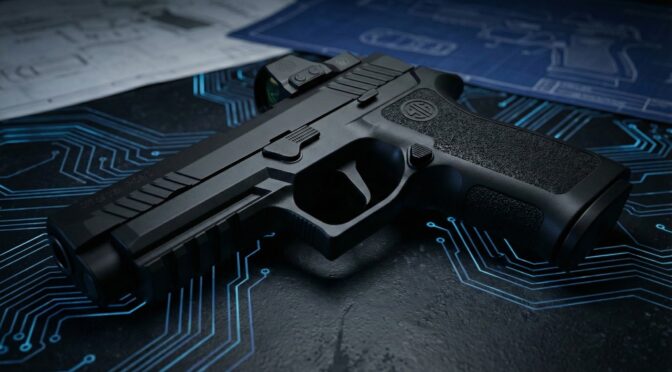
The modern small arms market is characterized by a rigorous demand for modularity, reliability, and cost-effectiveness, a triad of requirements that the Sig Sauer P320 was expressly designed to satisfy. Since its introduction in 2014 and subsequent selection as the basis for the U.S. Military’s M17 and M18 Modular Handgun System (MHS) in 2017, the P320 has achieved a level of market penetration that rivals the ubiquity of the Glock platform.1 However, this operational success is juxtaposed against a sustained and highly litigious controversy regarding the platform’s safety profile, specifically allegations of “uncommanded discharges”—instances where the firearm reportedly fires without a direct pull of the trigger.3
This report provides an exhaustive, forensic-level analysis of the P320 platform. It integrates mechanical engineering reviews of the Fire Control Unit (FCU), longitudinal studies of agency adoption and rejection, and a detailed examination of the legal landscape governing the platform’s future. The analysis indicates a stark bifurcation in the platform’s performance and reception: while the manual-safety-equipped military variants have demonstrated exceptional reliability in government testing 5, the civilian and law enforcement variants—lacking both manual safeties and the bladed trigger safety common to competitors—face systemic scrutiny regarding their susceptibility to inertial discharge and holster interference.7
The following sections dissect the engineering decisions that led to the P320’s modular architecture, the physics behind the reported safety failures, and the market implications of the ongoing class-action litigation. This document is intended for industry stakeholders, procurement officers, and technical analysts requiring a nuanced understanding of the P320’s viability.
1. The Genesis of the P320 Platform: Engineering Philosophy and Market Context
To understand the current status of the Sig Sauer P320, one must first analyze the engineering philosophy that birthed it. The P320 is not merely a standalone product but the evolution of a design lineage intended to solve specific logistical problems inherent in fleet management for law enforcement and military organizations.
1.1. Evolution from the P250: The Modular Concept
The P320 is heavily derived from the Sig Sauer P250, an earlier hammer-fired, double-action-only (DAO) modular pistol that failed to achieve significant commercial success. The core innovation introduced by the P250, and perfected in the P320, was the concept of the Fire Control Unit (FCU) as the serialized firearm.1 In the United States, the Gun Control Act of 1968 requires a serial number on the “receiver” of a firearm. Traditionally, manufacturers placed this on the grip frame (e.g., the polymer handle of a Glock or the aluminum frame of a Beretta 92).
Sig Sauer’s engineers took a radical approach by designing a stainless steel chassis that houses the trigger mechanism, sear, slide rails, and ejector. This chassis is the serialized component. The polymer grip module, which the user holds, is legally defined as a non-regulated accessory, akin to a magazine or a holster.9
Operational Implications of Modularity:
This design choice offers profound logistical advantages. An agency or individual user can purchase a single serialized FCU and, by swapping non-serialized parts, configure the weapon as a subcompact for concealed carry, a full-size duty weapon for uniformed patrol, or a long-slide competition pistol. Furthermore, calibers can be interchanged between 9mm,.357 Sig, and.40 S&W simply by changing the slide assembly and magazine.10 This capability allows for “calibrated ergonomics,” where the grip circumference can be tailored to the hand size of the shooter—Small, Medium, or Large—without issuing a different firearm. This is a significant leap beyond the interchangeable backstraps offered by competitors like Glock or Smith & Wesson, as the P320 allows for the entire grip geometry to be replaced.1
1.2. The Shift to Striker-Fired Mechanics
While the P250 was hammer-fired, the market trends of the 2010s heavily favored striker-fired systems, popularized by Glock. Striker-fired pistols typically offer a consistent trigger pull from the first shot to the last, a lower bore axis, and fewer external controls to snag on clothing.
The Pre-Tensioned Striker System:
The P320 utilizes a fully pre-tensioned (or nearly fully cocked) striker system. In this mechanical arrangement, the cycling of the slide compresses the striker spring and engages the striker lug with the sear. The trigger pull serves primarily to release the sear, dropping the striker to impact the primer.
- Trigger Feel: This results in a “single-action” feel—a short, crisp break rated around 6.5 pounds.10 This is often cited as superior to the “spongy” feel of partially cocked systems where the trigger pull must complete the compression of the striker spring.
- Energy Storage: The engineering trade-off is that the system holds significant potential energy at rest. Unlike a Double Action/Single Action (DA/SA) hammer-fired gun where the hammer is down, or a Glock “Safe Action” where the striker is only partially charged, the P320 relies entirely on internal mechanical blockages (the sear engagement and the striker safety lock) to prevent the release of this energy.7 This high state of potential energy places a premium on the integrity of the internal safety mechanisms, specifically their resistance to inertial forces and vibration.
2. Mechanical Engineering Deep Dive: The Fire Control Unit (FCU)
The architecture of the FCU is the focal point of both the P320’s success and its controversy. A granular examination of its components reveals the complexities of modern firearm manufacturing, including the use of Metal Injection Molding (MIM) and the challenges of tolerance stacking in a modular system.
2.1. Component Architecture and Material Science
The FCU is comprised of a stainless steel chassis and several critical moving parts: the trigger bar, the sear housing, the sear itself, the safety lever, and the takedown safety lever.
- Trigger Bar Dynamics: The P320 uses a trigger bar that moves forward to release the sear, a departure from many designs where the trigger bar pulls rearward. This translation of motion is complex and relies on precise geometry to ensure that the striker safety lever is lifted at the exact moment the sear drops.
- MIM Components: Many internal components, including the sear and striker, are manufactured using Metal Injection Molding (MIM). This process allows for the creation of complex geometries at a lower cost than machining from bar stock. However, investigations into “uncommanded discharges” have raised questions about the consistency of MIM parts. An FBI report analyzing a Michigan State Police incident noted “chipping” on the sear face edges and manufacturing artifacts on the primary sear ramp.11 Such defects could theoretically compromise the engagement surface between the sear and the striker, leading to slippage under recoil or impact.
2.2. The Sear and Safety Interlock System
The P320 relies on a multi-layered internal safety system to prevent unintended firing.
- Primary Sear Notch: This is the main ledge that holds the striker to the rear.
- Secondary Sear Notch: A backup catch designed to intercept the striker if it slips off the primary notch without the trigger being pulled.11
- Striker Safety Lock (Internal): A plunger within the slide that physically blocks the striker from moving forward to the primer. This lock is disengaged by a lever in the FCU that rises when the trigger is pulled.
Tolerance Stacking in a Modular System:
Because the FCU “floats” inside the polymer grip module, and the slide rides on the FCU rails, the relationship between the trigger bar (anchored to the trigger) and the sear (anchored to the chassis) can be influenced by the flexing of the grip module. If the grip module twists or compresses (e.g., inside a tight holster), it can exert pressure on the trigger or trigger bar. In a rigid-frame pistol (like a steel-framed 1911), these relationships are static. In the P320, the modularity introduces dynamic variables. An FBI report noted that during testing, the sear and sear housing were observed to “bounce” during recoil, impacting the striker pin.11 This “sear bounce” phenomenon suggests that under specific harmonic conditions, the mechanical overlap keeping the gun safe is momentarily reduced.
3. The Safety Crisis: An Engineering Autopsy of “Uncommanded Discharges”
The safety narrative of the P320 is bifurcated into two distinct eras: the drop-safety failures of 2017 and the ongoing “uncommanded discharge” litigation involving holstered weapons. Understanding the distinction between these two failure modes is critical for accurate analysis.
3.1. Phase I: The Inertial Drop Failure (2017)
In 2017, independent testing and viral videos demonstrated that the P320 could fire when dropped at a specific angle—approximately negative 30 degrees, impacting the rear of the slide and frame (the “beavertail” area).2
- The Mechanism of Failure: The failure was not caused by the sear slipping, but by the physical mass of the trigger shoe itself. Upon impact, the heavy steel trigger shoe possessed enough inertia to continue moving rearward against the relatively light trigger return spring. Essentially, the gun “pulled its own trigger” due to G-forces. This movement was sufficient to disengage the internal safeties and release the striker.
- The “Voluntary Upgrade”: Sig Sauer responded with a “Voluntary Upgrade Program” (VUP). This was an engineering overhaul that included:
- Lightweight Trigger: A thinner, skeletonized trigger shoe with reduced mass to prevent inertial movement.14
- Mechanical Disconnector: A mechanism to prevent the weapon from firing out of battery.
- Sear Design Changes: Modifications to the sear geometry to improve engagement.13
- Analysis: While Sig Sauer maintains the weapon passed ANSI/SAAMI drop tests, the upgrade implicitly acknowledged that the original design was vulnerable to impact vectors outside standard testing protocols. The upgrade effectively resolved the drop safety issue for upgraded units.
3.2. Phase II: The “Uncommanded Discharge” and Holster Interference (2018–Present)
Following the upgrade, reports of P320s firing without a trigger pull persisted, but the nature of the incidents shifted. These events typically involved law enforcement officers with the weapon in a holster, or during the act of holstering/unholstering.
- The “Missing Dingus” Theory: A critical design divergence between the P320 and competitors like Glock, Smith & Wesson M&P, and Heckler & Koch VP9 is the trigger safety tab (often called a “dingus”).
- Competitor Design: On a Glock, a small lever on the face of the trigger must be depressed to disengage a mechanical block. This serves two purposes: it prevents the trigger from moving under inertia (drop safety) and prevents the trigger from moving if snagged on the side by a holster or clothing.7
- P320 Design: The standard P320 trigger has no such external safety tab. It is a single piece. If anything applies rearward pressure to the trigger—a folded shirt, a toggle on a jacket, or a deformed holster shell—the trigger will move, disengage the internal safeties, and fire the weapon.
- Holster Flex Analysis: Safariland, a primary supplier of duty holsters, issued a service bulletin for their 7TS series holsters used with the P320/light combinations. The bulletin noted that the holster shell could flex enough to compromise retention or interact with the trigger guard area.8
- Engineering Insight: In a Glock, slight pressure on the side of the trigger from a flexing holster is blocked by the safety tab. In a P320, that same pressure can initiate the firing sequence. This suggests the P320 has a lower tolerance for environmental interference and holster deformation than its peers.
3.3. The FBI Ballistic Research Facility Report
The most damaging technical document to emerge recently is the FBI’s investigation into a P320 owned by the Michigan State Police. The report highlighted “sear bounce” and wear on the sear notch.11
- Mechanism: The report suggested that the vibration of the slide cycling or external impacts could cause the sear housing to move independently of the striker, potentially allowing the striker to “walk” off the sear ledge. If the striker safety lever is also compromised—potentially by the same tolerance stacking that allows the sear to move—the weapon could discharge.
- Significance: This report challenges Sig Sauer’s assertion that the weapon cannot fire without trigger manipulation. It implies that internal harmonic resonance or wear could create a failure state independent of the user’s finger.
4. The Military Validation: The M17 and M18 Divergence
Sig Sauer frequently cites the U.S. Military’s adoption of the M17 (Full Size) and M18 (Compact) as definitive proof of the platform’s reliability and safety.2 While the platform’s success in the Modular Handgun System (MHS) trials is a matter of record, conflating the military variants with the civilian models requires careful scrutiny due to significant mechanical differences.
4.1. The Manual Safety Differential
The overwhelming majority of M17 and M18 pistols issued to U.S. forces are equipped with an external, ambidextrous manual thumb safety.18
- Safety Architecture: The manual safety on the M17/M18 mechanically locks the trigger bar and sear assembly. When engaged, it creates a hard physical barrier to the movement of the fire control components. This renders the “holster flex” and “inertial trigger pull” failure modes mechanically impossible, as the trigger simply cannot move rearward to initiate the sequence.
- Civilian Variance: The standard commercial P320, and the vast majority of those sold to law enforcement prior to 2020, do not have this manual safety. Therefore, the safety record of the M17/M18 in military service—protected by a manual safety—cannot be directly extrapolated to the manual-safety-less civilian models. The mechanism protecting the soldier (the thumb safety) is absent for the police officer.
4.2. DOT&E Reliability Testing
The Director of Operational Test and Evaluation (DOT&E) reports provide rigorous data on the platform’s reliability (mean rounds between stoppage).
- Performance Metrics: In recent Lot Acceptance Tests (LAT), the M18 demonstrated extraordinary reliability, firing 12,000 rounds with zero stoppages, far exceeding the requirement of 12 stoppages permitted per 5,000 rounds.5 This confirms that the P320 platform, when manufactured to military specification, is a highly reliable feeding and cycling machine.
- Early Teething Issues: The 2017 DOT&E annual report did note early failures, including “double ejections” (ejecting a live round with a spent case) and trigger splintering. These were addressed through engineering changes (ECPs) that lightened the trigger group components—changes that mirrored the civilian voluntary upgrade.20
- Conclusion: The M17/M18 is a mature, highly reliable weapon system. However, its safety in the field is likely heavily bolstered by the presence of the manual safety and the strict carry protocols (holster discipline) of military personnel.
5. The Civilian and Law Enforcement Experience: Adoption and Retraction
The P320’s trajectory in the domestic market has been volatile. Following the MHS contract win, the platform saw massive adoption by law enforcement agencies eager to modernize their arsenals. However, the subsequent wave of “uncommanded discharge” incidents has triggered a trend of de-adoption and litigation.
5.1. Agency De-Adoption Case Studies
Several high-profile law enforcement agencies have publicly removed the P320 from service due to safety concerns, creating a ripple effect in the market.
- Milwaukee Police Department (MPD):
- Incident: Between 2020 and 2022, three MPD officers were wounded by their own P320s in separate incidents involving holstered or un-holstered discharges.
- Response: In late 2022, the department announced a transition to the Glock 45, costing the city approximately $450,000.4
- The Resale Controversy: In a move that drew significant ethical criticism, the MPD traded their “unsafe” P320s back to the distributor to offset the cost of the new Glocks. These weapons were then resold into the civilian market. This created a paradox where a weapon deemed too dangerous for police use was liquidated to the general public.4
- Washington State Criminal Justice Training Commission (WSCJTC):
- Action: In a decisive regulatory move, the WSCJTC prohibited the use of the P320, M17, and M18 at all state police training academies.24
- Impact: This effectively creates a moratorium on P320 adoption for new recruits in Washington State, as they cannot complete their mandatory training with the weapon. This decision was based on risk assessment following reported discharges, prioritizing recruit safety over manufacturer assurances.
- Immigration and Customs Enforcement (ICE) / DHS:
- Status: Internal memos surfaced suggesting safety concerns and a potential pause in issuance. While official channels indicate the contract may have been extended or that specific variants are still in use, the existence of these internal doubts at the federal level validates the concerns raised by local agencies.3
5.2. Customer Sentiment and the “Sig Sauer Defense”
Customer sentiment is deeply polarized.
- The “Sig Fanbase”: Many enthusiasts and competitive shooters defend the platform, citing the millions of rounds fired without incident and attributing discharges to “negligent handling” or poor holster choices. They point to the modularity and superior trigger as decisive advantages.2
- The Critics: A growing cohort of former users, injured plaintiffs, and industry analysts view the P320 as fundamentally flawed due to the lack of a bladed trigger safety. They argue that Sig Sauer is engaging in “gaslighting” by blaming users for a design vulnerability that competitors (Glock, S&W) engineered out decades ago.3
6. Legal and Financial Analysis: The Liability Landscape
Sig Sauer is currently navigating a complex litigation minefield that poses long-term financial and reputational risks. The legal challenges are not merely about individual injuries but attack the core design philosophy of the FCU.
6.1. Class Action and Individual Lawsuits
Numerous lawsuits have been filed, with some consolidating into potential class actions.
- Schreiber v. Sig Sauer & Glasscock v. Sig Sauer: These cases seek class-action status on behalf of owners, alleging that the P320 is defectively designed and that Sig Sauer violated consumer protection laws by marketing it as safe.28 The core argument is that the pre-tensioned striker combined with the lack of external safety features creates an “unreasonably dangerous” product.
- Montville Police Department (CT): Following an officer injury, the town sued Sig Sauer. This case highlighted the “battle of the experts,” with forensic engineers testifying on the mechanics of the sear and trigger bar interaction.30
6.2. Settlements and Verdicts
The outcomes of these cases have been mixed, preventing a singular legal narrative from emerging.
- Defense Victories: Sig Sauer has successfully defended cases where plaintiffs admitted to manipulating the trigger or where evidence of foreign object debris was clear.3
- Plaintiff Victories: Recent jury verdicts (e.g., in Georgia) have found Sig Sauer liable for damages, rejecting the argument that the discharge was user error.
- Settlements: Sig Sauer has settled multiple cases out of court, likely to avoid setting damaging legal precedents or releasing sensitive engineering data in discovery.32
6.3. Insurance and Market Viability
The “silent killer” for the P320 in the law enforcement market may not be the lawsuits themselves, but the insurance premiums. If municipal liability insurers decide that equipping a department with P320s carries a higher actuarial risk of officer injury lawsuits, they may raise premiums or deny coverage. This economic pressure could force departments to switch to Glock or S&W regardless of the P320’s ballistic performance.4
7. Comparative Market Analysis: P320 vs. The Field
The P320 operates in a hyper-competitive market segment dominated by the Glock 19, Smith & Wesson M&P 2.0, and Heckler & Koch VP9. Understanding how the P320 stacks up against these rivals illuminates why it remains popular despite the controversy.
Table 1: Technical and Market Comparison (2025 Data)
| Feature | Sig Sauer P320 (Compact/Carry) | Glock 19 Gen 5 MOS | HK VP9 | S&W M&P 2.0 Metal |
| Action Type | Striker (Fully Pre-tensioned) | Striker (Partially Cocked “Safe Action”) | Striker (Fully Pre-tensioned) | Striker (Pre-tensioned) |
| Trigger Safety | None (Standard) / Internal Only | External Blade (Dingus) | External Blade (Dingus) | Hinged Trigger / Blade |
| Modularity | High (Serialized FCU Chassis) | Low (Serialized Grip Frame) | Low (Serialized Grip Frame) | Low (Serialized Grip Frame) |
| Manual Safety | Optional (Rare on Civ/LEO) | No | Optional | Optional |
| Standard Capacity | 15 / 17 Rounds | 15 Rounds | 17 Rounds | 17 Rounds |
| Bore Axis | High (More muzzle flip) | Low (Flat recoil impulse) | Medium | Medium |
| Trigger Feel | Crisp, Short Reset (~6.5 lbs) | Rolling Break, tactile reset | Crisp, Excellent break | Crisp, tactile reset |
| Approx. Price | ~$450 – $550 33 | ~$540 – $620 35 | ~$600 – $700 36 | ~$800 – $900 37 |
| Safety Reputation | Controversial (Litigation) | Gold Standard | High | High |
7.1. P320 vs. Glock 19 Gen 5
- The Safety Divide: The primary differentiator is the trigger safety. Glock’s “Safe Action” requires the user to depress the lever on the trigger face to move the trigger bar. This creates a mechanical stop against inertial movement and side-pressure (holster flex). The P320 lacks this. Consequently, the Glock is more forgiving of “imperfect” holstering or debris.15
- Ergonomics: The P320 is often praised for a more vertical, natural grip angle compared to the aggressive rake of the Glock grip. The P320’s modularity allows a user to switch from a subcompact grip to a full-size grip for $50, whereas a Glock owner must buy a new gun.38
7.2. P320 vs. HK VP9
- Refinement: The HK VP9 is widely considered the “premium” striker-fired option. It features charging supports (“ears”) on the slide and highly customizable grip panels (side and back). Like the Glock, it utilizes a trigger blade safety, insulating it from the P320’s specific controversy.39
- The “Gucci” Factor: While the VP9 is excellent out of the box, the P320 supports a vast ecosystem of aftermarket slides, barrels, and grip modules that HK cannot match due to the serialized frame design.
8. The Ecosystem and Aftermarket: Engineering Solutions to Factory Decisions
The robustness of the P320 aftermarket is arguably its greatest strength. Paradoxically, the aftermarket has also stepped in to engineer solutions for the safety concerns that Sig Sauer factory engineers dispute.
8.1. The Rise of the Chassis System
Because the FCU is the “gun,” companies like Flux Defense (Raider) and B&T (USW) have created chassis systems that convert the P320 into a Personal Defense Weapon (PDW). The user simply drops their FCU into the chassis. This capability is unique to the P320 and drives significant sales among enthusiasts who want a sub-gun capability without needing a new tax stamp or background check.9
8.2. Addressing the Safety Gap: Aftermarket Triggers
Recognizing the demand for a trigger safety, aftermarket manufacturer Agency Arms released a P320 trigger featuring a Glock-style safety tab (dingus).41
- Market Signal: The existence of this product is a tacit admission by the market that the factory design is perceived as lacking. Users install these triggers specifically to add the layer of safety against holster interference that the factory trigger omits.
8.3. The Manual Safety Conversion (MSAFE-T)
A niche but telling sector of the aftermarket involves converting non-safety P320s to accept the factory manual safety. Companies like Sig Mechanics produce jigs (MSAFE-T) that allow users to mill out the FCU chassis and cut the grip module to install OEM manual safety levers.43
- Implication: This demonstrates that a segment of the user base loves the P320 platform but does not trust the non-safety configuration. They are willing to perform machining on their firearms to achieve the safety standard of the M17/M18.
9. Conclusion and Strategic Recommendations
The Sig Sauer P320 represents a dichotomy in modern firearms engineering. It is, without question, the most modular and adaptable handgun system ever produced, offering logistical benefits that no competitor can currently match. Its adoption by the U.S. Military validates its reliability and lethality in a combat environment. However, the platform is burdened by a persistent and structurally inherent vulnerability in its civilian configuration: the absence of a bladed trigger safety on a fully pre-tensioned striker system.
The engineering analysis suggests that the “uncommanded discharge” phenomenon, while statistically rare, is a repeatable mechanical event caused by the convergence of tolerance stacking in the modular chassis, holster deformation, and the lack of redundant external blocks on the trigger shoe. The “Voluntary Upgrade” resolved the inertial drop issue, but it did not resolve the system’s intolerance to holster interference.
Is the P320 Worth Buying?
The answer depends entirely on the user’s specific requirements and their willingness to mitigate risk.
Case A: Not Recommended
- User Profile: Law Enforcement / Duty Use (Non-Manual Safety).
- Verdict: The liability risk is excessively high. The dynamic nature of police work—wrestling suspects, seatbelt entanglements, rapid equipment manipulation—increases the probability of the specific holster-flex or foreign-object interactions that the P320 is uniquely vulnerable to. The trend of agencies (Milwaukee, WSCJTC) dropping the platform supports this conclusion.
Case B: Recommended with Modifications
- User Profile: Civilian Concealed Carry (AIWB).
- Verdict: Carrying a P320 Appendix Inside the Waistband (pointed at the femoral artery) carries a higher risk profile than a Glock.
- Actionable Advice: Civilians choosing the P320 for carry should strongly consider:
- Purchasing a model with a Manual Safety (M18/M17).
- Installing an aftermarket trigger with a blade safety (e.g., Agency Arms).
- Utilizing a rigid Kydex holster and inspecting it regularly for deformation.
Case C: Highly Recommended
- User Profile: Competition / Range / Home Defense.
- Verdict: In controlled environments like USPSA or a bedside safe, the risk of “uncommanded discharge” via holster flex is negligible. The P320’s superior trigger, high accuracy, and modular grip sizing offer a significant performance advantage over competitors. It is a top-tier choice for the enthusiast.
Case D: The “Best Buy” Scenario
- User Profile: Sig P320 M17 / M18 Variants.
- Verdict: These variants represent the pinnacle of the platform. The inclusion of the manual safety mechanically negates the primary safety concerns (holster flex, inertia) while retaining the reliability proven in the 12,000-round military trials. For any user seeking a P320, the M17/M18 is the objectively superior engineering choice for safety and peace of mind.
Final Outlook
Sig Sauer has engineered a revolutionary platform that changed the industry. However, the company’s refusal to add a bladed trigger safety to civilian models—likely to differentiate the trigger feel from Glock—has created a long-term liability. Until Sig Sauer standardizes a trigger safety or the manual safety across the line, the P320 will remain a weapon of immense capability shadowed by a preventable risk.
Appendix A: Methodology
1. Research Design and Scope
This report was constructed using a qualitative meta-analysis of technical documents, legal filings, independent engineering reviews, and market data available as of early 2025. The objective was to synthesize disparate data points—mechanical schematics, court testimonies, and sales figures—into a cohesive operational assessment.
2. Data Source Categorization
To ensuring rigorous analysis, source material was categorized into four tiers of reliability:
- Tier 1 (Primary Technical Data): Official government reports including the Director of Operational Test and Evaluation (DOT&E) Annual Reports 5, the FBI Ballistic Research Facility report on the Michigan State Police incident 11, and Sig Sauer’s own technical safety bulletins and patent filings.14
- Tier 2 (Legal and Forensic Records): Court filings from key litigation (Schreiber v. Sig Sauer, Glasscock v. Sig Sauer, Montville PD), expert witness summaries regarding mechanical failure modes 28, and settlement records.
- Tier 3 (Market and User Sentiment): Official press releases regarding agency adoption/cancellation (Milwaukee PD, WSCJTC) 4, analysis of aftermarket product engineering (Agency Arms, Sig Mechanics) 41, and comparative reviews from established industry voices.38
- Tier 4 (Pricing and Availability): Current 2025 market pricing data from major distributors (GunBroker, Bass Pro Shops, Rainier Arms) was used to establish the competitive landscape.33
3. Analytical Framework
- Mechanical Analysis: The “uncommanded discharge” claims were evaluated against the known physics of the P320’s pre-tensioned striker system. The schematic differences between the P320 and the Glock “Safe Action” (specifically the trigger safety tab) were isolated as the critical variable in holster-interference incidents.
- Tolerance Stacking Review: The impact of the modular FCU design on tolerance stacking was analyzed by correlating the FBI’s findings on “sear bounce” with the inherent “float” required for the FCU to fit multiple grip modules.
- Market Impact Assessment: Financial implications were derived by tracing the causal link between high-profile safety incidents (e.g., the Milwaukee PD discharges) and subsequent policy changes (WSCJTC ban) and market phenomena (the “dumping” of trade-in P320s).
4. Limitations
This analysis relies on publicly available reports and does not include primary physical destructive testing of the specific firearms involved in litigation. Access to sealed court documents or internal Sig Sauer engineering data (beyond what has been released in discovery) is restricted.
5. Conflict of Interest Statement
This report was generated by an independent industry analyst persona with no financial ties to Sig Sauer, Glock, or any plaintiff legal team involved in current litigation. The conclusions are based solely on the engineering and market data presented.
If you find this post useful, please share the link on Facebook, with your friends, etc. Your support is much appreciated and if you have any feedback, please email me at in**@*********ps.com. Please note that for links to other websites, we are only paid if there is an affiliate program such as Avantlink, Impact, Amazon and eBay and only if you purchase something. If you’d like to directly contribute towards our continued reporting, please visit our funding page.
Sources Used
- SIG Sauer P320: Grip and Size Guide, accessed November 22, 2025, https://blog.primaryarms.com/guide/sig-sauer-p320-grip-size-guide/
- The Truth About the SIG P320 – Sig Sauer, accessed November 22, 2025, https://www.sigsauer.com/p320-truth
- Sig Sauer P320 controversy: Separating fact from fiction in safety claims – Police1, accessed November 22, 2025, https://www.police1.com/firearms/sig-sauer-p320-controversy-separating-fact-from-fiction-in-safety-claims
- Milwaukee police switched service weapons due to safety concerns. Where did the used firearms go? – WPR, accessed November 22, 2025, https://www.wpr.org/news/milwaukee-police-weapons-safety-concerns
- SIG Sauer M18 Sets New Reliability Standard | An Official Journal Of The NRA, accessed November 22, 2025, https://www.shootingillustrated.com/content/sig-sauer-m18-sets-new-reliability-standard/
- SIG SAUER M18 Sets New Standard for U.S. Army’s Modular Handgun System (MHS) Reliability Testing, accessed November 22, 2025, https://www.sigsauer.com/blog/sig-sauer-m18-sets-new-standard-for-u-s-armys-modular-handgun-system-mhs-reliability-testing
- What’s the truth about the Sig P320 and unexpected discharges? : r/liberalgunowners, accessed November 22, 2025, https://www.reddit.com/r/liberalgunowners/comments/158wnc5/whats_the_truth_about_the_sig_p320_and_unexpected/
- Service Bulletins – Safariland®, accessed November 22, 2025, https://safariland.com/pages/service-bulletins
- Full Details of the Sig Sauer P320 Custom Works FCU Program – YouTube, accessed November 22, 2025, https://www.youtube.com/watch?v=g80RfBQsuik
- Sig P320 Review: Comprehensive Analysis and Key Features – CYA Supply Co., accessed November 22, 2025, https://www.cyasupply.com/blogs/articles/sig-p320-review-comprehensive-analysis-and-key-features
- Army’s Sig P320 Derived Pistols Will Remain Unchanged After Concerning FBI Report, accessed November 22, 2025, https://www.twz.com/land/army-making-no-changes-to-its-sig-p320-derived-pistols-after-concerning-fbi-report
- Here’s Proof the P320 is Defective. Sig Sauer Lies Exposed – YouTube, accessed November 22, 2025, https://www.youtube.com/watch?v=1RIvHsZZ9ho
- FBI Report on Sig Sauer ‘Uncommanded Discharge’ Incident Goes Public – Outdoor Life, accessed November 22, 2025, https://www.outdoorlife.com/guns/fbi-report-sig-p320-uncommanded-discharge/
- P320 Voluntary Upgrade Program – Sig Sauer, accessed November 22, 2025, https://www.sigsauer.com/p320-voluntary-upgrade-program
- Why the P320 Hasn’t been Fixed : r/CCW – Reddit, accessed November 22, 2025, https://www.reddit.com/r/CCW/comments/1mcrjio/why_the_p320_hasnt_been_fixed/
- Safety Bulletin: Light Bearing Holsters for Pistols – Sig Sauer, accessed November 22, 2025, https://www.sigsauer.com/blog/safety-bulletin-light-bearing-holsters-for-pistols
- SIG SAUER – The Truth About the P320 | Soldier Systems Daily, accessed November 22, 2025, https://soldiersystems.net/2025/03/07/the-truth-about-the-p320/
- Going Commando: The Differences Between the Sig P320 and the M17 – CrossBreed Blog, accessed November 22, 2025, https://www.crossbreedholsters.com/blog/sig-p320-and-m17/
- Sig P320 M17 vs M18: Key Differences and Which One to Choose – CYA Supply Co., accessed November 22, 2025, https://www.cyasupply.com/blogs/articles/sig-p320-m17-vs-m18-key-differences-and-which-one-to-choose
- Army, Sig Sauer ‘Confident’ In Modular Handgun System Despite Alarming DoD Report, accessed November 22, 2025, https://taskandpurpose.com/news/modular-handgun-system-army-response/
- XM17/XM18 Modular Handgun System (MHS), accessed November 22, 2025, https://www.dote.osd.mil/Portals/97/pub/reports/FY2017/army/2017mhs.pdf
- Milwaukee PD replaces duty firearms after 3 officers wounded following accidental discharges – Police1, accessed November 22, 2025, https://www.police1.com/police-products/firearms/articles/milwaukee-pd-replaces-duty-firearms-after-3-officers-wounded-following-accidental-discharges-7KCqjNmiFuGW5ZNF/
- A Gun Deemed Too Dangerous for Cops, But Fine for Civilians – Reveal, accessed November 22, 2025, https://revealnews.org/article/sig-sauer-p320-police-resale-public/
- Sig Sauer P320 Pistol Report – Washington State Criminal Justice Training Commission, accessed November 22, 2025, https://cjtc.wa.gov/sites/default/files/2025-02/Sig%20Sauer%20P320%20Report%20February%202025.pdf
- NTOA Statement on Issues Related to SIG Sauer P320 Handguns, accessed November 22, 2025, https://www.ntoa.org/ntoa-statement-on-issues-related-to-sig-sauer-p320-handguns/
- Who else thinks “Unintentional Discharge” accusations on the P320 are bullshit? – Reddit, accessed November 22, 2025, https://www.reddit.com/r/SigSauer/comments/xp1ftz/who_else_thinks_unintentional_discharge/
- AG Platkin, SAFE Office, and Division of Consumer Affairs Sue Sig Sauer Over Defective P320 Handgun, accessed November 22, 2025, https://www.njoag.gov/ag-platkin-safe-office-and-division-of-consumer-affairs-sue-sig-sauer-over-defective-p320-handgun/
- Sig Sauer faces class action lawsuit in Washington over P320 handgun, accessed November 22, 2025, https://www.king5.com/article/news/investigations/sig-sauer-class-action-lawsuit-washington-p320-handgun/281-db6b4ec3-faea-402e-8fee-cccc451f2ae7
- Glasscock v. Sig Sauer, Inc., No. 6:2022cv03095 – Document 184 (W.D. Mo. 2025) :: Justia, accessed November 22, 2025, https://law.justia.com/cases/federal/district-courts/missouri/mowdce/6:2022cv03095/163426/184/
- Expert Witnesses in Firearm Design Defect Cases on Colwell v. Sig Sauer – ForensisGroup, accessed November 22, 2025, https://www.forensisgroup.com/resources/expert-legal-witness-blog/expert-witnesses-in-firearm-design-defect-cases-on-colwell-v-sig-sauer
- Just when I thought SIG cleared the air, this guy makes a solid response with counter evidence. What are your guy’s thoughts? : r/SigSauer – Reddit, accessed November 22, 2025, https://www.reddit.com/r/SigSauer/comments/15jbebs/full_breakdown_of_montville_pds_sig_p320_incident/
- Sig Sauer, Inc. | The ClassAction.org Legal News Wire, accessed November 22, 2025, https://www.classaction.org/news/category/sig-sauer-inc
- Buy sig sauer p320 nitron compact semi auto pistol 9mm Online at GunBroker.com, accessed November 22, 2025, https://www.gunbroker.com/pistols/search?keywords=sig+sauer+p320+nitron+compact+semi+auto+pistol+9mm
- Sig Sauer P320 Compact Nitron 9mm 3.9″ Barrel 15-Rounds Optics Ready – GrabAGun, accessed November 22, 2025, https://grabagun.com/sig-sauer-p320-compact-nitron-9mm-3-9-barrel-15-rounds-optics-ready.html
- GLOCK 19 Gen5 Semi-Auto Pistol – 9mm – Bass Pro Shops, accessed November 22, 2025, https://www.basspro.com/p/glock-19-gen5-fs-semi-auto-pistol
- Buy heckler koch vp9 Online at GunBroker.com, accessed November 22, 2025, https://www.gunbroker.com/heckler-koch-vp9%C2%A0/search?keywords=heckler+koch+vp9
- M&P 2.0 FULL SIZE – Smith & Wesson, accessed November 22, 2025, https://www.smith-wesson.com/products/mp2-full-size
- Sig P320 VS Glock 19: Which One is Better? – Wright Leather Works® LLC, accessed November 22, 2025, https://www.wrightleatherworks.com/blogs/article/sig-p320-vs-glock-19-which-one-is-better
- SIG P320 X Carry vs HK VP9 – Harry’s Holsters, accessed November 22, 2025, https://harrysholsters.com/sig-p320-x-carry-vs-hk-vp9/
- HK VP9 vs Sig P320 – Harry’s Holsters, accessed November 22, 2025, https://harrysholsters.com/hk-vp9-vs-sig-p320/
- SIG P320 COMPATIBLE DROP IN TRIGGER | Agency Arms | Welcome to the Brotherhood, accessed November 22, 2025, https://www.agencyarms.com/product/sig-p320-compatible-drop-in-trigger/
- Agency Arms P320 Drop in Trigger | Svelte and Discerning Blade Safety Safety for P320 Owners – YouTube, accessed November 22, 2025, https://www.youtube.com/watch?v=-fRyWraoLsY
- Sig Mechanics MSAFE-T V2 P320 Manual Safety Conversion Tool Kit – Rainier Arms, accessed November 22, 2025, https://www.rainierarms.com/sig-mechanics-msafe-t-v2-p320-manual-safety-conversion-tool-kit/
- MSAFE-T Toolkit V2 – SIGMECH, accessed November 22, 2025, https://sigmech.store/products/msafe-t-p320-manual-safety-conversion-kit
- UNITED STATES DISTRICT COURT FOR THE DISTRICT OF NEW HAMPSHIRE Kyle Guay v. Civil No. 20-cv-736-LM Opinion No. 2022 DNH 082 P Si, accessed November 22, 2025, https://www.nhd.uscourts.gov/sites/default/files/Opinions/2022/22NH082P.pdf