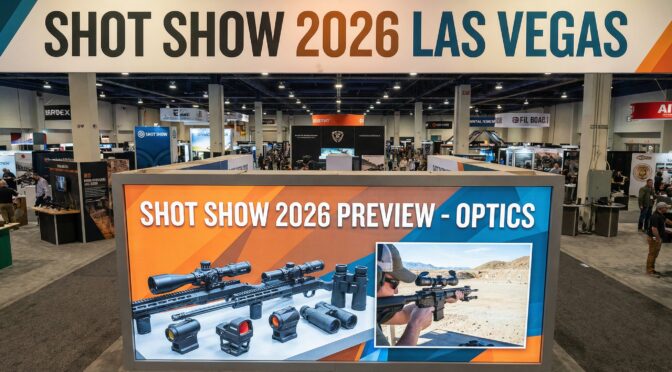
The optical landscape for small arms in 2026 represents a definitive inflection point in the industry’s trajectory, characterized by a departure from the “universal optic” philosophy that dominated the previous decade. We are witnessing the maturation of “digital fusion”—where the analog glass of the past century is irrevocably merging with onboard ballistics, thermal overlays, and laser integration—alongside a tactical regression to “Medium Power Variable Optics” (MPVOs) as a strategic reaction to the physical and optical limitations of Low Power Variable Optics (LPVOs). Based on an exhaustive analysis of pre-show chatter, distributor leaks, and manufacturing trends, SHOT Show 2026 will be defined not by incremental improvements in glass clarity, which has arguably reached a point of diminishing returns at the alpha tier, but by the integration of data and the specialization of magnification ranges.
The “must-see” products for this year are driven by three distinct operational requirements: the democratization of thermal imaging for the civilian and law enforcement market; the demand for “smart” sighting systems that reduce cognitive load for the shooter; and a return to the 2-10x or 2-12x magnification bracket for general-purpose rifles.
First, the “Smart Scope” revolution is moving from bulky prototypes to sleek, duty-ready implementations. Vortex Optics and Burris are leading this charge. Vortex’s rumored ballistic solving scope, likely integrated with their Fury HD 5000 AB ecosystem, suggests a future where dope cards are obsolete. Similarly, Burris’s Veracity PH, with its heads-up display (HUD), is expected to see a Generation 2 iteration that refines the user interface and reduces power consumption.
Second, the thermal market is bifurcating. On the high end, InfiRay and Pulsar are pushing sensor resolutions to 1280×1024, offering near-optical clarity.1 On the tactical end, Holosun and Sig Sauer are integrating thermal overlays directly into reflex sights, creating hybrid aiming solutions that offer day/night capability without the bulk of clip-ons.
Third, the industry is correcting the “LPVO bloat.” For years, manufacturers pushed 1-10x ratios in LPVOs, often resulting in tight eyeboxes and poor light transmission. The 2026 correction sees a surge in 2-10x MPVOs from titans like Nightforce, Leupold, and Zero Compromise Optic (ZCO). These optics acknowledge that for true 1x performance, a red dot is superior, and for magnification, 2-10x offers better optical physics than a 1-10x.
The following report provides a granular analysis of these trends, supported by technical specifications and market intelligence.
Summary of Expected Announcements
| Manufacturer | Product Category | Expected Model/Feature | Key Innovation/Trend |
| Vortex Optics | LPVO / Smart Optic | AMG 1-10×24 FFP & “Smart Scope” | Dual Zero Turrets, Integrated Ballistic Solver rumors, 8.4″ compact length.2 |
| Nightforce | MPVO | ATACR 2-10x or NX8 2.5-10x | Replacement for the legendary NXS 2.5-10x; focused on the SPR market gap.5 |
| Holosun | Hybrid / Laser | AEMS DUAL & ARO EVO DUAL | Integrated VIS/IR lasers directly into the optic housing; Thermal fusion pistol sights.7 |
| Leupold | MPVO / Hybrid | Mark 4HD & Mark 5HD 2-10×30 | 4:1 zoom ratio filling the mid-market gap; 2-10x ultra-lightweight tactical scope.9 |
| Sig Sauer | Thermal / Red Dot | Echo Thermal Reflex & Romeo9T | Democratization of thermal reflex sights; Titanium housed premium red dots.11 |
| InfiRay/Pulsar | Thermal | Thermion 2 LRF 60 & Nocpix ACE | 1280×1024 sensor resolution; integrated LRFs becoming standard.1 |
| Bushnell | Precision | Match Pro ED 5-30×56 | Bringing ED glass and high magnification to the “production class” price point.14 |
| ZCO | MPVO | ZC210 (2-10×30) | Ultra-premium glass in a compact MPVO form factor for the hunter/competitor.15 |
| EOTECH | Holographic / LPVO | Vudu X Series & EXPS3 Updates | Expansion of the Vudu line into mid-tier pricing; potential “HD” refresh of holographic sights.16 |
| Primary Arms | Prism / LPVO | PLxC 1-8x Nova & GLx MicroPrism | New reticle integration into compact PLx line; continued dominance of prism market.18 |
1. Market Overview 2026: The Post-Digital Transition
The firearms optics industry in 2026 finds itself navigating a complex intersection of technological capability and end-user practicality. Following the surge in demand during the early 2020s, the market has stabilized, but the baseline expectations for optical performance have shifted dramatically. The “analog” era of optics—defined by purely mechanical adjustments and glass quality—is yielding to a “post-digital” transition where electronics are no longer gimmicks but essential components of the firing solution.
This shift is driven primarily by the trickle-down effect of major military modernization programs, most notably the U.S. Army’s Next Generation Squad Weapon – Fire Control (NGSW-FC). The contract, awarded to Vortex Optics for the XM157, validated the concept of the “smart scope” at an institutional level. By 2026, the technology developed for that program—laser rangefinding, ballistic calculation, and disturbed reticle projection—has been miniaturized and cost-reduced for the commercial and law enforcement markets.4
Concurrently, supply chain dynamics have forced manufacturers to rethink product architectures. The global semiconductor tightness, while alleviated compared to previous years, has permanently altered how optics companies source components. Traditional glass manufacturers like Leupold and Nightforce are now competing for microprocessors alongside automotive and consumer electronics firms, creating a bifurcation in the market. We see “pure glass” companies doubling down on mechanical perfection (ZCO, Tangent Theta, high-end Nightforce) and “systems” companies (Sig Sauer, Vortex, Burris) pivoting toward software-defined optics.
The buzz surrounding SHOT Show 2026 indicates that the consumer is becoming increasingly educated and discerning. The blind chase for higher magnification ratios (e.g., the 1-10x LPVO craze) has cooled, replaced by a nuanced understanding of optical physics. Users are realizing that a 10x zoom ratio often necessitates compromises in eyebox, light transmission, and image distortion. Consequently, 2026 is shaping up to be the year of the “correction,” where specialized optics (MPVOs) regain market share from the “do-it-all” LPVOs.
Furthermore, the expiration of key patents—specifically regarding field of view (FOV) and optical designs previously held by European giants like Swarovski—is expected to unleash a wave of high-FOV optics from competitors.21 This “FOV War” will be a central theme in the precision rifle segment, with manufacturers racing to offer the widest sight picture without edge distortion.
2. The Smart Optics Revolution: Data Integration and Ballistic Solvers
The most significant technological leap evident at SHOT Show 2026 is the transition of the riflescope from a passive optical instrument to an active data processing node. The focus is no longer just on glass quality—which has largely plateaued at the alpha tier—but on the speed of the firing solution. The modern shooter demands an optic that does not just magnify the target but analyzes the environment.
Vortex Optics: The “System” Approach and the AMG 1-10×24
Vortex Optics has been aggressively positioning itself not just as a glass company, but as a systems integrator. Rumors surrounding their 2026 lineup point to a “Smart Scope” that leverages the ecosystem built around their Fury HD 5000 AB laser rangefinding binoculars.22
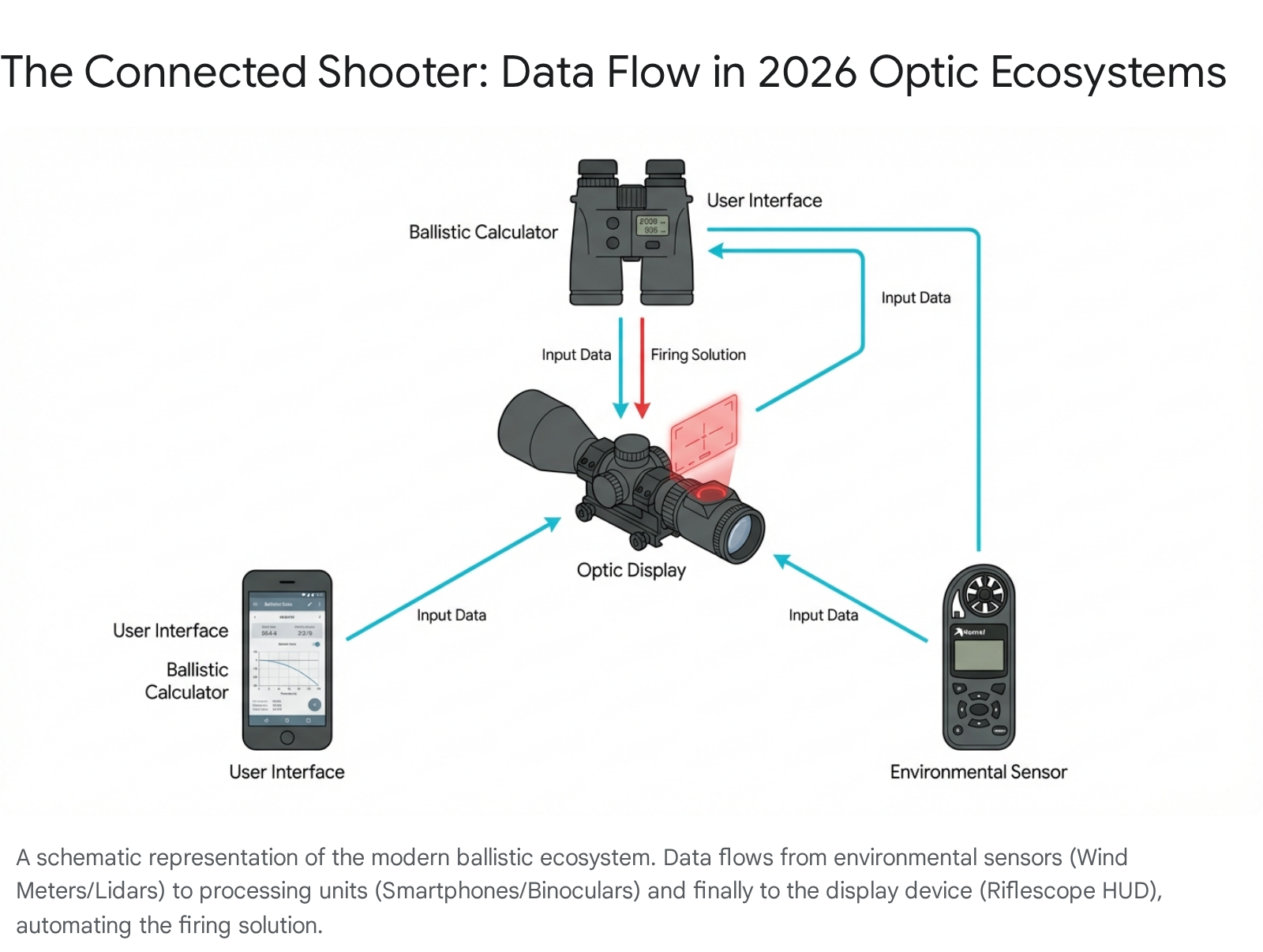
The anticipated release is a dedicated riflescope with an integrated heads-up display (HUD) or an advanced reticle system that communicates wirelessly with external sensors. While the military variant (XM157) is a known quantity, the commercial application is expected to be more modular. The industry buzz suggests a system where the scope receives ballistic data from a paired Kestrel or the Fury HD binoculars and projects a holdover dot directly onto the reticle.4 This development is critical because it addresses the primary failure point in long-range shooting: time. The traditional OODA loop (Observe, Orient, Decide, Act) for a long-range shot involves lasering the target, checking environmental data, calculating the solution, and dialing the turret. Vortex’s integration aims to compress this into a single action: lase and shoot.
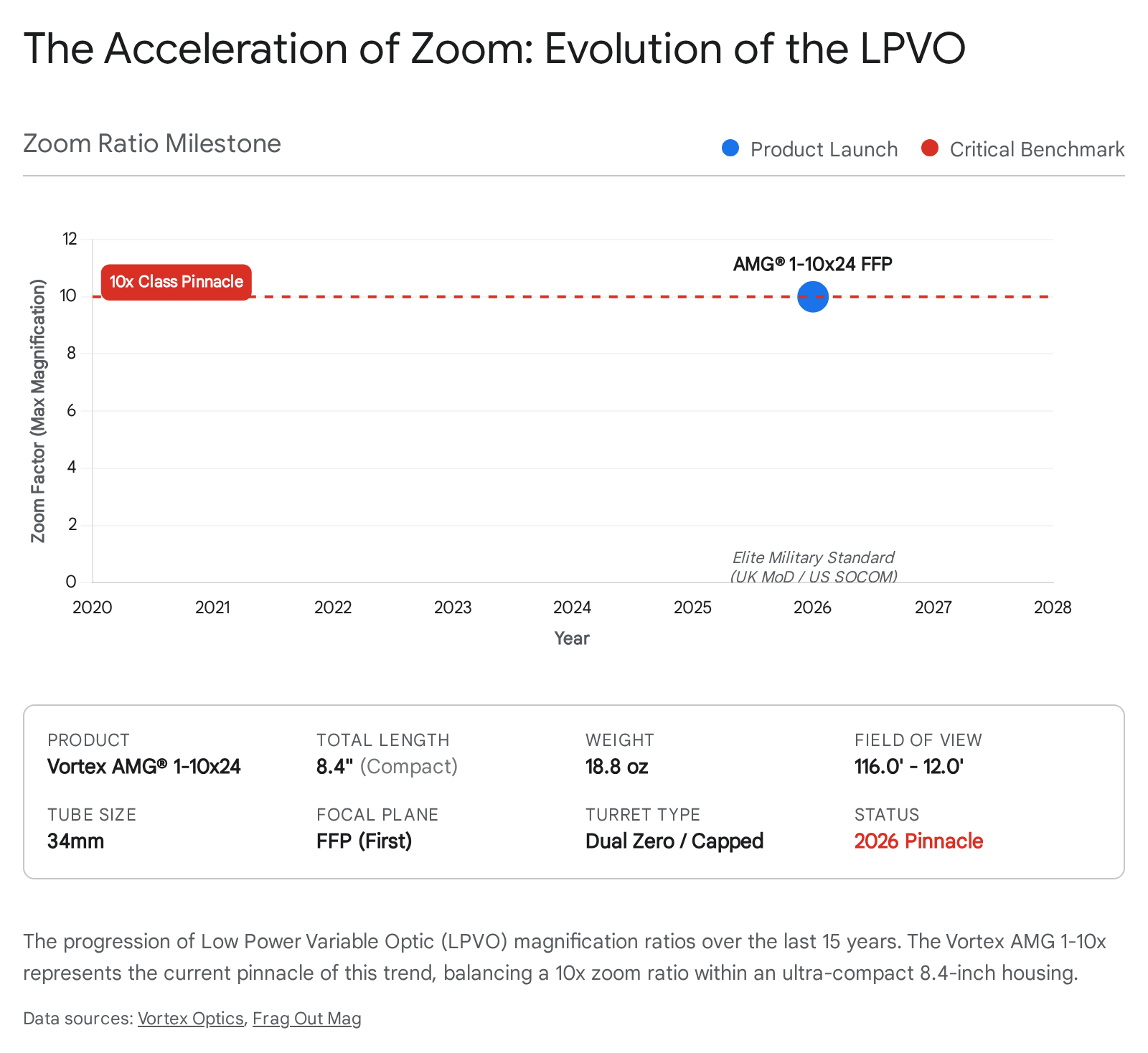
Beyond the digital realm, the official release of the Vortex AMG 1-10×24 FFP marks a significant milestone in mechanical engineering for LPVOs. Citing requirements from “elite military units” like the British SAS and US SOCOM, this optic is designed to withstand abuse that would crush standard commercial optics.3
Technical Analysis of the AMG 1-10×24:
- Dimensions: At only 8.4 inches long and 18.8 ounces, it is significantly shorter and lighter than competitors like the Razor Gen III 1-10x.2 This form factor is specifically designed to free up rail space for thermal clip-ons and laser aiming modules, acknowledging the “night fighting” requirement of modern carbines.
- Dual Zero Turrets: This feature allows the user to have two distinct zero settings—for example, one for suppressed and one for unsuppressed fire, or for two different ammunition types (subsonic vs. supersonic).2 This is a direct response to the increasing prevalence of suppressors in both military and civilian sectors.
- Optical System: The “Class Leading HD Optical System” claims to resolve the tight eyebox issues inherent in 10x erector assemblies.2 If Vortex has truly solved the light transmission loss at 10x in a 24mm objective, they have defied conventional optical physics.
Burris Veracity PH: The HUD Standard and “Clickless” Innovation
Burris has taken a slightly different approach with the Veracity PH series. Rather than projecting a point of aim via a laser or complex waveguide, the Veracity PH uses a “Clickless” digital turret system coupled with a Heads-Up Display inside the scope view.23
For 2026, the expectation is a Generation 2 refinement or expansion of this technology into other lines, possibly the Eliminator series (Eliminator 7 rumors). The current feedback on the Veracity PH highlights the utility of having elevation data (in yards, meters, or MOA) displayed directly in the shooter’s field of view, linked via Bluetooth to the BurrisConnect app for ballistic data.23
Strategic Implication: This technology lowers the barrier to entry for long-range hunting. By removing the need to count clicks or look at an external dope card, Burris is targeting the ethical hunter who needs to ensure shot placement without distraction. The “clickless” digital encoder is a clever mechanical workaround that reduces the complexity of the internal tracking mechanisms while increasing precision (1/10 MOA adjustments).25 The shooter simply dials the turret until the distance displayed in the HUD matches the ranged distance to the target. This “dial to distance” paradigm is intuitive and reduces the cognitive load under stress, which is often the cause of misses in the field.
Sig Sauer BDX: The Mature Ecosystem
While Vortex and Burris innovate with new hardware, Sig Sauer continues to refine its Ballistic Data Xchange (BDX) ecosystem. The integration between KILO rangefinders and SIERRA or ECHO sights is now a mature technology, but for 2026, we see this expanding into thermal. The ECHO3 Thermal Reflex Sight utilizes BDX to provide holdovers even in the thermal spectrum, calculating the drop based on the active ballistic profile and the range provided by a paired KILO unit.26 This fusion of thermal imaging and ballistic calculation creates a formidable “all-conditions” sighting system that was previously the domain of high-end military hardware like the Trijicon CCAS.
3. The Democratization of Thermal Imaging
If 2020-2025 was the era of “expensive” thermal, 2026 is the year thermal becomes a commodity. The technology curve has bent sufficiently to allow high-resolution sensors (640×512 and above) to enter mid-tier pricing, while entry-level 384×288 sensors are becoming aggressively affordable. Furthermore, the integration of Laser Rangefinders (LRF) into thermal units is becoming a mandatory standard rather than a premium feature.
InfiRay Outdoor and Pulsar: The Resolution Arms Race
InfiRay Outdoor, distributed by iRayUSA, continues to push the envelope with the Nocpix product line. The headline announcement for SHOT 2026 is the ACE S60R, which boasts an industry-leading 1280×1024 sensor. This is a massive leap from the standard 640 sensors, effectively quadrupling the pixel count.1
Market Impact of 1280 Resolution:
- Identification vs. Detection: Current 640 sensors are excellent for detecting a heat signature at distance, but identifying it (e.g., distinguishing a coyote from a domestic dog, or a boar from a sow) often requires closing the distance. A 1280 sensor allows for positive identification at significantly extended ranges, a critical safety factor for night hunting.
- Digital Zoom Usability: Thermal scopes rely on digital zoom, which degrades image quality. Starting with a 1280 base image allows for 2x, 4x, and even 8x digital zoom while maintaining a usable image, similar to the advantage of 4K video over 1080p when cropping.
Pulsar is countering with the Thermion 2 LRF 60 series (XL60, XG60, XP60). The focus here is on the 60mm objective lens combined with their high-definition sensors. The “XL60” model specifically features an HD sensor, likely competing in the high-resolution space.13 Pulsar’s strength remains its form factor—the Thermion housing mounts like a traditional scopes (30mm rings), making it approachable for traditional hunters.13
Sig Sauer and Holosun: The Fusion of Reflex and Thermal
Perhaps the most disruptive trend is the miniaturization of thermal technology into reflex sight form factors.
Sig Sauer is introducing the ECHO SV Thermal Sight and ECHO Clip-On. These are not traditional tube scopes but compact, reflex-style sights designed for AR platforms. The ECHO SV features a 2-16x magnification range in a direct-view thermal sight, eliminating the need for additional devices.11 This signals Sig’s intent to dominate the “thermal red dot” market, providing a lightweight solution for hog hunters and tactical teams.
Holosun is creating significant buzz with the DPS-TH Digital Pistol Sight. This is a fusion optic that overlays a thermal image onto a red dot sight window.27
- Tactical Significance: This allows a pistol user to see heat signatures through the optic window. In a home defense or law enforcement scenario, this could reveal a suspect hiding in shadows or foliage that the naked eye (and a standard red dot) would miss.
- Engineering Marvel: Fitting a thermal sensor, processor, and display overlay into a slide-mounted pistol optic footprint is a feat of miniaturization that places Holosun far ahead of competitors in terms of electronics integration.
4. The Resurgence of the MPVO (Medium Power Variable Optic)
For the past decade, the LPVO (1-6x, 1-8x, 1-10x) has been the dominant optic for general-purpose rifles (GPRs). However, physics imposes limits. To get a 10x zoom ratio, optical engineers must make compromises: tight eyeboxes, darker images at high magnification, and heavy housings. The market is now swinging back toward the MPVO, typically in the 2-10x or 2-12x range.
The logic is sound: A 2-10x scope is optically simpler than a 1-10x. It allows for brighter glass, a more forgiving eyebox, and a lighter chassis. For close quarters (1x), shooters are increasingly using an offset or piggybacked red dot, which is superior to a scope at 1x anyway. This “MPVO + Red Dot” setup is becoming the preferred configuration for the modern “Recce” rifle.
Nightforce: The Return of the King?
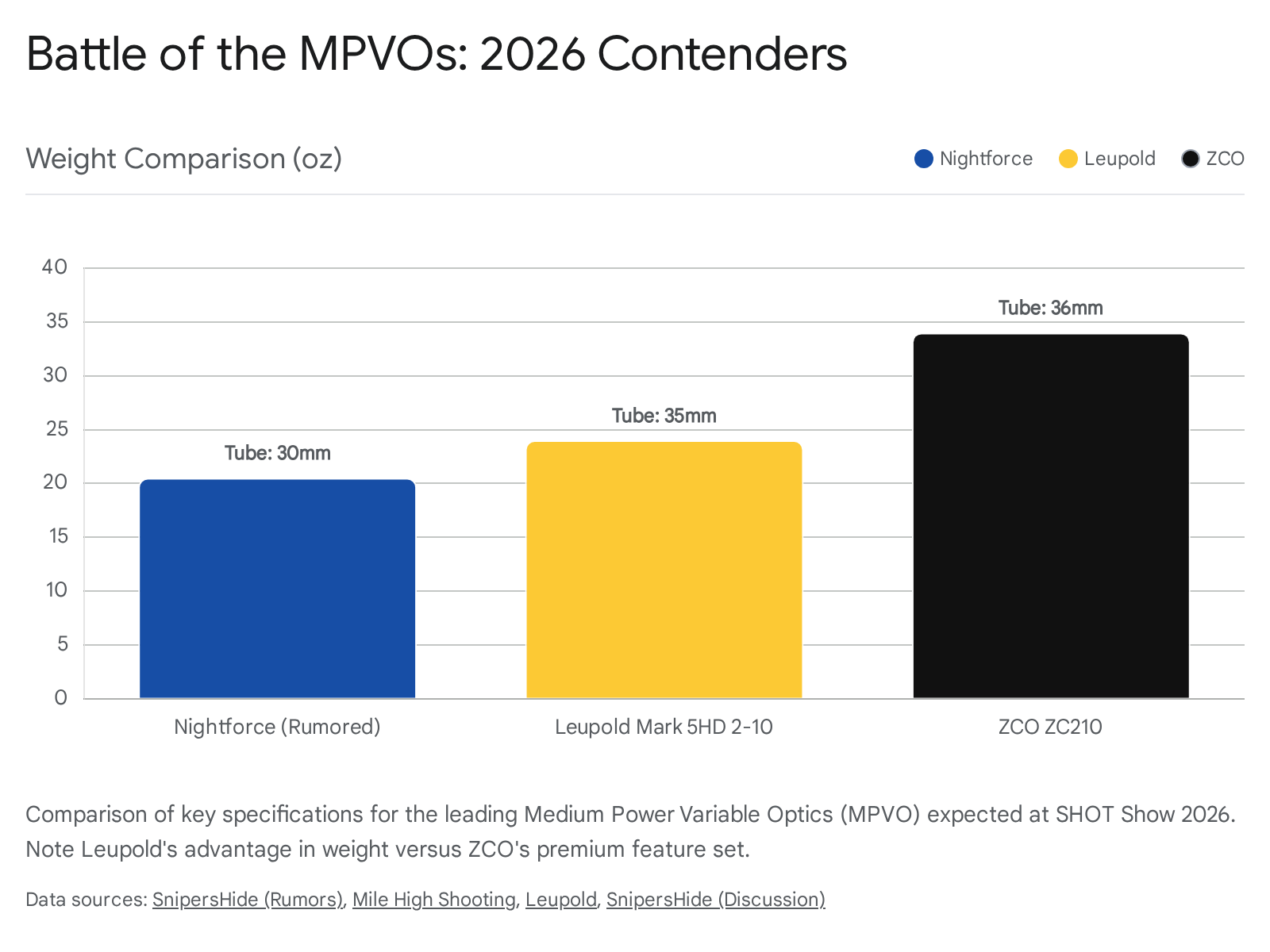
The most persistent and credible rumor for SHOT 2026 is the release of a new Nightforce 2.5-10x or 2-10x optic to replace the legendary NXS 2.5-10x compact.5
- The Context: The NXS 2.5-10×24 and x32 were favorites of US Special Forces (Mk12 SPR) due to their durability and compact size. When discontinued, they left a gap that the NX8 2.5-20x failed to fill completely due to its tight eyebox and sensitive parallax.6
- The Rumor: A new ATACR 2-10x or an updated NX8 2.5-10x is expected. The wishlist from the community includes a 30mm tube, weight under 28oz, capped windage, and the FC-DMx reticle.5 If Nightforce delivers this, it will likely be the best-selling bolt-action and SPR scope of the year. The move away from the “NXS” branding to “NX8” or “ATACR” for this magnification range signifies an update to modern glass standards and reticle choices (FFP dominance), moving away from the Second Focal Plane (SFP) heritage of the NXS.
Leupold: Filling the Mid-Range Gap
Leupold is aggressively targeting this sector with the Mark 5HD 2-10×30. This scope is marketed as “bridging the gap” between LPVOs and high-power scopes.29
- Key Features: It is extremely lightweight (a Leupold hallmark), features the M5C3 ZeroLock turret (3 revolutions of travel), and is Front Focal Plane (FFP).10
- Mark 4HD Line: Leupold is also launching the Mark 4HD series, featuring a 4:1 zoom ratio (e.g., 2.5-10×42). This line sits between the Mark 3HD and Mark 5HD, offering professional-grade glass and turrets at a slightly lower price point than the Mark 5HD. It uses the same optical system but with a simpler erector assembly.9 This 2.5-10×42 model is a direct competitor to the rumored Nightforce, likely beating it on price and weight.
Zero Compromise Optic (ZCO): The Alpha Option
For the discerning user where budget is secondary to performance, ZCO is showcasing the ZC210 (2-10×30). ZCO has built a reputation for having arguably the best mechanicals and glass in the industry. A 2-10x from them targets the premium hunter and the “Gas Gun” PRS competitor who needs absolute reliability and optical perfection in a smaller package.15
5. Innovation in Pistol and PDW Optics
The innovation in pistol optics is driven by Holosun, whose rapid prototyping and willingness to experiment have left legacy manufacturers playing catch-up. For 2026, the trend is “Integration.”
Holosun’s “Dual” Series: Solving the PDW Space
Holosun is set to unveil the AEMS DUAL and ARO EVO DUAL. These optics integrate visible and IR aiming lasers directly into the optic housing.7
- The Problem: On short PDWs (like the MP7, MCX Rattler, or Honey Badger), rail space is at a premium. Mounting a separate red dot and a laser (like a PEQ-15 or DBAL) often results in a cramped grip or the laser obscuring the sight picture.
- The Solution: By building the lasers into the riser or housing of the optic (similar to the legacy Wilcox BOSS but at a consumer price), Holosun frees up the rail for switches and lights. The AEMS DUAL features these lasers “clearly visible under the lens”.8 This creates a unified “Day/Night” aiming center. The “CompM5 style” side battery compartment on the ARO EVO DUAL suggests a shift towards robust, duty-grade features in their mid-tier line.
Sig Sauer Romeo9T and M17
Sig Sauer continues to target the professional user with the Romeo9T.12 While details are sparse, the “T” designation usually implies Titanium housing and “9” suggests a flagship large-format emitter similar to the Romeo8T but potentially with dual-emitter technology or enhanced durability features. This competes directly with the Aimpoint CompM5 and EOTECH EXPS series. Furthermore, the ROMEO-M17, previously a military-contract item for the M17 pistol system, is seeing wider civilian availability, bringing its unique mounting footprint (which mounts from underneath the slide) to the broader market.36
Trijicon and EOTECH: The Old Guard Reacts
Buzz around Trijicon suggests a Green Dot RMR and potentially updates to the RMR HD line to combat Holosun’s dominance in feature-rich pistol optics.7 Meanwhile, EOTECH is rumored to be updating the EXPS3 line, possibly with an “HD” moniker, improving reticle clarity or battery life, alongside their new EFLX mini red dot offerings which are now available in tan and black, targeting the pistol market directly.16
6. Precision Long Range: The Field of View Wars
In the world of precision rifle competition (PRS/NRL), the focus remains on optical clarity, field of view (FOV), and mechanical reliability.
Bushnell Match Pro ED 5-30×56
Bushnell is democratizing “Alpha” class features with the Match Pro ED 5-30×56.14
- The Disruption: Historically, to get a 30x magnification scope with a 56mm objective and ED (Extra-low Dispersion) glass, a shooter had to spend $2,000+. Bushnell’s Match Pro line has disrupted the entry-level market; the move to a 5-30×56 ED configuration aims to kill the mid-tier market ($1,000-$1,500).
- Binocular Innovation: Bushnell is also releasing the Match Pro ED 15×56 Binoculars with a rotating reticle.38 This allows the user to level the reticle independently of the binocular barrels (which change angle with IPD adjustment), solving a common headache for spotters calling shots.
Swarovski Patent Expiry and the Kahles K864
Distributor leaks suggest a new Kahles K864 or similar high-magnification optic with a larger eyepiece design and improved windage turret.39 The “buzz” on forums also centers around the expiration of Swarovski’s patent on wide-angle Field of View, potentially opening the door for other manufacturers (like Vortex and Nightforce) to release scopes with the ultra-wide FOV that has kept Kahles dominant in PRS.21 This patent expiry is a critical inflection point; for years, other manufacturers were legally restricted from using specific lens grouping designs that allowed for Kahles’ signature “edge-to-edge” clarity and massive FOV. With these restrictions lifting, we expect a surge in “ultra-wide” optics from competitors in the 2026-2027 cycle.
March Scopes (DEON Optical)
Never one to be outdone on pure magnification specs, DEON Optical is introducing the 6-60×56 HM and 8-80×56 Majesta tracking scopes.40 These are niche tools for F-Class and Extreme Long Range (ELR) shooters, pushing the boundaries of what is physically possible with zoom ratios. The “Majesta” line utilizes High Master (HM) lens systems to maintain clarity at 80x, a magnification level where atmospheric mirage is typically the limiting factor, not the glass.
7. The LPVO Battlefield: Evolving Forms
While the MPVO is rising, the LPVO is not dying; it is evolving.
Primary Arms is updating its PLx Compact (PLxC) 1-8×24 with the ACSS Nova reticle. The PLxC has been a breakout hit due to its weight (sub-17oz) and optical performance. Adding the “Nova” fiber-optic wire reticle (which offers Red Dot Brightness) to the PLxC chassis creates arguably the perfect 1-8x optic for general use.19 They are also refreshing the GLx 1x MicroPrism, a dominant force in the astigmatism-friendly market, with updated internals.18
EOTECH is expanding its Vudu line with the Vudu X series, likely a more budget-friendly entry point to compete with Vortex’s Viper PST Gen II and Strike Eagle lines, while maintaining the Vudu’s short overall length industrial design.17
8. Conclusion: Strategic Outlook
The 2026 SHOT Show optics landscape reveals a market that is maturing in hardware but exploding in software and integration.
- Supply Chain Complexity: The move to “Smart Scopes” and thermal fusion introduces semiconductor supply chains into the sporting optics industry. Manufacturers like Vortex and Sig Sauer are now competing for chips alongside automotive and consumer electronics sectors. This may lead to longer lead times or availability issues for these high-tech flagships compared to traditional glass.
- The “Good Enough” Glass Threshold: The resurgence of the MPVO and the focus on digital features suggests that pure optical performance (resolution, chromatic aberration control) has reached a point where consumers are satisfied. The new competitive frontier is utility—what can the scope do for me? Can it calculate my hold? Can it see in the dark? Can it save weight?
- Night Fighting Normalization: The massive influx of affordable, high-resolution thermal and integrated laser aiming devices confirms that “night vision capability” is no longer a niche for wealthy hog hunters or tactical teams. It is becoming a standard requirement for the prepared civilian’s general-purpose rifle.
For the industry analyst, SHOT Show 2026 is a signal that the era of the standalone tube scope is ending. The future belongs to integrated systems. The “must-see” booth visits are Vortex (for the future of ballistic integration), InfiRay/iRayUSA (for the new standard in thermal resolution), Nightforce (for the definitive mechanical MPVO), and Holosun (for the most innovative packaging of lasers and optics).
If you find this post useful, please share the link on Facebook, with your friends, etc. Your support is much appreciated and if you have any feedback, please email me at in**@*********ps.com. Please note that for links to other websites, we are only paid if there is an affiliate program such as Avantlink, Impact, Amazon and eBay and only if you purchase something. If you’d like to directly contribute towards our continued reporting, please visit our funding page.
Sources Used
- Nocpix Thermal Optics Demonstrating New Models at SHOT Show | The Outdoor Wire, accessed January 12, 2026, https://www.theoutdoorwire.com/releases/31b48431-a46d-4b14-baeb-f83318ad5d96
- Vortex AMG 1-10×24 FFP Riflescope, accessed January 12, 2026, https://vortexoptics.com/amg-1-10×24-ffp-riflescope.html
- Vortex introduces AMG 1-10×24 FFP Riflescope – Frag Out! Magazine, accessed January 12, 2026, https://fragoutmag.com/vortex-introduces-amg-1-10×24-ffp-riflescope/
- We Can’t Show It Yet… But Vortex’s 2026 Gear Will Change Long-Range Hunting…Right out of the Box – YouTube, accessed January 12, 2026, https://www.youtube.com/watch?v=3K-D7hzpkv4
- Rifle Scopes – New Nightforce MPVO???? | Sniper’s Hide Forum, accessed January 12, 2026, https://www.snipershide.com/shooting/threads/new-nightforce-mpvo.7268977/
- New 2024 MPVO Options | Page 3 | Sniper’s Hide Forum, accessed January 12, 2026, https://www.snipershide.com/shooting/threads/new-2024-mpvo-options.7205037/page-3
- Holosun 2026 Sneak Peek – Frag Out! Magazine, accessed January 12, 2026, https://fragoutmag.com/holosun-2026-sneak-peak/
- The new HOLOSUN optics for 2026 – SPARTANAT.com, accessed January 12, 2026, https://spartanat.com/en/die-neuen-holosun-optiken-fuer-2026
- Mark 4HD Riflescopes | Leupold, accessed January 12, 2026, https://www.leupold.com/shop/riflescopes/series/mark-4hd-rifle-scopes
- Mark 5HD 2-10×30 M5C3 FFP Illum. CMR-Mil – Leupold, accessed January 12, 2026, https://www.leupold.com/mark-5hd-2-10×30-m5c3-ffp-illum-cmr-mil
- ECHO SV50-LRF THERMAL SIGHT 2-16x50MM – Sig Sauer, accessed January 12, 2026, https://www.sigsauer.com/echo-sv50-lrf-thermal-sight-2-16x50mm.html
- Red Dot Sights | Rifle Optics – Sig Sauer, accessed January 12, 2026, https://www.sigsauer.com/electro-optics/red-dot-sights.html
- Pulsar is coming to SHOT Show 2025: visit us at Booth #11419 to see the full Thermion 2 LRF 60 series and Merger LRF XT50, accessed January 12, 2026, https://pulsarvision.com/journal/pulsar-is-coming-to-shot-show-2025-visit-us-at-booth-11419-to-see-the-full-thermion-2-lrf-60-series-and-merger-lrf-xt50/
- 5-30×56 Long Range Scope – Match Pro ED MOA – Bushnell, accessed January 12, 2026, https://www.bushnell.com/scopes/match-pro-ed-moa-5-30×56-riflescope/BU-MP53056AMI.html
- MPVO – Mile High Shooting Accessories, accessed January 12, 2026, https://www.milehighshooting.com/optics-mounts/mpvo/
- EOTECH 2026 Optics Sneak Peek – Frag Out! Magazine, accessed January 12, 2026, https://fragoutmag.com/eotech-2026-optics-sneak-peak/
- New Optics Coming in 2025 | NSSF SHOT Show 2026, accessed January 12, 2026, https://shotshow.org/new-optics-coming-in-2025/
- New Optics Coming in 2024 | NSSF SHOT Show 2026, accessed January 12, 2026, https://shotshow.org/new-optics-coming-in-2024/
- Primary Arms Optics ‘Discovery 2025’, accessed January 12, 2026, https://primaryarmsoptics.com/news-announcements/press-releases/primary-arms-optics-discovery-2025/
- New vortex smart optic. Where can I get one? : r/ar15 – Reddit, accessed January 12, 2026, https://www.reddit.com/r/ar15/comments/ygwug5/new_vortex_smart_optic_where_can_i_get_one/
- SHOT show 2026. New scopes ? | Rokslide Forum, accessed January 12, 2026, https://rokslide.com/forums/threads/shot-show-2026-new-scopes.434481/
- Vortex Nation Videos, accessed January 12, 2026, https://vortexoptics.com/vortex-nation-videos
- Veracity PH – Burris Optics, accessed January 12, 2026, https://www.burrisoptics.com/riflescopes/veracity-ph
- Veracity PH – Burris Optics, accessed January 12, 2026, https://www.burrisoptics.com/riflescopes/veracity-ph?bvstate=pg:2/ct:r
- Burris Veracity PH : r/longrange – Reddit, accessed January 12, 2026, https://www.reddit.com/r/longrange/comments/17w0osa/burris_veracity_ph/
- SIG SAUER Electro-Optics Introduces ECHO3™ Thermal Reflex Sight with BDX Technology, accessed January 12, 2026, https://www.sigsauer.com/blog/sig-sauer-electro-optics-introduces-echo3-thermal-reflex-sight-with-bdx-technology
- Holosun – Frag Out! Magazine, accessed January 12, 2026, https://fragoutmag.com/tag/holosun/
- Nightforce NX8. SFP ? | Rokslide Forum, accessed January 12, 2026, https://rokslide.com/forums/threads/nightforce-nx8-sfp.165092/
- Discover The Mark 5HD 2-10 Riflescope – Leupold, accessed January 12, 2026, https://www.leupold.com/blog/post/discover-the-mark-5hd-2-10-riflescope
- Mark 5HD Rifle Scope – Leupold, accessed January 12, 2026, https://www.leupold.com/shop/riflescopes/series/mark-5hd-rifle-scopes
- Mark 4HD vs. Mark 5HD: Which Leupold Riflescope is Right for You?, accessed January 12, 2026, https://www.leupold.com/blog/post/mark4hd-vs-mark5hd
- First Shots: Leupold Mark 4HD Riflescopes | An Official Journal Of The NRA, accessed January 12, 2026, https://www.shootingillustrated.com/content/first-shots-leupold-mark-4hd-riflescopes/
- 2026 SHOT Show Planner – ZCO Zero Compromise Optic, accessed January 12, 2026, https://n2a.goexposoftware.com/events/ss26/goExpo/exhibitor/viewExhibitorProfile.php?__id=428
- Shop Zero Compromise Optics & Scopes – Mile High Shooting Accessories, accessed January 12, 2026, https://www.milehighshooting.com/optics-mounts/riflescopes/zero-compromise-optic/
- Combat Red Dots – Sig Sauer, accessed January 12, 2026, https://www.sigsauer.com/shop/combat-red-dots
- 2024_LE_CATALOG_DEL.pdf – Sig Sauer, accessed January 12, 2026, https://www.sigsauer.com/media/sigsauer/resources/2024_LE_CATALOG_DEL.pdf
- Bushnell Match Pro ED 3-18×50 – Continuing Success. – YouTube, accessed January 12, 2026, https://www.youtube.com/watch?v=rc9w21nMXfU
- 15×56 Spotting Binoculars with Reticle – Match Pro ED – Bushnell, accessed January 12, 2026, https://www.bushnell.com/binoculars/ed-prime-glass/match-pro-ed-15×56-binoculars/BU-BMP1556G.html
- Rifle Scopes – New Kahles for 2026 is here | Sniper’s Hide Forum, accessed January 12, 2026, https://www.snipershide.com/shooting/threads/new-kahles-for-2026-is-here.7277896/
- SHOT Show 2026 preview for March scopes | Sniper’s Hide Forum, accessed January 12, 2026, https://www.snipershide.com/shooting/threads/shot-show-2026-preview-for-march-scopes.7275868/