The 2026 SHOT Show in Las Vegas, Nevada, convenes during a period of unprecedented disruption and opportunity for the small arms industry. While the annual trade show typically showcases iterative improvements in ballistics and firearm ergonomics, this year’s exhibition is defined by a singular, overarching regulatory catalyst: the elimination of the $200 National Firearms Act (NFA) tax stamp for suppressors and short-barreled rifles (SBRs), effective January 1, 2026. This legislative shift has instantly dismantled an artificial financial barrier that has stood since 1934, effectively transforming the suppressor from a luxury NFA item into a mass-market commodity. The downstream effects of this deregulation are profound, driving ammunition manufacturers to fundamentally re-engineer their product lines to prioritize subsonic performance, short-barrel optimization, and high-pressure efficiency.
The “must-see” ammunition announcements at SHOT Show 2026 are best understood not as isolated product launches, but as integrated components of this new “Suppressed & Compact” paradigm. The industry is witnessing a bifurcation of material science, with traditional brass casing technology being challenged by advanced steel and hybrid alloys designed to breach the century-old 65,000 psi chamber pressure ceiling.
Federal Premium’s introduction of the 7mm Backcountry is the flagship of this movement. By utilizing a proprietary “Peak Alloy” steel case, Federal has achieved a Maximum Average Pressure (MAP) of 80,000 psi, allowing for magnum velocities from suppressor-friendly 20-inch barrels. This is a direct technological answer to the logistical problem of adding length to hunting rifles via suppression. Similarly, Winchester’s .21 Sharp represents a structural modernization of the rimfire market, discarding the 19th-century heeled bullet design of the.22 Long Rifle in favor of a jacketed, non-heeled projectile that ensures compliance with expanding lead-free mandates while maintaining backward compatibility with the massive installed base of rimfire actions.
On the tactical front, Hornady’s .338 ARC (Advanced Rifle Cartridge) redefines the capabilities of the AR-15 platform by delivering heavy-payload subsonic energy that significantly outperforms the.300 Blackout, catering to the surge in demand for suppressed hunting and tactical applications. Meanwhile, the mid-market is seeing a resurgence of “value-premium” offerings from Nosler and Browning, who are introducing lines like Whitetail Country and Silver Series to address the economic realities of the average consumer while essentially conceding the “super-premium” tier to the new high-pressure metallurgies.
In summary, the 2026 ammunition landscape is characterized by the death of the “24-inch test barrel” standard and the rise of the specialized, system-integrated cartridge. Manufacturers are no longer simply selling bullets; they are selling ballistic solutions to the physics problems created by shorter barrels and silencers. The era of brass supremacy is fracturing, and the industry is aggressively pivoting toward a future where “standard” pressure is synonymous with “high” pressure, and where the sound signature of a firearm is as critical a metric as its muzzle velocity.
Summary Table of Expected Announcements: SHOT Show 2026
| Manufacturer | Product Line | Key Innovation / Technical Spec | Primary Market Driver | Strategic Implication |
| Federal Premium | 7mm Backcountry | “Peak Alloy” Steel Case; 80,000 psi MAP; 3,000 fps (170gr) from 20″ bbl.1 | “Short & Quiet” Hunting Trends | Validates steel as a premium component; challenges brass pressure limits. |
| Federal Premium | Federal Subsonic | Dedicated heavy loads for .30-30 Win (170gr),.45-70 Govt (300gr),.308,.300 BLK.3 | Deregulation of Suppressors | Revitalizes lever-action platforms for the suppressed era. |
| Winchester | .21 Sharp | Non-heeled, jacketed bullet (.210″ dia) in.22 LR case; 4 load types.5 | Lead-Free Mandates; Rimfire Modernization | Solves.22 LR lead-free accuracy issues; creates a new “Performance Rimfire” standard. |
| Hornady | .338 ARC | 307gr Subsonic / 175gr Supersonic; Fits AR-15 (Grendel bolt).7 | Tactical / Hog Hunting (Thermal/Night Vision) | Displaces.300 BLK in energy-critical subsonic applications. |
| Hornady | New SST / DGH | SST expansion to PRC calibers; Dangerous Game Handgun (DGH) bullets.9 | Long Range & Handgun Hunting | Consolidates dominance in the “PRC” ecosystem. |
| SIG Sauer | MCX-SPEAR /.277 Fury | Commercial availability of Hybrid Case ammo; 80,000 psi bi-metal tech.10 | Military-Civilian Tech Transfer | Normalizes bi-metallic case technology; solidifies 80k psi as the new benchmark. |
| Remington | 7mm Backcountry | Adoption of Federal’s cartridge; Expansion of Core-Lokt Handgun.11 | Industry Standardization | Ensures 7mm BC longevity beyond a single brand; signals broad industry buy-in. |
| Barnes | Pioneer / Suppressor | Lever-gun specific loads; Optimized low-velocity expansion geometry.13 | Traditionalists & Suppressor Users | Bridges heritage firearms with modern terminal ballistics technology. |
| Nosler | Whitetail Country | Solid Base bullets; Value-focused pricing; Straight-wall options.15 | Inflation-Weary Mid-Market | A strategic pivot to affordability; reliance on proven, non-bonded cup/core tech. |
| Browning | Silver Series | Plated soft points; Heavy-for-caliber options.17 | Traditional Big Game Hunting | Revitalizes the “budget premium” segment with modernized classic designs. |
1. The Regulatory Catalyst: The “Zero Tax” Market Shock and the New Acoustic Reality
To comprehensively analyze the ammunition trends of 2026, one must first dissect the regulatory earthquake that has reshaped the consumer landscape. For nearly a century, the National Firearms Act (NFA) of 1934 imposed a $200 tax stamp on the transfer and manufacture of silencers (suppressors). In 2025 dollars, $200 is not an insurmountable sum, but the process—fingerprinting, registration, and wait times often exceeding 9 to 12 months—acted as a massive friction point, artificially suppressing demand.
The elimination of this tax stamp fee, effective January 1, 2026, coupled with the streamlined eForm system 18, has acted as a massive accelerant. Industry data indicates a staggering 5,900% surge in NFA applications in the first week of January 2026 alone.19 This “Zero Tax” era has effectively transformed the suppressor from a niche tactical accessory into a standard piece of hunting equipment, akin to a riflescope or a sling.
1.1 The Demand Shock: 150,000 Applications in 24 Hours
The immediate impact of this policy shift was a logistical tsunami. The ATF processed approximately 150,000 applications on January 1, 2026, compared to a typical daily volume of 2,500.19 This surge indicates a massive pent-up demand that has now been unleashed upon the market.
For the ammunition industry, this is not merely a hardware story; it is a ballistics story. A suppressed rifle is only as quiet as the ammunition it fires. If a bullet breaks the sound barrier (traveling faster than ~1,125 fps), it creates a “sonic crack” that cannot be silenced by the muzzle device. Therefore, to fully realize the benefits of their new suppressors, this wave of 150,000+ new owners immediately requires ammunition that is inherently subsonic.
This has shifted the manufacturing priority from “maximum velocity” to “maximum terminal performance at minimal velocity.” The market is witnessing a scramble to produce heavy, aerodynamic projectiles that can stabilize at 1,000 fps and still expand reliably upon impact—a notoriously difficult engineering challenge.
1.2 The “Short & Quiet” Rifle Philosophy
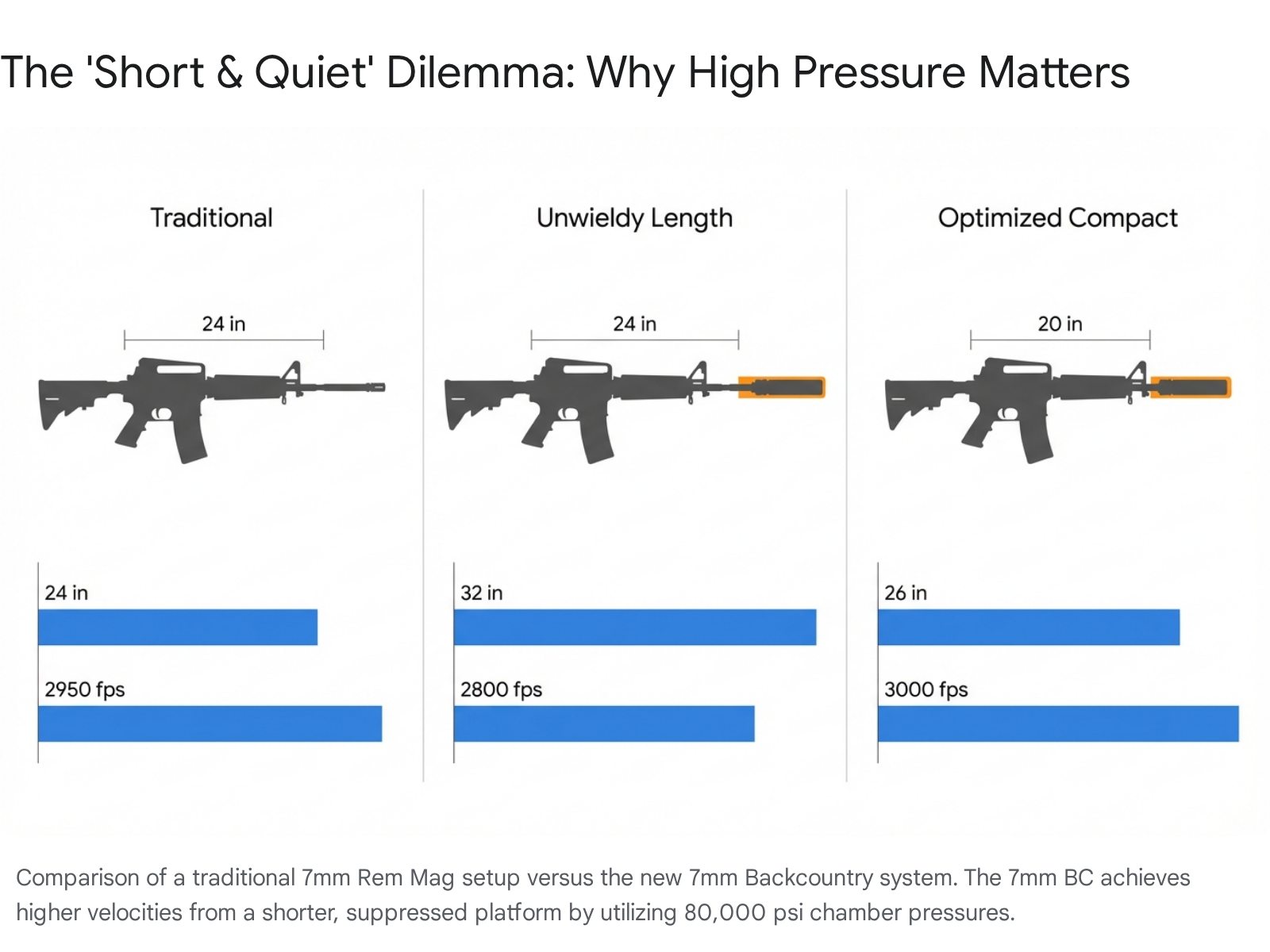
The ubiquity of suppressors has also fundamentally altered the geometry of the modern hunting rifle. A standard hunting rifle typically features a 24-inch barrel to maximize velocity. Adding a standard 7-to-9-inch suppressor to such a rifle results in a total system length of 31 to 33 inches. This “musket-like” length is unwieldy in a deer blind, difficult to maneuver in thick brush, and shifts the center of gravity too far forward for off-hand shooting.
To counteract this, rifle manufacturers and custom builders have aggressively moved toward shorter barrel lengths, with 18, 20, and even 16 inches becoming the new standard for suppressor-ready hosts.1 However, this reduction in barrel length creates a ballistic dilemma. Traditional magnum cartridges (like the 7mm Remington Magnum or.300 Winchester Magnum) rely on slow-burning powders to achieve their high velocities. These powders require long barrels to achieve a complete burn. Chopping 4 to 8 inches off the barrel results in:
- Velocity Loss: A loss of 25 to 50 fps per inch of barrel reduction, often stripping a magnum cartridge of its ballistic advantage.
- Muzzle Blast: Unburnt powder igniting outside the muzzle, which increases flash and blast baffle erosion inside the suppressor.
This specific engineering problem—how to extract magnum performance from a compact, suppressor-friendly 20-inch barrel—is the primary driver behind the most significant innovations at SHOT Show 2026. It is the reason for the existence of the 7mm Backcountry and the widespread adoption of high-pressure metallurgies.
2. Material Science Breakthroughs: The End of Brass Hegemony
For over a century, the limiting factor in small arms ammunition has not been the strength of the firearm action, but the strength of the cartridge case. Brass (an alloy of copper and zinc) has been the gold standard since the late 19th century due to its malleability, corrosion resistance, and ability to obturate (expand to seal the chamber) upon firing. However, brass has a structural yield strength that typically limits safe chamber pressures to a ceiling of approximately 60,000 to 65,000 psi (SAAMI specifications). Pushing a brass case beyond this limit risks blown primers, case head separation, and catastrophic gas venting into the shooter’s face.
SHOT Show 2026 marks the definitive breach of this “Brass Ceiling.” The industry has moved toward advanced metallurgies that allow for significantly higher operating pressures, fundamentally changing the internal ballistics equation.
2.1 Federal’s “Peak Alloy”: The Steel Revolution
Federal Premium’s “Peak Alloy” technology is arguably the most disruptive material innovation at the show.1 Unlike the mild steel used in economical Russian ammunition (which is often polymer-coated and non-reloadable), Peak Alloy is a proprietary, high-tensile stainless steel alloy designed specifically for high-pressure applications.
- Pressure Capability: This material allows cartridges like the new 7mm Backcountry to operate at a Maximum Average Pressure (MAP) of 80,000 psi.2 This is a massive leap over the 60,000 psi standard of heritage cartridges like the.30-06 Springfield.
- Corrosion Resistance: The cases are nickel-plated, providing lubricity for reliable feeding and extraction, as well as superior corrosion resistance for backcountry environments.
- Reloadability: A critical distinction of Peak Alloy is that it is reloadable. Federal has released specific reloading data and dies, challenging the dogma that steel cases are “single-use” trash. The alloy is ductile enough to be resized, though it likely requires sturdier press leverage than brass.20
2.2 SIG Sauer’s Hybrid Case: The Bi-Metallic Solution
Developing in parallel is SIG Sauer’s Hybrid Case Technology, popularized by the U.S. Army’s NGSW program and the.277 Fury cartridge. This design utilizes a stainless steel case head mechanically locked to a brass body.10
- Mechanism: The steel head contains the immense pressure of the primer ignition and initial expansion (80,000 psi), while the brass body retains the traditional obturation properties that ensure a gas-tight seal in the chamber.
- Strategic Divergence: While Federal has opted for a monolithic steel construction, SIG’s hybrid approach attempts to marry the strength of steel with the familiar behavior of brass. Both systems achieve the same goal—higher pressure and velocity from shorter barrels—but via different engineering pathways.
The commercial availability of both systems at SHOT Show 2026 signals that the industry has collectively accepted 80,000 psi as the new benchmark for high-performance ammunition.
3. The Flagship: Federal Premium 7mm Backcountry
If there is a single “must-see” item that encapsulates the technological and market trends of 2026, it is Federal Premium’s 7mm Backcountry (7mm BC). This cartridge is not merely a new chambering; it is a systematic attempt to render the traditional long-action magnum obsolete.
3.1 Breaking the Ballistic Compromise
The design mandate for the 7mm BC was specific: deliver 7mm Remington Magnum performance (or better) from a 20-inch barrel, in a standard.30-06 length action.1
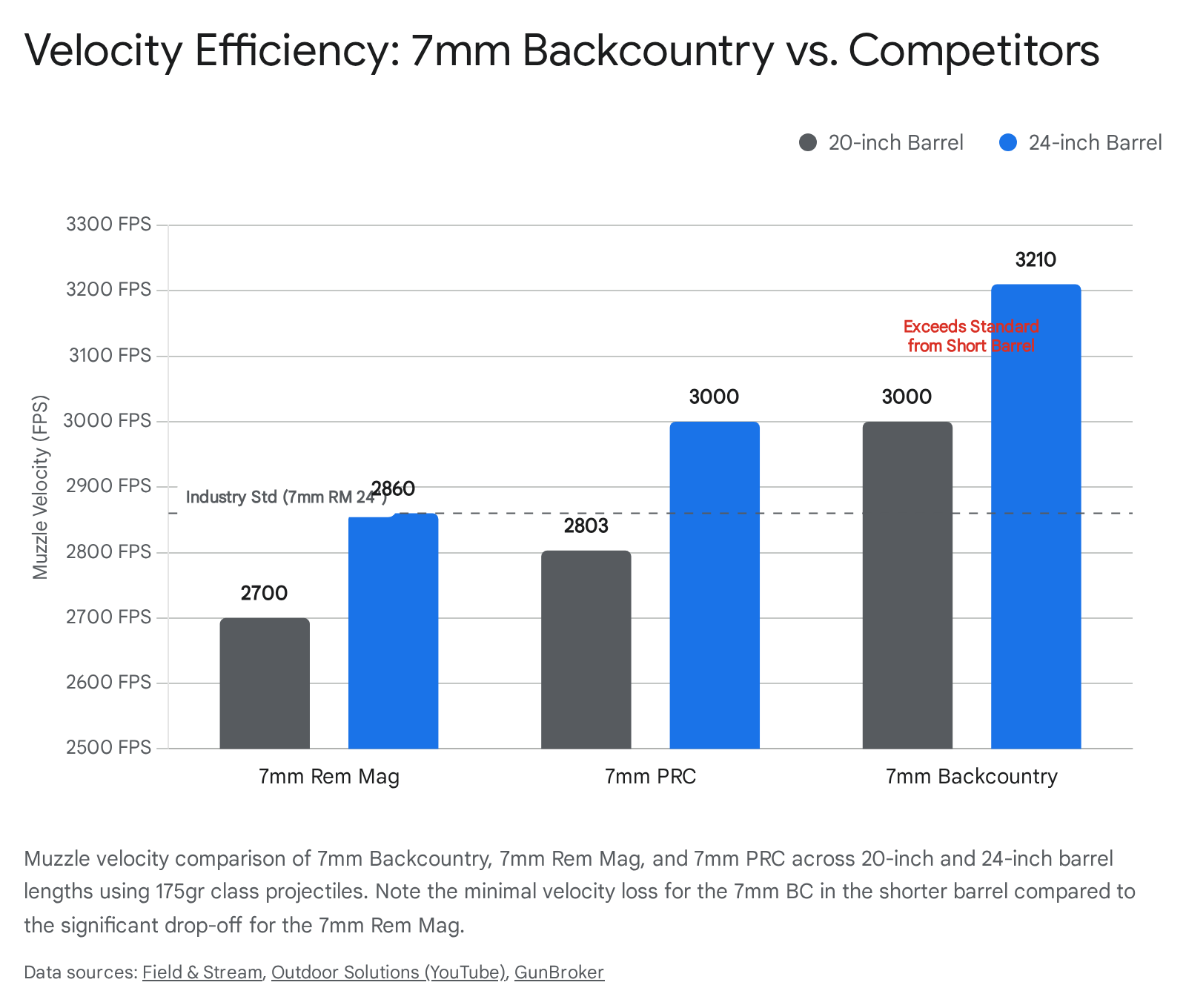
- Velocity: From a 20-inch barrel, the 7mm BC drives a 170-grain Terminal Ascent bullet at 3,000 fps.2 In comparison, a 7mm Rem Mag typically requires a 24-to-26-inch barrel to achieve this velocity. When chopped to 20 inches, a 7mm Rem Mag often drops to ~2,800 fps due to inefficient powder burn.
- Case Efficiency: The 7mm BC achieves this not by burning more powder, but by burning it more efficiently at higher pressures. The 80,000 psi Peak Alloy case allows for a rapid pressure spike that accelerates the bullet quickly within a shorter bore travel, making it the ideal cartridge for suppressed hunting rifles.
3.2 Detailed Load Offerings
Federal is launching the cartridge with a comprehensive suite of premium loads, ensuring it covers all hunting disciplines immediately 1:
- Terminal Ascent (170gr): The flagship all-purpose load. High BC (.646 G1), bonded core, and “Slipstream” polymer tip for long-range expansion. Muzzle Energy: 3,745 ft-lbs.23
- Terminal Ascent (155gr): A lighter, faster option clocking 3,300 fps from a 24-inch test barrel (approx. 3,150 fps from a 20-inch), marketing itself as the “fastest 7mm on the market”.23
- Barnes LRX (168gr): A lead-free, solid copper option for markets like California. The LRX (Long Range X) is optimized for aerodynamics, with a BC of.513.23
- Berger Elite Hunter (195gr): A heavy-for-caliber match/hunting hybrid load. With a massive BC of .755, this load is designed for extreme long-range energy retention, launching at ~2,850 fps.1
- Fusion Tipped (175gr): A more economical bonded soft-point option for deer and elk, traveling at 2,975 fps.24
3.3 Industry Adoption and Longevity
Proprietary cartridges often fail due to a lack of industry support (e.g., the.224 Valkyrie or.30 Super Carry). However, the 7mm BC appears to have secured critical “buy-in” from competitors. Remington Ammunition has announced that it will also load the 7mm Backcountry, utilizing Federal’s Peak Alloy cases.11 This is a massive strategic win for Federal; having “Big Green” (Remington) on board legitimizes the cartridge as an industry standard rather than a niche brand experiment.
Furthermore, a wide array of rifle manufacturers—including Christensen Arms, Gunwerks, Seekins Precision, Savage, Weatherby, and Proof Research—are chambering rifles for it at launch.3 This coordinated ecosystem launch suggests the 7mm BC is here to stay.
4. The Rimfire Renaissance: Winchester.21 Sharp
While Federal attacks the high-end magnum market, Winchester is targeting the highest-volume segment of the industry: rimfire. The introduction of the .21 Sharp is a bold attempt to modernize the .22 Long Rifle (.22 LR), a cartridge that dates back to 1887 and remains the most popular cartridge in the world by volume.
4.1 The “Heeled” Bullet Problem
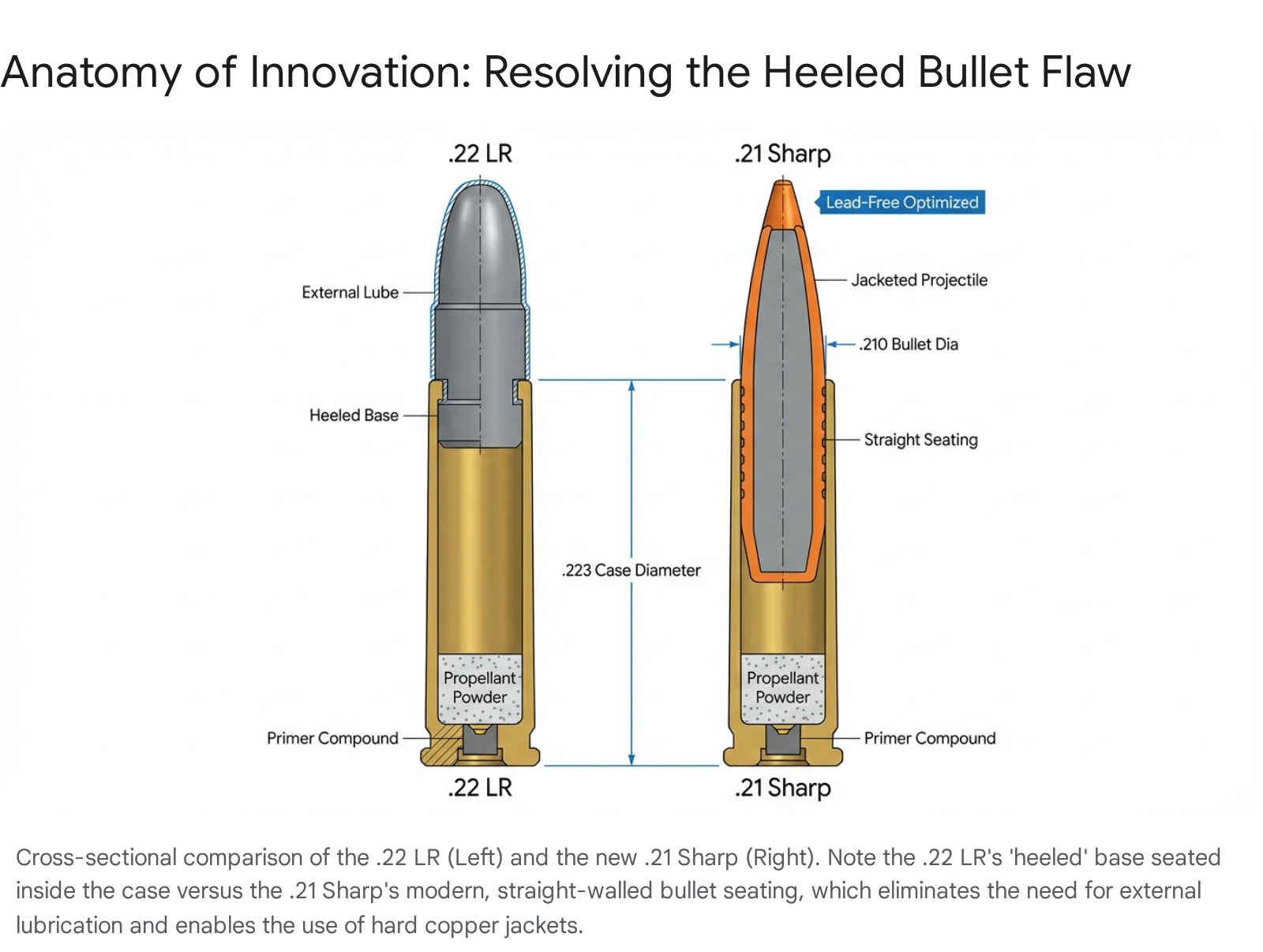
To understand the significance of the .21 Sharp, one must first understand the structural flaw of the .22 LR. The .22 LR utilizes a “heeled” bullet design. In this archaic system, the bullet diameter is the same as the outside diameter of the case, and a stepped-down “heel” at the base of the bullet fits inside the casing.
- Implications: This design necessitates the use of soft lead bullets that can easily obturate (expand) to engage the rifling. It makes the creation of modern, jacketed projectiles extremely difficult.
- The Lubrication Issue: Because the bullet is the same width as the case, the driving bands are exposed. These must be lubricated with wax or grease to prevent leading the barrel. This external lube attracts dirt, pocket lint, and grit, which is a primary cause of feeding failures in semi-automatic rimfire pistols and rifles.
4.2 The.21 Sharp Solution
The .21 Sharp utilizes the standard .22 LR case but does away with the heeled bullet entirely. Instead, the bullet is a non-heeled, .210-inch diameter projectile that seats inside the case, just like a centerfire round (e.g., 9mm or 5.56).5
- Jacketed Projectiles: This allows Winchester to load true Full Metal Jacket (FMJ) and Jacketed Hollow Point (JHP) bullets. These are cleaner to handle, feed more reliably (no sticky wax), and are more aerodynamic.
- Lead-Free Viability: This is the strategic crux of the cartridge. As lead bans expand (e.g., California, Europe), hunters are forced to use copper bullets. Copper is harder than lead and does not obturate well in a heeled design, leading to poor accuracy in standard .22 LR barrels. The .21 Sharp’s design allows the rifling to engrave the copper bullet directly, solving the accuracy issues inherent to lead-free .22 LR ammo.25
4.3 Market Outlook and Loads
Winchester is launching the ecosystem with four specific loads to cover all bases 5:
- Game & Target (25gr Copper Matrix): A lead-free option producing 1,750 fps. This is the direct answer to regulatory pressure, offering sub-1.5 MOA accuracy where lead-free.22 LR often struggles to hold 4 MOA.
- Game & Target (37gr Black Copper Plated): A general-purpose plinking round comparable to standard.22 LR velocity (~1,335 fps).
- Game & Target (42gr FMJ): A heavy, clean-shooting load for high-volume range use (~1,330 fps).
- Super-X (34gr JHP): A hunting load designed for maximum expansion on small game (~1,500 fps).
Crucially, the cartridge fits in standard.22 LR magazines and bolt faces. A user with a Ruger 10/22 or a Savage Mark II only needs a barrel swap to convert to .21 Sharp. Savage Arms has already announced the B-Series and Mark II rifles in this caliber.27
5. Tactical Evolution: Hornady.338 ARC
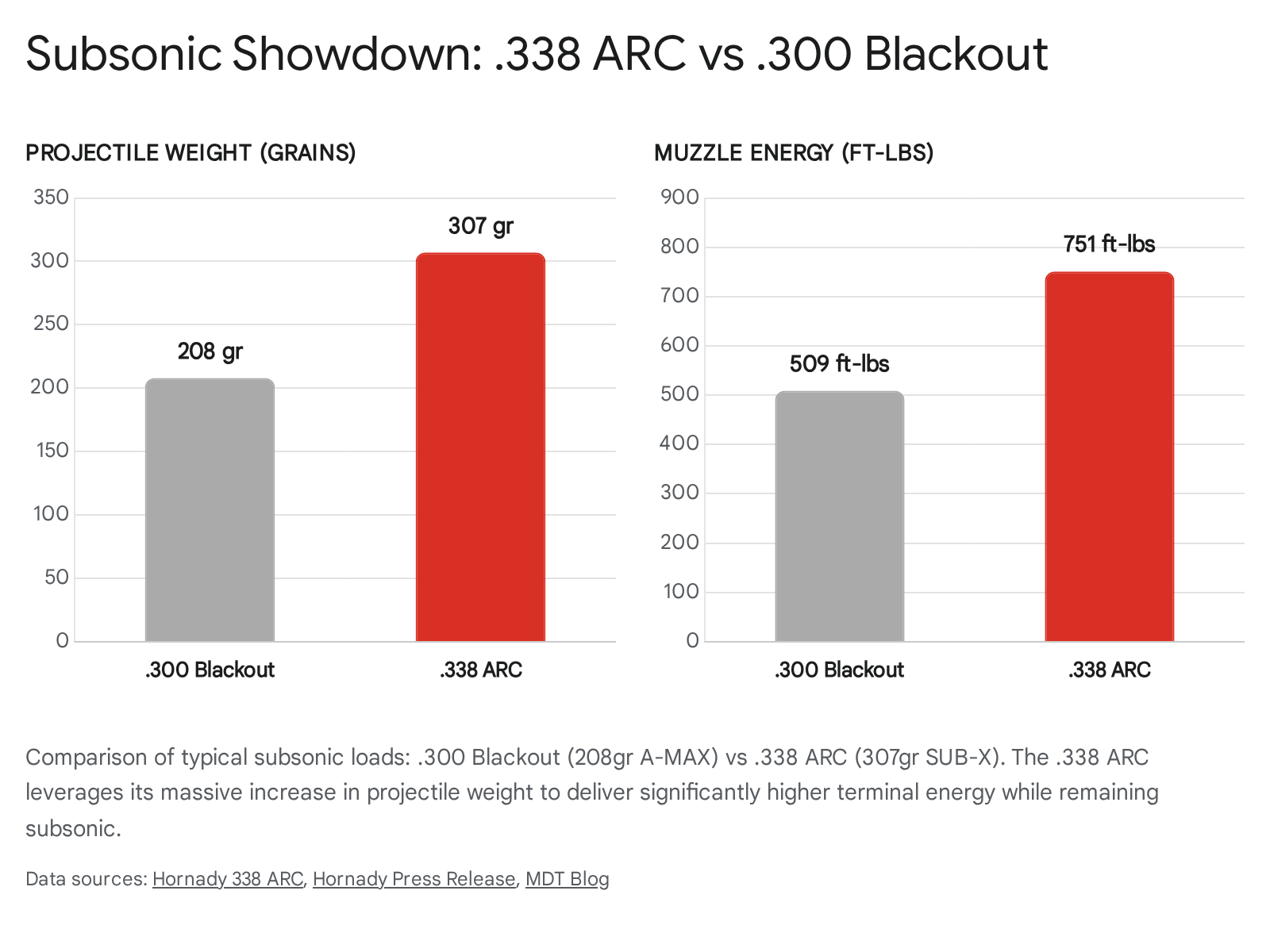
The AR-15 platform is America’s rifle, but it has historically struggled to deliver massive energy on target, especially in subsonic configurations. The.300 Blackout successfully brought.30-caliber suppression to the platform, but its subsonic loads (typically 190–220 grains) often lack the terminal mass and diameter required for ethical kills on large, tough game like hogs or deer at varying ranges.
Hornady’s .338 ARC (Advanced Rifle Cartridge) is the solution to this energy deficit, effectively creating a “Big Bore” class for the standard AR-15 receiver.
5.1 Engineering the “Heavy Hitter”
The.338 ARC is built on the 6.5 Grendel parent case. The Grendel case has a larger diameter case head (.440″) compared to the standard .223/5.56 (.378″), allowing for significantly more powder capacity while still fitting within the standard AR-15 magwell depth (using Grendel-pattern bolts and magazines).7
By necking this case up to .338 caliber, Hornady has created a cartridge capable of launching a massive 307-grain SUB-X bullet at subsonic velocities.
- The Physics of Subsonic Energy: Kinetic energy is calculated as E_k = 1/2mv^. When velocity (v) is capped at the speed of sound (~1,125 fps) to maintain silence, the only way to increase energy is to increase mass (m).
- Comparison: A standard subsonic.300 Blackout load uses a 208-220 grain bullet. The .338 ARC uses a 307-grain bullet. This roughly 50% increase in mass results in ~1.5x the terminal energy at the muzzle and downrange.7 This transforms the subsonic AR-15 from a “marginal” deer gun into a genuine “thumper” for hogs and medium game.
5.2 Dual-Role Capability and Reloading
Like the.300 Blackout, the.338 ARC is designed as a dual-role cartridge. It is not limited to subsonic work:
- Supersonic Load: Hornady offers a 175gr HP Match load in their BLACK line, which delivers supersonic velocities (approx. 2,075 fps from a 16-inch barrel) for mid-range tactical applications out to 300-400 yards.29
- Reloading Data: Hornady has released extensive load data, identifying powders like Accurate 1680 and Hodgdon CFE BLK as ideal propellants.8 The 1:8 twist rate is standard to stabilize the long, heavy 307gr projectiles.7
5.3 System Compatibility
The genius of the .338 ARC lies in its platform compatibility. It requires only a barrel, bolt (6.5 Grendel Type II), and magazine swap to convert any standard AR-15. This low barrier to entry, combined with Hornady’s industry clout (securing partners like Aero Precision, Faxon, and Proof Research at launch), positions the .338 ARC to potentially displace the.300 Blackout for hunters who prioritize knockdown power over cheap plinking ammo.
6. The “Quiet” Expansion: Mainstreaming Subsonic Hunting
Beyond the headline cartridges, there is a broad industry movement to fill the “subsonic gap” in existing heritage calibers. The removal of the tax stamp has emboldened owners of traditional rifles—lever actions, single shots, and bolt guns—to thread their barrels and join the suppressor revolution.
6.1 Federal Subsonic: Reviving the Lever Gun
Federal Premium’s new Federal Subsonic line is notable for targeting “Fudd” calibers (traditional hunting rounds) rather than just tactical ones.3
- .30-30 Winchester: By introducing a 170-grain subsonic load, Federal effectively turns the ubiquitous Marlin 336 or Winchester 94 (if threaded) into a silent brush gun.
- .45-70 Government: The new 300-grain subsonic load for the .45-70 is a game-changer. The .45-70 case has massive volume, making it difficult to load down to subsonic speeds without risking “flashover” or inconsistent ignition. Federal’s formulation ensures reliable ignition and creates a heavy-hitting, quiet round for the popular Henry Model X and Marlin Dark Series lever guns.
- .308 Winchester & .300 BLK: The line also includes a 190-grain load for the .308 and .300 BLK, utilizing the Fusion Tipped bullet which is chemically bonded to prevent core-jacket separation.4
6.2 Barnes Suppressor Series: The Copper Challenge
Known for their copper prowess, Barnes Bullets is tackling the hardest problem in subsonic hunting: expansion. Copper is a hard material that typically requires high velocity (1,800+ fps) to peel back its petals. At subsonic speeds (1,000 fps), standard copper bullets act like solids, punching pencil-sized holes through game with minimal tissue damage.
- The Solution: Barnes has re-engineered the geometry of their TSX bullets for the Suppressor Series.14 By creating a deeper, wider nose cavity and pre-scoring the petals more aggressively, they have ensured that the bullet “flowers” open even at crawling speeds of 900 fps. This provides ethical lethality for hunters in lead-free zones who wish to shoot suppressed.
7. Military Tech Goes Civil: SIG Sauer & The Hybrid Era
SIG Sauer’s presence at SHOT Show 2026 is defined by the full commercial maturation of the NGSW (Next Generation Squad Weapon) ecosystem. After winning the U.S. Army contract, SIG is now aggressively porting the technology to the civilian market.
7.1 The Commercialization of 80,000 PSI
The MCX-SPEAR (the civilian version of the Army’s XM7 rifle) is now widely available, and with it, the .277 SIG Fury (6.8x51mm) cartridge. The defining feature here is the Hybrid Case Technology.10
- The Tech: Unlike Federal’s monolithic steel “Peak Alloy,” SIG’s case uses a stainless steel case head attached to a traditional brass body. The steel head contains the immense pressure of the primer ignition (80,000 psi), while the brass body aids in smooth extraction and obturation.
- Market Implication: This confirms a bi-metallic future for high-performance ammunition. The commercial market now has access to ballistics that were previously theoretical—driving a 135-to-150 grain bullet at 3,000+ fps from a 16-inch barrel battle rifle.
SIG is also expanding its ammunition catalog to support this ecosystem, with new 300BLK Elite Match loads (125gr OTM) and Legion Tac-XP defensive rounds (185gr .45 Auto, 80gr .380 Auto), ensuring their “complete system” provider status.33
8. The Mid-Market Reality: The Battle for the Average Shooter
While the $4.00/round high-pressure ammo grabs headlines, the economic reality of 2026—characterized by lingering inflation and cost-of-living pressures—demands affordable options. Manufacturers are responding with “back-to-basics” product lines that prioritize value over exotic materials.
8.1 Nosler Whitetail Country: The Pivot to Value
Nosler, a brand historically associated with premium pricing and complex bullet designs (Partition, AccuBond), is aggressively pivoting to attack the volume deer market with the Whitetail Country line.15
- The Tech: This line eschews polymer tips and bonded cores for the Solid Base bullet—a classic, proven soft-point design with a tapered jacket and a boat tail. It is cheaper to manufacture but highly effective on thin-skinned game like deer.
- The Lineup: Nosler is launching this across a massive spread of calibers, including 6.5 Creedmoor (140gr), .270 Win (130gr), 7mm-08 (140gr), .308 Win (150gr), and .30-06 Sprg (150gr).16 They are also supporting the straight-wall trend with 350 Legend (180gr) and 400 Legend (215gr) loads, acknowledging the growing importance of the Midwest deer market.35
8.2 Browning Silver Series: Modern Classics
Similarly, Browning Ammunition is reviving the “heavy-for-caliber, plated soft point” aesthetic with the Silver Series.17 In an era of monolithic copper and high-BC polymer tips, there is a nostalgia-driven and practical demand for simple, heavy lead bullets that dump massive energy and are affordable to shoot.
- Offerings: The line includes heavy hitters like the 175gr 28 Nosler (usually loaded with lighter bullets), 150gr.270 Win, and 100gr.243 Win. These loads are designed to maximize Sectional Density (SD) for deep penetration, appealing to traditional hunters who prioritize “knockdown power” over flat trajectories.
9. Conclusion: The New Ballistic Normal
SHOT Show 2026 will be remembered as the year the industry broke the “Brass Ceiling.” The simultaneous availability of Federal’s Peak Alloy and SIG’s Hybrid Case proves that 80,000 psi is the new benchmark for performance, enabling a radical shortening of rifles to accommodate suppressors without ballistic compromise.
Combined with the regulatory freedom of the $0 tax stamp, the market is aggressively pivoting toward a “Short, Quiet, and Powerful” paradigm. Whether it is the rimfire modernization of the.21 Sharp, the subsonic energy of the.338 ARC, or the high-pressure efficiency of the 7mm Backcountry, every major innovation this year is designed to make the shooting experience more efficient, more suppressed, and more lethal. The “buzz” is justified: this is not just a new coat of paint on old bullets. It is a fundamental re-engineering of how ammunition is built, fired, and sold in the 21st century.
If you find this post useful, please share the link on Facebook, with your friends, etc. Your support is much appreciated and if you have any feedback, please email me at in**@*********ps.com. Please note that for links to other websites, we are only paid if there is an affiliate program such as Avantlink, Impact, Amazon and eBay and only if you purchase something. If you’d like to directly contribute towards our continued reporting, please visit our funding page.
Sources Used
- New Products | Federal Premium – Federal Ammunition, accessed January 12, 2026, https://www.federalpremium.com/this-is-federal/new-products.html
- 7mm Backcountry – Wikipedia, accessed January 12, 2026, https://en.wikipedia.org/wiki/7mm_Backcountry
- Federal Will Release More Than 20 New Centerfire Rifle Ammo Options in 2026, accessed January 12, 2026, https://www.petersenshunting.com/editorial/federal-ammo-new-centerfire-options/543521
- Federal Premium New Ammo Offerings for the New Year – Game & Fish, accessed January 12, 2026, https://www.gameandfishmag.com/editorial/federal-new-products-new-year/543146
- USA21 | Winchester Ammunition, accessed January 12, 2026, https://winchester.com/Products/Ammunition/Rimfire/USA/USA21
- Winchester® Ammunition Introduces NEW 21 Sharp™ Rimfire Cartridge, accessed January 12, 2026, https://winchester.com/Support/Media/In-The-News/2024/09/18/Winchester-Ammunition-Introduces-NEW-21-Sharp-Rimfire-Cartridge
- 338 ARC ‑ Hornady Manufacturing, Inc, accessed January 12, 2026, https://www.hornady.com/338arc
- 338 ARC – Hornady.media, accessed January 12, 2026, https://static.hornady.media/site/hornady/files/load-data/338-ARC.pdf
- Hornady® Announces New Products for 2026 – Media Center, accessed January 12, 2026, https://press.hornady.com/release/2025/10/15/hornady-announces-new-products-for-2026/
- SIG SAUER Launches Commercial Variant of U.S. Army Next Generation Squad Weapon (NGSW) MCX-Spear and 277 SIG FURY Ammunition, accessed January 12, 2026, https://www.sigsauer.com/blog/sig-sauer-launches-commercial-variant-of-us-army-next-generation-squad-weapon-ngsw-mcx-spear-and-277-sig-fury-ammunition
- Remington Launches New Centerfire Rifle and Handgun Ammo Options in 2026, accessed January 12, 2026, https://www.theoutdoorwire.com/releases/2026/01/remington-launches-new-centerfire-rifle-and-handgun-ammo-options-in-2026
- Remington’s 2026 Centerfire Ammo Revealed – The Firearm Blog, accessed January 12, 2026, https://www.thefirearmblog.com/blog/remingtons-2026-centerfire-ammo-revealed-44825146
- Barnes Pioneer Tested: Deep Dive into the Real World Use, accessed January 12, 2026, https://barnesbullets.com/blog/barnes-pioneer-tested-deep-dive/
- Barnes Bullets Announces 2026 New Product Lineup | thefirearmblog.com, accessed January 12, 2026, https://www.thefirearmblog.com/blog/barnes-bullets-announces-2026-new-product-lineup-44824624
- Nosler Introduces New Ammunition and Component Bullets for 2026 | The Outdoor Wire, accessed January 12, 2026, https://www.theoutdoorwire.com/releases/39003e84-599e-4d2e-a96d-1d7d0cf4dbc7
- Whitetail Country™ Ammunition – Nosler, accessed January 12, 2026, https://www.nosler.com/products/ammunition/product-line/white-tail-country-ammunition-prod.html
- Silver Series – Browning Ammunition, accessed January 12, 2026, https://browningammo.com/Products/Ammunition/Rifle/Silver-Series
- The Era of the $0 Tax Stamp: What the Fee Elimination Means for SIG SAUER Owners, accessed January 12, 2026, https://www.sigsauer.com/blog/the-era-of-the-0-tax-stamp-what-the-fee-elimination-means-for-sig-sauer-owners
- Silencer Applications Surge After Trump’s NFA Tax Cuts – The Smoking Gun, accessed January 12, 2026, https://smokinggun.org/silencer-applications-surge-after-trumps-nfa-tax-cuts/
- 7mm Backcountry – What is Peak Alloy Case Technology? – The Firearm Blog, accessed January 12, 2026, https://www.thefirearmblog.com/blog/7mm-backcountry-what-is-peak-alloy-case-technology-44819272
- Public Introduction – 7mm Backcountry – SAAMI, accessed January 12, 2026, https://saami.org/wp-content/uploads/2025/01/Public-Introduction-7mm-Backcountry-2025-01-27.pdf
- Time for another 7 Backcountry Thread | Rokslide Forum, accessed January 12, 2026, https://rokslide.com/forums/threads/time-for-another-7-backcountry-thread.389340/
- New Ammo Coming in 2025 | NSSF SHOT Show 2026, accessed January 12, 2026, https://shotshow.org/new-ammo-coming-in-2025/
- An In-Depth Look at 7mm Backcountry | An Official Journal Of The NRA – American Hunter, accessed January 12, 2026, https://www.americanhunter.org/content/an-in-depth-look-at-7mm-backcountry/
- Testing Winchester’s New 21 Sharp Rimfire Cartridge – Petersen’s Hunting, accessed January 12, 2026, https://www.petersenshunting.com/editorial/winchester-21-sharp-rimfire-cartridge/506361
- Winchester’s .21 Sharp Looks to Change the Rimfire Landscape – RifleShooter, accessed January 12, 2026, https://www.rifleshootermag.com/editorial/winchester-21-sharp-rimfire-modernized/529446
- Winchester Debuts New .21 Sharp Rimfire Cartridge, Savage Has Rifles – Guns.com, accessed January 12, 2026, https://www.guns.com/news/2024/09/19/winchester-debuts-new-21-sharp-rimfire-cartridge-savage-has-rifles
- Winchesters 21 Sharp. Any chance this cartridge could take off? : r/longrange – Reddit, accessed January 12, 2026, https://www.reddit.com/r/longrange/comments/1gbcff1/winchesters_21_sharp_any_chance_this_cartridge/
- 338 ARC 170 gr Monoflex® Black™ ‑ Hornady Manufacturing, Inc, accessed January 12, 2026, https://www.hornady.com/ammunition/rifle/338-arc-170-gr-monoflex-black
- 338 ARC Velocities Tested! : r/ar15 – Reddit, accessed January 12, 2026, https://www.reddit.com/r/ar15/comments/1hk32pn/338_arc_velocities_tested/
- Barnes Loads Up for 2026 with New Suppressor, Hunting, Straightwall Ammo, accessed January 12, 2026, https://www.hookandbarrel.com/news/barnes-new-suppressor-hunting-straightwall-ammo
- MCX-SPEAR 6.8X51 – Sig Sauer, accessed January 12, 2026, https://www.sigsauer.com/mcx-spear-6-8-x-51.html
- Elite Performance Ammunition | SIG SAUER, accessed January 12, 2026, https://www.sigsauer.com/ammunition.html
- Field Tested: Nosler Whitetail Country | An Official Journal Of The NRA – American Hunter, accessed January 12, 2026, https://www.americanhunter.org/content/field-tested-nosler-whitetail-country/
- 2026 PRODUCT GUIDE – Nosler, accessed January 12, 2026, https://www.nosler.com/media/binaryanvil/media_library/2026-Catalog-Layout_Web.pdf