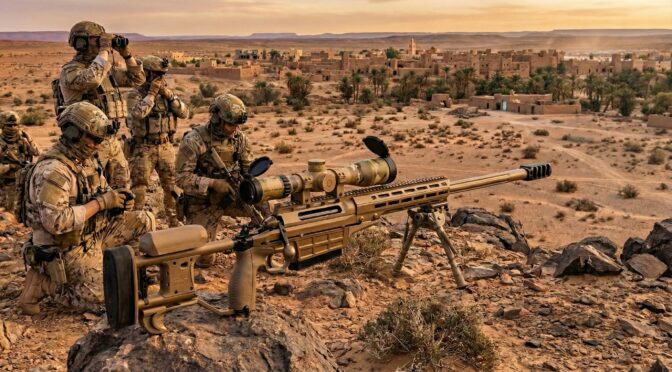
The emergence of the Sako TRG 62 A1 marks a definitive inflection point in the engineering of man-portable precision weapon systems. For decades, the small arms industry has operated under a bifurcated paradigm: lightweight sniper rifles were limited to the ballistic envelope of the.338 Lapua Magnum (effective to approximately 1,500 meters), while engagement capabilities beyond 2,000 meters were the exclusive domain of heavy anti-materiel rifles chambered in .50 BMG (12.7x99mm) or specialized 20mm systems. These heavier platforms, typically weighing between 12 and 16 kilograms, necessitated two-man teams for transport and imposed significant logistical burdens regarding signature management and mobility.
The TRG 62 A1, developed by Sako Ltd. of Finland—a cornerstone of Beretta Defense Technologies—dismantles this dichotomy. By engineering a platform around the 9.5x77mm cartridge (commercially synonymous with the.375 CheyTac) that weighs approximately 7.0 kg (15.4 lbs), Sako has successfully packaged anti-materiel range capabilities into a sniper-class mobility profile.1 This report finds that the TRG 62 A1 offers a critical solution to modern “Overwatch Interdiction” requirements, delivering 25% to 50% greater terminal energy than legacy.338 systems while maintaining the handling characteristics of a standard field rifle.1
Our technical analysis reveals that this feat was achieved not through radical experimental materials, but through the rigorous optimization of the proven TRG M10 architecture. The receiver has been dimensionally scaled and metallurgically reinforced to withstand chamber pressures exceeding 440 MPa (63,800 psi), while the cold hammer-forged stainless steel barrel utilizes a fast 1:8 twist rate to stabilize modern high-ballistic-coefficient solid projectiles.2 Crucially, the system features a 7-round double-feed steel magazine, a distinct advantage over single-stack competitors, ensuring sustained fire capability in high-stress environments.4
Market analysis indicates the TRG 62 A1 is positioned to dominate the premium institutional sector, directly challenging the Accuracy International AXSR and Cadex CDX-40 Shadow. While the initial acquisition cost is projected in the high-premium tier (€9,000–€15,000 estimated range), the system’s integration with the broader TRG ecosystem significantly lowers the training and logistics burden for existing Sako user nations.2 Operational feedback from preliminary testing highlights exceptional recoil management—comparable to the.338 Lapua Magnum—attributed to a highly efficient four-chamber muzzle brake design, facilitating operator self-spotting.6
However, the report identifies the availability and cost of 9.5x77mm ammunition as the primary barrier to widespread adoption, particularly in the civilian sector. Sako’s strategic decision to vertically integrate by manufacturing proprietary factory ammunition is a decisive countermeasure to this risk, aiming to secure supply chain confidence for military contracts.4
Overall Verdict: The Sako TRG 62 A1 is classified as a “Buy” for military and specialized law enforcement units requiring extended standoff capability without the logistical penalty of .50 BMG platforms. For civilian enthusiasts, it represents the premier factory option for Extreme Long Range (ELR) competition, provided the operator can sustain the high amortization costs of the 9.5x77mm caliber.
1. Introduction: The Strategic Landscape of Modern Sniping
The trajectory of precision small arms development over the last quarter-century has been driven by a singular, relentless operational requirement: the extension of the effective engagement envelope. The paradigm of the “Safe Standoff” has shifted dramatically as potential adversaries have acquired comparable precision capabilities, necessitating that western military forces out-range opponent systems to ensure survivability. This section analyzes the historical context that necessitated the creation of the TRG 62 A1 and defines the strategic gap it fills.
1.1 The Post-GWOT Ballistic Reality
During the early phases of the Global War on Terror (GWOT), the 7.62x51mm NATO (.308 Winchester) cartridge was the standard for urban and medium-range precision, with an effective limit of approximately 800 meters. As engagements in Afghanistan shifted to valley-to-valley contacts exceeding 1,000 meters, the.300 Winchester Magnum and subsequently the.338 Lapua Magnum became the gold standards for personnel engagement, pushing the reliable envelope to 1,500 meters.1
However, the modern near-peer conflict environment presents threats that dictate engagement distances beyond 1,800 meters. At these extreme ranges, the.338 Lapua Magnum encounters the “Transonic Wall”—the point where the projectile slows from supersonic to subsonic speeds, causing destabilization and a catastrophic loss of accuracy. Furthermore, the kinetic energy delivered by a.338 projectile at 2,000 meters is often insufficient to penetrate modern Level IV body armor or disable hardened surveillance optics.
Concurrently, heavy anti-materiel rifles chambered in .50 BMG (12.7x99mm), such as the Barrett M82/M107 or the McMillan Tac-50, have successfully dominated the 2,000-meter space. Yet, these systems present severe tactical limitations. A loaded M107 weighs nearly 14 kg (31 lbs) and measures nearly 1.5 meters in length.9 The logistical footprint of such a weapon requires a dedicated two-man sniper team, where one operator’s primary combat load is largely consumed by the weapon system itself, reducing the unit’s overall mobility, sustainability, and stealth. The acoustic and thermal signature of the .50 BMG is also massive, making shooter concealment difficult after the first shot.
1.2 The Emergence of the “Interdiction” Class
Military planners and ballisticians identified a “Gap of Capability” between the 8.6mm (.338) and the 12.7mm ( .50). This gap necessitated a system that could:
- Match or Exceed .50 BMG Ballistics: Utilize projectiles with extremely high Ballistic Coefficients (BC) to retain supersonic velocity past 2,000 meters.
- Retain Sniper Mobility: Conform to the weight and ergonomic profile of a standard sniper rifle (under 8-9 kg), allowing for single-operator transport and deployment.
- Minimize Signature: Produce less recoil and blast than the .50 BMG to facilitate follow-up shots and concealment.
The solution was found in the.375 and.408 CheyTac family of cartridges. The 9.5x77mm (.375 CheyTac), in particular, emerged as the optimal balance, offering a trajectory flatter than the .50 BMG and kinetic energy far surpassing the.338, all within a cartridge form factor that could fit into a long-action rifle receiver.2
1.3 Sako’s Heritage and the TRG Lineage
To understand the significance of the TRG 62 A1, one must contextualize it within the lineage of Sako’s TRG family, widely acknowledged as one of the most successful purpose-built sniper architectures in history. Unlike many competitors who adapted hunting actions for tactical use (e.g., the Remington 700 lineage), the Sako TRG was designed from the ground up as a military precision tool.
- TRG-21/41 (1989): The genesis of the modular sniper rifle. Sako introduced a chassis-like internal bedding system that set new standards for accuracy.
- TRG-22/42 (1999): The refinement that became a global standard. The TRG-42 in.338 Lapua Magnum is currently in service with countless military units worldwide, prized for its reliability in arctic conditions.
- TRG M10 (2011): A response to the US SOCOM PSR (Precision Sniper Rifle) trials. The M10 introduced true modularity, allowing user-level caliber changes and extensive accessory integration via a modern aluminum chassis.
- TRG 62 A1 (2024): The culmination of this evolution. Sako has taken the ergonomic and modular lessons of the M10 and applied them to the 9.5x77mm cartridge. This is not merely a re-chambering; it is a structural scaling of the platform to handle “magnum-plus” pressures while retaining the user interface that thousands of operators are already trained on.11
The introduction of the TRG 62 A1 signifies Sako’s commitment to the future of “Overwatch” doctrine, placing a strategic asset into the hands of a tactical team.
2. Technical Anatomy of the TRG 62 A1 System
The Sako TRG 62 A1 is an exercise in engineering optimization. While many Extreme Long Range (ELR) rifles are built as heavy, single-shot benchrest-style guns or bulky bullpups, Sako’s design mandate was to create a repeating rifle that functions, feels, and carries like a standard sniper weapon. This section provides a granular analysis of the system’s subsystems.
2.1 The Receiver: Strengthening the Core
The core challenge in adapting a standard sniper rifle design to the 9.5x77mm cartridge is managing the internal ballistics. The.375 CheyTac generates a maximum C.I.P. pressure of 440 MPa (63,800 psi).12 While this pressure is similar to the.338 Lapua Magnum, the bolt thrust—the rearward force exerted by the cartridge case on the bolt face—is significantly higher due to the larger surface area of the 9.5mm case head.
Sako engineers addressed this by scaling up the TRG M10 receiver geometry.
- Bolt Architecture: The TRG 62 A1 utilizes a massive bolt featuring three locking lugs.13 The choice of three lugs is critical for two reasons. First, it provides a symmetrical distribution of the high pressure forces across the receiver ring. Second, it allows for a 60-degree bolt throw.14 In tactical environments, a short 60-degree throw is vastly superior to the 90-degree throw found on two-lug systems (like the Remington 700 or CheyTac M200). It allows for faster cycling and, crucially, ensures the bolt handle clears large optical sights, preventing the operator’s knuckles from striking the scope during rapid fire.
- Structural Integrity: The receiver is machined from high-grade alloy steel (likely a localized hardening variant similar to previous TRG iterations) to resist the cyclic fatigue of the high-impulse recoil. The receiver is “beefed up” compared to the standard M10, with thicker sidewalls to maintain rigidity—a prerequisite for accuracy at 2,000 meters where even microscopic receiver flex can result in meters of deviation.2
- Feed System Engineering: Unlike many competitors that utilize single-stack magazines to save width, Sako engineered a detachable, staggered two-row steel magazine with a capacity of 7 rounds.4 This is a significant engineering achievement for a rimless, rebated rim cartridge of this size. A staggered feed keeps the rifle’s vertical profile lower, allowing the shooter to stay closer to the ground (prone) and reducing the target silhouette, while maintaining a high round count.
2.2 Barrel Technology: The Cold Hammer Forged Advantage
The barrel is the single most critical component for ELR efficacy. Sako employs its signature Cold Hammer Forging (CHF) process for the TRG 62 A1 barrel.2
- Manufacturing Process: In CHF, a mandrel with the reverse image of the rifling is inserted into a barrel blank, and massive hammers pummel the steel around the mandrel. This process work-hardens the steel and creates an incredibly smooth internal bore surface. While some custom precision gunsmiths prefer “cut rifling” (like Bartlein or Krieger) for absolute stress-free molecular structure, Sako’s CHF process is globally renowned for producing “match grade” accuracy with superior durability.
- Durability Factor: The 9.5x77mm is an “overbore” cartridge, meaning it burns a large volume of powder through a relatively small bore diameter. This creates intense throat erosion, often burning out barrels in as few as 1,000–1,500 rounds. Sako’s work-hardened CHF barrels are likely engineered to extend this service life, offering a lower Total Cost of Ownership (TCO) for military users compared to button-rifled alternatives.
- Twist Rate: The barrel features a 1:8 twist rate.2 This is a critical specification. Legacy.375 rifles often used 1:10 or 1:12 twists. However, the modern trend in ELR ballistics is toward monolithic solid copper projectiles (like the 379gr or 400gr Warner Tool or Cutting Edge bullets) which are extremely long. These projectiles require a faster twist rate for gyroscopic stability. By standardizing on 1:8, Sako future-proofs the rifle for the heaviest, highest-BC bullets available.
- Harmonics and Dimensions: The barrel is free-floating and fluted. The fluting serves a dual purpose: it increases the surface area for heat dissipation—vital when firing strings of high-powder-capacity rounds—and significantly reduces weight at the muzzle end, shifting the center of gravity rearward for better handling.2
2.3 Chassis and Ergonomics: The Human Interface
The interface between the shooter and the weapon determines the practical accuracy of the system. If a rifle is uncomfortable or difficult to adjust, theoretical accuracy becomes irrelevant in the field.
- Weight Engineering: The TRG 62 A1 weighs approximately 7.0 kg (15.4 lbs) empty.1 This is arguably the system’s most disruptive feature. Competitor systems like the CheyTac M200 weigh upwards of 14 kg (31 lbs). Sako has achieved a 50% weight reduction, placing an anti-materiel capability into a package that weighs less than some standard issue.338 sniper rifles. This allows for “One-Man Portability,” eliminating the need to split the weapon and ammo load between a shooter and a spotter.2
- Stock Adjustability: The chassis features a folding stock that hinges to the right (bolt side), locking securely to minimize overall length for transport in vehicles or aircraft.4 The stock offers tool-free adjustments for length of pull, cheek piece height, and recoil pad height, allowing the rifle to be tailored to any shooter’s biometrics or clothing layers (e.g., arctic gear vs. t-shirt).
- M-LOK Integration: The forend is fully modular, utilizing the M-LOK attachment standard.4 This allows for the direct mounting of accessories such as bipods, tripod adapters, and laser rangefinders without the added weight and bulk of full-length Picatinny quad-rails.
- The “Toolbox” Feature: A unique, user-centric innovation is the integrated storage compartment within the forend. This “toolbox” contains the specific Torx keys (T10, T15, T25) required for field maintenance.7 This ensures that the operator always has the means to tighten a loose scope ring or adjust the trigger without needing to rummage through a ruck sack—a small detail that speaks to Sako’s understanding of field realities.
2.4 Trigger Mechanism
The TRG 62 A1 utilizes a two-stage match trigger, a hallmark of the TRG line.
- Adjustability: The trigger weight is adjustable between 1.2 kg and 2.5 kg (approx. 2.6 lbs to 5.5 lbs).7 This range is ideal for field work; it is light enough for precision work but heavy enough to be safe under stress or with gloved hands.
- Serviceability: The entire trigger group can be removed in the field for cleaning or replacement.7 This is crucial in military environments where sand or ice can render a trigger inoperable; being able to swap a module instantly is a significant reliability advantage.
- Consistency: The trigger geometry and “break” feel are consistent with the TRG-22/42 and M10. This allows operators to transition between platforms without needing to relearn the trigger control, preserving muscle memory.
2.5 Recoil Management System
Firing a 350+ grain projectile at nearly 3,000 feet per second generates substantial recoil energy. Unmanaged, this recoil would be punishing to the shooter and make “spotting trace” (seeing the bullet’s flight path) impossible.
- Muzzle Brake: Sako designed a specific four-chamber muzzle brake for the TRG 62 A1.4 By venting the high-pressure gases sideways and rearward, the brake counteracts the rearward momentum of the rifle.
- Operational Impact: Feedback from testing indicates that the felt recoil is comparable to a standard.338 Lapua Magnum.7 This reduction is critical. It prevents the shooter from developing a “flinch” anticipation and allows the optic to remain on target after the shot, enabling the shooter to observe the impact and make rapid corrections without relying solely on a spotter.
3. The 9.5x77mm Cartridge Ecosystem
The Sako TRG 62 A1 is built around a specific ballistic philosophy. While the rifle’s engineering is impressive, it is ultimately a delivery mechanism for the 9.5x77mm cartridge. Understanding the weapon requires a deep understanding of the ammunition.
3.1 The Cartridge Profile
The 9.5x77mm is dimensionally interchangeable with the .375 CheyTac (Cheyenne Tactical). Developed in the early 2000s, the.375 CheyTac is a necked-down version of the.408 CheyTac.
- The Physics of Dominance: The.408 CheyTac was designed to bridge the gap between.338 and .50. However, ballisticians quickly realized that necking the case down to.375 (9.5mm) allowed for the use of projectiles with even better sectional density and ballistic coefficients relative to their weight.
- Energy & Velocity: The cartridge typically drives a 350-grain to 400-grain solid copper projectile at velocities ranging from 2,850 to 3,000 fps (approx. 870–915 m/s).8 This results in muzzle energies approaching 10,000 to 11,000 Joules—dwarfing the ~6,500 Joules of a typical.338 Lapua Magnum load.10
- Supersonic Retention: The defining characteristic of the 9.5x77mm is its ability to remain supersonic beyond 2,000 meters. The.338 Lapua generally goes subsonic (and thus loses stability) around 1,500–1,700 meters depending on atmospheric conditions. The 9.5x77mm extends this “accurate supersonic zone” by nearly 800 meters, fundamentally changing the geometry of the battlespace.
3.2 Sako’s Strategic Ammunition Move
Historically, the adoption of.375 CheyTac weapons by military forces has been hindered by supply chain insecurity. The ammunition was primarily produced by boutique manufacturers or required hand-loading, which is unacceptable for large-scale military procurement.
Sako has addressed this vulnerability directly by manufacturing its own line of factory 9.5x77mm ammunition.4
- The Offerings: Sako is producing a 380-grain Solid and a 350-grain Solid option.4 These “Solids” are monolithic lathe-turned projectiles, likely made of copper or brass alloy. Unlike traditional lead-core jacketed bullets, solids do not suffer from jacket separation at high rotational speeds and offer perfect concentricity for extreme accuracy.
- Strategic Impact: By offering the rifle and the ammunition as a single verified system, Sako eliminates the “ammunition risk” for defense ministries. A procurement officer can now buy the TRG 62 A1 with the assurance of a guaranteed, industrial-scale ammunition supply chain from the same vendor, simplifying logistics and accountability.
3.3 Comparative Ballistics
When pitted against its peers, the 9.5x77mm offers a “Goldilocks” solution.
- Vs..338 Lapua Magnum: The 9.5x77mm offers ~40% more energy and ~30% longer effective range, at the cost of higher recoil and ammunition weight.
- Vs. .50 BMG: The 9.5x77mm offers a flatter trajectory and higher hit probability at long range due to superior aerodynamics, but delivers less payload (explosive/incendiary capability) than the massive 12.7mm projectile.
- Vs..375 EnABELR: The.375 EnABELR is a competing high-performance cartridge. While ballistically similar, the EnABELR is a proprietary design often requiring specific actions. The 9.5x77mm (CheyTac) is a C.I.P. standardized cartridge, making it more accessible globally.
4. Market Competitive Landscape
The Sako TRG 62 A1 does not exist in a vacuum. It enters a niche but fiercely competitive market segment: the “Lightweight Anti-Materiel / ELR Sniper Rifle.” This section evaluates the TRG 62 A1 against its primary rivals: the Accuracy International AXSR, the Cadex CDX-40 Shadow, and the legacy CheyTac M200 Intervention.
4.1 Comparative Analysis Overview
The following analysis highlights the key differentiators in this class.
4.2 Competitor Profiles
Accuracy International AXSR (UK)
The AXSR is the current benchmark for multi-caliber military systems, recently winning the US SOCOM ASR (Advanced Sniper Rifle) contract.
- Pros: Extreme durability, battle-proven heritage, quick-change barrel system allowing calibers from.308 to.338 (and potentially.375 in specific configurations like the AX50 ELR).
- Cons: The standard AXSR is optimized for.338 Lapua. While ELR versions exist, they are often significantly heavier and bulkier than the TRG 62 A1’s dedicated chassis. The AI system is also notoriously expensive, with costs often exceeding $15,000 for a complete kit.
- The Sako Advantage: Sako offers a purpose-built 9.5mm geometry that is significantly lighter (7kg vs ~9-10kg for comparable AI setups) and likely more cost-effective for dedicated ELR roles.
Cadex CDX-40 Shadow (Canada)
Cadex Defence produces high-end chassis rifles known for their recoil mitigation and robust build.
- Pros: The CDX-40 is a dedicated anti-materiel platform with a highly regarded recoil lug system and “mirage control” tube. It is a favorite among North American ELR competitors.
- Cons: Weight. At nearly 8.9 kg (19.6 lbs), the Cadex is essentially a “crew-served” weapon compared to the Sako.16 It is not designed for the same level of mobile infantry patrol as the TRG 62 A1.
- The Sako Advantage: Mobility. A soldier carrying a TRG 62 A1 can keep pace with a squad; a soldier carrying a Cadex is significantly burdened.
CheyTac M200 Intervention (USA)
The rifle that started the caliber craze.
- Pros: Iconic status, extreme inherent accuracy, massive effective range (2,500m+).
- Cons: It is a legacy design. Weighing 14.1 kg (31 lbs) and featuring a non-folding (telescoping) stock that is extremely long, it is impractical for modern dynamic warfare.9 It lacks the modularity (M-LOK, quick adjustable triggers) of modern systems.
- The Sako Advantage: Obsolescence. The TRG 62 A1 renders the M200 obsolete for any application requiring movement. The Sako offers 90% of the M200’s range capability at 50% of the weight.
Victrix Tormentum (Italy)
Another Beretta-associated brand, Victrix produces high-end ELR rifles.
- Pros: Excellent manufacturing quality, competitive pricing in Europe.
- Cons: Like the Cadex and CheyTac, the Tormentum is heavy (~11.5 kg or 25.3 lbs).18 It is built more for static defense or competition than for patrol operations.
- The Sako Advantage: Again, weight and the Sako logistics ecosystem.
4.3 The “Mobility-Range Ratio”
The decisive market advantage of the TRG 62 A1 is its “Mobility-Range Ratio.” When analyzing the data, a clear trend emerges:
- CheyTac M200: 14.1 kg for ~2,200m range. (High Range / Very Low Mobility)
- Cadex CDX-40: 8.9 kg for ~2,000m range. (High Range / Medium Mobility)
- Sako TRG 62 A1: 7.0 kg for ~2,000m range. (High Range / High Mobility)
Sako occupies a unique “High Mobility / High Range” quadrant in the market. It allows a single operator to bring 2,000-meter lethality to a high-altitude ridge line or a difficult urban hide that would be physically inaccessible or logistically impossible for a team hauling a 14kg weapon system.
4.4 Pricing Dynamics
While official pricing is subject to contract specifics, market indicators suggest the TRG 62 A1 will retail in the €9,500 to €13,000 range ($10,500 – $14,500 USD).20
- Value Proposition: This places it at parity with or slightly below the Accuracy International AXSR, and above the Cadex CDX-40. However, for institutional buyers, the “Total Cost of Ownership” (TCO) is lower due to shared parts commonality (triggers, bipods, accessories) with existing TRG-22/42 fleets.
5. Operational Evaluation and Customer Sentiment
As a newly introduced platform (unveiled 2024/2025), long-term field data is still accumulating. However, immediate feedback from military trials, trade show demonstrations (EnforceTac, Eurosatory), and expert commentary provides a clear picture of the rifle’s operational character.
5.1 Military & Professional Feedback
The professional community’s response has been defined by three key themes:
- The Weight Anomaly: Defense industry analysts and military testers have consistently expressed shock at the weight-to-power ratio. The ability to carry a.375 CheyTac class weapon as easily as a.300 Win Mag is viewed as a “game changer” for special operations forces (SOF) mobility.1 It allows for the re-integration of the heavy sniper into the assault element, rather than relegating them to a fixed support by fire position.
- Recoil Management: Initial skepticism about the recoil of a 7kg rifle firing a 10,000 Joule cartridge was high. However, field reports confirm that the 4-chamber muzzle brake is highly effective. Operators report that the recoil impulse is a “heavy push” rather than a sharp snap, making it manageable for sustained fire. The ability to “self-spot”—to recover from recoil fast enough to see the impact through the scope—is cited as a major operational benefit.6
- Ergonomic Continuity: For nations like Finland, Italy, and others already fielding Sako TRGs, the “zero training delta” is a massive plus. A sniper trained on a TRG-42 can pick up a TRG 62 A1 and immediately operate the safety, bolt, and stock adjustments without new instruction. This reduces the training pipeline and increases readiness.23
5.2 Civilian & Enthusiast Sentiment
The civilian ELR community (e.g., participants in King of 2 Miles, Sniper’s Hide forum members) has reacted with a mix of excitement and pragmatic caution.
- Enthusiasm for Factory ELR: There is significant demand for a “turn-key” ELR solution. Historically, getting into 2,000m+ shooting required commissioning a custom rifle from a gunsmith, with lead times of 6–12 months. The TRG 62 A1 offers a “buy it today, shoot it tomorrow” solution backed by a major manufacturer’s warranty.24
- Ammunition Anxiety: The primary negative sentiment revolves around the cost and availability of 9.5x77mm ammunition. Civilian shooters are acutely aware that factory.375 CheyTac ammo is rare and often costs $7.00 to $10.00+ per round. While Sako promises factory support, enthusiasts remain skeptical until they see boxes on shelves. The fear of buying a $12,000 rifle that becomes a “paperweight” due to ammo shortages is a recurring theme in forum discussions.24
- The “AI vs. Sako” Debate: Comparison threads often pit the TRG against the Accuracy International AXSR. The consensus among enthusiasts is that AI holds the “brand prestige” and “cool factor,” but the TRG 62 A1 is increasingly viewed as the more pragmatic, purpose-built tool for pure ELR performance due to its optimized weight and dedicated action geometry.26
5.3 Reliability in Harsh Environments
Sako’s “Arctic Warfare” heritage provides a baseline of trust. The TRG series is legendary for functioning in deep freeze conditions where other actions bind. The TRG 62 A1 has reportedly undergone the same rigorous testing protocols: barrel obstruction tests, high-pressure endurance firing, drop tests, and freezing tests.1 This testing pedigree assures potential buyers that the lightweight chassis has not compromised the system’s ruggedness.
6. Conclusion and Verdict: Is It Worth Buying?
The Sako TRG 62 A1 is not merely a new rifle; it is a statement of intent. It asserts that the future of long-range engagement belongs to high-BC, medium-caliber systems rather than heavy, large-bore anti-materiel rifles.
6.1 Strategic Value Proposition
The rifle’s core value lies in its efficiency. It delivers 90% of the capability of a .50 BMG at 50% of the weight and logistical footprint. It renders the.338 Lapua Magnum obsolete for any application where weight is not the absolute primary constraint (and even there, the difference is marginal).
6.2 The Verdict
Based on the comprehensive engineering and market analysis, we offer the following recommendations:
Case A: Military and Law Enforcement Procurement
- Verdict: STRONG BUY.
- Rationale: For special operations forces and specialized infantry units, the TRG 62 A1 offers an unmatched combination of range and mobility. It allows units to engage threats at 2,000+ meters without the burden of a heavy .50 BMG team. The Sako ecosystem (training, maintenance, factory ammo) significantly de-risks the adoption of a new caliber. It is the superior choice for “Interdiction” and “Overwatch” roles.
Case B: Civilian ELR Competitor
- Verdict: BUY.
- Rationale: For competitors in disciplines like “King of 2 Miles,” the TRG 62 A1 provides a competitive, factory-tuned platform that is ready out of the box. It avoids the long lead times and potential inconsistencies of custom builds. The 1:8 twist barrel is perfectly spec’d for winning projectiles.
Case C: Recreational Long Range Shooter (<1,500m)
- Verdict: DO NOT BUY.
- Rationale: For engagements inside 1,500 meters, the 9.5x77mm is ballistic overkill. The ammunition cost ($7–$10/round), increased recoil, and accelerated barrel wear make it an inefficient choice for standard long-range target shooting. A TRG-42 in.338 Lapua Magnum or a TRG-22 in 6.5 Creedmoor remains the superior, more economical choice for these distances.
6.3 Final Summary
The Sako TRG 62 A1 is a Category Leader. It has successfully redefined the parameters of the portable sniper rifle. By prioritizing weight reduction without sacrificing structural integrity, Sako has created a weapon system that enables new tactical possibilities, allowing operators to reach further, move faster, and strike harder than ever before.
Appendix: Methodology
A.1 Research Objectives
The primary objective of this report was to conduct a rigorous technical and market assessment of the Sako TRG 62 A1 to determine its operational viability and commercial competitiveness. The analysis sought to answer three core questions:
- Technical Verification: What are the definitive engineering specifications of the system, and how do they differ from the standard TRG line?
- Market Positioning: How does the rifle compare quantitatively (weight, price, range) against its peer group?
- User Sentiment: What is the reception of the system among professional and enthusiast communities?
A.2 Data Collection Sources
This report aggregates data from a multi-tiered research strategy:
- Primary Technical Documentation: Official specifications were sourced directly from Sako Global and Beretta Defense Technologies product sheets to ensure accuracy regarding weight, barrel twist rates, and dimensions.1
- Defense Industry Journalism: Reports from major trade shows (EnforceTac 2025, Eurosatory 2024) by accredited defense outlets (EDR Magazine, Gunsweek, Frag Out!) were utilized to gather “on-the-ground” impressions and verify release timelines.2
- Multimedia Analysis: Hands-on video reviews and technical overviews (e.g., TFB TV, official Sako Tech Talks) were analyzed to extract qualitative data points not found in spec sheets, such as the specific location of the tool kit, the ease of trigger removal, and visual confirmations of recoil behavior.4
- Community Sentiment Analysis: Forums such as Sniper’s Hide and Reddit (r/longrange) were monitored to gauge the “voice of the customer,” specifically identifying concerns regarding ammunition logistics and comparisons to the AI AXSR.24
A.3 Analytical Framework
- Comparative Normalization: To ensure fair comparisons, all competitor weights were normalized to “empty rifle, no optic” status.
- Engineering First Principles: Claims regarding range and accuracy were evaluated against established ballistic physics (e.g., assessing the 1:8 twist rate against the gyroscopic stability requirements of 400gr solid projectiles).
- Synthesized Insight: Disparate data points (e.g., a forum comment about ammo cost + a press release about factory ammo production) were synthesized to reveal broader strategic insights (e.g., Sako’s vertical integration strategy).
A.4 Limitations
- Long-Term Durability Data: As the TRG 62 A1 is a recent release (2024/2025), there is currently no available data on long-term barrel life or receiver fatigue after high round counts (5,000+ rounds).
- Variable Pricing: Retail pricing is estimated based on European market indicators and competitor tiering; exact US MSRP and government contract pricing may vary.
If you find this post useful, please share the link on Facebook, with your friends, etc. Your support is much appreciated and if you have any feedback, please email me at in**@*********ps.com. Please note that for links to other websites, we are only paid if there is an affiliate program such as Avantlink, Impact, Amazon and eBay and only if you purchase something. If you’d like to directly contribute towards our continued reporting, please visit our funding page.
Sources Used
- Sako TRG 62 A1 – Extreme Long Range Accuracy and Precision, accessed January 8, 2026, https://www.sako.global/rifle/sako-trg-62-a1-b2b
- Eurosatory 2024 – A new tool for snipers: Sako TRG 62A1 9.5×77 mm rifle – EDR Magazine, accessed January 8, 2026, https://www.edrmagazine.eu/a-new-tool-for-snipers-sako-trg-62a1-9-5×77-mm-rifle
- .375 Chey Tac, accessed January 8, 2026, https://vertassets.blob.core.windows.net/download/3811266d/3811266d-0b7c-4837-9f62-ce16bb6fc15d/_375__9_5_x_77_.pdf
- SAKO TRG 62 A1 – Long Range Accuracy – YouTube, accessed January 8, 2026, https://www.youtube.com/watch?v=0n65SZY4OJ0
- Sako Rifles in Stock – EuroOptic.com, accessed January 8, 2026, https://www.eurooptic.com/sako
- SAKO TRG 62 A1 – Stability and Reduced Recoil – YouTube, accessed January 8, 2026, https://www.youtube.com/watch?v=APj8bN6DlHc
- Sako’s Newest, Finest, Finnish Long Range Sniper Rifle: The TRG 62 | EnforceTac 2025, accessed January 8, 2026, https://www.youtube.com/watch?v=uIKXfHLvN4g
- New Sako TRG 62 A1 bolt-action sniper rifle – GUNSweek.com, accessed January 8, 2026, https://gunsweek.com/en/rifles/news/new-sako-trg-62-a1-bolt-action-sniper-rifle
- CheyTac Intervention – Wikipedia, accessed January 8, 2026, https://en.wikipedia.org/wiki/CheyTac_Intervention
- .408 Cheyenne Tactical – Wikipedia, accessed January 8, 2026, https://en.wikipedia.org/wiki/.408_Cheyenne_Tactical
- Sako TRG – Wikipedia, accessed January 8, 2026, https://en.wikipedia.org/wiki/Sako_TRG
- 375 Chey Tac – C.I.P., accessed January 8, 2026, https://bobp.cip-bobp.org/uploads/tdcc/tab-i/375-chey-tac-170627-en.pdf
- Sako TRG, accessed January 8, 2026, https://www.sako.global/series/sako-trg-b2b
- Accuracy International AXSR Review – PrecisionRifleBlog.com, accessed January 8, 2026, https://precisionrifleblog.com/2020/08/16/accuracy-international-axsr-review/
- Sako TRG 62 A1: The evolution of long-range precision in military – Frag Out! Magazine, accessed January 8, 2026, https://fragoutmag.com/sako-trg-62-a1-the-evolution-of-long-range-precision-in-military/
- Cadex CDX-40 375 EnABELR 375 Cheytac and 408 Cheytac – B&B Firearms, accessed January 8, 2026, https://bnbfirearms.com/products/cdx-40-shdw
- Cadex Defense CDX-40 SHDW .375CT 32″ 1:10″ Bbl Hybrid Gry/Blk Rifle w/MX1 MB CDX40-DUAL-375-32-BR40-D2E4N-HGB – EuroOptic.com, accessed January 8, 2026, https://www.eurooptic.com/cadex-defense-shadow-375ct-32-hybrid-grey-black-rifle-cdx40-shdw-375-32-hgb-ft
- Tormento – Victrix Armaments, accessed January 8, 2026, https://victrixarmaments.com/en/tormento/
- 375 Victrix Tormento V 30″ Medium Brown Cerakote NZ – Bolt Action by Gun City, accessed January 8, 2026, https://www.guncity.com/375-victrix-tormento-v-30-medium-brown-cerakote-378587
- Buy sako trg Online at GunBroker.com, accessed January 8, 2026, https://www.gunbroker.com/bolt%20action%20rifles/search?keywords=sako+trg
- Sako TRG-62A1 | Sniper’s Hide Forum, accessed January 8, 2026, https://www.snipershide.com/shooting/threads/sako-trg-62a1.7221846/
- Sako TRG 62 A1 Stability and Reduced Recoil, accessed January 8, 2026, https://www.sako.global/article/trg-62-a1-stability-and-reduced-recoil
- Sako TRG 62 A1 evolution of long range military equipement, accessed January 8, 2026, https://www.sako.global/article/sako-trg-62-a1-long-range-military-equipment
- NEW SAKO TRG62? | Sniper’s Hide Forum, accessed January 8, 2026, https://www.snipershide.com/shooting/threads/new-sako-trg62.7063966/
- Caliber .375 CheyTAC Reloading Data, accessed January 8, 2026, https://www.xxlreloading.com/caliber-load-data/.375-cheytac
- TRG v AI v MRAD : r/longrange – Reddit, accessed January 8, 2026, https://www.reddit.com/r/longrange/comments/1g5zl7f/trg_v_ai_v_mrad/
- SAKO TRG 62 A1 – Frozen Shadows – YouTube, accessed January 8, 2026, https://www.youtube.com/watch?v=RM13aXZV8Qk
- Sako TRG 62 A1 Long Range Accuracy, accessed January 8, 2026, https://www.sako.global/article/trg-62-a1-long-range-accuracy
- Sako TRG M10 : r/longrange – Reddit, accessed January 8, 2026, https://www.reddit.com/r/longrange/comments/1igc4hc/sako_trg_m10/
- Accuracy International Vs TRG | Sniper’s Hide Forum, accessed January 8, 2026, https://www.snipershide.com/shooting/threads/accuracy-international-vs-trg.7132762/