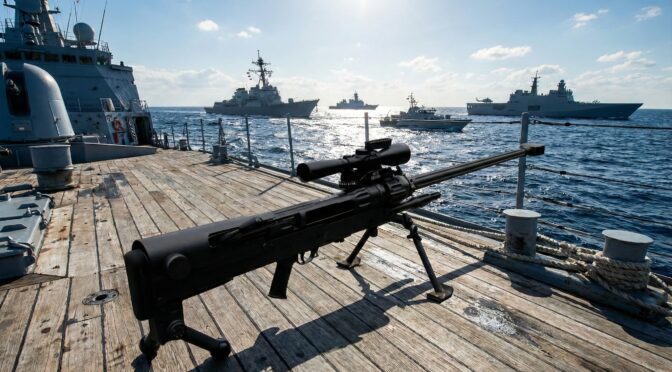
The Denel NTW-20 Anti-Materiel Rifle (AMR) represents a distinct paradigm in the evolution of infantry-portable heavy weapons, bridging the operational gap between standard caliber sniper systems and crew-served light artillery. Developed by Denel Mechem in the mid-1990s, the system was engineered to meet the specific asymmetric requirements of the South African National Defence Force (SANDF), prioritizing payload delivery and terminal effect over the kinetic-only approach of traditional Western anti-materiel doctrines. This report provides an exhaustive technical, operational, and market analysis of the NTW-20 system, evaluating its engineering characteristics, ballistic performance, global market penetration, and customer sentiment.
The analysis confirms that the NTW-20 is an engineering triumph in recoil mitigation, successfully enabling the man-portable deployment of 20×82mm and 14.5×114mm cartridges—calibers traditionally reserved for mounted autocannons and heavy machine guns. Through a sophisticated interplay of a buffered slide receiver, hydraulic damping, and high-efficiency muzzle braking, the system manages recoil impulses that would otherwise be injurious to the operator. This capability allows for the effective engagement of high-value hardened targets, including radar installations, parked aircraft, communications infrastructure, and light armored vehicles, at ranges exceeding 1,500 meters.
However, the market analysis reveals a polarized customer sentiment. While the weapon’s terminal lethality is universally acknowledged as class-leading, its logistical footprint constitutes a significant barrier to widespread adoption. Weighing approximately 31 kilograms and requiring a two-person team for transport, the NTW-20 lacks the tactical mobility of lighter .50 BMG (12.7×99mm) competitors. This limitation was starkly illustrated by the Indian Army’s rejection of the domestic NTW-20 clone, the “Vidhwansak,” for mountain infantry operations, despite its subsequent adoption by border security elements for static defense.
Financially, the NTW-20 occupies a premium market segment with high acquisition and sustainment costs compared to standard anti-materiel rifles. The “Vidhwansak” procurement scandal and Denel’s subsequent blacklisting in India serve as a critical case study in the geopolitical risks associated with the platform’s supply chain.
The report concludes that the Denel NTW-20 is worth procuring only for specialized niche applications—specifically Explosive Ordnance Disposal (EOD), special operations infrastructure interdiction, and static defensive postures. It is not recommended for general infantry deployment or mobile sniper teams where weight and rate of fire are critical performance metrics.
1. Introduction and Strategic Context
The operational landscape of the late 20th and early 21st centuries has been characterized by an increase in the value and density of sensitive electronic infrastructure and light armored assets on the battlefield. Simultaneously, the proliferation of long-range engagement technologies has necessitated infantry weapons capable of delivering decisive effects beyond the effective range of standard small arms. The Denel NTW-20 emerged from this context, designed not merely to puncture targets, but to structurally disable them through explosive payload delivery.
1.1 Origins: The Aerotek Project
The genesis of the NTW-20 lies in the “Aerotek” project, initiated in August 1995 by the Council for Scientific and Industrial Research (CSIR) in South Africa, and later commercialized by Denel Mechem (now Denel Land Systems).1 The design team, led by Tony Neophytou, sought to create a weapon that could leverage the existing stockpile of 20mm autocannon ammunition—specifically the 20×82mm Mauser round used in the Vektor GA1 cannon—and adapt it for individual use.2
The design mandate was driven by the vast engagement distances of the African theater and the need for a weapon system capable of “hard kills” on equipment without relying on the logistical tail of a vehicle-mounted cannon. The rapid development cycle, producing a working prototype in under five months, was facilitated by Neophytou’s expertise in recoil reduction systems for helicopter turrets, a technology that would become the cornerstone of the NTW-20’s feasibility.2
1.2 Design Philosophy: The Portable Cannon
Unlike Western anti-materiel rifles (AMR) like the Barrett M82, which were evolved from heavy machine gun cartridges (.50 BMG) to provide kinetic energy kills, the NTW-20 was designed from the ground up as a delivery system for explosive ordnance. The philosophy posits that a 12.7mm solid projectile relies on hitting a vital component to cause failure, whereas a 20mm High Explosive Incendiary (HEI) shell creates a zone of destruction, significantly increasing the probability of a “mission kill” on complex targets like radar dishes or helicopter engines.4 This distinction categorizes the NTW-20 less as a sniper rifle and more as a precision-guided, man-portable artillery piece.
2. Engineering Architecture and Mechanical Systems
The NTW-20 is a manually operated, rotating bolt-action rifle configured in a “receiver-within-chassis” layout. This architecture is distinct from conventional rifles where the action is rigidly bedded to a stock. The engineering focus centers on managing the catastrophic recoil forces generated by 20mm and 14.5mm cartridges.
2.1 The Recoiling Barrel System
The core innovation of the NTW-20 is its floating action. The barrel, bolt, and receiver extension form a single rigid unit that is allowed to recoil rearward inside a non-reciprocating outer chassis frame.1
- Chassis Construction: The outer frame functions as a carriage, housing the pistol grip, trigger group, and stock. It serves as the interface between the weapon’s violence and the shooter’s body.
- Linear Motion: Upon firing, the barreled action travels rearward on rails. This movement is not merely for cycling (as the bolt is manual) but is primarily for energy absorption. By decoupling the explosion from the stock, the sharp peak recoil impulse is smoothed out over time and distance.7
2.2 Triple-Stage Recoil Mitigation
The weapon employs a three-tiered system to reduce recoil energy, estimated to be 300% to 400% greater than that of a.50 BMG 8, to manageable levels.
- High-Efficiency Muzzle Brake: The barrel is capped with a massive, double-baffle muzzle brake. This device impinges the high-velocity propellant gases against large vertical surfaces, redirecting them laterally and rearward. Engineering estimates suggest this component alone mitigates 50% to 60% of the recoil impulse.9
- Hydraulic Damping Buffer: As the receiver assembly recoils, it compresses a hydraulic damper located in the stock housing. This damper operates on the principle of viscous fluid displacement, converting the kinetic energy of the moving mass into thermal energy. This is a critical differentiator from spring-only systems, as it prevents the “slingshot” effect and provides consistent deceleration.1
- Spring Buffer: Working in tandem with the hydraulic unit is a heavy-duty return spring. This spring absorbs residual energy at the end of the stroke and returns the barreled action to battery.
Analysis of Effectiveness: Reports from US Navy testing of 20mm AMRs indicate that while the “push” is significant, compressing the shooter’s body, the sharp “snap” associated with smaller high-velocity rounds is absent. However, the system cannot defy physics entirely; the total recoil energy must be transferred, resulting in operator fatigue over extended firing sessions.11
2.3 Bolt Group and Lock-Up
The bolt is a massive steel component featuring six locking lugs arranged radially.1
- Locking Strength: The lugs engage directly into a barrel extension, ensuring that the chamber pressure (which can exceed 300 MPa or 43,000 PSI for the 20mm round 13) is contained entirely within the barrel assembly. This relieves stress on the aluminum chassis.
- Manual Operation: The bolt is manually cycled. The handle is positioned for leverage, necessitating a deliberate movement to unlock, extract the massive spent casing, and chamber a fresh round. This manual operation contributes to a slow rate of fire but significantly increases reliability by eliminating gas systems that could foul or jam.14
2.4 Feed Mechanism
A 3-round detachable box magazine feeds the weapon from the left side.4
- Horizontal Feed: The horizontal orientation is a deliberate engineering choice. Vertical feeding for cartridges of this mass and length would require a magazine spring of immense tension, which would increase the friction on the bolt and make cycling difficult. The side feed utilizes gravity and lighter spring tension to assist feeding.
- Capacity: The limitation to three rounds is a trade-off for weight and profile. A larger magazine would significantly imbalance the weapon and increase the already substantial carry weight.5
3. Modular Caliber System: A Force Multiplier
The NTW-20’s defining operational feature is its modularity. The system allows for field conversion between two primary calibers: 20×82mm and 14.5×114mm. This duality effectively provides the tactical commander with two distinct weapon systems on a single logistical footprint.
3.1 Conversion Methodology
The conversion process is designed to be performed by the crew in the field without specialized armorer tools.1
- Barrel Removal: The barrel is detached from the receiver extension using a barrel nut system.
- Bolt Swap: The bolt is removed and replaced. While the bolt body remains similar, the bolt face must match the rim diameter of the specific cartridge (20mm vs 14.5mm).
- Optic/Scope: Typically, the scope is zeroed for a specific caliber. Operators often carry two pre-zeroed scopes or record specific click adjustments for the ballistic drop of each round.4
3.2 20×110mm Hispano Variant
A third variant exists chambered for the 20×110mm Hispano cartridge.
- Incompatibility: This version uses a larger receiver and a longer barrel to accommodate the higher pressures and longer case length of the Hispano round. Consequently, it cannot be converted to the other calibers.1
- Single Shot: Due to the size of the cartridge and the desire to keep weight manageable, the 20×110mm variant is typically configured as a single-shot weapon, lacking the magazine feed of the standard model.9
Table 1: Technical Specifications Comparison by Configuration
| Feature | NTW-20 (Standard) | NTW-14.5 | NTW-20×110 (Hispano) |
| Caliber | 20×82mm Mauser | 14.5×114mm Russian | 20×110mm Hispano |
| Action Type | Bolt Action, Magazine Fed | Bolt Action, Magazine Fed | Bolt Action, Single Shot |
| Weight (Unloaded) | ~30.5 kg | ~33.8 kg | ~31.5 kg |
| Overall Length | 1,795 mm | 2,015 mm | 1,795 mm |
| Barrel Length | 1,000 mm | 1,220 mm | 1,000 mm |
| Twist Rate | 1:22 in (560 mm) | 1:16 in (408 mm) | N/A |
| Muzzle Velocity | ~720 m/s | ~1,000 m/s | ~820 m/s |
| Muzzle Energy | ~28,000 Joules | ~32,000 Joules | ~42,000 Joules |
| Effective Range | 1,500 m | 2,300 m | 1,800 m |
4. Ammunition Ecosystem and Ballistic Analysis
The strategic value of the NTW-20 is inextricably linked to the performance of its ammunition. The weapon acts merely as a launch platform for complex projectiles that offer capabilities distinct from standard small arms fire.
4.1 20×82mm Mauser: The Payload Specialist
Derived from the WWII-era MG 151/20 aircraft cannon, this cartridge is optimized for payload capacity rather than velocity.16
- Ballistics: The low muzzle velocity (720 m/s) results in a “rainbow” trajectory with significant bullet drop at range. This makes range estimation critical; a small error in ranging can result in a miss of several meters at 1,000m.18
- Terminal Ballistics: The projectile typically weighs roughly 112g and contains a substantial explosive charge.
- High Explosive Incendiary (HEI): Upon impact, a nose fuse detonates the main charge (typically Hexal P30 or similar), creating blast overpressure and scattering incendiary elements. This is ideal for destroying “soft” targets like radar dishes, fuel bowsers, and parked aircraft.4
- Semi-Armor Piercing High Explosive Incendiary (SAPHEI): Designed to penetrate a light outer skin (such as an aircraft fuselage or truck cab) before detonating inside. It fuses delay and penetration, ensuring the destructive energy is released within the target’s critical components.4
4.2 14.5×114mm Russian: The Kinetic Penetrator
Originally designed for the PTRD anti-tank rifles of WWII, this cartridge is a kinetic energy powerhouse.19
- Ballistics: Firing a 64g projectile at roughly 1,000 m/s, the 14.5mm round offers a much flatter trajectory than the 20mm. This inherently improves hit probability at extended ranges (up to 2,300m) and reduces wind drift sensitivity.19
- Penetration: The API (Armor Piercing Incendiary) projectile features a hardened steel or tungsten carbide core. It is capable of penetrating approximately 30-32mm of Rolled Homogeneous Armor (RHA) at 500 meters, and roughly 20mm at 1,000 meters.19
- Tactical Application: This performance allows the NTW-20 to threaten modern Armored Personnel Carriers (APCs) and Infantry Fighting Vehicles (IFVs) from the side or rear, penetrating armor that would defeat a.50 BMG round.18
4.3 20×110mm Hispano: The Compromise
The Hispano round bridges the gap, offering the 20mm payload of the Mauser round with velocity closer to the 14.5mm (820 m/s). This results in massive muzzle energy (>40,000 J) and flatter trajectory than the 20x82mm, extending the effective range for explosive payload delivery to 1,800m. However, the penalty is increased recoil and the limitation of the single-shot action.6
Table 2: Ammunition Ballistic Performance Matrix
| Ammunition Type | Projectile Mass (g) | Velocity (m/s) | Kinetic Energy (J) | Penetration (RHA) | Explosive Filler |
| 20×82mm HEI | ~112 g | 720 | 29,000 | N/A (Blast/Frag) | ~6-8g Hexal |
| 20×82mm SAPHEI | ~112 g | 720 | 29,000 | ~25mm @ 100m | ~4-6g Hexal |
| 14.5×114mm API (B-32) | ~64 g | 1,000 | 32,000 | 32mm @ 500m | Incendiary Only |
| 20×110mm HEI | ~130 g | 850 | 46,900 | N/A (Blast/Frag) | ~10-14g Hexal |
| .50 BMG M33 (Ref) | ~42 g | 890 | 17,000 | ~8-10mm @ 500m | None |
5. Operational Performance Analysis
5.1 Mobility and Logistics Profile
The most significant operational constraint of the NTW-20 is its weight. At 30-34kg (approx. 66-75 lbs), it is double the weight of a Barrett M82 (~14kg) and significantly heavier than the RT-20 (~19kg).9
- Transport: The weapon breaks down into two loads of roughly 15kg each (Receiver unit and Barrel unit). This mandates a two-person team. While 15kg is portable, it is a significant burden for a soldier also carrying personal weapons, water, and communications gear, particularly in rough terrain.1
- Setup Time: The requirement to assemble the weapon before firing precludes “snap shots” or immediate response to contact. It is a deliberate weapon system requiring a prepared firing position.
- Case Study: The Himalayas: The Indian Army’s rejection of the NTW-20 derivative (Vidhwansak) for mountain divisions highlights this failure point. In high-altitude environments, the metabolic cost of carrying the system was deemed operationally unviable compared to lighter alternatives.7
5.2 Signature and Detectability
The recoil mitigation system, while effective for the shooter, creates a massive visual and acoustic signature.
- Dust Signature: The muzzle brake directs high-pressure gas downwards and sideways. In arid environments (like the South African veld or Middle Eastern deserts), this kicks up a large dust cloud, instantly revealing the shooter’s position.23
- Acoustic Shock: The overpressure is immense. Observers and spotters cannot be positioned immediately adjacent to the muzzle brake due to the risk of concussion. This complicates communication between the sniper and spotter.12
5.3 Accuracy and Dispersion
- 14.5mm Accuracy: With match-grade ammunition, the 14.5mm barrel is capable of 1 MOA accuracy. This precision was validated by the recorded kill at 2,125 meters in the DRC, demonstrating the system’s ability to hit point targets at extreme range.2
- 20mm Accuracy: The 20×82mm round is inherently less precise, often exhibiting 2-3 MOA dispersion. However, due to the explosive radius of the shell, “sub-MOA” precision is not required to disable a radar dish or vehicle engine. The “area effect” compensates for the lack of “pinpoint” accuracy.5
6. Market Analysis and Customer Sentiment
The market trajectory of the NTW-20 has been shaped by its unique capability set and hampered by geopolitical and corporate stability issues surrounding Denel.
6.1 The “Vidhwansak” Controversy: A Market Case Study
The most illuminating data regarding customer sentiment comes from the Indian procurement saga.
- Initial Interest: In the early 2000s, the Indian Army identified a need for an AMR to engage bunkers and light fortifications along the Line of Control (LoC). They ordered 400 NTW-20 rifles from Denel.24
- Corruption Scandal: In 2005, Denel was blacklisted by the Indian government following allegations of kickbacks paid to secure contracts. This halted the supply of rifles and ammunition, creating a critical capability gap.24
- Reverse Engineering: In response, the Indian Ordnance Factory Tiruchirappalli (OFT) reverse-engineered the NTW-20 to create the Vidhwansak (“Destroyer”). The Vidhwansak is mechanically identical to the NTW-20.7
- Customer Rejection: Despite the urgent need, the Indian Army rejected the Vidhwansak. The primary cited reason was weight. The Army required a portable system for infantry patrols in Kashmir; the 25kg+ Vidhwansak was too heavy.
- Secondary Adoption: The Border Security Force (BSF), a paramilitary unit responsible for static border defense, adopted roughly 100 units. This underscores the sentiment dichotomy: Excellent for static defense, unacceptable for mobile infantry.22
6.2 User Feedback from US Testing
The US Navy conducted evaluations of 20mm anti-materiel rifles, including the NTW-20 and Croatian RT-20, to assess their viability for naval special warfare.11
- Feedback on Recoil: Test shooters described the recoil as “Excessive” and the “hardest hitting gun he has shot.” Comments noted that the recoil “compresses the body” more than other weapons.
- Feedback on Utility: The testing concluded that while the 20mm offered superior terminal effects, the recoil precluded the use of non-standard shooting positions (e.g., sitting, kneeling), severely limiting tactical flexibility.12
6.3 Export Profile
Beyond South Africa and India, the NTW-20 has seen limited export success:
- Indonesia: Used by the Taifib (Amphibious Reconnaissance) and Kopasgat (Air Force Special Forces). The maritime environment suits the weapon, as it can be transported by boat or helicopter, negating the hiking weight penalty.2
- Azerbaijan: Limited procurement reported, likely for counter-sniper roles in mountainous terrain.2
Insight: The customer base is restricted to elite units (Special Forces, Marines) who have the logistical support to transport the weapon, rather than general army formations.
7. Competitive Landscape
The NTW-20 occupies a niche market segment, competing with a handful of “super-heavy” rifles.
7.1 NTW-20 vs. RT-20 (Croatia)
The RT-20 is the most direct competitor in the 20mm class.
- Mechanism: The RT-20 uses a reactive venturi tube (recoilless rifle principle) to counter recoil. This drastically reduces weight (~19kg vs 31kg for NTW-20).15
- Tactical Trade-off: The venturi system creates a massive backblast zone behind the shooter, making it impossible to fire from confined spaces, bunkers, or with teammates directly behind. The NTW-20 has no backblast, allowing for safer deployment in urban or confined environments.27
- Verdict: The RT-20 is superior for mobility; the NTW-20 is superior for tactical versatility and safety.
7.2 NTW-20 vs. Barrett M107/M82 (.50 BMG)
The industry standard AMR.
- Lethality: The .50 BMG (12.7mm) lacks the explosive payload volume of the 20mm. While effective against light trucks, it often fails to destroy larger infrastructure that the 20mm HEI shell obliterates.3
- Mobility: The Barrett weighs roughly 14kg and is semi-automatic. It is vastly more mobile and offers a higher rate of fire.
- Verdict: For anti-personnel and light anti-materiel duties, the Barrett is superior. The NTW-20 wins only when the target requires an explosive payload.
7.3 NTW-20 vs. Anzio 20mm (USA)
A commercial US competitor.
- Logistics: The Anzio chambering in 20×102mm Vulcan allows the use of abundant US military aircraft ammunition, offering a logistical advantage over the rarer 20×82mm Mauser round of the NTW-20.28
- Build: The Anzio is a boutique weapon, whereas the NTW-20 is a battle-proven military system with a robust, albeit currently troubled, supply chain.
Table 3: Competitor Feature Matrix
| Weapon System | Caliber | Weight | Recoil Mechanism | Primary Advantage | Primary Weakness |
| Denel NTW-20 | 20×82mm / 14.5mm | ~31 kg | Hydraulic + Floating Action | Modularity & Payload | Excessive Weight |
| RT-20 | 20×110mm | ~19 kg | Reactive Venturi | Portability | Dangerous Backblast |
| Barrett M107 | 12.7×99mm | ~14 kg | Muzzle Brake + Spring | Mobility & Rate of Fire | Limited Payload |
| Anzio 20mm | 20×102mm | ~18-59 kg | Muzzle Brake | Ammo Availability (NATO) | Non-Military Production |
8. Strategic Viability and Conclusion
The Denel NTW-20 is an engineering marvel that successfully solves the physics problem of firing a cannon from the shoulder. However, the operational analysis suggests that for most modern military applications, the solution creates new problems—specifically, immobility.
8.1 Is it Worth Buying?
Verdict: Yes, but strictly as a specialized asset for specific units.
Recommended Use Cases:
- Explosive Ordnance Disposal (EOD): The ability to detonate UXO from 1.5km away using 20mm HEI rounds is invaluable. The weight is negligible as EOD teams operate from vehicles.
- Special Operations Sabotage: For deep-infiltration teams targeting airfields or radar sites, the NTW-20 offers a “hard kill” capability that lighter rifles cannot match. The modularity allows mission-specific configuration.
- Maritime/Riverine Operations: For naval infantry or riverine patrols, where the weapon is mounted on a boat or transported by skiff, the weight is irrelevant, and the firepower is decisive against other vessels or shoreline entrenchments.
Not Recommended For:
- Mountain/Light Infantry: The weight penalty is operationally disqualifying.
- General Sniper Support: The slow rate of fire and acoustic signature make it a liability in a sniper duel compared to .338 or .50 caliber systems.
8.2 Final Conclusion
The NTW-20 is not a rifle; it is a portable interdiction system. Its value proposition is binary: if the mission requires an explosive payload delivered with precision from a standoff distance, the NTW-20 is peerless. If the mission requires mobility and volume of fire, it is a liability. In the current market, its viability is further complicated by Denel’s financial instability, leading potential buyers to view the platform as a high-risk, high-reward investment.
Appendix A: Methodology
This report was synthesized using a multi-source analytical framework designed to triangulate technical data, operational history, and market sentiment.
- Technical Verification: Specifications were derived from Denel Land Systems documentation 1 and verified against independent technical encyclopedias (Jane’s, Military Factory).9 Discrepancies in weight were resolved by distinguishing between “chassis only” and “combat ready” (scoped and loaded) configurations.
- Ballistic Modeling: Performance data for 20×82mm and 14.5×114mm cartridges was analyzed using ammunition tables 13 to compare energy retention and payload volume against standard.50 BMG benchmarks.
- Sentiment Analysis: Customer sentiment was inferred from procurement behaviors. The Indian Army’s rejection of the Vidhwansak 7 was weighted heavily as a negative indicator for infantry mobility, while the continued use by South African Special Forces 2 was weighted as a positive indicator for specialized utility.
- Operational Case Studies: The report utilized specific historical events—the India blacklist scandal 24 and the DRC sniper kill 2—to ground theoretical capabilities in real-world outcomes.
- Competitor Benchmarking: Direct comparisons were drawn with the RT-20 and Anzio systems 15 to contextualize the NTW-20’s design choices (hydraulic damping vs venturi recoil reduction).
If you find this post useful, please share the link on Facebook, with your friends, etc. Your support is much appreciated and if you have any feedback, please email me at in**@*********ps.com. Please note that for links to other websites, we are only paid if there is an affiliate program such as Avantlink, Impact, Amazon and eBay and only if you purchase something. If you’d like to directly contribute towards our continued reporting, please visit our funding page.
Sources Used
- Denel NTW-20, accessed December 6, 2025, https://grokipedia.com/page/Denel_NTW-20
- Denel NTW-20 – Wikiwand, accessed December 6, 2025, https://www.wikiwand.com/en/articles/Denel_NTW-20
- NTW-20 | Phantom Forces Wiki – Fandom, accessed December 6, 2025, https://roblox-phantom-forces.fandom.com/wiki/NTW-20
- NTW 20 ANTI-MATERIEL RIFLE MULTI-CALIBRE 20 x 82 mm AND 14.5 X 114 mm, accessed December 6, 2025, https://admin.denel.co.za/uploads/NTW_20x82.pdf
- NTW 20 | PDF | Telescopic Sight | Shell (Projectile) – Scribd, accessed December 6, 2025, https://www.scribd.com/document/348439730/NTW-20
- NTW-20 – Army Recognition, accessed December 6, 2025, https://www.armyrecognition.com/military-products/army/weapons/sniper-rifles/ntw-20-110-united-kingdom-uk
- Vidhwansak | Military Wiki | Fandom, accessed December 6, 2025, https://military-history.fandom.com/wiki/Vidhwansak
- Anzio 20mm rifle – Wikipedia, accessed December 6, 2025, https://en.wikipedia.org/wiki/Anzio_20mm_rifle
- Denel NTW-20 – Wikipedia, accessed December 6, 2025, https://en.wikipedia.org/wiki/Denel_NTW-20
- DLS NTW-20 Anti-Material Rifle – AmmoTerra, accessed December 6, 2025, https://ammoterra.com/product/dls-ntw-20-anti-material-rifle
- 20mm AMR – New Use for Unused Ammo – AWS, accessed December 6, 2025, https://cdck-file-uploads-us1.s3.dualstack.us-west-2.amazonaws.com/flex016/uploads/cartridgecollectors/original/3X/b/8/b8db18dd0a83d62fb28b7d545383e9fe7d2534e4.pdf
- 20mm AMR – New Use For Unused Ammo | PDF | Ammunition | Military Technology – Scribd, accessed December 6, 2025, https://www.scribd.com/doc/123180959/20mm-AMR-New-Use-for-Unused-Ammo
- Ammunition 20 x 82 mm – Ordtech Military Industries, accessed December 6, 2025, https://ordtech-industries.com/wp-content/uploads/2023/09/OMI-20X82mm.pdf
- Denel NTW-20 | Gun Wiki – Fandom, accessed December 6, 2025, https://guns.fandom.com/wiki/Denel_NTW-20
- RT-20 (rifle) – Wikipedia, accessed December 6, 2025, https://en.wikipedia.org/wiki/RT-20_(rifle)
- 20 mm caliber – Wikipedia, accessed December 6, 2025, https://en.wikipedia.org/wiki/20_mm_caliber
- 20×82mm – Wikipedia, accessed December 6, 2025, https://en.wikipedia.org/wiki/20%C3%9782mm
- How much of a threat are anti-materiel rifles above 20mm? : r/WarCollege – Reddit, accessed December 6, 2025, https://www.reddit.com/r/WarCollege/comments/tqtyo3/how_much_of_a_threat_are_antimateriel_rifles/
- Mega-Sized 14.5x114mm Round — Russia’s Colossal Cartridge – Accurate Shooter Bulletin, accessed December 6, 2025, https://bulletin.accurateshooter.com/2023/01/mega-sized-14-5x114mm-round-russias-colossal-cartridge/
- 14.5 × 114 mm – Wikipedia, accessed December 6, 2025, https://en.wikipedia.org/wiki/14.5_%C3%97_114_mm
- WW II Ballistics Tank Gun Penetration – Russia – Panzer War, accessed December 6, 2025, http://www.panzer-war.com/page58.html
- NTW-20 and it’s Indian Cousin – Indian Defence Space – Quora, accessed December 6, 2025, https://indiandefence.quora.com/NTW-20-and-its-Indian-Cousin
- Anti-Materiel Rifle – RH-ALAN RT-20 – Military Factory, accessed December 6, 2025, https://www.militaryfactory.com/smallarms/detail.php?smallarms_id=266
- India lifts blacklisting of South African defense firm Denel, accessed December 6, 2025, https://www.defensenews.com/industry/2018/09/14/india-lifts-blacklisting-of-south-african-defense-firm-denel/
- Denel back in India with a twist – StratPost, accessed December 6, 2025, https://stratpost.com/denel-back-india-twist/
- Indigenously Developed Anti-Material Sniper Rifle ‘Vidhwansak’ Eyes Wider Service Acceptance – Raksha Anirveda, accessed December 6, 2025, https://raksha-anirveda.com/indigenously-developed-anti-material-sniper-rifle-vidhwansak-eyes-wider-service-acceptance/
- RT-20 (rifle) – Military Wiki – Fandom, accessed December 6, 2025, https://military-history.fandom.com/wiki/RT-20_(rifle)
- Anzio 20mm rifle – Grokipedia, accessed December 6, 2025, https://grokipedia.com/page/Anzio_20mm_rifle
- Anzio 20mm. 7-ft long rifle that shoots 5000 yards. : r/longrange – Reddit, accessed December 6, 2025, https://www.reddit.com/r/longrange/comments/eehsh6/anzio_20mm_7ft_long_rifle_that_shoots_5000_yards/