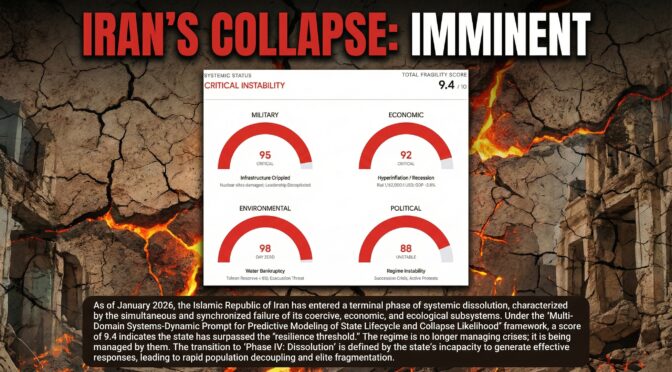
Assessed Fragility Score: 9.4 / 10 (Critical Systemic Instability)
Assessed Lifecycle Phase: Phase IV: Dissolution and Pre-Collapse
Data Collection and Report Generation: January 10, 2026
(Framework: Multi-Domain Systems-Dynamic Prompt for Predictive Modeling of State Lifecycle and Collapse Likelihood)
As of January 2026, the Islamic Republic of Iran has entered a terminal phase of systemic dissolution, characterized by the simultaneous and synchronized failure of its coercive, economic, and ecological subsystems. Under the “Multi-Domain Systems-Dynamic Prompt for Predictive Modeling of State Lifecycle and Collapse Likelihood” framework, a score of 9.4 indicates that the state has surpassed the “resilience threshold” where internal feedback loops (reform, repression, or co-optation) can restore equilibrium. The regime is no longer managing crises; it is being managed by them. The transition to “Phase IV: Dissolution” is defined not merely by the presence of threats, but by the state’s incapacity to generate effective responses to those threats, leading to a rapid decoupling of the population from the state apparatus and the fragmentation of the elite cohesion that has historically ensured regime survival.
This assessment is driven by a “polycrisis” event—a cluster of related global risks with compounding effects—that crystallized in the latter half of 2025. The catastrophic military defeat in the “12-Day War” of June 2025 shattered the regime’s external deterrence doctrine, while the subsequent “Snapback” of United Nations sanctions in September precipitated a hyperinflationary collapse of the Rial, which traded at 1.4 million to the U.S. dollar by late December. Domestically, the social contract has been severed. The nationwide uprisings that began on December 28, 2025, distinguished by the unprecedented participation of the traditional merchant class (Bazaaris) alongside the urban poor and student movements, indicate a loss of legitimacy that transcends class boundaries and historical loyalties. Furthermore, the ecological “bankruptcy” of the Iranian plateau, epitomized by Tehran’s approach to “Day Zero” water depletion, introduces a non-negotiable physical limit to the state’s continuity in its current geographic and demographic configuration.
The following report provides an exhaustive, multi-domain analysis of these converging vectors. It examines the disintegration of the “Axis of Resistance,” the paralysis of the clerical leadership amid a chaotic succession struggle, and the radicalization of street protests into a revolutionary movement. The analysis suggests that without a massive and unlikely external intervention, the trajectory points toward either a transition to a naked military dictatorship or territorial fragmentation within the coming fiscal year.
1. The Geopolitical Aftermath: The 12-Day War and Strategic Degradation
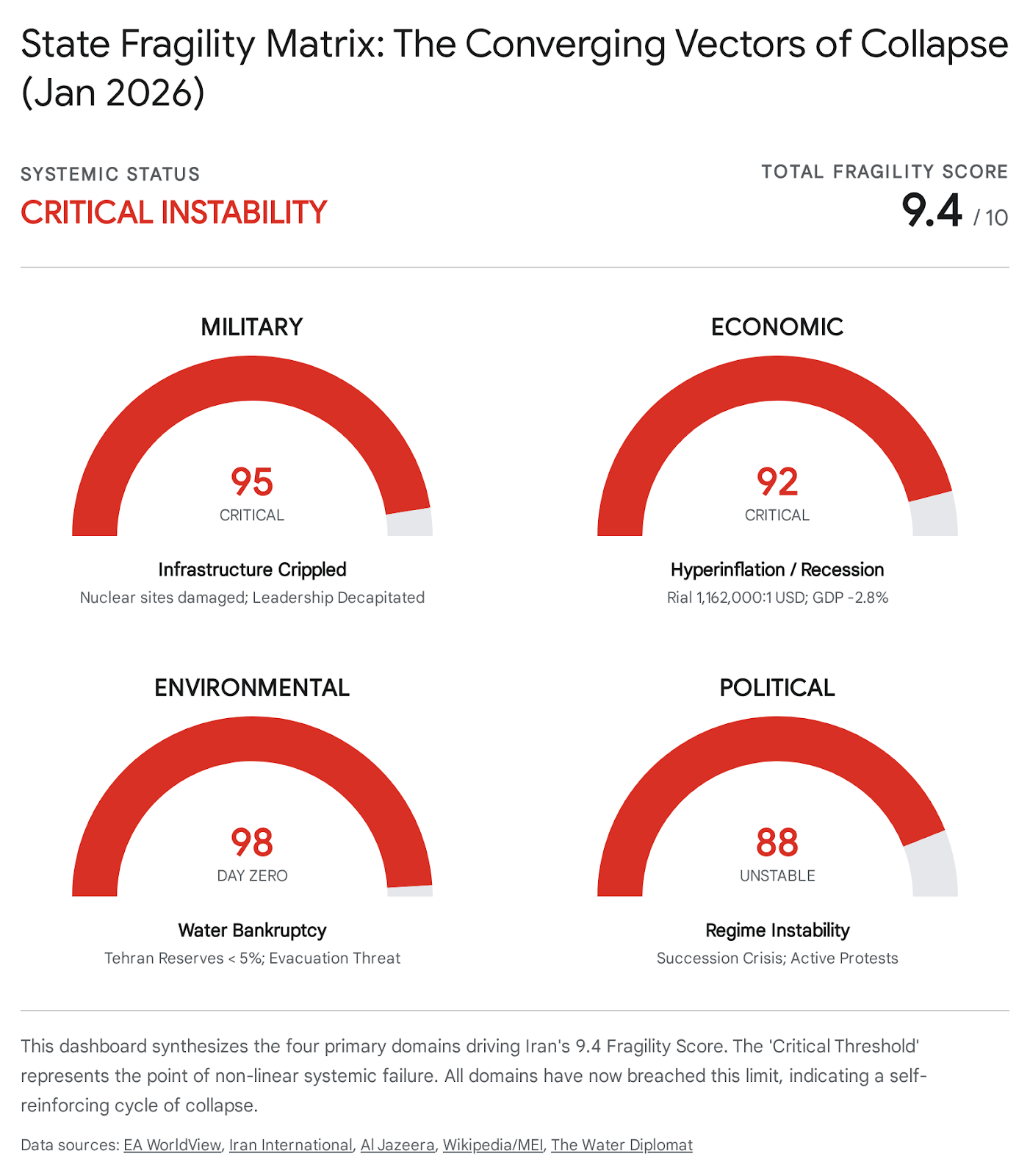
The geopolitical landscape of the Middle East was fundamentally and irrevocably altered by the conflict of June 13–24, 2025. This confrontation, now colloquially referred to in security circles as the “12-Day War,” was not merely a tactical exchange of fire but a strategic dismantlement of the Islamic Republic’s deterrence architecture. For decades, Tehran had cultivated a “Forward Defense” doctrine, relying on a “Ring of Fire” comprising proxy groups and missile forces to deter direct attacks on Iranian soil. This doctrine was predicated on the assumption that the cost of striking Iran would be too high for Israel or the United States to bear. The war exposed this assumption as a catastrophic miscalculation, revealing the hollowness of Iran’s conventional and asymmetric capabilities when faced with sustained, high-intensity warfare.
1.1. Operation Midnight Hammer and the Nuclear Dismantlement
The most consequential and irreversible outcome of the war was the physical degradation of Iran’s nuclear program. On June 22, 2025, in a decisive escalation codenamed Operation Midnight Hammer, United States forces executed a precision strike campaign utilizing B-2 Spirit bombers. These aircraft deployed GBU-57 Massive Ordnance Penetrators (MOPs)—30,000-pound precision-guided bunker busters—against the regime’s most deeply buried and fortified facilities at Fordow and Natanz.1
The strategic implications of these strikes cannot be overstated. For over two decades, the Iranian regime viewed its nuclear infrastructure not just as a scientific endeavor or an energy project, but as the ultimate guarantee of regime survival—an insurance policy against external regime change similar to the North Korean model. The regime had invested billions in burying these facilities deep underground, believing they had constructed a “Zone of Immunity.” The successful penetration and destruction of these sites demonstrated that this immunity was illusory. The B-2s flew continuously for nearly 37 hours, refueling mid-air, to deliver a payload that shattered the subterranean complexes.1
Post-strike assessments paint a grim picture for Tehran’s nuclear ambitions. International Atomic Energy Agency (IAEA) Director General Rafael Grossi confirmed in September 2025 that “almost all sensitive equipment” at the Fordow facility had been destroyed.1 While Grossi cautioned that the intellectual capital remains—”knowledge cannot be bombed away”—and that Iran retains the theoretical capacity to resume enrichment, the physical infrastructure that took decades to build has been reduced to rubble.2 The loss of the centrifuges, cascades, and support infrastructure has reset the clock on Iran’s breakout time, forcing a dangerous recalibration in Tehran. The regime is now paralyzed by a binary existential choice: a frantic rush to weaponization using surviving clandestine stockpiles—a move that risks a regime-ending war—or a humiliating capitulation to reopen negotiations from a position of extreme weakness. The current paralysis in decision-making suggests the leadership is incapable of choosing a path, trapped between the fear of further U.S. strikes and the humiliation of surrender.
1.2. Fragmentation of the “Axis of Resistance”
Parallel to the destruction of its nuclear shield, the war shattered the cohesion of Iran’s regional proxy network. The “Axis of Resistance,” comprising Hezbollah in Lebanon, Shia militias in Iraq and Syria, and the Houthis in Yemen, failed to provide the deterrent effect Tehran had invested billions to cultivate. The “Unity of Fronts” strategy, which posited that an attack on one member would trigger a coordinated response from all, collapsed under the pressure of the Israeli and American offensives.
- Hezbollah’s Neutralization: Hezbollah, the crown jewel of Iran’s proxy network, has been forced into a defensive crouch. Following intense Israeli operations, the group agreed to a ceasefire that mandated the withdrawal of its forces north of the Litani River. While the group has not been fully disarmed, its ability to threaten northern Israel with ground incursions or short-range saturation fire has been severely curtailed.3 Reports indicate that Iranian operatives, led by Quds Force commander Esmail Ghaani, are frantically attempting to reorganize the group’s military wing, introducing younger commanders and tighter secrecy to mitigate Israeli intelligence penetration.5 However, the strategic reality is that Hezbollah is currently focused on its own survival within the Lebanese political sphere rather than projecting Iranian power.
- The Fall of the Assad Regime: Perhaps the most devastating blow to Iran’s regional projection was the fall of the Assad regime in Syria in late 2024. This event stripped Iran of its critical “land bridge” to the Levant. Without friendly control of Syrian territory, the logistical supply lines that fed weapons and funds to Hezbollah have been severed.6 The loss of Syria isolates Hezbollah geographically and strategically, reducing Iran’s ability to resupply its most important proxy in the event of a future conflict.
- Proxy Disillusionment and Command Fracture: Intelligence reports suggest a growing rift between Tehran and its remaining proxies. The failure of the IRGC to protect its allies, or to effectively retaliate for the assassination of its own commanders, has led to a crisis of confidence. Iraqi militias, specifically groups like Kataib Hezbollah and Asaib Ahl al-Haq, are reportedly engaging in independent maneuvering, demanding concessions from the U.S. independently of Tehran’s guidance.8 This signals a fragmentation of command and control, where local interests are superseding loyalty to the Velayat-e Faqih.
1.3. Diplomatic Isolation and the “Snapback” Mechanism
The diplomatic fallout has been equally catastrophic, cementing Iran’s status as a pariah state. In late September 2025, the United Nations “Snapback” sanctions mechanism was triggered. This mechanism, a provision of the original 2015 nuclear deal (JCPOA), allows for the restoration of all pre-2015 UN Security Council resolutions against Iran if the country is found to be in significant non-compliance.9 Iran’s escalation of uranium enrichment to 60% and its obstruction of IAEA inspections provided the legal justification for European powers to activate the snapback.
The restoration of UN sanctions has effectively severed the country’s last remaining legal lifelines to the global financial system. It mandates that all UN member states enforce bans on missile technology transfers, conventional arms sales, and nuclear-related commerce. Crucially, it provides a legal framework for countries to interdict Iranian shipping and seize assets.
Furthermore, Iran’s traditional great power patrons have begun to distance themselves. China, previously Iran’s economic lifeline and largest oil customer, has reduced its purchases. While illicit trade continues, the volume has decreased, and Beijing is demanding steeper discounts—up to $11 per barrel—to offset the increased risk of secondary sanctions.9 The diplomatic isolation is compounded by the hostile stance of the new U.S. administration, which has explicitly stated a policy of “maximum pressure” and non-negotiation until specific, maximalist behavioral changes are met.11
2. Economic Collapse: Hyperinflation and Fiscal Paralysis
The Iranian economy has moved beyond the familiar territory of “recession” or “stagflation” into a state of hyperinflationary disintegration. The confluence of war damages, the reimposition of comprehensive international sanctions, and chronic internal mismanagement has created a vicious cycle of value destruction that the government is powerless to break. The economic subsystem, once characterized by a degree of resilience due to its diversified non-oil sector, has now shattered under the weight of “polycrisis.”
2.1. Currency Crisis and the Psychology of Hyperinflation
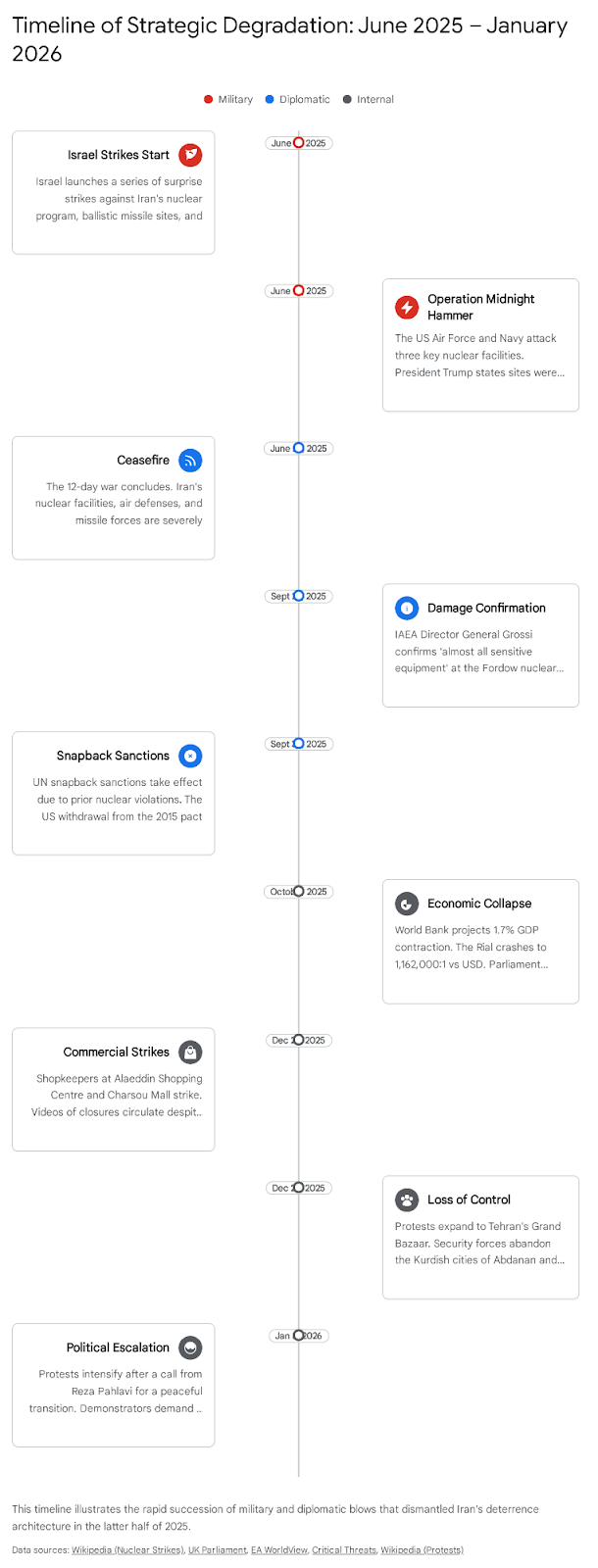
The most visible symptom of the economic collapse is the obliteration of the national currency, the Rial. As of January 2026, the currency trades on the open market at approximately 1,400,000 Rials to the U.S. Dollar. To place this in historical context, the rate was roughly 45,000 to the dollar in early 2018, before the U.S. withdrawal from the JCPOA.9 This represents not just a depreciation, but a near-total evaporation of the currency’s value. The slide has accelerated dramatically in the post-war period; in December 2025 alone, the Rial lost significant value, breaching psychological barriers daily.11
This currency collapse has triggered a hyperinflationary spiral. While the government officially reports inflation at over 40%, independent economists and market data suggest the real rate of inflation—particularly for the basket of essential goods like food and medicine—is hovering between 70% and 100%.15 Point-to-point food inflation was recorded at 72% in late 2025.16 The government’s attempt to manage the optics of this disaster by redenominated the currency—removing four zeros to create the “Toman” as the official unit—has been a failure. The “psychological effect” of 100 Tomans buying what 1,000,000 Rials used to buy has not fooled the market; instead, it has underscored the worthlessness of the printed notes.9
The economy has undergone a de facto dollarization. Shopkeepers, manufacturers, and service providers now price goods based on the hourly fluctuations of the Black Market dollar rate rather than official indices. This has led to a breakdown of the supply chain, as importers cannot secure foreign currency to bring in raw materials, leading to factory closures and mass layoffs. The “dual exchange rate” system—where favored insiders get dollars at a subsidized rate while the public pays the market rate—has fueled massive corruption, further delegitimizing the state in the eyes of the public.17
2.2. The 1405 Budget: A Blueprint for Unrest
The proposed budget for the Iranian year 1405 (March 2026 – March 2027), submitted by President Masoud Pezeshkian’s administration, demonstrates the regime’s detachment from the economic reality of its citizens. Far from a relief package, the budget is a “war budget” that prioritizes the security apparatus over social welfare, a decision that has directly fueled the current uprising.
- Militarization of Spending: The draft budget allocates a staggering 145% nominal increase to defense and security institutions, specifically the IRGC and the Ministry of Defense.18 This massive injection of funds—totaling approximately $9.23 billion at official rates—is intended to rebuild the military infrastructure shattered during the 12-Day War and to ensure the loyalty of the security forces during domestic crackdowns. The IRGC alone is set to receive nearly $2 billion in direct budget allocations, separate from its vast off-book commercial empire.19
- Austerity for the Public: Conversely, the budget proposes severe austerity measures for the general population. It targets a 63% increase in tax revenues, shifting the burden onto the crumbling private sector and the merchant class (Bazaaris).13 This tax hike is an attempt to plug the deficit caused by falling oil revenues, but it is strangling the very businesses that keep the economy afloat. Furthermore, public sector wage increases are capped at 20%, a figure that lags woefully behind the 40-70% inflation rate, guaranteeing a massive drop in real purchasing power for millions of government employees and teachers.21
- Fuel Price Hikes: In a move reminiscent of the spark for the 2019 protests, the government has introduced a three-tier gasoline pricing system. The subsidized quota has been capped, and prices for usage beyond that quota have effectively tripled.11 This policy is designed to reduce the fiscal deficit and curb consumption, but in an environment of high inflation, it acts as an accelerant for the cost of transport and food, further inflaming public anger.
2.3. Banking Sector Insolvency and Capital Flight
The banking system is effectively insolvent, sustained only by the Central Bank’s printing presses. The collapse of confidence in the Rial and the stability of the regime has triggered a massive run on the banks, with capital flight reaching historic highs. The Central Bank of Iran reported $9 billion in capital outflows in just the first quarter of the fiscal year, with projections of $36 billion by March 2026.23 This figure represents nearly 10% of the country’s GDP fleeing the country in a single year.
This exodus of capital is not limited to the wealthy elite moving funds to Dubai or Toronto; it has democratized. Ordinary citizens are converting whatever assets they have—selling cars, jewelry, and apartments—into gold, cryptocurrency, or foreign cash to protect against the vanishing Rial. Analysts have noted that the volatility of the Rial now resembles that of speculative cryptocurrencies, underscoring the complete loss of monetary sovereignty.24 The regime’s attempts to stem this flow through arrests of currency dealers and limits on withdrawals have only intensified the panic.
3. Ecological Collapse: The Water Bankruptcy
Beyond the political instability and economic ruin, Iran faces a threat that is absolute and non-negotiable: the irreversible ecological collapse of the Iranian plateau. This “water bankruptcy” is not a future projection but a present reality that is reshaping the country’s demographics and fueling its instability. The environmental subsystem has crashed, acting as a threat multiplier that exacerbates every other crisis the state faces.
3.1. Tehran’s “Day Zero” and the Crisis of Habitability
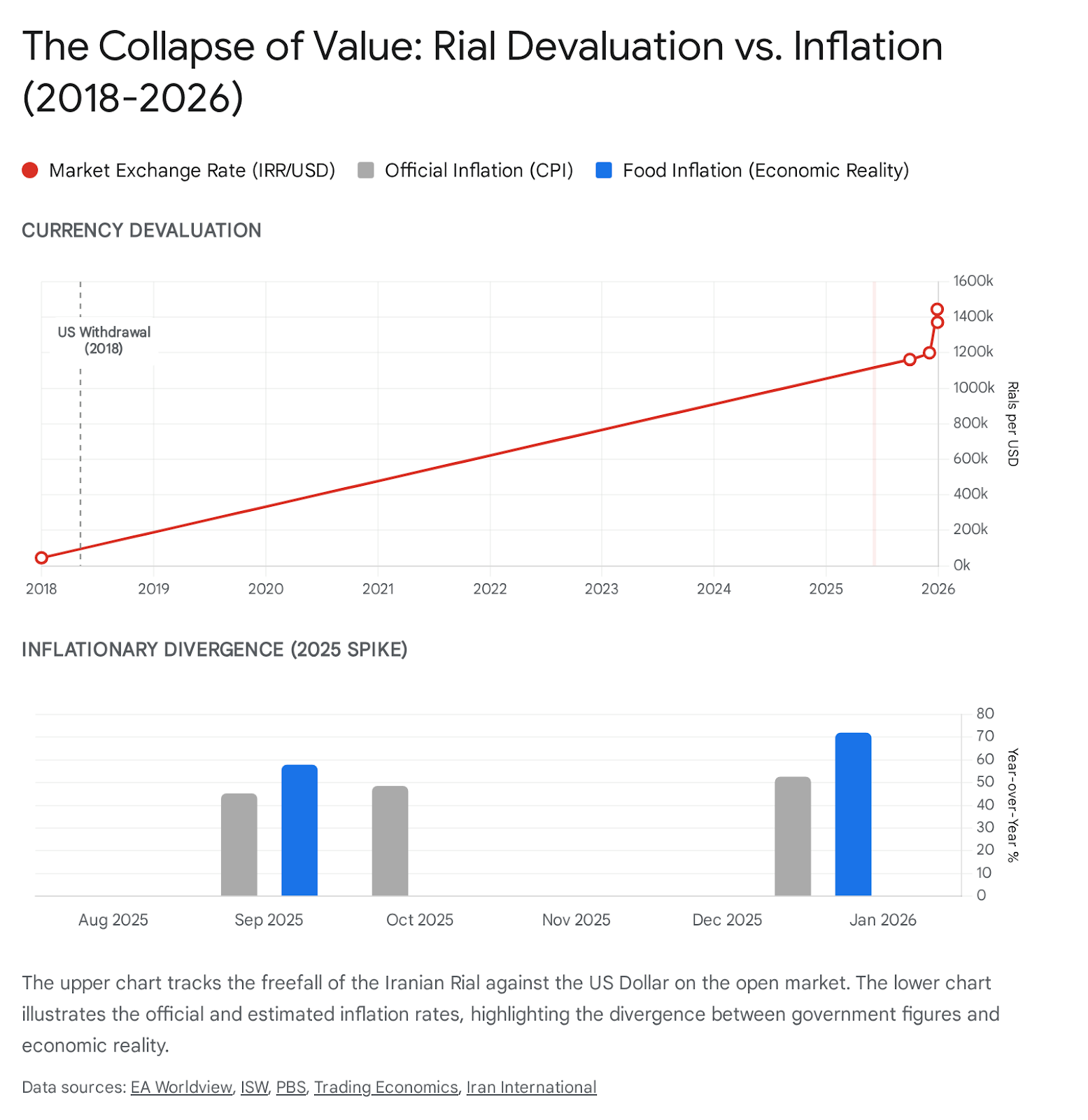
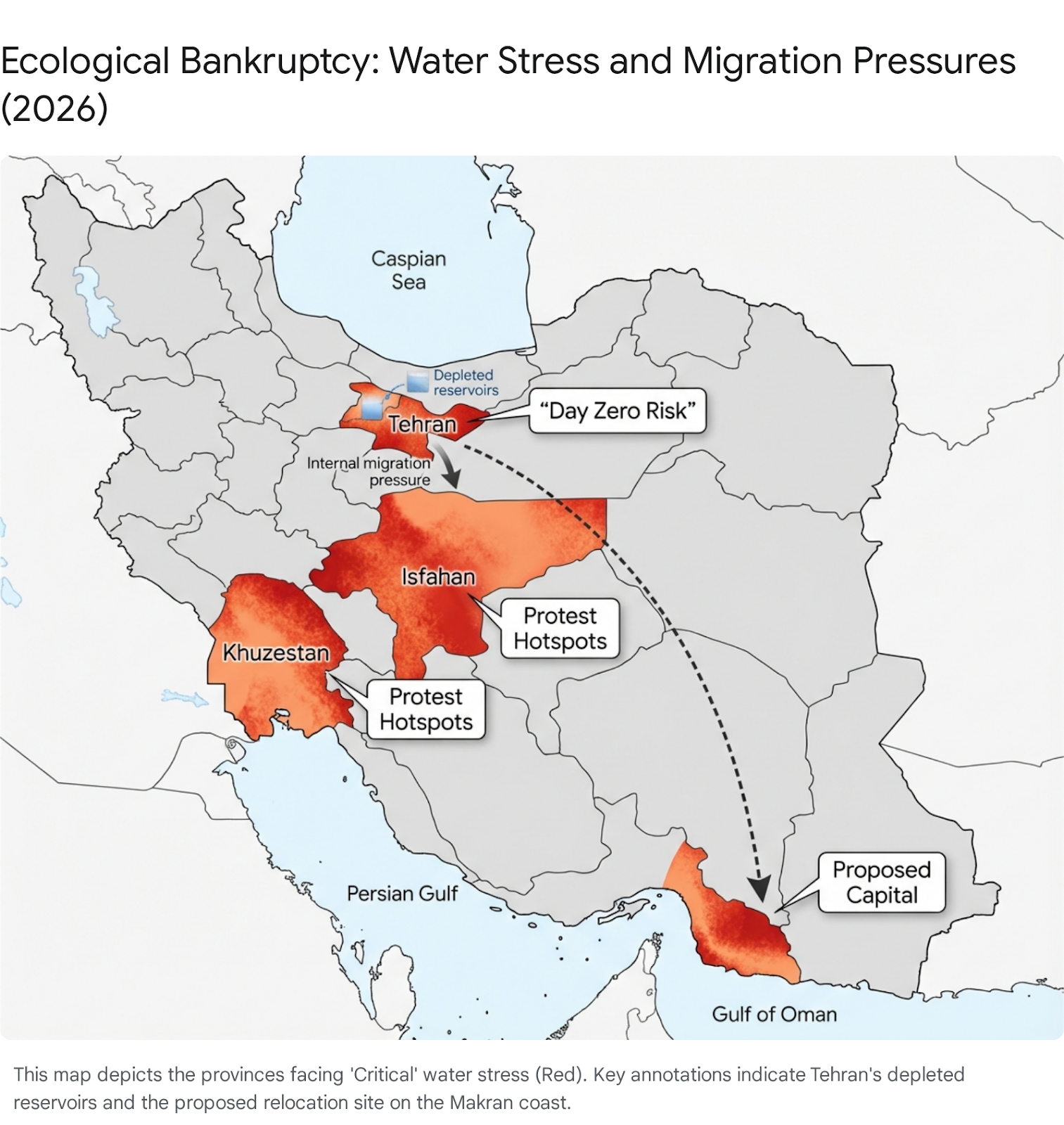
The capital city, Tehran, home to over 15 million people and the beating heart of the nation’s economy and administration, is fast approaching “Day Zero”—the point at which municipal water reserves are exhausted, and taps run dry. As of late 2025, water reserves in the dams supplying Tehran have dropped below 5% of capacity, a historic low that signals the failure of the hydrological infrastructure.25 President Masoud Pezeshkian has publicly and starkly warned that if substantial rains do not arrive by December—which they have largely failed to do—the government will have “no choice” but to implement severe rationing and potentially begin evacuating segments of the city.26
This crisis is the result of decades of systemic mismanagement, corruption, and a development model that ignored ecological limits. The regime dismantled the ancient, sustainable qanat systems in favor of massive, prestige-driven dam projects and unregulated groundwater extraction. The consequences are now visible underfoot: the land under Tehran is subsiding at a rate of 30cm per year due to the depletion of aquifers, threatening the structural integrity of buildings, bridges, and the metro system.28 The very ground the capital is built on is collapsing.
3.2. The Makran Relocation Fantasy
In a desperate and widely criticized attempt to address the habitability crisis, the government has revived proposals to move the capital from Tehran to the Makran coast on the Gulf of Oman.29 Presented as a strategic pivot to a “sea-based economy,” this plan is largely regarded by urban planners and economists as a fantasy.
The logistical and financial hurdles are insurmountable for a bankrupt state. The cost of building a new capital is estimated at between $77 billion and $100 billion.30 For a country struggling to pay pensions and under heavy sanctions, such an expenditure is impossible. Furthermore, the Makran region is severely underdeveloped, lacks basic infrastructure, and is located in the volatile Sistan and Baluchestan province—a region currently engulfed in Sunni insurgency and anti-regime unrest. The announcement of this plan acts less as a viable policy solution and more as a tacit admission by the regime that Tehran is dying and that they have no solution for saving it.31
3.3. Environmental Protests as a Catalyst
The environmental crisis has ceased to be a local issue for farmers; it has merged with the broader political grievances of the urban population. Protests in provinces like Isfahan and Khuzestan, traditionally driven by farmers angry over water diversion, have now linked up with national anti-regime movements. The drying of the Zayandeh Rud river in Isfahan and the blinding dust storms in Khuzestan are no longer viewed as natural disasters but as the direct result of the regime’s incompetence, corruption, and prioritization of water-intensive industries owned by the IRGC.32 The slogan “They took our water, they took our oil” reflects the unification of ecological and economic grievances into a singular narrative of dispossession.
4. Sociopolitical Fragility: Legitimacy Crisis and Succession
The political foundation of the Islamic Republic is crumbling. The “social contract”—an implicit agreement where the population tolerated restricted political freedoms in exchange for stability, security, and modest economic subsidies—has been irrevocably broken. The regime can no longer deliver stability (as evidenced by the war), security (as evidenced by the ISIS-K attacks and Israeli strikes), or subsidies (as evidenced by the austerity budget).
4.1. The “Hidden Imam” Scenario and the Succession Battle
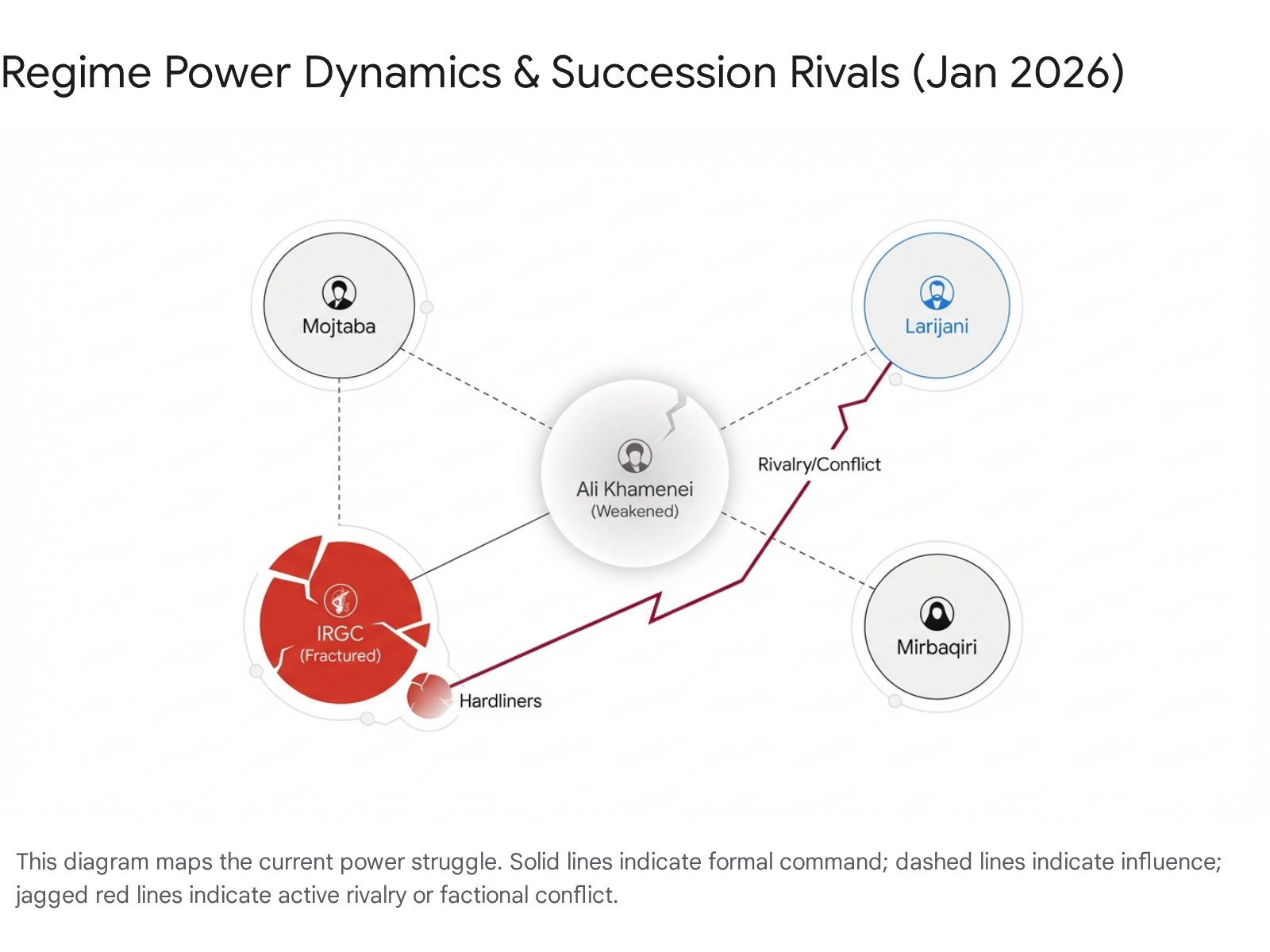
Supreme Leader Ali Khamenei, aged 86, has largely vanished from public view since the onset of the June war. Reports indicate he is operating from a secure, hardened bunker, communicating only through a trusted aide.34 This physical absence has created a political vacuum, transforming him into an “absentee landlord” figure and fueling wild rumors about his health and grip on power.
This vacuum has sparked a vicious and destabilizing succession battle. The Assembly of Experts is reportedly paralyzed by factional infighting as they consider three primary candidates, each representing a different vision for the regime’s survival:
- Mojtaba Khamenei: The Supreme Leader’s son, widely seen as the candidate of the “Deep State” and the security apparatus (IRGC). While he commands the loyalty of the gun, he lacks religious standing and popular legitimacy, and his succession would signal the transformation of the Islamic Republic into a hereditary dynastic dictatorship.36
- Mohammad Mirbaqiri: An ultra-hardline cleric and head of the Academy of Islamic Sciences. He advocates for a “purified” Islamic society and permanent confrontation with the West. His ascension would likely push the regime toward a Taliban-style governance model, alienating the modern urban class entirely.36
- Alireza Arafi: A more traditional conservative figure, viewed by some as a potential compromise candidate to preserve the clerical system, though he lacks the independent power base of the other two.
The uncertainty of the transition is destabilizing the regime from within. Factions are positioning themselves for the post-Khamenei era, hoarding resources and intelligence, leading to paralysis in decision-making at the state level.
4.2. IRGC: Fracture and “Dumbification”
The Islamic Revolutionary Guard Corps (IRGC), the regime’s primary instrument of coercion, is facing an unprecedented internal crisis. The 12-Day War decimated its leadership structure, killing over 30 senior commanders and revealing deep intelligence penetrations by Israeli and Western agencies.38 The aura of invincibility that surrounded the Guard has evaporated.
In response to these failures, the regime has initiated a “purification” campaign within the Guard. However, analysts note that this has led to a process of “dumbification,” where professional competence is sacrificed for ideological loyalty.38 Paranoid about spies, the leadership has purged capable officers, replacing them with ideological zealots who lack military expertise. This degradation was evident in the clumsy handling of the post-war protests and the inability to secure the country’s borders or airspace. The IRGC is no longer a monolithic entity; it is fracturing into competing fiefdoms, with some commanders reportedly prioritizing their business interests over national defense.38
4.3. The Return of Ali Larijani and Elite Fragmentation
In a sign of the regime’s desperation to restore some semblance of administrative competence, Ali Larijani, a former moderate-conservative Speaker of Parliament who was previously disqualified from running for president, has been rehabilitated. He has been appointed as the Secretary of the Supreme National Security Council (SNSC), replacing the ineffective Ali Akbar Ahmadian.40
Larijani’s return represents an attempt by the Supreme Leader (or those acting in his name) to bridge the gap with the “technocratic” class and bring experienced hands back to the wheel. However, this move has infuriated the ultra-hardline Paydari front, who view Larijani as a “liberal” and a traitor to the revolutionary cause. This infighting at the very top of the system—between the “Purifiers” and the “Pragmatists”—is further paralyzing the state’s ability to respond to the crisis on the streets.42
5. The Current Uprising: A Revolution of the Hungry
The protests that erupted on December 28, 2025, represent a qualitative shift from previous waves of unrest in Iran. Unlike the 2009 Green Movement (which focused on political reform) or the 2022 Mahsa Amini protests (which focused on social freedoms and women’s rights), the current uprising is a “Revolution of the Hungry” driven by existential economic desperation. Yet, it has rapidly adopted maximalist political slogans, bridging the gap between economic grievance and regime change.
5.1. The Bazaari Factor: A Historic Shift
Crucially, the spark for this uprising came from the Tehran Grand Bazaar.43 The merchant class, or Bazaaris, has historically been a conservative pillar of support for the clergy, playing a key role in funding the 1979 revolution. However, the collapse of the Rial and the aggressive tax hikes in the 1405 budget have destroyed their businesses. When the Bazaar strikes—closing shops and marching in the streets—it paralyzes the distribution of goods across the country and sends a powerful signal to the conservative religious classes that the regime has lost its economic and moral mandate. The Bazaaris are no longer aligned with the state; they are now leading the charge against it.
5.2. Nationwide Scope and Demographics
The unrest has spread with unprecedented speed to over 180 cities in all 31 provinces.43 This geographic spread indicates that the protest movement has successfully bridged the rural-urban divide. It unites the water-starved farmers of Isfahan and the marginalized ethnic minorities in Kurdistan and Baluchestan with the unemployed youth and student movements of Tehran and Shiraz.
The slogans have shifted rapidly from economic demands like “Death to high prices” to explicitly anti-regime chants such as “Death to the Dictator” and calls for the return of the Pahlavi dynasty, indicating a total rejection of the Islamic Republic as a system.43 The movement is leaderless but coordinated, utilizing neighborhood networks to organize despite internet blackouts.
5.3. State Repression and Rumors of Martial Law
The state’s response has been brutal, utilizing the full spectrum of repression. Security forces have killed hundreds of protesters and arrested thousands.45 However, reports suggest that the crackdown is less effective than in the past. There are persistent rumors of hesitation and even limited defections among rank-and-file security personnel, who are suffering from the same inflation and economic hardships as the protesters they are ordered to beat.
As of early January 2026, unconfirmed reports suggest that the regime is preparing to declare martial law, with military commanders taking direct control of provincial administration and bypassing civilian governors.47 This would mark the final militarization of the state, removing the last veneer of republican governance.
6. Conclusion and Strategic Outlook
The Islamic Republic of Iran is currently a “Zombie State”—institutionally dead but kept moving by the sheer inertia of its coercive apparatus. However, that apparatus is now fracturing under the weight of multiple, simultaneous crises. The convergence of military defeat, economic ruin, environmental collapse, and political illegitimacy has created a scenario where the regime has no good options left.
6.1. Scenario A: Military Junta (High Probability – 45%)
As the clerical establishment loses all credibility and Khamenei eventually passes or is incapacitated, the IRGC—specifically its hardline faction led by figures aligned with Mojtaba Khamenei—may execute a soft coup. They would sideline the clergy, militarize the economy completely, and rule as a secular nationalist dictatorship. This would involve a brutal crackdown but might stabilize the security situation temporarily by shedding the ideological baggage of the theocracy.
6.2. Scenario B: Systemic Collapse and Civil War (Medium Probability – 35%)
If the security forces fracture along lines of loyalty or ethnicity, the state could collapse into civil war. The breakdown of the central government would lead to the rise of local warlords, particularly in border regions like Kurdistan and Baluchestan. This “Syria scenario” would likely invite foreign intervention to secure nuclear materials and prevent regional spillover.
6.3. Scenario C: Managed Transition/Revolution (Low Probability – 20%)
A broad coalition of the army (Artesh), dissatisfied IRGC elements, and civil society leaders could force a transition to a transitional government. This is the “optimistic” scenario but requires a level of coordination and leadership that the opposition currently lacks.
Final Assessment: The Iranian state is in Phase IV: Dissolution. Without a massive external bailout (which is unlikely given the geopolitical climate) or a radical internal transformation that abandons the revolutionary ideology, the Islamic Republic as currently constituted is unlikely to survive the next 12-24 months intact. The 1405 budget, rather than saving the regime, acts as an accelerant, fueling the very fires it seeks to extinguish.
If you find this post useful, please share the link on Facebook, with your friends, etc. Your support is much appreciated and if you have any feedback, please email me at in**@*********ps.com. Please note that for links to other websites, we are only paid if there is an affiliate program such as Avantlink, Impact, Amazon and eBay and only if you purchase something. If you’d like to directly contribute towards our continued reporting, please visit our funding page.
Sources Used
- United States strikes on Iranian nuclear sites – Wikipedia, accessed January 10, 2026, https://en.wikipedia.org/wiki/United_States_strikes_on_Iranian_nuclear_sites
- Iran: Impacts of June 2025 Israel and US strikes – House of Commons Library, accessed January 10, 2026, https://commonslibrary.parliament.uk/research-briefings/cbp-10292/
- Lebanon 2025: Plans to disarm Hezbollah – House of Commons Library – UK Parliament, accessed January 10, 2026, https://commonslibrary.parliament.uk/research-briefings/cbp-10347/
- Israel–Hezbollah conflict (2023–present) – Wikipedia, accessed January 10, 2026, https://en.wikipedia.org/wiki/Israel%E2%80%93Hezbollah_conflict_(2023%E2%80%93present)
- Hamas and Hezbollah rebuild during truce, Israeli officials say – JPost | Iran International, accessed January 10, 2026, https://www.iranintl.com/en/202511206795
- The State Of The Axis Of Resistance: Assessing Risks And Opportunities For The United States | Critical Threats, accessed January 10, 2026, https://www.criticalthreats.org/analysis/the-state-of-the-axis-of-resistance
- Iran’s proxy war paradox: strategic gains, control issues, and operational constraints, accessed January 10, 2026, https://www.tandfonline.com/doi/full/10.1080/09592318.2025.2512807
- Iran Update, December 26, 2025 | ISW – Institute for the Study of War, accessed January 10, 2026, https://understandingwar.org/research/middle-east/iran-update-december-26-2025/
- Iran’s Economy Is Sinking – EA WorldView, accessed January 10, 2026, https://eaworldview.com/2025/10/iran-economy-is-sinking/
- The Year in Review: Iran’s Deepening Economic Crisis – Middle East Forum, accessed January 10, 2026, https://www.meforum.org/mef-observer/the-year-in-review-irans-deepening-economic-crisis
- Iran’s currency plummets to new low, sparking fears of higher food prices, accessed January 10, 2026, https://www.pbs.org/newshour/world/irans-currency-plummets-to-new-low-sparking-fears-of-higher-food-prices
- What to know about the intensifying protests shaking Iran and putting pressure on its theocracy, accessed January 10, 2026, https://www.pbs.org/newshour/world/what-to-know-about-the-intensifying-protests-shaking-iran-and-putting-pressure-on-its-theocracy
- Iran Update, December 29, 2025 – Institute for the Study of War, accessed January 10, 2026, https://understandingwar.org/research/middle-east/iran-update-december-29-2025/
- Iran rial hits new record low of 1.31 million to the dollar, accessed January 10, 2026, https://www.iranintl.com/en/202512153499
- Iran Inflation Rate – Trading Economics, accessed January 10, 2026, https://tradingeconomics.com/iran/inflation-cpi
- Iran economy contracts despite modest oil growth as inflation and rial slide, accessed January 10, 2026, https://www.iranintl.com/en/202512280124
- Behind the Inflation Crisis: Why Iran’s Streets are Erupting Again – India’s World Magazine, accessed January 10, 2026, https://indiasworld.in/behind-the-inflation-crisis-why-irans-streets-are-erupting-again/
- Links: 145% Increase in Iran’s Defense and Security Budget for 1405 – iroon.com, accessed January 10, 2026, https://iroon.com/irtn/link/63644/145-increase-in-iran-s-defense-and-security-budget-for-1405/
- 145% Increase in Iran’s Defense and Security Budget for 1405 – WANA News, accessed January 10, 2026, https://wanaen.com/145-increase-in-irans-defense-and-security-budget-for-1405/
- Tax Increase in Iran to Finance the IRGC and Religious Institutions – Middle East Forum, accessed January 10, 2026, https://www.meforum.org/mef-observer/tax-increase-in-iran-to-finance-the-irgc-and-religious-institutions
- Iran submits budget signaling one of sharpest fiscal pullbacks in years, accessed January 10, 2026, https://www.iranintl.com/en/202512234988
- Stealth austerity: Tehran seeks fuel price hike without a reckoning | Iran International, accessed January 10, 2026, https://www.iranintl.com/en/202512236352
- Double squeeze: Iran faces record capital flight as oil revenues fall, accessed January 10, 2026, https://www.iranintl.com/en/202511078141
- Iran’s Currency Collapse Mirrors Cryptocurrency Volatility Amid Economic Turmoil, accessed January 10, 2026, https://www.weareiowa.com/article/news/local/plea-agreement-reached-in-des-moines-murder-trial/524-3069d9d4-6f9b-4039-b884-1d2146bd744f?y-news-25066994-2026-01-09-iran-currency-crash-like-crypto
- Threat of Day Zero in Tehran: water reserves drop below 5%, accessed January 10, 2026, https://www.waterdiplomat.org/story/2025/11/threat-day-zero-tehran-water-reserves-drop-below-5
- After Ruining a Treasured Water Resource, Iran Is Drying Up – Yale …, accessed January 10, 2026, https://e360.yale.edu/features/iran-water-drought-dams-qanats
- Satellite Imagery Shows Tehran’s Accelerating Water Crisis – CSIS, accessed January 10, 2026, https://www.csis.org/analysis/satellite-imagery-shows-tehrans-accelerating-water-crisis
- Iran must move its capital from Tehran, says president as water crisis worsens, accessed January 10, 2026, https://www.theguardian.com/world/2025/oct/02/iran-must-move-its-capital-from-tehran-says-president-as-water-crisis-worsens
- Iran Mulls Plans to Relocate Capital as Tehran Faces Water Crisis | Vantage on Firstpost, accessed January 10, 2026, https://www.youtube.com/watch?v=ndscdueXnlg
- Iranian capital relocation – Wikipedia, accessed January 10, 2026, https://en.wikipedia.org/wiki/Iranian_capital_relocation
- Iran president says capital move now a necessity as water crisis deepens, accessed January 10, 2026, https://www.iranintl.com/en/202511209098
- Iran’s Water Crisis Is a Warning to Other Countries, accessed January 10, 2026, https://carnegieendowment.org/emissary/2025/11/iran-water-crisis-warning-climate?lang=en
- Environmental and Human Rights Crisis in Iran under the Mullahs’ Regime, accessed January 10, 2026, https://iran-hrm.com/2025/10/13/environmental-and-human-rights-crisis-in-iran-under-the-mullahs-regime/
- Iran’s Khamenei said to pick three potential successors as he hides in bunker, accessed January 10, 2026, https://www.timesofisrael.com/khamenei-said-to-pick-three-potential-successors-as-he-hides-in-bunker/
- Khamenei picks possible successors amid war, son Mojtaba not among them – NYT, accessed January 10, 2026, https://www.iranintl.com/en/202506218672
- Next Supreme Leader of Iran election – Wikipedia, accessed January 10, 2026, https://en.wikipedia.org/wiki/Next_Supreme_Leader_of_Iran_election
- Controversial ultra-hardliner claims Khamenei endorsed his path | Iran International, accessed January 10, 2026, https://www.iranintl.com/en/202410121746
- Humiliation and Transformation: The Islamic Republic After the 12 …, accessed January 10, 2026, https://www.fpri.org/article/2025/10/humiliation-and-transformation-the-islamic-republic-after-the-12-day-war/
- How 12 days have changed Iran – The International Institute for Strategic Studies, accessed January 10, 2026, https://www.iiss.org/online-analysis/online-analysis/2025/07/how-12-days-have-changed-iran/
- Iran’s War Doctrine After the 2025 Conflict With Israel: Nuclear Calculations and the Question of the Fatwa | International Institute for Iranian Studies, accessed January 10, 2026, https://rasanah-iiis.org/english/monitoring-and-translation/reports/irans-war-doctrine-after-the-2025-conflict-with-israel-nuclear-calculations-and-the-question-of-the-fatwa/
- Iran security chief likens Trump to Hitler as Tehran mood darkens, accessed January 10, 2026, https://www.iranintl.com/en/202510231221
- Iran’s Hard-Pivot from “Detente” to Coercion—And the Purge Politics Driving It – NCRI, accessed January 10, 2026, https://www.ncr-iran.org/en/news/irans-hard-pivot-from-detente-to-coercion-and-the-purge-politics-driving-it/
- 2025–2026 Iranian protests – Wikipedia, accessed January 10, 2026, https://en.wikipedia.org/wiki/2025%E2%80%932026_Iranian_protests
- How Iran’s latest protests mark a break from past cycles of dissent, accessed January 10, 2026, https://www.trtworld.com/article/5715f0a3c0ec
- Iran protests are the biggest in years to challenge the regime. Here’s what to know., accessed January 10, 2026, https://www.cbsnews.com/news/iran-protests-biggest-in-years-against-ayatollah-what-to-know/
- 2025 Iran internal crisis – Wikipedia, accessed January 10, 2026, https://en.wikipedia.org/wiki/2025_Iran_internal_crisis
- Iran Update, January 7, 2026 | ISW – Institute for the Study of War, accessed January 10, 2026, https://understandingwar.org/research/middle-east/iran-update-january-7-2026/