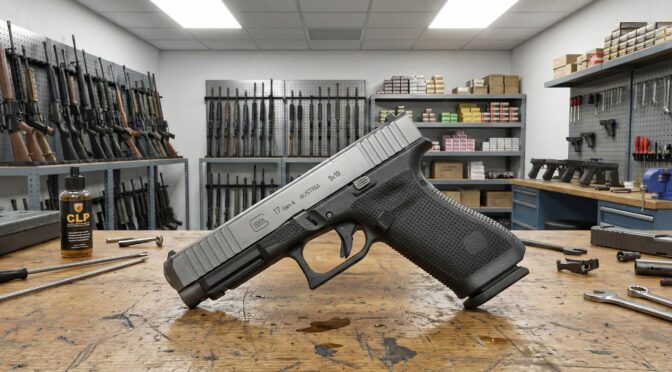
The global small arms market is currently observing the most significant strategic bifurcation in the history of Glock Ges.m.b.H. For nearly four decades, the Austrian manufacturer has dominated the striker-fired pistol market through a philosophy of iterative, conservative evolution—a strategy famously encapsulated by their marketing axiom, “Perfection.” However, the 2025-2026 product cycle marks a radical departure from this monolithic approach. Our analysis of open-source intelligence, patent filings, and industry releases confirms that Glock is effectively splitting its product identity into two distinct lineages: the V Series, a compliance-driven baseline platform designed to insulate the company from liability, and the Generation 6 (Gen 6), a performance-centric evolutionary leap designed to recapture market share from technically superior competitors.
This report provides an exhaustive technical and market analysis of this schism. The introduction of the V Series in December 2025 1 and the subsequent release of the Gen 6 in January 2026 3 represents a coordinated response to two existential threats. The first threat is legal and regulatory: the proliferation of illegal auto-sears (“switches”) has drawn intense scrutiny from U.S. legislators, necessitating a hardware-level lockout mechanism found in the V Series.5 The second threat is competitive: the widespread adoption of pistol-mounted optics and advanced ergonomics by rivals such as Sig Sauer and Walther has rendered the legacy Glock Modular Optic System (MOS) and blocky grip geometry obsolete, necessitating the Gen 6 overhaul.6
The industry implications of this shift are profound. By discontinuing the bulk of the Gen 3, Gen 4, and Gen 5 commercial lines in favor of the V Series 8, Glock is forcing a hardware reset on its consumer base and the aftermarket ecosystem. Simultaneously, the Gen 6 introduces a new direct-mount optic standard and ergonomic features that break compatibility with decades of holster and accessory infrastructure. This report advises that institutional and private consumers must now navigate a complex landscape where “Glock compatibility” is no longer a universal constant.
2. Historical Engineering Context: The Trajectory to Gen 6
To fully appreciate the magnitude of the Gen 6 and V Series engineering decisions, one must first analyze the technical lineage that precipitated this divergence. Glock’s engineering history is characterized by a reluctance to alter the core “Safe Action” system unless forced by caliber shifts or profound market pressure.
2.1 The Single-Spring Era (Gen 1–3)
The foundational architecture of the Glock 17 (Gen 1 through Gen 3) utilized a single captive recoil spring assembly. This design was optimized for the 9x19mm Parabellum cartridge. The single spring provided a linear recoil impulse, high reliability with a wide range of ammunition pressures, and simplified logistics. It became the industry benchmark for reliability. However, as the.40 S&W cartridge gained dominance in U.S. law enforcement during the 1990s and 2000s, the single-spring system—originally calculated for 9mm forces—struggled with the sharper pressure curve and slide velocity of the.40 caliber, leading to accelerated frame wear and muzzle flip.
2.2 The Dual-Spring Pivot (Gen 4–5)
The introduction of the Generation 4 (and subsequently Gen 5) marked a shift to a dual, nested recoil spring assembly. This engineering change was primarily driven by the need to tame the.40 S&W cartridge. The dual-spring system functions by using a lighter outer spring for initial slide movement and a heavier inner spring to cushion the slide at the rear of its travel, preventing frame battering. While effective for.40 S&W, this system was technically over-engineered for the 9mm platform. For 9mm shooters, the dual-spring system introduced a non-linear recoil impulse—a “hump” in the slide travel that some competitive shooters found less predictable than the linear push of the Gen 3.9
2.3 The Stagnation of the MOS System
With Generation 4 and 5, Glock introduced the Modular Optic System (MOS). While it allowed Glock to enter the optics-ready market, the MOS design was fundamentally flawed compared to direct-mill solutions. It relied on a “one-cut-fits-all” slide milling masked by various adapter plates. This introduced “tolerance stacking,” where the variances in the slide cut, the plate, and the optic combined to reduce structural integrity. The use of adapter plates also increased the “height over bore,” forcing the optic higher on the slide and often preventing the use of standard iron sights as backups. Furthermore, the reliance on short screws to hold the plate to the slide, and separate screws to hold the optic to the plate, created multiple failure points for shear stress.10 By 2024, the MOS system was widely regarded by industry engineers as a stopgap solution that had outlived its viability, with professional end-users frequently discarding the factory plates in favor of aftermarket solutions from manufacturers like Forward Controls Design or CHPWS.
2.4 The Crisis of Conformity
By late 2024, Glock faced a “pincer movement” of pressure. On the technical front, competitors like the Walther PDP had introduced superior grip textures and direct-mount optic cuts. On the legal front, the prevalence of “Glock Switches”—illegal auto-sears that replace the slide cover plate—had led to lawsuits and legislation (such as California’s AB 1127) targeting the widespread convertibility of the platform.11 The Gen 5 architecture, with its standard slide cover plate interface, was deemed too vulnerable to these modifications. The company could no longer rely on a single product line to satisfy both the performance demands of the market and the compliance demands of the courts.
3. The V Series: Engineering for Compliance and Liability Mitigation
Official Designation: Glock V Series
Release Date: December 2025
Strategic Role: Commercial Baseline / Liability Shield
The V Series is the most controversial release in Glock’s history. Contrary to initial social media speculation that “V” stood for “Victory” or a Roman numeral variant, industry analysis indicates the designation represents a divergence from the standard generational nomenclature to signify a distinct regulatory category. It is a “compliance-first” platform.
3.1 The Anti-Switch Architecture
The defining characteristic of the V Series is its resistance to unauthorized full-auto conversion. Standard “Glock Switches” function by exploiting the space behind the cruciform of the trigger bar. A selector switch on the backplate depresses the trigger bar as the slide moves forward, bypassing the disconnector and allowing the striker to release immediately upon battery, facilitating automatic fire.13
To counteract this, the V Series introduces a tripartite engineering lockout:
- Hardened Steel Rail Block: Unlike previous generations which used a polymer over-mold or open channel, the V Series incorporates a hardened steel rail interface at the rear of the slide/frame engagement.5 This physical barrier changes the internal geometry of the slide’s rear, effectively blocking the intrusion of the trip arm found on standard auto-sears.
- Cruciform Geometry Revision: The trigger bar’s cruciform—the component that holds the striker lug—has been redesigned. The interaction point where a switch would depress the bar has been altered, meaning even if a device could penetrate the slide, it would fail to engage the trigger mechanism to force a disconnect failure.5
- Slide Cover Plate Incompatibility: The interface for the slide cover plate has been modified to prevent the seating of standard Gen 3-5 backplates, which are the host component for most auto-switch devices.15
Implications: This redesign renders the V Series incompatible with the vast majority of aftermarket triggers designed for Gen 5, including Glock’s own “Performance Trigger” (GPT), which utilizes a different housing geometry.16
3.2 The “Baseline” Philosophy and Discontinuation
Coinciding with the V Series launch, Glock initiated a massive discontinuation of its legacy commercial portfolio. As of November 30, 2025, production ceased for most Gen 3 and Gen 4 models, as well as Gen 5 MOS models.2 The V Series serves as the replacement “baseline” product.
This move forces a market consolidation. By removing the easily convertible legacy models from the commercial supply chain, Glock creates a “firebreak” against liability claims. If a user modifies a V Series pistol to fire fully automatically—which reports suggest is already happening via new, complex machining methods 12—Glock can argue in court that they engineered significant barriers to prevent such misuse, shifting the burden of liability entirely to the criminal actor.
3.3 Product Matrix: V Series Models
The initial V Series rollout focuses on the core 9mm and major caliber duty roles, effectively mirroring the Gen 5 lineup but with the new internal architecture.4
| Model | Caliber | Role | Key Distinction |
| G17 V | 9x19mm | Standard Duty | Non-MOS at launch; Anti-switch rail. |
| G19 V | 9x19mm | Compact Carry | Non-MOS at launch; Anti-switch rail. |
| G45 V | 9x19mm | Crossover | Anti-switch rail; Replaces G45 Gen 5. |
| G26 V | 9x19mm | Subcompact | Updated internal geometry. |
| G23 V | .40 S&W | Compact Duty | Available in MOS configurations. |
| G20 V | 10mm Auto | Heavy Duty | Available in MOS configurations. |
Analyst Insight: It is notable that while 9mm V models launched without MOS cuts initially 18, the large-frame (10mm,.45 ACP) and.40 S&W V models appear to retain MOS compatibility sooner.16 This likely reflects the lower volume of these calibers and the specific demands of the hunting/outdoor market which relies heavily on optics.
4. Generation 6: A Technical Deep Dive into Modernization
Official Designation: Generation 6 (Gen 6)
Announcement Date: December 6, 2025
Projected Availability: January 20, 2026
Target Audience: Professional End-Users, Competition Shooters, Enthusiasts
If the V Series is the shield, the Gen 6 is the sword. The Generation 6 platform represents the most aggressive ergonomic and mechanical update to the Glock pistol since 1998. It directly addresses the “Perfection Paradox”—the idea that the pistol was perfect and therefore unchangeable—by acknowledging and rectifying long-standing user complaints regarding grip angle, texture, and optic mounting.
4.1 The “Optic Ready” Revolution: Death of MOS
The headline feature of the Gen 6 is the abandonment of the MOS system in favor of a proprietary direct-mount architecture.
The Engineering Problem:
As established, the MOS system’s reliance on adapter plates introduced height-over-bore issues and mechanical weakness. The sheer force exerted on an optic during the slide’s reciprocation (up to 10,000 Gs) often sheared the shallow screws used in plate systems.
The Gen 6 Solution:
The Gen 6 utilizes a system derived from the “A-Cut” developed for the Glock/Aimpoint COA contract.7
- Direct Thread Engagement: The slide is machined with a “universal” pocket that allows optic mounting screws to thread directly into the slide steel, rather than into a thin adapter plate. This dramatically increases the tensile strength of the mount.19
- Polymer Interface Plates: Instead of structural steel plates, the Gen 6 uses polymer interface plates. These are not adapters in the traditional sense; they function as “crush washers” or gaskets. They fill the gap between the optic’s footprint and the slide cut, providing recoil lugs for indexing (e.g., RMR or DPP footprints) and vibration dampening.19
- Low Deck Height: Because the optic sits inside the cut rather than on top of a plate, the deck height is significantly lower. This allows standard-height iron sights to be visible through the optic window (co-witness), eliminating the need for suppressor-height “tall” sights that can snag on holsters.20
Operational Impact: This system provides the durability of a custom-milled slide with the modularity of a factory system. It is a direct challenge to the supremacy of the Trijicon RMR and Holosun ecosystems, forcing them to conform to this new universal pocket.
4.2 Mechanical Reversion: The Return of the Single Recoil Spring
In a move that surprised many engineers, the Gen 6 9mm models (G17, G19, G45, G49) have reverted to a single captive recoil spring assembly, abandoning the dual-spring system of the Gen 4 and 5.7
Physics and Ballistics:
With the global decline of the.40 S&W cartridge, the structural necessity for the dual spring has evaporated. For 9mm ballistics, a single spring offers a smoother, more consistent recoil impulse. The dual spring often created a non-linear resistance curve—a soft start followed by a hard “wall” as the secondary spring engaged. The single spring provides a linear resistance, which skilled shooters find easier to track during rapid fire. This simplification also reduces the mass of the reciprocating assembly, potentially aiding in faster cycle times.
Compatibility Note: This change renders Gen 6 recoil assemblies incompatible with Gen 4 and Gen 5 slides.21
4.3 Ergonomic Overhaul: “Human Interface” Redesign
The Gen 6 frame represents a total re-sculpting of the Glock grip, moving away from the “block” aesthetic toward a more organic, anatomical shape.
- Palm Swell: The side panels of the grip now feature a subtle curvature (palm swell), filling the void in the user’s palm that previous generations left empty. This increases the surface area of contact between hand and gun, improving recoil control through friction.4
- Integrated Thumb Rests (“Gas Pedals”): Perhaps the most radical frame change is the inclusion of textured ledges on both sides of the frame, forward of the slide lock. These “gas pedals” provide a dedicated index point for the support-hand thumb. By applying downward pressure on this ledge, the shooter can mechanically counteract muzzle rise.6 This feature, previously only available through custom polymer work (“stippling”), is now factory standard.
- Enlarged Beavertail: The frame now features a prominent, integrated beavertail. This extends rearward over the web of the hand, protecting the shooter from “slide bite” and allowing for a significantly higher grip purchase. A higher grip places the bore axis lower relative to the wrist, reducing the lever arm of recoil and minimizing muzzle flip.4
- RTF6 Texture: A new texturing pattern, dubbed RTF6, combines the aggressive “pyramid” structure of the Gen 2/3 RTF2 with the dot pattern of the Gen 4/5. This hybrid texture is applied to a larger surface area, wrapping fully around the grip and covering the new thumb rests.6
4.4 Trigger and Barrel Architecture
- Flat-Faced Trigger: Responding to aftermarket trends, the Gen 6 ships with a flat-faced trigger shoe. This geometry provides a consistent tactile index point for the finger and increases the mechanical leverage slightly, making the pull feel lighter and more consistent.4
- Barrel Geometry: The Gen 6 barrels feature new locking block geometry and chamfering. They are not interchangeable with previous generations.21 This change likely correlates with the single recoil spring and the need to optimize lock-up timing for the new mass distribution of the slide.
5. Comparative Matrix: Gen 5 vs. V Series vs. Gen 6
The following table summarizes the technical divergences across the three relevant platforms, illustrating the clear delineation between legacy, compliance, and performance lines.
| Feature / System | Generation 5 (Legacy) | V Series (2025) | Generation 6 (2026) |
| Status | Discontinued (mostly) Nov 2025 | Active (Baseline/Compliance) | Active (Flagship/Performance) |
| Primary Market | General Commercial / LE | Compliance / Liability Averse | Enthusiast / Premium LE |
| Recoil System | Dual Captive Spring | Dual Captive Spring (Presumed) | Single Captive Spring |
| Optic System | MOS (Adapter Plates) | None (Initial) / MOS (Select) | Direct Mount (Polymer Interface) |
| Trigger Style | Curved Face | Curved Face (Anti-Switch mod) | Flat Face |
| Grip Texture | RTF4 (Dots) | RTF4 (Standard) | RTF6 (Hybrid Aggressive) |
| Ergonomics | Standard Block Frame | Standard Block Frame | Palm Swell, Ext. Beavertail |
| Frame Features | Smooth Dust Cover | Smooth Dust Cover | Integrated Thumb Rests (“Gas Pedals”) |
| Auto-Sear Block | None | Steel Rail / Geo Change | Unknown (likely present) |
| Barrel Compat. | Gen 5 Specific | Gen 5 Compatible (Likely) | Gen 6 Exclusive |
| Price Point | ~$540-$620 | ~$540 (Est.) | ~$745 (MSRP) / ~$650 (Street) |
6. Market and Industry Impact Analysis
6.1 The End of the Universal Glock Ecosystem
For decades, the “universal compatibility” of Glock parts was a primary selling point. A Gen 3 magazine fit a Gen 5 gun; sights were universal; holsters were largely interchangeable. The simultaneous release of the V Series and Gen 6 shatters this ecosystem.
- Aftermarket Disruption: Trigger manufacturers (Apex, Timney, Johnny Glocks) face a crisis. Their existing inventory of Gen 5 triggers is incompatible with the V Series due to the anti-switch geometry and potentially incompatible with the Gen 6 due to housing changes. They must now R&D two separate product lines.
- Holster Obsolescence: The Gen 6 “gas pedals” significantly widen the frame profile at the trigger guard. This renders the vast majority of existing Kydex holsters—particularly rigid duty holsters like the Safariland 6360 or 7TS series—incompatible.24 The holster industry will require 6-12 months to re-tool molds for the Gen 6 geometry.
6.2 Competitor Landscape
The Gen 6 is a direct counter-attack against specific competitors:
- Sig Sauer P320/P365: Sig’s dominance in modularity and optics readiness eroded Glock’s market share. The Gen 6’s direct-mount system is an attempt to match Sig’s “Romeo” integration ease.
- Walther PDP: The PDP is widely praised for its texture and ergonomics. The Gen 6’s RTF6 texture, palm swell, and flat trigger are clear attempts to neutralize the PDP’s advantages.
- HK VP9: The palm swell and ergonomic focus of the Gen 6 mimic the “custom fit” philosophy of the VP9.
6.3 Law Enforcement Transition Challenges
For Law Enforcement agencies, this bifurcation presents a logistical nightmare. Agencies currently fielding Gen 5 pistols cannot simply “top up” their armories with new purchases, as the Gen 5 is discontinued. They must choose between the V Series (which maintains holster compatibility but lacks performance features) or the Gen 6 (which offers performance but requires purchasing entirely new holsters and spare parts). We predict a significant delay in agency procurements in 2026 as departments evaluate the cost-benefit analysis of these two paths.
7. Consumer Guidance and Operational Doctrine
7.1 The “V Series” Dilemma: To Buy or Avoid?
Recommendation: Avoid for Enthusiasts.
From a pure performance engineering standpoint, the V Series offers no advantages over the Gen 5. It is a product of subtraction, not addition. The internal modifications to prevent switch installation effectively “lock out” desirable upgrades and introduce a new, proprietary parts standard that offers no ballistic or ergonomic benefit.
- Exception: Consumers in restrictive jurisdictions (California, Massachusetts) or those purchasing for liability-conscious entities (security firms) may find the V Series the only available option.
7.2 The Gen 6 Value Proposition
Recommendation: Buy for Performance.
The Gen 6 represents a tangible, functional upgrade. The integration of the thumb rests alone saves the consumer the cost of custom frame stippling (typically $200-$400). The direct mount optic system saves the cost of high-end aftermarket plates ($60-$80) and offers superior reliability.
- Price Analysis: With an MSRP of $745 6, the Gen 6 is priced higher than previous generations. However, when calculating the “hidden costs” of upgrading a Gen 5 (sights, plate, stippling, trigger), the Gen 6 is remarkably cost-effective.
7.3 The “Panic Buy” Strategy
We are currently observing “panic buying” of Gen 5 MOS models.8 This behavior is rational. The Gen 5 MOS represents the peak of the “tunable” Glock platform—compatible with the vast, mature ecosystem of triggers, barrels, and accessories that the V Series and Gen 6 will largely orphan.
- Investment Advice: Collectors and serious shooters should prioritize acquiring Gen 5 MOS models and Gen 3 “legacy” models (like the G17L) immediately. The secondary market value of these “unlocked” frames is projected to rise by 20-30% in Q1 2026 as supply dries up.
7.4 Training Implications
The introduction of the Gen 6 requires a doctrinal update for shooters.
- Grip Mechanics: Instructors must teach students to actively utilize the “gas pedals.” A passive grip will not realize the recoil mitigation benefits of the new frame.
- Optic Zeroing: The lower deck height of the Gen 6 optic system will change the “hold over” data for close-range shots (0-7 yards) compared to the taller MOS system.
8. Summary of Specifications
The following table details the launch specifications for the Generation 6 platform, derived from official announcements and technical leaks.
| Specification | Glock 17 Gen 6 | Glock 19 Gen 6 | Glock 45 Gen 6 | Glock 49 Gen 6 |
| Caliber | 9x19mm | 9x19mm | 9x19mm | 9x19mm |
| Barrel Length | 4.49 in (114 mm) | 4.02 in (102 mm) | 4.02 in (102 mm) | 4.49 in (114 mm) |
| Capacity | 17+1 | 15+1 | 17+1 | 15+1 |
| Slide Material | Steel (nDLC Finish) | Steel (nDLC Finish) | Steel (nDLC Finish) | Steel (nDLC Finish) |
| Frame Material | Polymer (RTF6) | Polymer (RTF6) | Polymer (RTF6) | Polymer (RTF6) |
| Optic System | Direct Mount (Polymer Interface) | Direct Mount (Polymer Interface) | Direct Mount (Polymer Interface) | Direct Mount (Polymer Interface) |
| Recoil System | Single Captive Spring | Single Captive Spring | Single Captive Spring | Single Captive Spring |
| Release Date | Jan 20, 2026 | Jan 20, 2026 | Jan 20, 2026 | Jan 20, 2026 |
| MSRP | ~$745 | ~$745 | ~$745 | ~$745 |
| Notable Features | Gas Pedals, Flat Trigger | Gas Pedals, Flat Trigger | Gas Pedals, Flat Trigger | Crossover (Long Slide/Short Grip) |
9. Future Outlook
The release of the Gen 6 suggests that Glock is moving toward a specialized future. We anticipate that the “C” (Compensated) models will return within the Gen 6 lineup by late 2026 to compete with the Sig P365 Macro and Spectre Comp series. Furthermore, the rotating barrel technology seen in the Glock 46 patents remains a “wildcard”.25 While absent from the initial Gen 6 launch, it may resurface in a future “Gen 6 Supreme” or military-specific contract pistol.
The V Series, while unexciting to the enthusiast, effectively secures Glock’s existence in the U.S. market against the rising tide of litigation. It is the “foundation” that allows the “skyscraper” of the Gen 6 to exist. Without the V Series mitigating liability, the innovative risks of the Gen 6 might not have been financially viable.
10. Conclusion
Glock’s 2026 strategy is a calculated bifurcation that prioritizes survival and modernization in equal measure. The V Series acts as a regulatory firewall, securing the company’s liability flank against the “switch” epidemic and ensuring continued sales in restrictive jurisdictions. It is a necessary, if uninspired, evolution.
The Gen 6, conversely, is the modernization offensive the market has demanded for a decade. By integrating direct-mount optics, aggressive texturing, and recoil-mitigating ergonomics, Glock has finally modernized its platform to meet the standards set by its competitors. However, this progress comes at the cost of the universal compatibility that defined the brand. The era of “Legos for adults”—where any Glock part fit any Glock—is effectively over. The future is segmented, specialized, and higher-performance.
Appendix A: Research Methodology
This report was compiled using a multi-source intelligence gathering methodology, synthesizing open-source intelligence (OSINT), industry press releases, patent filings, and technical specifications released by authorized distributors.
1. Source Categorization:
- Primary Sources: Official press releases from Glock Inc. (Smyrna, GA) and Glock Ges.m.b.H. (Austria) were prioritized for technical specifications (dimensions, operating system changes, release dates).
- Secondary Sources: Industry journalism (e.g., American Rifleman, All4Shooters, Pew Pew Tactical) was utilized to verify release dates, physical handling impressions (ergonomics, texture), and confirm the “direct mount” nature of the optic cut.
- Tertiary Sources: Distributor leak data (SKU lists, pricing) and social media/forum discourse (Reddit, GlockTalk) were analyzed to gauge market sentiment, identify unauthorized leaks (e.g., the “V Series” leaks from Oct 2025), and track the real-world emergence of holster compatibility issues.
2. Verification Protocol:
- Conflicting Data Resolution: Initial reports regarding a “Rotating Barrel” (Glock 46 technology) were cross-referenced against official Gen 6 launch announcements. The confirmation of “Single Recoil Spring” and “Tilting Barrel” in the Gen 6 launch materials 9 allowed us to isolate the rotating barrel technology to separate, non-commercial projects.
- Date Triangulation: Release dates were triangulated between European announcements (IWA 2026) and US announcements (SHOT Show 2026) to provide a unified global timeline.
3. Technical Inference:
- Engineering Deduction: Where explicit engineering data was redacted (e.g., specific alloy of the V series rail), standard small arms engineering principles were applied to infer functionality based on the stated goal (“Anti-Switch”).
- Optic System Analysis: The analysis of the optic system’s “polymer interface” was derived from descriptions of the Glock/Aimpoint COA contract 7, applying mechanical engineering principles regarding shear strength, fastener torque specifications, and tolerance stacking.
4. Limitations:
- Physical Verification: Access to physical pre-production samples of the V Series anti-switch rail was not available for independent metallurgic verification.
- Long-term Reliability: Reliability data for the Gen 6 single recoil spring in 9mm +P loads is currently projected based on historical Gen 3 performance data and has not been independently verified through high-round-count torture testing.
If you find this post useful, please share the link on Facebook, with your friends, etc. Your support is much appreciated and if you have any feedback, please email me at in**@*********ps.com. Please note that for links to other websites, we are only paid if there is an affiliate program such as Avantlink, Impact, Amazon and eBay and only if you purchase something. If you’d like to directly contribute towards our continued reporting, please visit our funding page.
Sources Used
- BREAKING NEWS: Glock Announces new V-Series Pistols | Shoot On, accessed December 8, 2025, https://shoot-on.com/breaking-news-glock-announces-new-v-series-pistols/
- Glock Confirms V Series, Discontinues Gen 4 & Gen 5 Pistols [UPDATED!], accessed December 8, 2025, https://www.pewpewtactical.com/glock-discontinue-popular-pistols/
- Glock announces its Gen6 pistols! | GUNSweek.com, accessed December 8, 2025, https://gunsweek.com/en/pistols/news/glock-announces-its-gen6-pistols
- BREAKING – The GLOCK Gen6 pistols are coming! | all4shooters, accessed December 8, 2025, https://www.all4shooters.com/en/shooting/pistols/glock-gen6-starting-from-january-20th-2026/
- Facing Legal Pressure, Glock Revamps Pistols To Prevent Machine Gun Conversions, accessed December 8, 2025, https://www.thetrace.org/2025/11/glock-switch-ban-new-pistol-machine-gun/
- New Product Highlight: Glock Launches Gen6 – Pew Pew Tactical, accessed December 8, 2025, https://www.pewpewtactical.com/new-product-highlight-glock-gen6/
- BREAKING – The GLOCK Gen6 pistols are coming! – All4Shooters.com, accessed December 8, 2025, https://www.all4shooters.com/en/shooting/pistols/glock-gen6-pistols-announced-available-from-january-20th-2026/
- Glock Discontinuing Gen 4 & Gen 5 Models: Complete List + What You Need to Know, accessed December 8, 2025, https://damagefactory.com/glock-discontinuing-gen-4-gen-5-models-complete-list-what-you-need-to-know/
- Glock Unveils Its GEN6, V-Series Pistols | An Official Journal Of The NRA, accessed December 8, 2025, https://www.americanrifleman.org/content/glock-unveils-its-gen6-v-series-pistols/
- Gen 6 Optic mounting concerns : r/Glocks – Reddit, accessed December 8, 2025, https://www.reddit.com/r/Glocks/comments/1pg014o/gen_6_optic_mounting_concerns/
- Glock V pistols, coming November 2025 (in the US) – GUNSweek.com, accessed December 8, 2025, https://gunsweek.com/en/pistols/news/glock-v-pistols-coming-november-2025-us
- Glock’s New V-Series Just Hit A Major Problem: Reports Of New “Switch” Compatibility Surface » Concealed Carry Inc, accessed December 8, 2025, https://www.concealedcarry.com/gear/glocks-new-v-series-just-hit-a-major-problem-reports-of-new-switch-compatibility-surface/
- Glock switch – Wikipedia, accessed December 8, 2025, https://en.wikipedia.org/wiki/Glock_switch
- “Glock Switches” and Auto Sears – The Smoking Gun, accessed December 8, 2025, https://smokinggun.org/glock-switches-auto-sears/
- Top 5 Things We Know About the Glock V Series: Latest Updates and Features, accessed December 8, 2025, https://www.cyasupply.com/blogs/articles/top-5-things-we-know-about-the-glock-v-series-latest-updates-and-features
- The Glock V-Series is HERE: Everything You Need to Know About the Next Evolution of the Polymer Pistol, accessed December 8, 2025, https://legion-precisionweaponsystems.com/the-glock-v-series-is-here-everything-you-need-to-know-about-the-next-evolution-of-the-polymer-pistol/
- Shop All Glock Models | Best Prices on Glock Pistols – Palmetto State Armory, accessed December 8, 2025, https://palmettostatearmory.com/brands/glock.html
- Rumor Alert: GLOCK Discontinuing Vast Majority of Handguns, Introducing “V Models” to Combat Switch Conversions – USA Carry, accessed December 8, 2025, https://www.usacarry.com/rumor-alert-glock-discontinuing-vast-majority-of-handguns-introducing-v-models-to-combat-switch-conversions/
- GLOCK Gen 6: The Next Evolution Of Perfection [FIRST LOOK] – Recoil Magazine, accessed December 8, 2025, https://www.recoilweb.com/glock-gen-6-the-next-evolution-of-perfection-first-look-190560.html
- A look at the new Glock and Aimpoint Collab – SHOT Show 2025 – YouTube, accessed December 8, 2025, https://www.youtube.com/watch?v=sycjfwNX9sI
- GLOCK Introduces the Gen 6 – The Armourers Bench, accessed December 8, 2025, https://armourersbench.com/2025/12/06/glock-introduces-the-gen-6/
- Glock Gen6: All the details on the new pistols – Militär Aktuell, accessed December 8, 2025, https://militaeraktuell.at/en/glock-gen6-all-the-details-on-the-new-pistols/
- GLOCK Reveals the Highly Anticipated 6th Generation of GLOCK Pistols, accessed December 8, 2025, https://us.glock.com/en/Press-Release/News-Page/Gen6-Announcement
- Gen 6 Holster Compatibility : r/Glocks – Reddit, accessed December 8, 2025, https://www.reddit.com/r/Glocks/comments/1pgk66s/gen_6_holster_compatibility/
- Glock 46: Solicited Pistol Is Real and It Has a Rotating Barrel – Athlon Outdoors, accessed December 8, 2025, https://athlonoutdoors.com/article/glock-46-real-rotating-barrel/