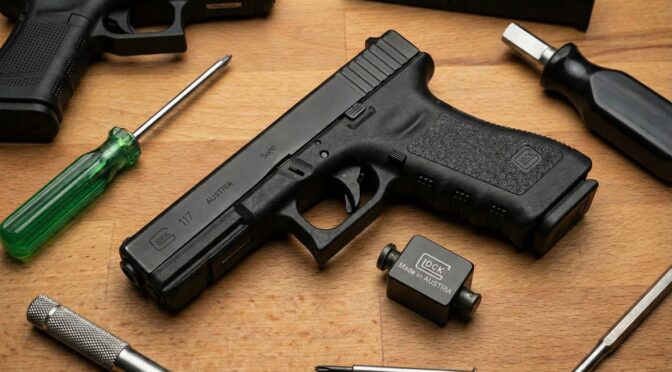
The global small arms industry stands at a critical juncture, precipitated by the proliferation of the “Glock Switch,” an illicit auto-sear capable of converting the world’s most ubiquitous polymer-framed pistol into a subcompact machine gun. This report provides a comprehensive technical and strategic analysis of this phenomenon, dissecting the engineering vulnerabilities of the Glock Safe Action® System, the subsequent development of the “V Series” countermeasure, and the complex web of legal and regulatory pressures driving these design changes.
Our analysis indicates that the introduction of the V Series in late 2025 represents a paradigm shift in firearm manufacturing strategy. While publicly positioned as a safety innovation, the engineering reality suggests the V Series is primarily a legal bulwark designed to navigate the tightening definition of “readily convertible” firearms in jurisdictions like California and Illinois. The immediate defeat of the V Series’ anti-conversion features by illicit manufacturers—occurring within days of the platform’s release—confirms that mechanical “switch-proofing” is an asymptotic engineering goal within the constraints of the current Glock architecture. Consequently, the industry is witnessing a transition from purely performance-driven design to “compliance-driven engineering,” where the primary design constraint is no longer reliability or ergonomics, but liability mitigation.
1. Technical Anatomy of the Crisis: The Glock Safe Action® Architecture
To understand the mechanics of the unauthorized conversion and the limitations of Glock’s countermeasures, it is essential to establish a granular understanding of the pistol’s baseline engineering. The Glock design, celebrated for its simplicity, relies on a striker-fired mechanism that differs fundamentally from the hammer-fired systems it replaced in law enforcement service.
1.1 The Cruciform Trigger Bar Assembly
The nexus of the conversion vulnerability lies in the geometry of the trigger bar. In the standard Glock architecture (Gen 1 through Gen 5), the trigger bar is a stamped sheet metal component that transfers the kinetic energy of the operator’s trigger pull to the fire control group located at the rear of the frame.
The rear section of this bar is shaped into a cruciform (cross) structure. This component performs two critical, simultaneous functions during the firing cycle:
- Sear Engagement: The rearward lip of the cruciform acts as the sear. It engages the lug of the firing pin (striker), holding it under tension against the striker spring.
- Drop Safety Mechanics: The cruciform rides on a polymer “safety ramp” or shelf integral to the trigger mechanism housing. In the resting state, this shelf physically supports the cruciform, preventing it from dropping downwards and releasing the striker, even if the weapon is subjected to extreme vertical acceleration (e.g., being dropped).
This open-top design, where the sear interface is essentially a flat plane accessible from the top of the frame, is distinct from competitors like the Sig Sauer P320 or the Heckler & Koch VP9. Those platforms utilize rotary sears or fully enclosed chassis systems where the critical engagement surfaces are buried deep within the mechanism, shielded by the slide rails and housing geometry. The Glock’s design, which emphasizes ease of maintenance and minimal part count, inadvertently leaves the cruciform sear exposed to manipulation from the rear of the slide—specifically, through the opening occupied by the slide cover plate.1
1.2 The Semi-Automatic Firing Cycle Mechanics
A review of the standard operating cycle reveals the precise moment of vulnerability exploited by the auto-sear.
- Phase 1: Pre-Travel and Safety Disengagement. As the operator depresses the trigger, the trigger bar moves rearward. The vertical extension on the trigger bar engages the firing pin safety plunger in the slide, pushing it upward to clear the striker channel. Simultaneously, the trigger safety lever on the shoe disengages from the frame.
- Phase 2: The Break. As the trigger bar continues its rearward travel, the cruciform moves off the drop-safety shelf. It then contacts the connector, a small, angled metal leaf spring. The connector acts as a ramp, forcing the rear of the trigger bar downward. This downward vector causes the cruciform sear to slip off the striker lug. The striker, now free, is propelled forward by the striker spring to impact the primer.1
- Phase 3: The Disconnect (The Critical Interval). Upon discharge, the slide reciprocates rearward under recoil forces. A cam track machined into the slide interacts with the connector, pushing it inward towards the center of the housing. This action “disconnects” the trigger bar from the connector’s path, allowing the trigger bar to spring upward. As the slide returns to battery (moves forward), the striker lug catches the raised cruciform sear. The weapon is now cocked.
- Phase 4: Reset. The operator must physically release the trigger. This allows the trigger bar to move forward, resetting closely against the connector, ready for the next pull. This requirement for a physical reset is what defines the semi-automatic function.
2. Engineering the Override: Mechanics of the “Glock Switch”
The device colloquially known as the “Glock switch” is, in engineering terms, a drop-in auto-sear. It does not replace the existing fire control group but rather introduces a parasitic mechanical logic that overrides the disconnect function described above.
2.1 Mechanical Interaction
The auto-sear is fundamentally a replacement slide cover plate (backplate) equipped with a selector switch and a protruding “sear trip” or leg. This leg extends forward from the backplate into the internal cavity of the slide housing, occupying the space directly above the trigger mechanism housing.5
The conversion mechanics function as follows:
- Selection: When the selector is toggled to the “automatic” position, the sear trip is lowered into the operational path of the trigger bar.
- The Forced Trip: As the slide cycles forward into battery after a shot is fired, the sear trip physically strikes the cruciform section of the trigger bar.
- Bypass of Reset: This impact forces the trigger bar downward mechanically, replicating the action of the connector but doing so automatically as a function of the slide’s position.
- Timing: The geometry of the sear trip is tuned to depress the cruciform at the precise moment the slide achieves battery (closes). Because the cruciform is held down, it cannot catch the striker lug. The striker is essentially “handed off” from the rearward movement of the slide directly to a released state, impacting the primer immediately.
- Cycle Loop: As long as the operator maintains pressure on the trigger (keeping the drop safety disengaged and the trigger bar in a position to be struck), this cycle repeats. The rate of fire is determined solely by the spring constant of the recoil spring and the mass of the slide, typically resulting in a cyclic rate of 1,100 to 1,200 rounds per minute.6
2.2 The “Drop-In” Vulnerability
The defining characteristic of this threat is the low barrier to entry. The conversion does not require milling, drilling, or sophisticated gunsmithing. It requires only the removal of the standard backplate and the insertion of the switch—a process that can be completed in seconds without tools. This “plug-and-play” capability is a direct result of the Glock’s design architecture, which provides a straight-line access channel to the sear from the rear of the slide.2
| Feature | Standard Operation | Operation with Auto-Sear |
| Trigger Bar Reset | Required after every shot | Bypassed; bar held down |
| Striker Capture | Captured by sear on return to battery | Released immediately upon battery |
| Cycle Control | Operator input (finger release) | Mechanical timing (slide position) |
| Cyclic Rate | Semi-Auto (User dependent) | ~1,200 RPM (Spring/Mass dependent) |
3. The Countermeasure: Glock V Series Engineering Analysis
In October 2025, Glock formally announced the “V Series” (Gen V), a new generation of pistols intended to replace the Gen 4 and Gen 5 lines. While marketed with standard industry rhetoric regarding “future innovations” and “streamlining,” the technical changes reveal a singular focus: anti-conversion denial.9
3.1 Design Philosophy: Physical Interference
The engineering strategy behind the V Series is not a redesign of the fire control group (which would require a completely new platform) but rather the introduction of physical interference geometry. The goal is to occupy the specific volume of space required by the auto-sear’s trip leg, thereby preventing its installation or function.11
3.2 Specific Design Alterations
Analysis of technical reports and patent filings suggests three primary modifications in the V Series:
- The “Blocker Rail” Insert: The most significant alteration is the addition of a hardened steel insert or “rail” at the rear of the frame/slide interface. This component is strategically located in the channel previously used by the auto-sear’s leg to reach the cruciform. In previous generations, this area contained empty space or a soft polymer overmold. The steel insert acts as a physical barrier, theoretically shearing off or blocking any device attempting to protrude into the sear housing.9
- Slide Cover Plate Interface Revision: The geometry of the slide’s rear opening, where the cover plate seats, has been recontoured. This change breaks compatibility with the “universal” backplate form factor that has existed since Gen 1. By altering the dimensions and locking interface of the backplate, Glock renders the existing stockpile of illicit switches mechanically incompatible.9
- Trigger Bar Geometry Shift: Reports indicate subtle changes to the dimensions of the cruciform itself and its relationship to the housing. By altering the vertical or horizontal position of the sear engagement surface, Glock attempts to desynchronize the timing of existing auto-sears, ensuring that even if a device were inserted, it would fail to trip the sear at the correct moment for ignition.9
3.3 Strategic Obsolescence: The “Hard Fork”
Concurrent with the V Series launch, Glock announced the discontinuation of Gen 3, Gen 4, and most Gen 5 models.14 This decision is strategically significant. By cutting off the supply of “legacy” frames that are known to be convertible, Glock is attempting to flush the market over time. While millions of legacy Glocks remain in circulation, the new inventory entering the commercial channel will be the hardened V Series. This creates a divergence in the market: a “legacy” market of convertible firearms and a “modern” market of non-convertible (theoretically) firearms.15
4. Operational Failure: The Speed of Defeat
The crucial metric for evaluating the V Series is its resistance to adaptation by illicit manufacturers. The data indicates that the V Series failed to provide a durable engineering solution, with countermeasures appearing almost instantaneously.
4.1 Timeline of the Bypass
The speed at which the black market adapted to the V Series is unprecedented in the history of small arms manufacturing.
- Announcement: October 20, 2025.10
- First Bypass Reports: Late October 2025.15
- Confirmation: By early November 2025, verified videos circulated on social media platforms demonstrating V Series pistols firing in full-auto mode using modified switches.18
This timeline suggests that the “time-to-defeat” was effectively zero days relative to the retail release. Illicit engineers likely obtained pre-production specifications or early T&E (Test and Evaluation) units to develop workarounds before the guns even reached dealer shelves.
4.2 The Mechanics of the Bypass
The “defeat” of the V Series did not require a quantum leap in technology. It required only a slight modification of the manufacturing process or the host weapon.
- Subtracting the Blocker (Milling): The steel rail blocker prevents a drop-in installation. However, users quickly discovered that this blocker could be removed. Using a simple end mill or even a Dremel tool with a carbide burr, the steel rail can be ground down, reopening the channel for the auto-sear leg. This converts the “denial” feature into a mere “speed bump”.11
- Adapting the Switch: Conversely, illicit manufacturers modified the geometry of the switch itself. By thinning the sear trip leg or altering its angle of approach, the device could be made to navigate around the blocker rail while still contacting the cruciform. These “Gen V Switches” appeared on the black market almost immediately.15
- Functionality Compromise: Some early bypass methods resulted in pistols that functioned only in full-automatic mode, losing the selective fire capability. However, this is often considered an acceptable trade-off for the end-users of these devices (criminal enterprises).18
4.3 Implication: The End of “Drop-In”
While the V Series failed to stop conversion, it did achieve one specific engineering goal: it raised the barrier to entry. Conversion now requires machining (removing material from the frame/slide) or specialized parts (Gen V specific switches), rather than the universal drop-in compatibility of previous generations. As we will explore in Section 5, this shift from “assembly” to “machining” is the linchpin of Glock’s legal strategy.
5. The “Why”: Regulatory and Legal Forces Behind the V Series
If Glock’s engineers knew that a physical blocker could be milled out (as any engineer would), why invest in the massive retooling required for the V Series? The answer lies not in mechanics, but in lawfare. The V Series is a direct response to a coordinated legal and legislative assault on the Glock platform.
5.1 The City of Chicago v. Glock Litigation
In March 2024, the City of Chicago filed a landmark lawsuit against Glock, alleging that the company “knowingly manufactures” a product that is uniquely susceptible to conversion, thereby creating a public nuisance.20
- The Argument: The plaintiffs argue that Glock’s design is “negligent” because it allows for conversion with a simple drop-in part, a vulnerability not shared by competitors. They allege Glock has known about this for decades but refused to fix it to protect profits.20
- The Defense Strategy (V Series): The V Series provides Glock with a critical evidentiary defense. In court, Glock can now argue: “We have taken reasonable steps to mitigate this misuse. We redesigned our product line to include physical blockers and discontinued the legacy models.”
- Mitigation of Liability: Even if the V Series is defeated, the fact that a criminal must now use a Dremel to grind away a safety feature shifts the narrative. It moves the act from “exploiting a design flaw” to “willful destruction of safety features.” This creates a stronger defense against claims of negligence and negligent entrustment.17
5.2 California Assembly Bill 1127 (AB 1127)
The most immediate driver of the V Series is likely California’s AB 1127, signed in October 2025. This legislation is a surgical strike against the Glock platform.24
- The Definition: The bill prohibits the sale of “machinegun-convertible pistols.” Crucially, it defines these pistols by specific engineering criteria: any semi-automatic pistol with a “cruciform trigger bar” that can be “readily converted” by “common household tools”.26
- Targeting the Architecture: This language is not generic; it describes the Glock mechanism exclusively. No other major striker-fired pistol uses a cruciform trigger bar in this configuration. The law effectively bans the sale of all legacy Glocks in California.
- The “Readily Convertible” Standard: The term “readily convertible” is the legal fulcrum. Under California Code of Regulations (Title 11, Section 4082), “common household tools” includes screwdrivers and pliers.28 It typically excludes specialized milling equipment or heavy machining.
- The V Series Compliance: By adding the steel blocker, Glock forces the conversion process to require grinding or milling. Glock’s legal team can argue that a modification requiring the removal of hardened steel exceeds the definition of “readily convertible” and requires “manufacturing” rather than simple “assembly.” This technicality allows the V Series to arguably remain legal for sale in California, bypassing the ban that would have decimated Glock’s market share in the state.15
5.3 Federal scrutiny and the “Readily” Standard
The ATF has also tightened its definition of “readily convertible” in relation to frame and receiver rules (2022 Final Rule).30 The V Series aligns with this federal shift by ensuring that the “time, ease, and expertise” required to convert the weapon is increased just enough to argue it is no longer “readily” convertible under the strict statutory definition.
| Jurisdiction | Regulatory Standard | Glock Legacy Status | Glock V Series Status |
| Federal (ATF) | “Readily Restored/Converted” | Potentially Vulnerable | Compliant (Requires Machining) |
| California (AB 1127) | “Cruciform Trigger Bar” + “Common Tools” | Banned | Compliant (Requires Milling) |
| Civil Litigation | “Negligent Design” / “Public Nuisance” | High Liability Risk | Mitigated Defense |
6. Feasibility Analysis: Is a “Switch-Proof” Glock Realistic?
A core question for stakeholders is whether Glock can fundamentally block these switches through design changes. From an engineering perspective, the answer is nuanced but ultimately negative for the current architecture.
6.1 The Inherent Constraint of the Safe Action System
The vulnerability is not a “bug” but a feature of the Safe Action System. The trigger mechanism requires the cruciform sear to drop vertically to release the striker.
- The Physics of the Override: Because the sear must be capable of downward movement to fire the gun, any mechanism that can apply downward force to it will fire the gun.
- Accessibility: The cruciform is located in the rear housing to facilitate assembly and maintenance. As long as there is an opening for the slide cover plate (necessary for removing the striker for cleaning), there is a path for a foreign object to reach the sear.2
6.2 The “Sealed Slide” Option
One theoretical solution is to permanently seal the rear of the slide, eliminating the backplate entirely.
- Trade-off: This would make the striker assembly inaccessible for maintenance. If a striker spring broke or the channel became fouled, the gun would be unserviceable. This would render the weapon unsuitable for duty use, leading to its rejection by police and military contracts.2
6.3 The “Rotary Sear” Solution
The only definitive way to “switch-proof” the pistol is to abandon the cruciform trigger bar entirely and adopt a rotary sear mechanism similar to the Sig P320.
- Trade-off: This would require a complete redesign of the frame, slide, and fire control group. It would effectively mean discontinuing the “Glock” as a mechanical entity and creating a new firearm that merely looks like a Glock. This would cost hundreds of millions in tooling, invalidate all existing armorer training, and destroy the parts compatibility ecosystem that is Glock’s greatest commercial asset.
Conclusion on Feasibility: It is not realistic to think Glock can change the current design enough to physically block switches while retaining the Safe Action System and field serviceability. The V Series represents the limit of what can be done: obstruction, not denial.
7. Market Impact and Future Outlook
The introduction of the V Series and the obsolescence of the Gen 3/4/5 lines will have profound ripple effects across the small arms industry.
7.1 The “Bricking” of the Legacy Fleet
By discontinuing the legacy models, Glock is effectively capping the supply of easily convertible hosts. While millions of Gen 3-5 pistols exist, they will slowly attrition out of the primary market. The black market for “drop-in” switches will eventually face a supply constraint as the available hosts become scarcer or more expensive.14
7.2 The Aftermarket Disruption
The V Series breaks compatibility with a vast ecosystem of third-party parts.
- Triggers: The popular “Glock Performance Trigger” and other aftermarket drop-in triggers will not function in the V Series due to the new housing geometry.9
- Slides and Barrels: The changes to the locking block and slide interface mean that consumers cannot easily swap upper receivers between Gen 5 and V Series frames.
This forces the entire aftermarket industry to re-engineer their product lines, creating a temporary period of exclusivity for Glock’s own OEM parts and accessories.
7.3 The Rise of “Compliance Engineering”
The V Series signals a broader trend where firearm design is dictated by “anti-feature” requirements. Just as the 1994 Assault Weapons Ban forced manufacturers to remove bayonet lugs and flash hiders, the “Switch Crisis” is forcing manufacturers to design internal impediments to modification. We can expect other manufacturers to follow suit or face similar legislative bans.
8. Conclusion
The analysis leads to a definitive conclusion regarding the nature of the Glock V Series. It is not a purely earnest attempt to achieve mechanical security, as any competent engineer understands that the “switch” vulnerability is intrinsic to the platform’s geometry. Rather, the V Series is a highly calculated legal and strategic maneuver.
- To the Legislator: It is a compliance device. It technically meets the requirements of laws like CA AB 1127 by removing the “readily convertible” attribute via common tools.
- To the Litigator: It is a shield. It allows Glock to argue in court that they have innovated to improve safety, shifting the burden of liability to the criminal who must now “manufacture” a bypass.
- To the Engineer: It is a patch. It adds complexity and cost without solving the fundamental problem, evidenced by its immediate defeat by the black market.
The V Series solves Glock’s problem—which is liability and market access. It does not solve society’s problem—which is the existence of machine guns. As long as the cruciform moves, the switch will persist, evolving in parallel with whatever barriers are placed in its path.
If you find this post useful, please share the link on Facebook, with your friends, etc. Your support is much appreciated and if you have any feedback, please email me at in**@*********ps.com. Please note that for links to other websites, we are only paid if there is an affiliate program such as Avantlink, Impact, Amazon and eBay and only if you purchase something. If you’d like to directly contribute towards our continued reporting, please visit our funding page.
Image Source
Note, the main blog image was entirely computer generated. To be clear, the author does not own a switch.
Sources Used
- GLOCK Safe Action System, accessed December 8, 2025, https://us.glock.com/en/about/technology/Safe-Action-System
- Glock Could Make It Harder to Outfit Its Pistols With Switches — For a Price – The Trace, accessed December 8, 2025, https://www.thetrace.org/2024/09/glock-switch-lawsuits-pistol-design/
- Glock Safeties; The Basics – Overwatch Precision, accessed December 8, 2025, https://overwatchprecision.com/blog/glock-safeties-the-basics/
- The Genesis of the Glock Pistol: How Gaston Glock Created the Dominant Design for Handguns – Preprints.org, accessed December 8, 2025, https://www.preprints.org/manuscript/202505.1764
- Glock switch – Grokipedia, accessed December 8, 2025, https://grokipedia.com/page/Glock_switch
- Glock switch – Wikipedia, accessed December 8, 2025, https://en.wikipedia.org/wiki/Glock_switch
- Glock Switches: A Full Breakdown – Pew Pew Tactical, accessed December 8, 2025, https://www.pewpewtactical.com/glock-switch/
- “Glock Switches” and Auto Sears – The Smoking Gun, accessed December 8, 2025, https://smokinggun.org/glock-switches-auto-sears/
- The Glock V-Series is HERE: Everything You Need to Know About the Next Evolution of the Polymer Pistol, accessed December 8, 2025, https://legion-precisionweaponsystems.com/the-glock-v-series-is-here-everything-you-need-to-know-about-the-next-evolution-of-the-polymer-pistol/
- BREAKING NEWS: Glock Announces new V-Series Pistols – Shoot On, accessed December 8, 2025, https://shoot-on.com/breaking-news-glock-announces-new-v-series-pistols/
- Facing Legal Pressure, Glock Revamps Pistols To Prevent Machine Gun Conversions, accessed December 8, 2025, https://www.thetrace.org/2025/11/glock-switch-ban-new-pistol-machine-gun/
- Glock Unveils Its GEN6, V-Series Pistols | An Official Journal Of The NRA, accessed December 8, 2025, https://www.americanrifleman.org/content/glock-unveils-its-gen6-v-series-pistols/
- Facing Pressure, Glock Is Set to Phase Out Current Pistols For New “V Series”, accessed December 8, 2025, https://smokinggun.org/facing-pressure-glock-is-set-to-phase-out-current-pistols-for-new-v-series/
- Glock Discontinuing Gen 4 & Gen 5 Models: Complete List + What You Need to Know, accessed December 8, 2025, https://damagefactory.com/glock-discontinuing-gen-4-gen-5-models-complete-list-what-you-need-to-know/
- Glock’s New V-Series Just Hit A Major Problem: Reports Of New “Switch” Compatibility Surface » Concealed Carry Inc, accessed December 8, 2025, https://www.concealedcarry.com/gear/glocks-new-v-series-just-hit-a-major-problem-reports-of-new-switch-compatibility-surface/
- Glock: Doing it Right – Inside Safariland, accessed December 8, 2025, https://inside.safariland.com/blog/glock-doing-it-right/
- Glock V Switch Update : r/Glocks – Reddit, accessed December 8, 2025, https://www.reddit.com/r/Glocks/comments/1p0qps2/glock_v_switch_update/
- From the Glocks community on Reddit: As promised, a video of the …, accessed December 8, 2025, https://www.reddit.com/r/liberalgunowners/comments/1p0x2j3/from_the_glocks_community_on_reddit_as_promised_a/
- Thoughts on Glock Model V already having a new “machine gun switch” – Reddit, accessed December 8, 2025, https://www.reddit.com/r/AskALiberal/comments/1p1lch8/thoughts_on_glock_model_v_already_having_a_new/
- Chicago Announces First-of-Its-Kind Lawsuit Seeking to Hold Glock Accountable for Manufacturing and Selling Pistols That Can Easily Be Turned into Machine Guns Using ‘Glock Switches’ – City of Chicago, accessed December 8, 2025, https://www.chicago.gov/city/en/depts/mayor/press_room/press_releases/2024/march/glock-lawsuit.html
- 2024CH02216 – Everytown Law, accessed December 8, 2025, https://everytownlaw.org/documents/2024/03/3052.pdf/
- Memorandum-and-Opinion-in-City-of-Chicago-v.-Glock-Inc.pdf – Everytown Law, accessed December 8, 2025, https://everytownlaw.org/wp-content/uploads/sites/5/2025/09/Memorandum-and-Opinion-in-City-of-Chicago-v.-Glock-Inc.pdf
- Chicago lawsuit to outlaw Glocks doesn’t violate 2A: Judge | Cook County Record, accessed December 8, 2025, https://www.legalnewsline.com/cook-county-record/chicago-lawsuit-to-outlaw-glocks-doesn-t-violate-2a-judge/article_82e33e9d-0d10-4638-9566-406a2c3e19bc.html
- Glock V pistols, coming November 2025 (in the US) – GUNSweek.com, accessed December 8, 2025, https://gunsweek.com/en/pistols/news/glock-v-pistols-coming-november-2025-us
- AB 1127 – SENATE COMMITTEE ON PUBLIC SAFETY, accessed December 8, 2025, https://spsf.senate.ca.gov/system/files/2025-06/ab-1127-analysis.pdf
- Bill Text: CA AB1127 | 2025-2026 | Regular Session | Chaptered – LegiScan, accessed December 8, 2025, https://legiscan.com/CA/text/AB1127/id/3272950
- Bill Text: CA AB1127 | 2025-2026 | Regular Session | Amended – LegiScan, accessed December 8, 2025, https://legiscan.com/CA/text/AB1127/id/3209201
- Cal. Code Regs. Tit. 11, § 4082 – Definition of Key Terms | State Regulations | US Law, accessed December 8, 2025, https://www.law.cornell.edu/regulations/california/11-CCR-4082
- Glock’s New V-Series: A Promising Upgrade That California May Never See, accessed December 8, 2025, https://phase5wsi.com/blog/copper-jacket-tv-glock-has-just-forsaken-california-with-the-new-v-series/
- Oral Arguments – SUPREME COURT OF THE UNITED STATES, accessed December 8, 2025, https://www.supremecourt.gov/oral_arguments/argument_transcripts/2024/23-852_ca7d.pdf
- 18 USC 921(a)(3)(A) and (B): DEFINITIONS (FIREARM) – ATF, accessed December 8, 2025, https://www.atf.gov/file/11711/download
- Glock Confirms V Series, Discontinues Gen 4 & Gen 5 Pistols [UPDATED!], accessed December 8, 2025, https://www.pewpewtactical.com/glock-discontinue-popular-pistols/
- Which states have laws prohibiting auto sears/Glock switches? – Everytown Research, accessed December 8, 2025, https://everytownresearch.org/rankings/law/auto-sears-glock-switches-prohibited/
- Supreme Court of the United States – CNN, accessed December 8, 2025, https://cdn.cnn.com/cnn/2019/images/08/01/remington.-.filed.cert.petition.and.appendix.pdf
- US7703230B2 – Positive striker lock safety for use with a firearm – Google Patents, accessed December 8, 2025, https://patents.google.com/patent/US7703230B2/en
- (12) United States Patent – Googleapis.com, accessed December 8, 2025, https://patentimages.storage.googleapis.com/b6/6f/3e/7458e75e193888/US7886468.pdf
- Fire control mechanism for striker-fired pistols with enhanced safety features – Justia Patents, accessed December 8, 2025, https://patents.justia.com/patent/10184742
- US20160209142A1 – Trigger mechanism for a pistol – Google Patents, accessed December 8, 2025, https://patents.google.com/patent/US20160209142A1/en
- 24678 Federal Register / Vol. 87, No. 8d / Tuesday, April 26, 2022 / Rules and Regulations because the only way the public can g – Vermont Legislature, accessed December 8, 2025, https://legislature.vermont.gov/Documents/2024/WorkGroups/Senate%20Judiciary/Bills/S.209/Drafts,%20Amendments,%20and%20Legal%20Documents/S.209~Erik%20FitzPatrick~DOJ%20and%20ATF%20Rules%20and%20Regulations-%20Readily%20Converted%20Definition~1-31-2024.pdf
- Baltimore and Maryland Sue Glock for Harming Marylanders’ Public Health and Safety with Easily Modified Pistols | Everytown Law, accessed December 8, 2025, https://everytownlaw.org/case/everytown-law-partners-with-baltimore-and-maryland-to-hold-glock-accountable/