The Federal Bureau of Investigation (FBI) has executed a defining cycle of small arms modernization over the past five years, fundamentally restructuring its lethal capabilities to address an increasingly complex domestic threat landscape. Between 2021 and 2025, the Bureau transitioned from a maintenance-focused procurement model to an aggressive acquisition strategy centered on platform modularity, signature reduction, and optical superiority. This period marks the finalization of the agency-wide shift from the .40 S&W cartridge to the 9mm Luger, the universal adoption of pistol-mounted red dot sights, and the operational fielding of next-generation suppression technologies.
The Bureau’s procurement activity during this window reveals a sophisticated tiered strategy. At the foundational level, the General Issue (GI) pistol program has solidified around the Glock “M” series ecosystem, supported by massive multi-year ammunition contracts with Winchester and Hornady. At the specialized tier, the Hostage Rescue Team (HRT) and regional SWAT elements have moved toward bespoke, component-based weapon systems that leverage high-performance commercial-off-the-shelf (COTS) parts from manufacturers such as Geissele Automatics, Hodge Defense, and Genesis Arms. This divergence highlights a doctrinal recognition that the operational requirements of a field agent differ vastly from those of a tactical operator, necessitating distinct supply chains.
Financially, the Bureau has demonstrated a preference for Indefinite Delivery/Indefinite Quantity (IDIQ) contract vehicles, allowing for flexible ordering against localized budget availability. The ammunition sector remains the largest sustainment cost, with Winchester Ammunition securing the dominant position for service, training, and sniper cartridges. Simultaneously, the tactical optics sector has seen a consolidation of awards to Aimpoint, establishing the Swedish manufacturer as the primary provider of both rifle and pistol sighting systems.
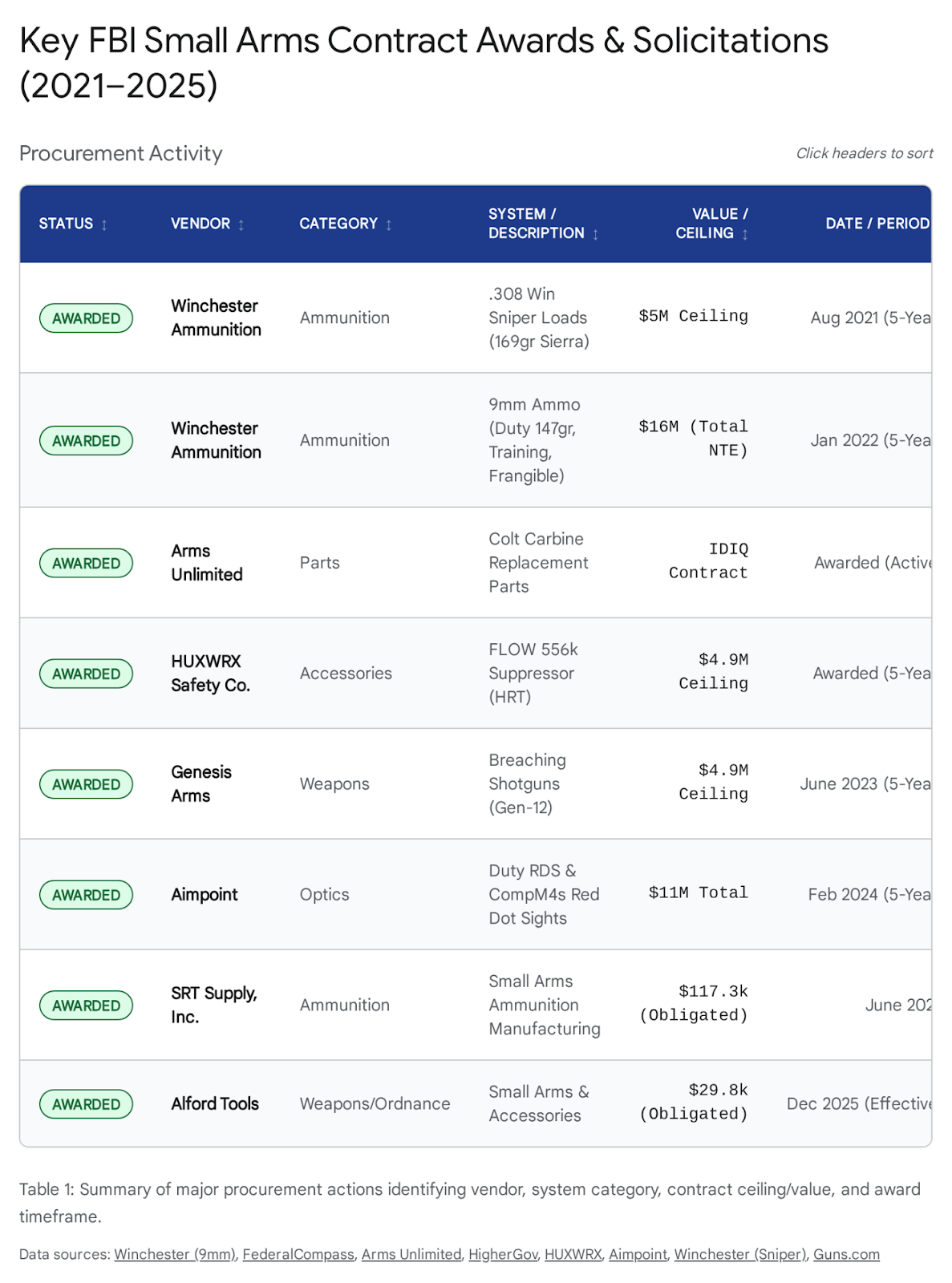
The following summary details the critical small arms contracts and solicitations identified during the 2021–2025 analysis period.
1. Strategic Overview of Bureau Small Arms Modernization
The modernization of the Federal Bureau of Investigation’s armory is not merely a replacement of aging inventory but a reflection of a profound shift in law enforcement doctrine. The period from 2021 to 2025 has been characterized by the “Systems Integration” philosophy. In previous decades, a firearm was procured as a standalone mechanical device, with accessories added ad hoc by individual agents or field offices. Today, the Bureau procures weapon systems where the host firearm, optic, suppressor, light, and holster are validated as a single, cohesive unit. This holistic approach is driven by the FBI’s Ballistic Research Facility (BRF) at Quantico, which continues to serve as the de facto standards body for American law enforcement. When the FBI adopts a technology or caliber, it signals a market-wide shift that ripples through state and local agencies, validating concepts that might otherwise be considered experimental.
A primary driver of this modernization is the imperative of “Overmatch Capability.” As threat actors increasingly utilize body armor and rifle-caliber platforms, the FBI has sought to equip its agents—specifically its tactical teams—with weaponry that offers superior terminal ballistics and faster target acquisition. This is evident in the shift away from iron sights to red dot optics on handguns, a change that significantly decreases engagement times and increases hit probability under stress. Furthermore, the Bureau has placed a renewed emphasis on operator health and safety. The selection of flow-through suppressors and lead-free training ammunition underscores a strategic priority to mitigate long-term health risks associated with heavy metal exposure and toxic gas blowback, ensuring that the agency’s most valuable asset—its human capital—remains operational for extended careers.
The procurement data also indicates a strategic diversification of the supply chain. While legacy relationships with major defense primes like Winchester and Glock remain the bedrock of the Bureau’s logistics, there is a marked increase in contracts awarded to agile, specialized manufacturers. Companies such as Genesis Arms, HUXWRX Safety Co., and Geissele Automatics have secured critical contracts for niche capabilities that larger primes could not rapidly provide. This hybrid procurement model allows the FBI to maintain the logistical stability of mass-produced platforms while integrating cutting-edge technology from the commercial tactical sector. This adaptability is crucial in an era where commercial innovation cycles often outpace traditional government acquisition timelines.
2. The Pistol Paradigm: Comprehensive Transition to 9mm and Optics
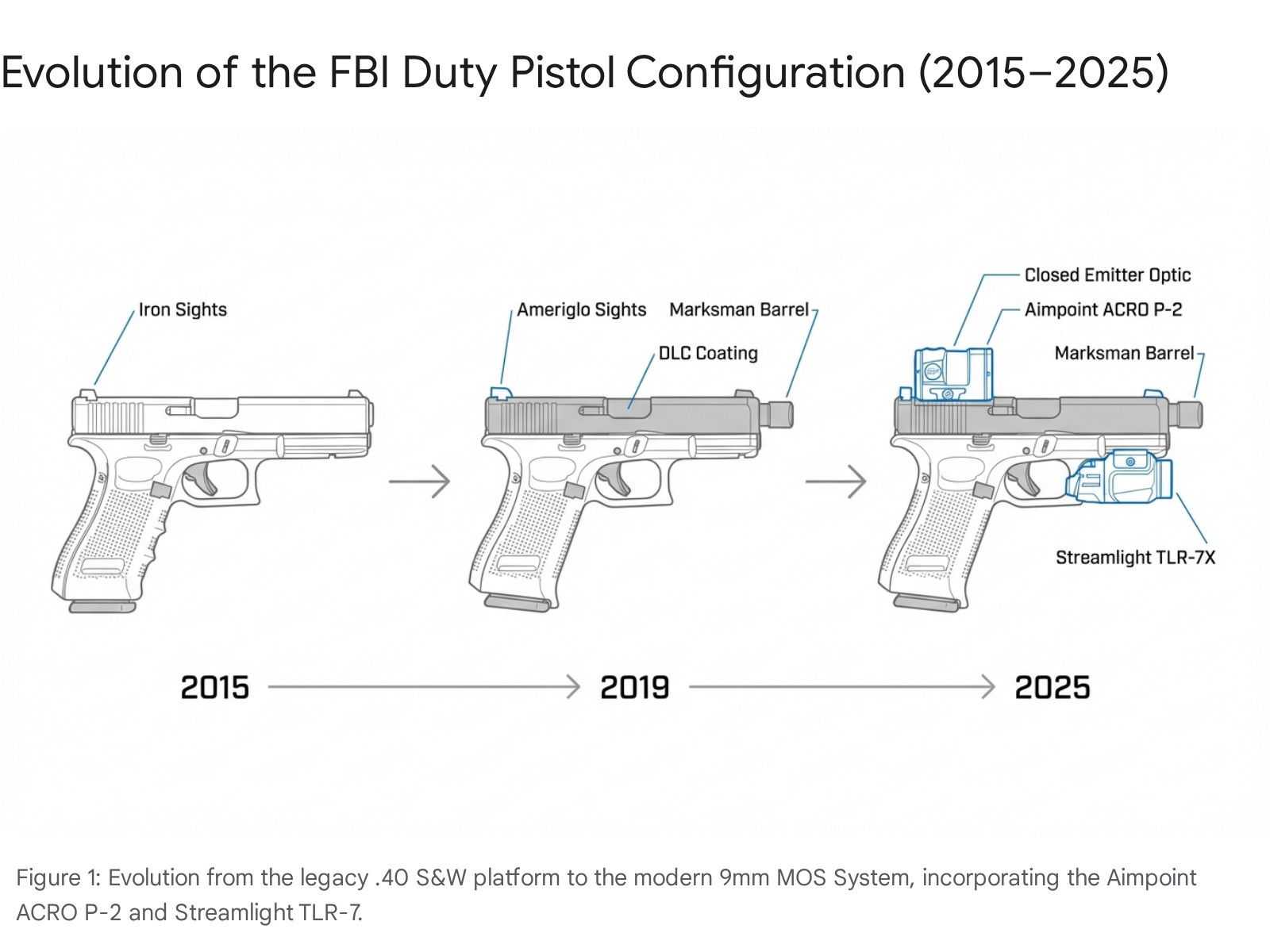
The Federal Bureau of Investigation’s transition to the 9mm Luger cartridge, initiated in the mid-2010s, reached full maturity during the 2021–2025 reporting period. This era marks the definitive end of the.40 S&W primacy within federal law enforcement, a caliber originally championed by the Bureau itself following the 1986 Miami shootout. The current pistol ecosystem is built entirely around the Glock “M” series architecture, a platform that has evolved from a simple sidearm into a sophisticated, optic-enhanced weapon system.
2.1 The Glock “M” Series Ecosystem
The core of the FBI’s handgun capability remains the Glock 19M (Compact) and Glock 17M (Standard). These platforms differ significantly from the commercial “Gen 4” models that preceded them and served as the prototype for the consumer “Gen 5” series. The “M” specification was born from a rigorous solicitation that demanded the removal of finger grooves to accommodate a wider range of hand sizes, the installation of a “Marksman” barrel for enhanced accuracy, and a flared magwell to expedite reloading under stress.1 While the initial contracts for these pistols were awarded prior to 2021, the last five years have seen substantial sustainment and expansion activity.
In September 2022, the Bureau awarded a contract specifically for Glock 19T Gen 5 MOS Simulation Training Pistols.3 The “T” designation refers to training platforms designed to fire non-lethal marking cartridges, such as Simunition FX rounds. The significance of this award lies in the “MOS” (Modular Optic System) designation. By procuring training variants that are optic-ready, the FBI acknowledges that the red dot sight is no longer an optional accessory but a primary sighting system. Agents must train with the specific height-over-bore and sight picture of an optic-equipped pistol in force-on-force scenarios to build valid muscle memory. This investment in high-fidelity training simulators demonstrates a commitment to realistic, scenario-based training that mirrors the configuration of the duty weapon.
Looking forward, recent market research and solicitations from the Bureau of Engraving and Printing—which often piggybacks on FBI and DOJ contract vehicles—indicate a potential future migration or supplementation with the Glock 47 and Glock 45 models.4 The Glock 47 offers a full-size slide on a frame compatible with Glock 19 magazines, providing a longer sight radius (or more secure optic mounting surface) while maintaining magazine commonality with the compact pistols carried by plainclothes agents. The Glock 45 offers the reverse: a full-size grip for maximum capacity and control, paired with a compact slide for faster clearing from a holster. These potential additions suggest the FBI is refining its inventory to offer agents more ergonomic choices without breaking the logistical chain of the 9mm Glock magazine ecosystem.
2.2 The Optic-Ready Standard and Sighting Systems
The most transformative development in the FBI’s small arms program is the standardization of the Miniature Red Dot Sight (MRDS) on duty pistols. This shift parallels the widespread adoption of optics on patrol rifles in the early 2000s and represents a fundamental change in handgun marksmanship doctrine. The data confirms that the FBI has moved beyond testing and into full-scale implementation.
In early 2024, the FBI awarded a significant five-year contract to Aimpoint with a ceiling of $7 million for the “Duty RDS” and an additional $4 million for the “CompM4s”.5 While the CompM4s serves the rifle program, the Aimpoint ACRO P-2 has emerged as the premier choice for the pistol program. Solicitations for holsters issued in 2025 explicitly list the ACRO P-2 as a primary configuration.7 The selection of the ACRO (Advanced Combat Reflex Optic) series is technically significant because it utilizes a “closed emitter” design. Unlike open-emitter sights (like the Trijicon RMR) where the LED project is exposed to the elements, the ACRO seals the electronic components between two panes of glass. This design is critical for law enforcement officers who work in rain, snow, and dusty environments, as it prevents debris from blocking the dot—a failure point that had previously hindered the widespread adoption of pistol optics.
The integration of these optics requires specialized mounting solutions. The FBI has solicited specific adapter plates, such as the Aimpoint adapter plate AP-200520 and C&H Precision V4 plates 7, to interface the optic with the Glock MOS slide cut. Furthermore, the inclusion of “AmeriGlo Custom Pistols suppressor height sight sets” (GL-815, GL-814) in procurement documents indicates a requirement for “co-witnessing”.7 This means that if the electronic optic fails, the iron sights are tall enough to be seen through the optic’s window, providing a fail-safe backup sighting system. This redundancy is a non-negotiable requirement for duty weapons used in life-threatening situations.
2.3 Holster Logistics and Illumination
The transition to optic-equipped pistols with weapon-mounted lights (WML) has necessitated a complete overhaul of the Bureau’s holster inventory. A holster designed for a standard Glock 19 cannot accommodate the added bulk of a light or the height of an optic. Consequently, the FBI issued a solicitation in March 2025 for a new family of concealment and tactical holsters.7
This solicitation is notable for its specificity. It demands holsters capable of accommodating the Glock 17M/19M Gen 5 MOS equipped with the Aimpoint ACRO P-2 or Trijicon RMR HD, as well as Streamlight TLR-7A and TLR-7X lights.7 The mention of the Streamlight TLR-7 series confirms this compact light as the standard-issue illumination tool for the FBI’s general agent population. The TLR-7’s form factor is flush with the muzzle of a Glock 19, making it ideal for concealment, whereas larger lights like the SureFire X300 extend past the muzzle, making seated comfort in vehicles difficult for plainclothes investigators.
The solicitation was designated as a small business set-aside, suggesting the Bureau is targeting specialized tactical nylon manufacturers rather than large primes.7 This allows the FBI to access the rapid innovation seen in the commercial holster market, where smaller companies often iterate designs faster than major defense contractors. The requirement for both “Concealment” (inside the waistband or high-ride belt) and “Tactical” (outer vest carrier or drop-leg) variants underscores the dual nature of the FBI agent’s role—shifting from investigative work in suits to tactical entries in body armor.
3. The Duty Ammunition Landscape: Ballistics, Contracts, and Effectiveness
Ammunition procurement represents the single largest sustained financial commitment in the FBI’s small arms portfolio. The Bureau’s ammunition choices are governed by the famous “FBI Protocol,” a series of ballistic tests developed after the 1986 Miami shootout revealed the inadequacy of then-standard projectiles. This protocol mandates that duty ammunition must penetrate between 12 and 18 inches of calibrated ballistic gelatin after passing through barriers such as heavy clothing, steel, wallboard, plywood, and laminated automotive glass.
3.1 The 9mm Contract Consolidation
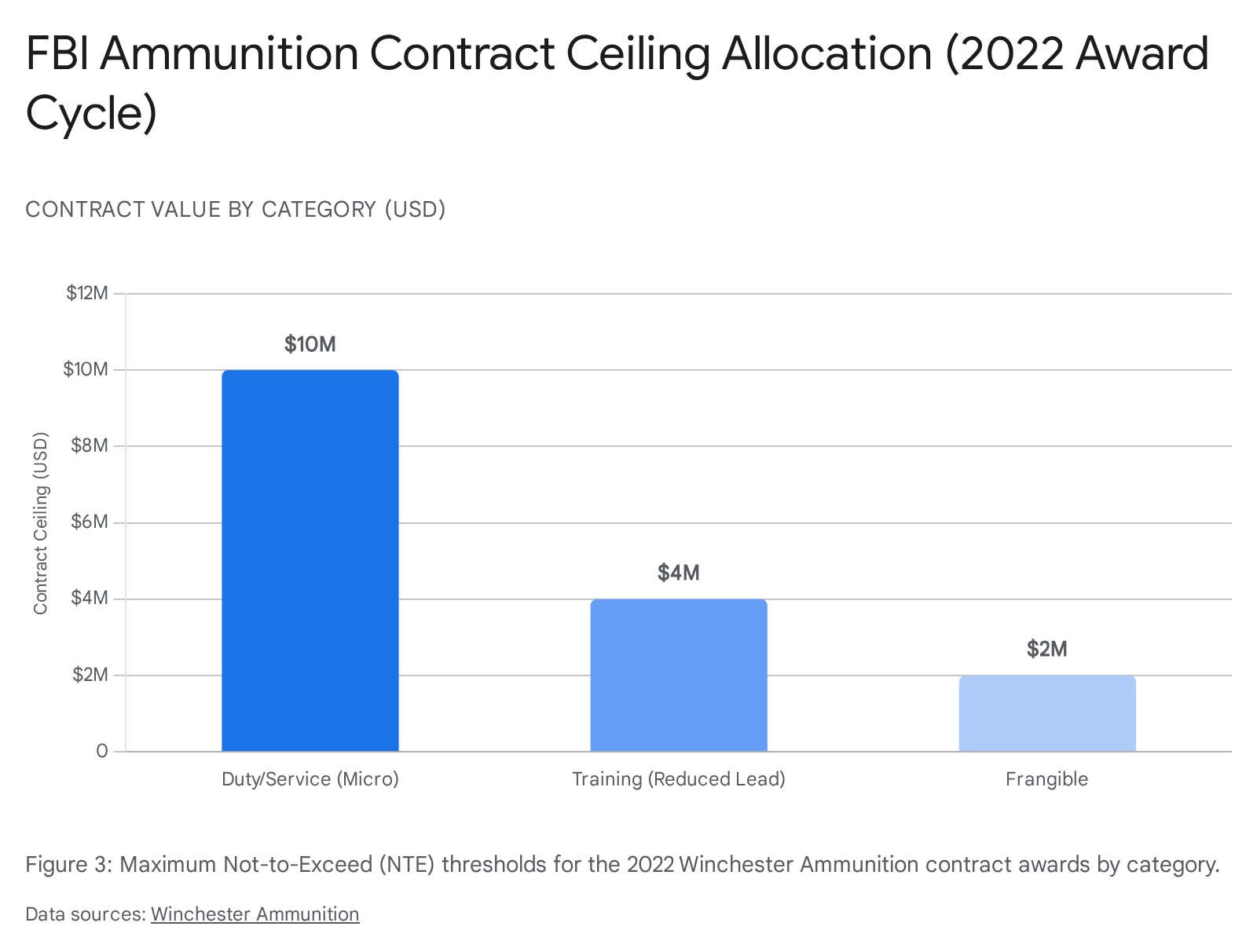
In a decisive procurement action in early 2022, the FBI awarded a massive, annually renewable five-year contract to Winchester Ammunition.9 This award effectively consolidated the Bureau’s primary 9mm needs under the Olin Corporation subsidiary. The contract includes three distinct Categories:
- Duty/Service (Micro): The award for the Winchester 147 gr. Bonded Encapsulated +P carries a Maximum Not-to-Exceed (NTE) threshold of $10 million.9 This round utilizes a bonded core technology, where the lead core is chemically fused to the copper jacket. This bonding is essential for the FBI’s barrier blind requirement, preventing the jacket from separating from the core when punching through auto glass, thereby ensuring the bullet retains enough mass to penetrate deeply enough to incapacitate a threat. The “+P” designation indicates higher pressure, which translates to higher velocity, ensuring consistent expansion even from the shorter barrels of the Glock 19M.
- Training (Reduced Lead): The Winchester 147 gr. EFMJ (Encapsulated Full Metal Jacket) was awarded with an NTE of $4 million.9 The EFMJ design fully encloses the lead core in copper, including the base. This prevents lead vaporization upon firing, significantly reducing airborne lead levels at indoor ranges. This selection highlights the FBI’s focus on long-term agent health and OSHA compliance.
- Frangible: The Winchester 90 gr. Frangible Lead Free +P (NTE $2 million) is designed for close-quarters training on steel targets.9 Frangible rounds disintegrate into dust upon impact with hard surfaces, eliminating the risk of spatter and ricochets injuring agents during dynamic entry training.
3.2 The Hornady Critical Duty Role
While Winchester secured the 2022 prime award, Hornady Manufacturing continues to play a vital role in the FBI’s ammunition supply. In 2018, the FBI split the ammunition award, granting Hornady an $11 million contract for the 9mm+P Luger 135 gr. FlexLock Critical Duty ammunition.11 The Critical Duty load is unique because it features a patented “Flex Tip”—a polymer plug in the hollow point cavity. This plug prevents clothing or drywall from clogging the hollow point, which can cause other bullets to fail to expand and act like a full metal jacket round. The Flex Tip initiates expansion hydraulically upon impact.
The coexistence of both Winchester and Hornady contracts suggests a diversified supply strategy. While Winchester may be the primary volume supplier for the broad agent population, the Hornady load is often favored for specific operational profiles or as a secondary approved duty load to mitigate supply chain risks. If one factory suffers a production halt, the Bureau has a validated alternative ready to issue.
3.3 Sole Source Ballistic Research
The maintenance of these rigorous standards is supported by the FBI’s Ballistic Research Facility (BRF). However, an audit by the Office of the Inspector General (OIG) in 2024 revealed a potential vulnerability in this support structure: the Bureau had awarded sole-source contracts to the same individual for ballistic research assistant services for over 18 years.13 While the audit criticized the lack of competition, it inadvertently highlighted the extreme specialization of this field. The “institutional knowledge” required to replicate the FBI’s testing protocols consistently is held by very few individuals, creating a dependency on legacy experts. This facility’s output is not just for the FBI; its data drives the purchasing decisions of almost every major police department in the United States.
4. Rifle Systems: The Evolution of the Federal Patrol Carbine and HRT Platforms
The FBI’s rifle procurement strategy is bifurcated. The vast majority of agents are issued standard patrol carbines, while the elite Hostage Rescue Team (HRT) and regional SWAT teams utilize highly specialized, custom-built platforms. This duality allows the Bureau to manage costs for the general fleet while ensuring its tier-one operators have the absolute pinnacle of small arms technology.
4.1 The Hostage Rescue Team (HRT) Rifle Program
The “FBI HRT Rifle” has achieved legendary status in the firearms industry, influencing civilian and law enforcement builds nationwide. Unlike the military’s M4A1, which is a standardized technical data package produced by the lowest bidder, the HRT rifle is a “connoisseur’s” weapon—a curated assembly of the best components available on the market, assembled by expert gunsmiths at Quantico.
Recent procurement data confirms the heavy involvement of Geissele Automatics in this program. The Geissele Mk4 Federal Rail was designed specifically to FBI requirements, featuring a longer bottom rail section to accommodate light and laser mounting without interfering with the shooter’s grip.14 Snippets indicate active delivery orders for “GEISSELE AR COMPONENTS” via FBI Headquarters, validating their continued role as a prime supplier of rail systems and triggers.
Furthermore, there is credible evidence of Hodge Defense components being integrated into these systems. Hodge Defense is known for its proprietary “Al-Li” (Aluminum-Lithium) alloy receivers, which offer a superior strength-to-weight ratio compared to standard 7075-T6 aluminum.16 The integration of such boutique components—often scarce even in the commercial market—demonstrates the Bureau’s willingness to pursue marginal gains in durability and weight reduction, regardless of supply chain complexity. Despite these modern upgrades, the Bureau often retains Colt 11.5″ Heavy Barrels for their proven chrome-lining and accuracy longevity.17 This hybridization—using a Colt barrel in a Hodge receiver with a Geissele rail—epitomizes the Bureau’s “best of breed” philosophy.
4.2 General Patrol Carbine Sustainment
For the thousands of patrol carbines issued to field agents, the strategy is one of sustainment rather than replacement. The FBI maintains a massive fleet of Colt M4-pattern carbines. Rather than replacing these wholesale, which would incur massive capital costs, the Bureau utilizes IDIQ contracts to procure replacement parts to keep them running.
In June 2025, the FBI awarded a $9 million IDIQ contract to Arms Unlimited for “Colt Replacement Carbine Parts”.18 This award highlights a strategic shift towards distributors. Arms Unlimited is a major commercial distributor that stocks high volumes of OEM parts. By contracting with them instead of solely relying on Colt Defense (which can have erratic government delivery schedules), the FBI ensures a steady stream of bolts, carriers, springs, and barrels. This contract is also open to other DOJ agencies, such as the ATF and DEA, centralizing the sustainment logistics for the entire Department of Justice.
4.3 Advanced Suppressor Technology: The HUXWRX Revolution
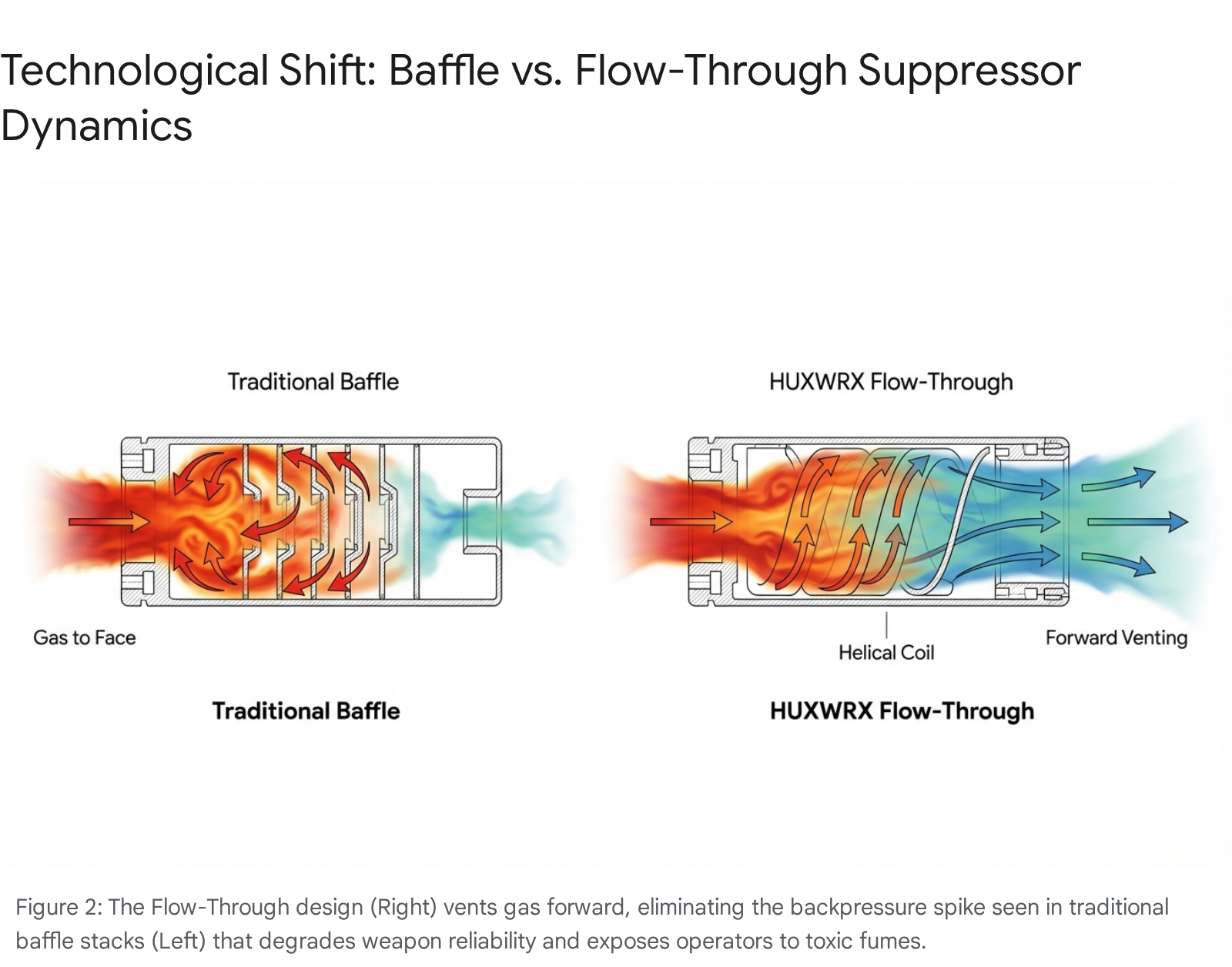
Perhaps the most significant technological leap in the rifle sector is the adoption of flow-through suppressors. In 2022/2023, the FBI awarded a $4.9 million contract to HUXWRX Safety Co. (formerly OSS) for the FLOW 556k suppressor.20 This award followed a comprehensive test by the Ballistic Research Facility where the HUXWRX design outperformed competitors in weight, flash reduction, sound suppression, and gas blowback.
The selection of the FLOW 556k addresses a critical issue with short-barreled rifles (SBRs) like the FBI’s 11.5″ carbines. Traditional baffle suppressors trap gas to reduce noise, but this creates high “backpressure,” forcing toxic gas back down the barrel and into the shooter’s face. This not only obscures the shooter’s vision and breathing but also speeds up the bolt carrier group, leading to parts breakage and reliability issues. The FLOW 556k utilizes 3D-printed (DMLS) helical channels to vent gas forward, virtually eliminating this backpressure. The FBI’s adoption of this technology validates additive manufacturing for duty-use critical components and signals the end of the “baffle stack” era for law enforcement SBRs.
5. Precision Fire: The Sniper Program’s Chassis Revolution
The FBI’s sniper capability is undergoing a generational transformation. Historically, the Bureau relied on the “Quantico built” Remington 700—a customized bolt-action rifle bedded into a traditional fiberglass stock (often H-S Precision or McMillan). While accurate, these systems lacked the modularity required for modern urban sniper operations, where concealment, transportability, and accessory integration are paramount.
5.1 The Shift to Accuracy International (AI)
Recent contract activity indicates a decisive move toward chassis-based systems, specifically those from Accuracy International (AI). While some contract data explicitly links AI awards to Customs and Border Protection (CBP) 22, the FBI’s tactical equipment often aligns with broader federal trends, and the Bureau has been observed transitioning to the AI AT (Arctic Warfare) and AT-X platforms. The AI chassis offers a folding stock for discreet transport, a quick-change barrel system that allows for caliber changes (e.g., from.308 to 6.5 Creedmoor) at the user level, and a fully adjustable interface for length of pull and cheek height. This modularity is essential for HRT snipers who may need to configure their weapon differently for a maritime interdiction versus a rural surveillance hide.
Despite this shift, the Bureau continues to support its legacy fleet. Snippets reference “Near Clone” builds utilizing McMillan A3-5 stocks and Remington 700 actions.24 These components represent the bridge between the old and new eras, offering enhanced ergonomics over the original stocks while retaining the familiar Remington action.
5.2 Optical Dominance: Nightforce and Spuhr
The “glass” atop these rifles has seen a similar standardization. Following the lead of US Special Operations Command (USSOCOM), the FBI has largely standardized on the Nightforce ATACR series of riflescopes, specifically the 7-35×56 F1 and 5-25×56 F1.25 These optics feature First Focal Plane (FFP) reticles, meaning the reticle substensions remain accurate at any magnification. This is critical for snipers who may need to range a target or hold for wind at an intermediate magnification setting. The reticle of choice is typically the Horus TREMOR3, a complex grid system that allows for rapid holdovers without touching the turrets—a vital capability for engaging multiple moving targets in a dynamic hostage situation.
To mount these heavy optics, the FBI utilizes Spuhr ISMS (Ideal Scope Mount System) mounts. These mounts are machined from a single piece of aluminum and feature a built-in bubble level and 45-degree split rings, preventing the optic from losing zero even under the shock of 40mm breaching rounds or rough handling during insertion.
5.3 Sniper Ammunition Specifications
In August 2021, the FBI awarded a specific $5 million contract to Winchester Ammunition for the sniper program.27 The contract specified a .308 Winchester load utilizing a 169-grain Sierra Boat-Tail Hollow Point (BTHP) bullet. This selection is technically nuanced. Traditionally, law enforcement used the 168-grain MatchKing, which is excellent at short range but becomes unstable at longer distances (transonic zone). The military uses the 175-grain load for long range. The 169-grain selection represents a modern optimization—offering a higher ballistic coefficient than the 168-grain for better wind bucking, while maintaining the velocity needed for immediate incapacitation. It is a “Goldilocks” load tailored specifically for the urban and suburban engagement distances typical of domestic law enforcement.
6. Specialized Capabilities: Breaching, Less-Lethal, and Sub-Compact Weapons
Beyond pistols and rifles, the FBI maintains a suite of specialized tools for specific tactical problems: gaining entry to fortified structures and operating in ultra-low-profile environments.
6.1 Ballistic Breaching: The Genesis Arms Gen-12
In June 2023, the FBI awarded a $4.9 million IDIQ contract to Genesis Arms for “Breaching Shotguns”.29 This award represents a radical departure from the traditional pump-action Remington 870. The Gen-12 is a semi-automatic shotgun based on the AR-10 platform.
The solicitation required a system capable of reliably cycling the FBI Breaching Round (12ga, 2 3/4″, 45 gram)—a heavy frangible slug designed to disintegrate hinges and lock mechanisms.30 Cycling semi-automatic shotguns with such specialized ammunition is notoriously difficult due to varying pressure curves. The Gen-12 uses a short-recoil operation (where the barrel moves extensively) rather than a gas system, making it largely immune to these pressure variances. For an HRT operator, this means they can fire multiple breaching shots in rapid succession without manually pumping the action, saving critical seconds during an explosive breach.
6.2 40mm Less-Lethal Launchers
The Bureau has also modernized its less-lethal capabilities. While specific contract awards for the launchers themselves are less publicized in the snippet data, references to “40mm Launcher” protocols 31 and FN America’s development of 40mm systems 32 point to the LMT (Lewis Machine & Tool) 40mm and FN 40GL as the industry standards utilized. The primary munition for these launchers is the “Direct Impact” foam round, which allows agents to incapacitate subjects at distances greater than taser range, providing a crucial intermediate force option before lethal force is required.
6.3 Sub-Compact Weapons (SCW): The B&T APC9K
While the 5.56mm carbine is the primary shoulder-fired weapon, there is still a need for ultra-compact submachine guns for protective details (PSD) and covert operations. The FBI, leveraging the US Army’s “Sub Compact Weapon” (SCW) selection, has adopted the B&T APC9K.33 This Swiss-made 9mm subgun is compact enough to be carried under a jacket on a sling but offers far more firepower than a pistol. Its hydraulic buffer system significantly mitigates recoil, allowing for controllable fully automatic fire. The APC9K replaces the legacy MP5 fleets, offering modern ergonomics (AR-style controls) that are consistent with the Bureau’s M4 carbines, reducing training friction.
7. Optical and Electronic Augmentation
The modern firearm is merely a platform for electronics. The 2021–2025 period confirms that the FBI now prioritizes the electronic sighting system as highly as the weapon itself.
7.1 Aimpoint’s Dominance
The early 2024 awards to Aimpoint ($7M for Duty RDS, $4M for CompM4s) 5 solidify the Swedish company’s monopoly on the Bureau’s red dot needs. The Duty RDS is a newer, budget-conscious optic designed to offer the durability of the flagship T-2 at a lower price point, making wide-scale issue financially viable. The continued procurement of the CompM4s—a larger, AA-battery powered optic—suggests it remains the standard for the patrol rifle fleet due to its legendary battery life (80,000 hours) and robustness.
7.2 Night Vision and Passive Aiming
The integration of night vision capability is evident in the specific component choices. The Aimpoint T-2 and ACRO P-2 are renowned for their light transmission under night vision devices (NVDs). The solicitation for “tall” mounts (Unity Tactical FAST mounts, implied by HRT configurations) allows operators to aim through the optic while wearing night vision goggles (NVGs) without craning their necks. Additionally, the presence of Steiner DBAL-A3 lasers 15 on HRT rifles indicates a dual-path capability: operators can aim using an infrared laser (active aiming) or look through their red dot with NVGs (passive aiming), a technique that has become standard in modern CQB to avoid detection by opponents who might also have night vision.
8. Supply Chain Architecture and Industry Impact
The FBI’s procurement behavior reveals a strategic restructuring of its supply chain to value speed and resilience over traditional direct-to-manufacturer relationships.
8.1 The Rise of the Distributor
The $9 million award to Arms Unlimited for Colt parts 18 is a key indicator. By utilizing a commercial distributor, the FBI insulates itself from the manufacturing fluctuations of a single OEM. Arms Unlimited acts as a buffer, holding inventory that the Bureau can draw down immediately. This “commercial-off-the-shelf” (COTS) model is faster and often cheaper than the traditional government procurement cycle.
8.2 Small Business and Innovation
The FBI actively utilizes “Small Business Set-Aside” designations to access innovation. The holster solicitation 7 and the 3D-printed suppressor contract 20 are prime examples. Large defense primes are often risk-averse and slow to innovate. By targeting smaller, agile companies (like HUXWRX or specialized nylon shops), the FBI can acquire cutting-edge technology that has already been validated in the competitive civilian tactical market.
8.3 The “FBI Effect” on the Market
The Bureau’s choices have an outsized impact on the civilian market. The adoption of the “19M” led directly to Glock’s commercial Gen 5 series. The selection of the HUXWRX Flow 556k has legitimized 3D-printed suppressors, causing a surge in civilian demand for flow-through technology. When the FBI validates a concept—be it 9mm ballistics, red dots on pistols, or 1.93″ scope mounts—it effectively sets the standard for the entire US firearms industry.
9. Future Outlook and Recommendations
Looking toward 2026 and beyond, the FBI’s small arms program is poised for further refinement rather than radical upheaval. The transition to 9mm and red dots is complete; the next phase will likely focus on enhancing the electronic integration of the soldier system.
We anticipate:
- Expansion of Suppressor Issue: Following the success of the HRT’s HUXWRX contract, expect to see flow-through suppressors migrate to the regional SWAT teams and eventually, perhaps, to the general patrol rifle fleet to mitigate hearing loss liability.
- Ammo Evolution: While the 9mm is here to stay, advancements in projectile technology (like the two-piece shell design seen in the Sig Sauer NGSW program or composite casings) may eventually find their way into FBI solicitations to reduce weight.
- Weapon Mounted Data: Future optics may integrate shot counters or wireless connectivity to track maintenance intervals, a concept already being explored in the military sector.
The FBI has successfully positioned itself at the bleeding edge of law enforcement lethality. By embracing a “Systems” approach and leveraging the agility of the commercial market, the Bureau has ensured its agents are equipped with tools that offer a distinct tactical advantage in an increasingly dangerous world.
If you find this post useful, please share the link on Facebook, with your friends, etc. Your support is much appreciated and if you have any feedback, please email me at in**@*********ps.com. Please note that for links to other websites, we are only paid if there is an affiliate program such as Avantlink, Impact, Amazon and eBay and only if you purchase something. If you’d like to directly contribute towards our continued reporting, please visit our funding page.
Sources Used
- Is this a rare Glock? – Reddit, accessed January 5, 2026, https://www.reddit.com/r/Glocks/comments/12wyvd1/is_this_a_rare_glock/
- Glock 19M – The Truth About It – YouTube, accessed January 5, 2026, https://www.youtube.com/watch?v=AySWrduJFc0
- CONTRACT to GLOCK, INC. | USAspending, accessed January 5, 2026, https://www.usaspending.gov/award/CONT_AWD_15F06722F0001732_1549_DJF161200V0006459_1549
- Replacement Duty Weapons System – SAM.gov, accessed January 5, 2026, https://sam.gov/workspace/contract/opp/9d8942e30f214155bddb16a8e95e460e/view
- FBI selects the Aimpoint Duty RDS red dot sight and procures additional units of the slightly larger Aimpoint CompM4s | all4shooters, accessed January 5, 2026, https://www.all4shooters.com/en/shooting/pro-zone/fbi-decides-in-favour-of-the-aimpoint-duty-rds-and-purchases-additional-aimpoint-compm4s/
- Aimpoint chosen by FBI to supply Duty RDS and CompM4s optics for Red Dot Sights and Mounts program – Police1, accessed January 5, 2026, https://www.police1.com/police-products/firearms/accessories/sights-scopes/aimpoint-chosen-by-fbi-to-supply-duty-rds-and-compm4s-optics-for-red-dot-sights-and-mounts-program
- FBI Seeks Concealment and Tactical Holsters | Soldier Systems Daily, accessed January 5, 2026, https://soldiersystems.net/2025/03/14/fbi-seeks-concealment-and-tactical-holsters/
- Concealment and Tactical Holsters – SAM.gov, accessed January 5, 2026, https://sam.gov/opp/af6385d67d9a4222b4498d87acace3b1/view
- Winchester Ammunition FBI 9mm Contract Award, accessed January 5, 2026, https://winchester.com/Support/Media/In-The-News/2022/01/07/Winchester-Ammunition-FBI-9mm-Contract-Award
- FBI Issues Ammunition Contracts to Winchester, Federal, and Speer – The National Interest, accessed January 5, 2026, https://nationalinterest.org/blog/buzz/fbi-issues-ammunition-contracts-winchester-federal-and-speer-199448
- FBI divides $35M contract among three ammo companies – Guns.com, accessed January 5, 2026, https://www.guns.com/news/2018/04/30/fbi-divides-35m-contract-to-three-ammo-companies
- Hornady Awarded FBI 9 mm+P Ammunition Contract | An Official Journal Of The NRA, accessed January 5, 2026, https://www.americanrifleman.org/content/hornady-awarded-fbi-9-mm-p-ammunition-contract/
- Audit of the Federal Bureau of Investigation’s Contract for Ballistics Research Assistant Services – U.S. Department of Justice Office of the Inspector General, accessed January 5, 2026, https://oig.justice.gov/sites/default/files/reports/24-098.pdf
- Geissele Automatics Profile – HigherGov, accessed January 5, 2026, https://www.highergov.com/awardee/geissele-automatics-llc-371532217/
- FBI HRT/SWAT Style Rifle (GBLS DAS Based) by Alex Dai – The Reptile House, accessed January 5, 2026, https://thereptilehouseblog.com/2019/10/29/fbi-hrt-swat-style-rifle-gbls-das-based-by-alex-dai/
- Hodge Defense Systems Inc., accessed January 5, 2026, https://hodgedefensesystems.com/
- FBI “HRT type” custom 11.5″ Upper Receiver Group | For Sale, accessed January 5, 2026, https://charliescustomclones.com/fbi-hrt-type-custom-11-5-upper-receiver-group/
- FBI Awards Colt Replacement Carbine Parts IQID Contract to Arms Unlimited, accessed January 5, 2026, https://soldiersystems.net/2025/06/13/fbi-awards-colt-replacement-carbine-parts-iqid-contract-to-arms-unlimited/
- FBI Awards Colt Replacement Carbine Parts IDIQ Contract to Arms Unlimited, accessed January 5, 2026, https://armsunlimited.com/press-releases/fbi-awards-colt-replacement-carbine-parts-idiq-contract-to-arms-unlimited/
- FBI Awards HUXWRX Safety Co with HRT Suppressor Contract, accessed January 5, 2026, https://huxwrx.com/fbi-awards-huxwrx-safety-co-with-hrt-suppressor-contract
- FBI Selects 3D-Printed Suppressors | An Official Journal Of The NRA – Shooting Illustrated, accessed January 5, 2026, https://www.shootingillustrated.com/content/fbi-selects-3d-printed-suppressors/
- Accuracy International Tapped for Border Patrol Sniper Rifle Contract – Guns.com, accessed January 5, 2026, https://www.guns.com/news/2023/11/08/accuracy-international-tapped-for-border-patrol-sniper-rifle-contract
- Accuracy International Of North America – HigherGov, accessed January 5, 2026, https://www.highergov.com/awardee/accuracy-international-of-north-america-inc-10405556/
- FBI HRT Custom Precision Rifle – Near Clone, accessed January 5, 2026, https://charliescustomclones.com/fbi-hrt-custom-precision-rifle-near-clone/
- Nightforce ATACR Riflescopes Win USSOCOM P-VPS Contract For MK22 Advanced Sniper Rifle System! – EuroOptic, accessed January 5, 2026, https://www.eurooptic.com/blog/post/nightforce-atacr-riflescopes-win-ussocom-p-vps-contract-for-mk22-advanced-sniper-rifle-system
- NIGHTFORCE® OPTICS AWARDED USSOCOM P-VPS CONTRACT, accessed January 5, 2026, https://www.nightforceoptics.com/nightforce-optics-awarded-ussocom-p-vps-contract
- What 308 Sniper Ammo do FBI Snipers Use? – HOP Munitions, accessed January 5, 2026, https://hopmunitions.com/what-308-sniper-ammo-do-fbi-snipers-use/
- FBI Selects Winchester for Sniper Ammo Contract – Guns.com, accessed January 5, 2026, https://www.guns.com/news/2021/08/11/fbi-selects-winchester-for-sniper-ammo-contract
- 15F06723D0001937 – HigherGov, accessed January 5, 2026, https://www.highergov.com/idv/15F06723D0001937/
- Breaching Shotguns DJF-23-2200-PR-0000669 – HigherGov, accessed January 5, 2026, https://www.highergov.com/contract-opportunity/breaching-shotguns-djf-23-2200-pr-0000669-o-d907b/
- Less-lethal Munitions 40mm Launcher, accessed January 5, 2026, https://www.providenceri.gov/wp-content/uploads/2021/07/310.05-Less-Lethal-Munitions-40mm-Launcher.pdf
- FN WINS U.S. ARMY DEVELOPMENT CONTRACT FOR THE PRECISION GRENADIER SYSTEM | FN® Firearms – FN America, accessed January 5, 2026, https://fnamerica.com/press-releases/fn-wins-u-s-army-development-contract-for-the-precision-grenadier-system/
- Army Selects B&T APC9K for New Sub Compact Weapon – Athlon Outdoors, accessed January 5, 2026, https://athlonoutdoors.com/article/army-bt-apc9k-sub-compact-weapon/
- CBP Purchases B&T Army APC9 from Army Sub Compact Weapon Contract, accessed January 5, 2026, https://soldiersystems.net/2020/07/15/cbp-purchases-bt-army-apc9-from-army-sub-compact-weapon-contract/