
Desert Tech, formerly known as Desert Tactical Arms, represents one of the most polarizing and technically ambitious case studies in the contemporary American firearms industry. Established in 2007 in West Valley City, Utah, the company was founded on a singular, disruptive hypothesis: that the traditional long-action sniper rifle was obsolete. While the established defense industrial base focused on incremental improvements to the Remington 700 action and the AR-10 platform, Desert Tech committed its entire engineering lineage to the bullpup configuration—placing the action and magazine behind the trigger group to dramatically reduce overall length without sacrificing ballistic performance.1
Over the course of nearly two decades, the company has evolved from a boutique manufacturer of the Stealth Recon Scout (SRS)—a platform that offered the lethality of a.338 Lapua Magnum in a package the size of a submachine gun—into a diversified defense brand incorporating ammunition manufacturing (Desert Tech Munitions) and specialized training facilities.3 This expansion was driven by a strategic vision to create a vertically integrated ecosystem where hardware, software (ballistics), and wetware (operator skill) were unified under a single “Tomorrow’s Weapons” doctrine.3
However, the company’s trajectory has been anything but linear. It has been defined by a tension between engineering brilliance and operational overreach. This was most visible in the decade-long saga of the Micro Dynamic Rifle (MDR), a project that sought to solve the inherent ergonomic flaws of the bullpup assault rifle through complex mechanical innovation. The MDR’s eventual discontinuation in 2024, in favor of the mechanically simplified WLVRN platform, marks a significant maturation point for the company—a pivot from theoretical perfectionism to pragmatic reliability.5
Simultaneously, Desert Tech operates under a unique and persistent cloud of reputational risk stemming from its ownership structure. The company is owned and financed by members of the Kingston family, founders of the Latter Day Church of Christ (LDCC), a polygamous fundamentalist group that has been the subject of federal investigations and civil rights lawsuits.7 The 2019 conviction of key family members for a $1 billion biofuel tax fraud scheme, coupled with ongoing 2025 federal lawsuits alleging human rights abuses within the group, creates a complex “glass ceiling” for the company.8 While Desert Tech hardware is technically competitive with Tier 1 defense contractors like Barrett or Accuracy International, these extra-industrial factors have complicated its ability to secure large-scale Programs of Record with the U.S. Department of Defense.
Despite these hurdles, Desert Tech weapons have found their way to the frontlines of modern high-intensity conflict. From the urban ruins of Ukraine to the mountains of Central Asia, the SRS and HTI platforms are in active service. Recent investigative reports from late 2024 indicate that while the company adheres to U.S. export controls, its products are being diverted to Russian forces via grey-market channels in the Eurasian Economic Union, highlighting the dual-use proliferation risks inherent in producing high-end precision technology.10
As of 2025, Desert Tech stands at a critical strategic juncture. Technically, the release of the WLVRN and the high-capacity Quattro-15 system suggests a renewed focus on market-driven product development. Commercially, the company must navigate the dual headwinds of a saturated tactical market and the existential legal threats facing its parent network. This report provides an exhaustive analysis of the company’s history, technology, and future prospects, dissecting the intricate interplay between its innovative hardware and its controversial corporate foundations.
1. The Genesis of Unconventionality (2007–2010)
The origins of Desert Tech are rooted not in a government solicitation or a military requirement document, but in the specific logistical frustrations of the civilian precision shooter. In the mid-2000s, the long-range shooting market was dominated by a “one caliber, one rifle” paradigm. If a shooter wanted to compete in a.308 Winchester class, hunt with a.300 Winchester Magnum, and engage targets at extreme distances with a.338 Lapua Magnum, they were required to purchase, equip, and zero three separate rifle systems. This inefficiency was the catalyst for Nick Young’s entry into the industry.
1.1 The “Glass Snob” Philosophy
Nicholas “Nick” Young founded Desert Tactical Arms (DTA) in May 2007 while completing an MBA program at the University of Utah.1 His initial business plan was drafted as a class project, driven by a personal realization following the death of his father: a desire to create something “meaningful” combined with his existing expertise in firearms.12
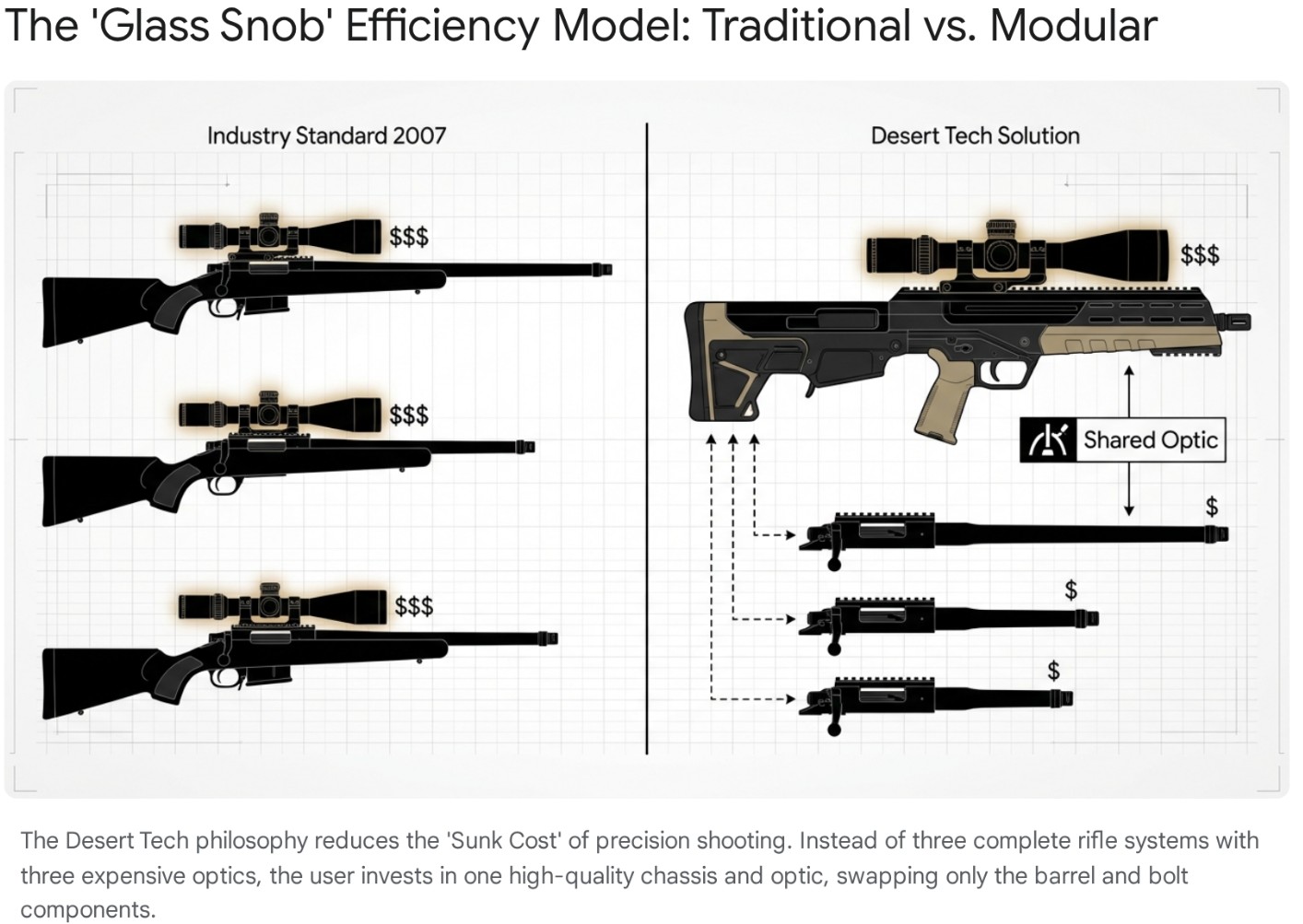
Young’s design philosophy was shaped by his self-identification as a “glass snob”—a shooter who prioritized high-end optics but lacked the funds to equip multiple rifles with top-tier scopes.2 In 2007, a premium tactical scope (such as a Schmidt & Bender or US Optics) could easily cost $3,000 to $4,000, often exceeding the cost of the rifle itself. Young realized that the most efficient way to access multiple calibers was not to buy more rifles, but to build a single, modular chassis that could swap calibers while retaining the same optic, trigger, and ergonomics.2
This “one rifle, one scope” concept necessitated a chassis system with a quick-change barrel mechanism. However, Young took the concept further by adopting the bullpup layout. By locating the action and magazine behind the fire control group, inside the stock, the design eliminated the “dead space” of a traditional buttstock. This allowed the rifle to maintain a full 26-inch barrel—essential for achieving the velocity required for long-range ballistics—while reducing the overall length of the weapon by nearly a foot compared to conventional competitors like the Remington 700 or the Accuracy International AW series.2
1.2 Engineering the Stealth Recon Scout (SRS)
The result of this philosophy was the Stealth Recon Scout (SRS), unveiled at the 2008 SHOT Show.4 The SRS was a radical departure from the prevailing design language of the time. In 2008, the U.S. military was heavily invested in the M110 SASS and the M24 Sniper Weapon System, both traditional layouts. The SRS challenged the status quo by offering a rifle that was as short as an M4 carbine yet capable of effective fire out to 1,500 meters.13
The primary engineering challenge for the SRS was the trigger. Bullpup rifles were historically notorious for having poor, “mushy” triggers due to the long linkage bars required to connect the forward trigger shoe to the rearward sear. Young and his engineering team focused on creating a linkage that operated in tension rather than compression, or utilized stiffened transfer bars to eliminate flex.13 The result was a match-grade trigger that defied the negative stereotypes of the bullpup configuration, a critical factor in gaining acceptance among the precision shooting community.
The SRS also introduced a unique barrel clamping mechanism. Unlike traditional rifles where the barrel is threaded into the receiver (requiring a gunsmith and a vice to remove), the SRS barrel was held in place by a clamping system accessible via a torque wrench. This allowed the user to switch from a.308 training barrel to a.338 Lapua combat barrel in less than 60 minutes in the field, with a guaranteed return to zero.14
1.3 Early Market Penetration
Despite its innovative features, the SRS faced initial skepticism. The professional sniper community is deeply conservative, prioritizing proven reliability over novel features. The “unofficial” disqualification of the SRS from early military trials due to a trigger weight technicality (despite being adjustable) highlighted the institutional resistance to the bullpup form factor.13 However, the rifle found a strong following in the civilian tactical market and among law enforcement agencies that required a compact sniper system for urban environments (SWAT), where maneuvering a 45-inch rifle through hallways was impractical. The SRS Covert model, with an even shorter handguard and 16-inch barrel, was specifically developed to meet this urban requirement.4
2. Scaling Lethality: The Anti-Materiel Expansion (2011–2013)
By 2011, Desert Tactical Arms had established the viability of the bullpup precision rifle. The next phase of the company’s evolution involved scaling this concept up to the anti-materiel class, addressing the logistical burdens of heavy caliber weaponry.
2.1 The Hard Target Interdiction (HTI)
In 2012, DTA launched the Hard Target Interdiction (HTI) rifle.16 The HTI was essentially a scaled-up SRS designed to handle the massive.50 BMG cartridge, as well as the.375 and.408 CheyTac rounds.
The strategic significance of the HTI lay in its size-to-power ratio. The standard-issue anti-materiel rifle of the U.S. military, the Barrett M107, is approximately 57 inches long and weighs nearly 30 pounds. The HTI, utilizing the bullpup layout, achieved a similar barrel length in a package that was 12 inches shorter and significantly lighter.16 This reduction in size transformed the logistical profile of a heavy sniper team. An HTI could be transported in a standard sedan or jumped by a paratrooper without the specialized disassembly required for a Barrett.
The HTI also reinforced the company’s modularity ethos. While.50 BMG is the standard for anti-vehicle work, the.375 CheyTac offers superior ballistics for anti-personnel sniping at extreme ranges (2,000+ meters). The HTI allowed a unit to field both capabilities in a single chassis, reducing the logistics footprint of the armory.16
2.2 Rebranding to “Desert Tech”
In December 2013, the company underwent a significant corporate restructuring and rebranding, changing its name from Desert Tactical Arms to Desert Tech.1 This was not merely a cosmetic change but a reflection of a broader strategic ambition. Nick Young envisioned a “universal brand” that integrated three distinct pillars:
- Desert Tech (Firearms): The core manufacturing arm.
- Desert Tech Munitions (DTM): A newly formed division dedicated to producing “match-paired” ammunition. Young recognized that a precision rifle is only as good as the ammo it fires. By manufacturing their own munitions, Desert Tech could guarantee the performance of their rifles, offering a complete “system” to the customer.3
- Desert Tech Training Center: A massive 25,000-acre facility in northeastern Utah designed to provide long-range shooting instruction, effectively creating a funnel of educated users for their hardware.3
This vertical integration was summarized in the new slogan, “Tomorrow’s Weapon Technologies,” signaling a shift from a machine shop mentality to a systems integrator mentality.18
3. The Battle Rifle Ambition: The MDR Saga (2014–2023)
If the SRS and HTI represented Desert Tech’s mastery of the manual bolt-action, the Micro Dynamic Rifle (MDR) represented its struggle to tame the semiautomatic. Announced in 2014, the MDR was an ambitious attempt to create the “ultimate” assault rifle, but its development would prove to be a decade-long crucible for the company’s engineering team.
3.1 The Promise: Solving the Bullpup Paradox
The bullpup assault rifle (exemplified by the Steyr AUG, FAMAS, and IWI Tavor) has historically suffered from a critical flaw: lack of true ambidexterity. Because the ejection port is located on the stock, right next to the shooter’s cheek, a left-handed shooter (or a right-handed shooter switching shoulders to slice a corner) risks being struck in the face by hot brass.
Desert Tech announced the MDR in 2014 with a revolutionary solution: a forward-ejection mechanism. The concept involved a complex system of a “scissor” extractor and a chute cover that would catch the spent casing as it was pulled from the chamber, then punch it forward and away from the shooter.5 This would allow the rifle to be fully ambidextrous without any field reconfiguration, a “holy grail” feature for modern infantry combat.
3.2 Development Hell and the “Icarus Moment”
The complexity of the forward-ejection system caused severe production delays. While the rifle was announced in 2014, it did not ship to customers until 2017—three years behind schedule.19 When it finally arrived, early adopters reported reliability issues. The mechanical energy required to strip the round, orient it, and punch it forward robbed the bolt carrier group of momentum. If the gas system was not perfectly tuned, or if the ammunition was slightly underpowered, the rifle would suffer from failure-to-eject (FTE) malfunctions.
This period was a “Icarus moment” for Desert Tech. The company had flown too close to the sun of engineering perfection, creating a mechanism that was theoretically brilliant but practically fragile in the chaos of real-world variables.
3.3 The MDRX Stabilization (2020)
In January 2020, acknowledging the flaws of the original MDR, Desert Tech released the MDRX (Extreme).21 This updated platform introduced several critical fixes:
- Material Upgrades: A stronger polymer resin was used to prevent receiver flex, which had contributed to accuracy issues in the Gen 1 models.19
- Side Eject Option: Crucially, the MDRX offered a “Side Eject” (SE) configuration alongside the “Forward Eject” (FE) one. This was a tacit admission that the forward ejection system, while innovative, was not for everyone. The SE option simplified the mechanism, increasing reliability for users who did not strictly need the forward-eject capability.22
- Gas Block Improvements: Improved drainage and venting were added to the gas block to prevent hydro-locking and allow for better tuning with suppressors.23
Despite these improvements, the MDRX remained a heavy and complex platform. While it found a cult following in the civilian market—bolstered by its futuristic aesthetic and inclusion in popular video games like Escape from Tarkov—it struggled to gain widespread military adoption.20
4. Corporate Structure & The Kingston Shadow (2019–2025)
No analysis of Desert Tech is complete without addressing its ownership structure. The company is inextricably linked to the Kingston family, a lineage that provides both its financial foundation and its greatest reputational liability.
4.1 The “Order” Connection
Desert Tech is owned and financed by members of the Kingston family, the founders and leaders of the Latter Day Church of Christ (LDCC), also known as the Davis County Cooperative Society (DCCS) or simply “The Order”.7 This fundamentalist group, which split from the mainstream LDS Church in the 1930s, practices polygamy and operates a cooperative financial system. Members often work for Order-owned businesses, and a portion of their wages and business profits flow into a central “Order Bank” or “Office,” which then redistributes capital to finance other group ventures.24
This communal asset structure means that Desert Tech is not merely a private company but part of a larger, insular economic network. The Southern Poverty Law Center (SPLC) has designated the Order as a hate group, citing alleged white supremacist teachings within their doctrine, a charge the group denies but which has nonetheless alienated potential corporate partners.25
4.2 The Washakie Renewable Energy Fraud
In 2019, the Department of Justice unraveled a massive fraud scheme involving Washakie Renewable Energy, a company owned by Jacob and Isaiah Kingston—brothers of Desert Tech CEO Nick Young.8 The brothers pleaded guilty to a $1.1 billion scheme involving the fraudulent claiming of renewable fuel tax credits (RINs). They had rotated millions of gallons of biodiesel through the U.S. shipping system to create the appearance of production, collecting payouts from the IRS and EPA.27
While Nick Young was not criminally charged in the fraud, the investigation directly threatened Desert Tech. In July 2019, federal prosecutors filed a notice of intent to seize the Desert Tech headquarters in West Valley City, alleging that the property had been purchased or improved with laundered proceeds from the Washakie fraud.7 Young vigorously defended the company, asserting his independence from his brothers’ criminal activities. Ultimately, the seizure of the Desert Tech building did not proceed, allowing the company to remain operational, but the close call highlighted the fragility of the company’s asset base due to the intermingled nature of Kingston family finances.7
4.3 2025: Deepening Legal Peril
The legal pressure on the Kingston network has only intensified in the mid-2020s. In 2024 and early 2025, a series of federal civil lawsuits were filed by former members of the Order against the group’s leadership, including Paul Elden Kingston (the group’s patriarch). These lawsuits, such as Grant et al v. Kingston et al, allege systemic human trafficking, labor exploitation, and the sexual abuse of minors.9
Specifically, the January 2025 filing accuses the leadership of coercing underage girls into incestuous marriages to “maintain pure Kingston blood”.28 While Nick Young is rarely the primary named defendant in these abuse allegations, the lawsuits target the “Order Bank” and the network of businesses that sustain the group. This creates a persistent “glass ceiling” for Desert Tech. Government procurement officers are risk-averse; the prospect of awarding a multi-million dollar Program of Record (POR) to a company whose ultimate beneficial owners are embroiled in human trafficking litigation is politically toxic. Consequently, Desert Tech remains a “Tier 2” contractor, successful in the civilian and grey markets but largely locked out of the lucrative U.S. military industrial complex prime contracts.7
5. Modern Conflict & Geopolitics (2022–2025)
Despite the domestic legal firestorms, Desert Tech hardware has seen significant active-duty use in the high-intensity conflict in Ukraine, serving as a grim but effective proving ground for the bullpup sniper concept.
5.1 The Ukrainian Proving Ground
Since the full-scale invasion in 2022, photographic evidence has confirmed the widespread presence of Desert Tech rifles in the hands of Ukrainian forces. The SRS-A1 and SRS-A2, as well as the HTI, have been documented in use by Ukrainian Special Operations Forces (SOF) and territorial defense units.30
The SRS platform is particularly well-suited for the urban warfare that characterizes much of the Ukrainian conflict. In battles for cities like Bakhmut or Avdiivka, snipers often operate from deep within rooms to mask their muzzle flash and sound. A traditional 45-inch sniper rifle is difficult to maneuver in tight apartments and its barrel may protrude from windows, exposing the shooter. The compact SRS allows the sniper to remain mobile and concealed while delivering.338 Lapua payloads.13 While Desert Tech lists Ukraine as a client, it is likely that many of these rifles arrived via volunteer supply networks and private donations rather than direct government-to-government contracts.13
5.2 The Insider Report: Sanctions Evasion and the Russian Connection
In December 2024, a joint investigative report by The Insider, IrpiMedia, and Vlast.kz revealed that Desert Tech rifles were not only defending Ukraine but were also being used to attack it. The investigation uncovered that Russian snipers, including units from the 155th Naval Infantry Brigade (notorious for alleged war crimes), were equipping themselves with SRS and HTI rifles.10
The mechanism of this acquisition highlights the complexity of modern sanctions enforcement. Since direct export to Russia is banned, Russian procurement networks utilized intermediaries in Central Asia. The report detailed a supply chain where rifles were legally exported from the U.S. to distributors in Kyrgyzstan and Kazakhstan—members of the Eurasian Economic Union (EAEU).33 Once inside the EAEU customs union, goods can flow freely across borders. Companies like “Edelweiss” in Kyrgyzstan would import the rifles as civilian hunting weapons, after which they were re-exported or transshipped to Russian military buyers.33

This revelation places Desert Tech in a precarious position. While there is no evidence that Desert Tech management knowingly colluded with Russian buyers, the presence of their flagship products in the hands of an adversary military creates immense regulatory risk. It invites scrutiny from the U.S. State Department’s Directorate of Defense Trade Controls (DDTC) regarding the company’s “Know Your Customer” (KYC) vetting processes for its international distributors.
6. The Great Reset: WLVRN and Quattro (2024–Present)
Recognizing the limitations of the MDR platform and the need to diversify its product base, Desert Tech executed a major strategic pivot in 2024.
6.1 The WLVRN Revolution
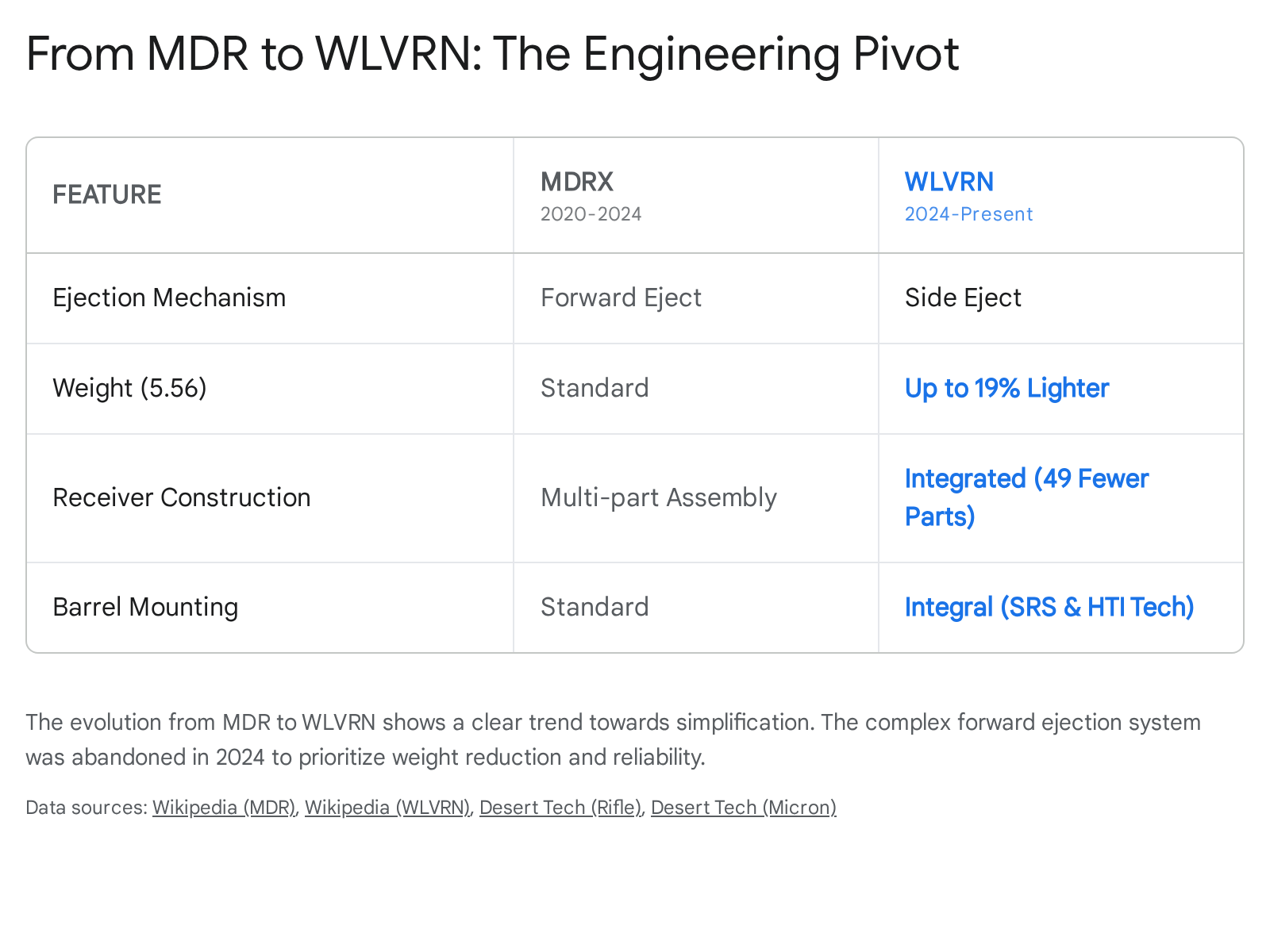
In January 2024, Desert Tech officially discontinued the MDR and MDRX lines, replacing them with the WLVRN (Wolverine).5 The WLVRN represents a triumph of pragmatism over ambition. It completely abandons the complex forward-ejection mechanism that defined the MDR. By reverting to a simpler side-ejection system (borrowing from the SRS barrel mounting architecture), the engineers achieved significant performance gains:
- Weight Reduction: The WLVRN is up to 19% lighter than the MDRX, addressing one of the primary complaints about the previous platform.34
- Simplicity: The new receiver uses 49 fewer parts, drastically reducing the points of failure.34
- Accuracy: The barrel is now mounted via a trunnion machined directly into the aluminum upper receiver (similar to the SRS), which reportedly improves accuracy by 30% compared to the polymer-bedded barrel of the MDRX.6
6.2 The Quattro-15 and QMAG-53
Simultaneously, Desert Tech moved to capture the broader AR-15 market with the Quattro-15 system, shipping in volume by early 2025.36 This system consists of a specialized lower receiver designed to accept the QMAG-53, a 53-round quad-stack magazine.
Quad-stack magazines (like the legacy SureFire 60) have historically suffered from reliability issues because tapering four columns of ammo into a single feed point creates immense friction. The Quattro-15 solves this by widening the magwell itself, allowing the magazine to remain wide until the very top feed lips. This product was born from Desert Tech’s submission to the U.S. Army’s Next Generation Squad Weapon (NGSW) program, showcasing their attempt to spin off military R&D into civilian commercial success.38
7. Future Outlook & Strategic Analysis
As Desert Tech moves through 2025, it occupies a unique “High Innovation / Civilian-Primary” quadrant of the firearms market. Unlike competitors such as Barrett or Accuracy International, which are “Mil-Spec Traditional” and derive the bulk of their revenue from government contracts, Desert Tech relies heavily on the high-end civilian enthusiast market.
7.1 Market Trends
The global firearms market is witnessing a “bullpup renaissance,” driven by the adoption of the VHS-2 (Hellion) and the continued relevance of the Tavor.39 The WLVRN is well-positioned to compete in this space, provided the company can permanently shed the reputation for poor quality control that plagued the early MDR years.
7.2 The Existential Risk
The primary threat to Desert Tech remains the legal instability of the Kingston family. As the 2025 lawsuits against the Order progress, the risk of asset forfeiture or banking de-risking (where banks refuse to service the company due to reputational toxicity) increases. For Desert Tech to thrive long-term, it may eventually require a divestiture—separating the innovative engineering and the “Desert Tech” brand from the ownership of the Order, much like how other controversial defense firms have rebranded or restructured to survive.
8. Summary of Key Milestones
| Year | Milestone Event | Significance |
| 2007 | Founding | Nick Young founds Desert Tactical Arms (DTA) in West Valley City, Utah.1 |
| 2008 | SRS Launch | The Stealth Recon Scout (SRS) is unveiled at SHOT Show, introducing the modern modular bullpup sniper.4 |
| 2012 | HTI Launch | The Hard Target Interdiction (HTI) is released, bringing.50 BMG capability to a portable chassis.16 |
| 2013 | Rebranding | Company changes name to Desert Tech; integrates Munitions and Training divisions.3 |
| 2014 | MDR Announcement | The Micro Dynamic Rifle (MDR) is announced, promising a revolution in bullpup ergonomics.19 |
| 2014 | Pakistan Contract | Desert Tech publicly rejects a rumored $15M Pakistan contract on ethical grounds.40 |
| 2017 | MDR Shipping | After 3 years of delays, the MDR finally ships to customers.19 |
| 2019 | Fraud Case | Jacob and Isaiah Kingston plead guilty to $1B tax fraud; Desert Tech building threatened with seizure (later dropped).8 |
| 2020 | MDRX Release | The MDRX replaces the MDR, fixing polymer flex and reliability issues; adds Side Eject option.21 |
| 2022 | Trek-22 Launch | Entry into the rimfire market with the Trek-22 chassis for Ruger 10/22.36 |
| 2023 | Quattro-15 Launch | The 53-round quad-stack magazine system (QMAG-53) and lower receiver are launched.38 |
| 2024 | WLVRN Release | The WLVRN replaces the MDRX, abandoning forward ejection for a lighter, simpler, side-eject design.5 |
| 2024 | Ukraine/Russia Usage | Reports confirm widespread use of DT rifles in Ukraine; investigations reveal grey-market flow to Russia.10 |
| 2025 | Legal Battles | New federal lawsuits filed against Kingston family leadership alleging abuse; continued operation of the company under cloud of litigation.9 |
If you find this post useful, please share the link on Facebook, with your friends, etc. Your support is much appreciated and if you have any feedback, please email me at in**@*********ps.com. Please note that for links to other websites, we are only paid if there is an affiliate program such as Avantlink, Impact, Amazon and eBay and only if you purchase something. If you’d like to directly contribute towards our continued reporting, please visit our funding page.
Sources Used
- Desert Tech | Gun Wiki | Fandom, accessed December 21, 2025, https://guns.fandom.com/wiki/Desert_Tech
- About Us – Desert Tech, accessed December 21, 2025, https://deserttech.com/about-us
- Desert Tactical Arms (DTA) to Rebrand Company as Desert Tech (DT), and Thomas Alexander is Named CEO of Desert Tech Training Center – Defense Review, accessed December 21, 2025, https://defensereview.com/desert-tactical-arms-dta-to-rebrand-company-as-desert-tech-dt-and-thomas-alexander-is-named-ceo-of-desert-tech-training-center/
- Desert Tech SRS – Wikipedia, accessed December 21, 2025, https://en.wikipedia.org/wiki/Desert_Tech_SRS
- The NEW Desert Tech WLVRN Bullpup – YouTube, accessed December 21, 2025, https://www.youtube.com/watch?v=ko07rGsKYtM
- WLVRN Micron – Desert Tech, accessed December 21, 2025, https://deserttech.com/wlvrn-micron.html
- Desert Tech – Wikipedia, accessed December 21, 2025, https://en.wikipedia.org/wiki/Desert_Tech
- Utah polygamist clan members sentenced to federal prison for billion-dollar tax fraud scheme | KSL.com, accessed December 21, 2025, https://www.ksl.com/article/50620241/utah-polygamist-clan-members-sentenced-to-federal-prison-for-billion-dollar-tax-fraud-scheme
- Grant et al v. Kingston et al, No. 2:2024cv00155 – Document 292 (D. Utah 2024) – Justia Law, accessed December 21, 2025, https://law.justia.com/cases/federal/district-courts/utah/utdce/2:2024cv00155/146641/292/
- Shooting Ukraine in the back: Sniper rifles and ammunition from the …, accessed December 21, 2025, https://theins.ru/en/politics/277169
- Russian state TV shows military using U.S.-made sniper rifles and ammunition, despite 2014 embargo – The Insider, accessed December 21, 2025, https://theins.ru/en/news/278477
- I Built a Gun Company – Desert Tech, accessed December 21, 2025, https://deserttech.com/blog/i-built-a-gun-company
- Who Really Won the $80 Million SOCOM Sniper Rifle Contract? – Desert Tech, accessed December 21, 2025, https://deserttech.com/blog/sniper-rifle-contract
- SRS M-2 Flyer (2024) front – Desert Tech, accessed December 21, 2025, https://deserttech.com/media/attachments/products/SRS_M-2_Flyer_2024__1.pdf
- Desert Tech SRS-A2 – the unreal hi-tech sniper rifle coming from the future, accessed December 21, 2025, https://bulgarianmilitary.com/2020/07/25/desert-tech-srs-a2-the-unreal-hi-tech-sniper-rifle-coming-from-the-future/
- Desert Tech HTI – Wikipedia, accessed December 21, 2025, https://en.wikipedia.org/wiki/Desert_Tech_HTI
- Origin Story of Desert Tech – YouTube, accessed December 21, 2025, https://www.youtube.com/watch?v=qGsxs-0lS30
- Desert Tactical Arms To Rebrand Company As Desert Tech | Soldier Systems Daily, accessed December 21, 2025, https://soldiersystems.net/2013/12/19/desert-tactical-arms-to-rebrand-company-as-desert-tech/
- Desert Tech MDR – Wikipedia, accessed December 21, 2025, https://en.wikipedia.org/wiki/Desert_Tech_MDR
- A Year with the Desert Tech MDRX (Review) – YouTube, accessed December 21, 2025, https://www.youtube.com/watch?v=aUr-JEJoufg
- SHOT Show 2020: Desert Tech MDRX | An Official Journal Of The NRA – American Rifleman, accessed December 21, 2025, https://www.americanrifleman.org/content/shot-show-2020-desert-tech-mdrx/
- WLVRN Reliability/Durability : r/DesertTech – Reddit, accessed December 21, 2025, https://www.reddit.com/r/DesertTech/comments/1m272xm/wlvrn_reliabilitydurability/
- WLVRN has been out for 9 months and I’m still salty : r/DesertTech – Reddit, accessed December 21, 2025, https://www.reddit.com/r/DesertTech/comments/1ga8ff8/wlvrn_has_been_out_for_9_months_and_im_still_salty/
- Latter Day Church of Christ – Wikipedia, accessed December 21, 2025, https://en.wikipedia.org/wiki/Latter_Day_Church_of_Christ
- Blood Cult – Southern Poverty Law Center, accessed December 21, 2025, https://www.splcenter.org/resources/reports/blood-cult/
- Jury Finds Los Angeles Businessman Guilty in $1 Billion Biodiesel Tax Fraud Scheme, accessed December 21, 2025, https://www.justice.gov/archives/opa/pr/jury-finds-los-angeles-businessman-guilty-1-billion-biodiesel-tax-fraud-scheme
- Los Angeles Businessman, Utah Fuel Plant Operators and Employees Sentenced to Prison for Billion-Dollar Biofuel Tax Fraud Scheme – Department of Justice, accessed December 21, 2025, https://www.justice.gov/archives/opa/pr/los-angeles-businessman-utah-fuel-plant-operators-and-employees-sentenced-prison-billion
- ‘Kingston clan’ lawsuit alleges incestuous, underage plural marriage – KSL.com, accessed December 21, 2025, https://www.ksl.com/article/51250692/kingston-clan-lawsuit-alleges-incestuous-underage-plural-marriage
- Donald Trump Jr. appeared in promotion for gun company run by prominent member of polygamous group – CBS News, accessed December 21, 2025, https://www.cbsnews.com/news/donald-trump-jr-desert-tech-riles-promotion-nicholas-young-the-order-polygamous-group-utah/
- Desert Tech Equipment deployed to Ukraine War (Including MDRx) : r/DesertTech – Reddit, accessed December 21, 2025, https://www.reddit.com/r/DesertTech/comments/wfno1v/desert_tech_equipment_deployed_to_ukraine_war/
- Desert Tech MDR in Ukraine : r/ForgottenWeapons – Reddit, accessed December 21, 2025, https://www.reddit.com/r/ForgottenWeapons/comments/13vy9ko/desert_tech_mdr_in_ukraine/
- SRS Contract – Desert Tech, accessed December 21, 2025, https://deserttech.com/contract-srs
- Russian snipers use Western rifles, ammunition despite sanctions, media investigation says, accessed December 21, 2025, https://kyivindependent.com/russian-snipers-sanctions-insider/
- WLVRN Bullpup Rifle – Desert Tech, accessed December 21, 2025, https://deserttech.com/wlvrn-rifle.html
- Desert Tech WLVRN 6mm ARC – Coldboremiracle, accessed December 21, 2025, https://coldboremiracle.com/2024/12/14/desert-tech-wlvrn-6mm-arc/
- [SHOT 2025] Desert Tech Introduce Complete Trek-22 and Quattro Rifles – The Firearm Blog, accessed December 21, 2025, https://www.thefirearmblog.com/blog/shot-2025-desert-tech-introduce-complete-trek-22and-quattro-rifles-44818591
- Quattro-15 – Desert Tech, accessed December 21, 2025, https://deserttech.com/blog/quattro-15
- Development History: Quattro 15 & QMAG-53 – Desert Tech, accessed December 21, 2025, https://deserttech.com/blog/development-history-quattro-15-qman-53
- 9 Best Bullpup Rifles & Shotguns [Updated 2025 ] – Gun University, accessed December 21, 2025, https://gununiversity.com/best-bullpup-rifles-and-shotguns/
- Pak slams Utah gun maker’s claim of rejecting rifles contract as ‘baseless’ – The Siasat Daily, accessed December 21, 2025, https://archive.siasat.com/news/pak-slams-utah-gun-makers-claim-rejecting-rifles-contract-baseless-527080/