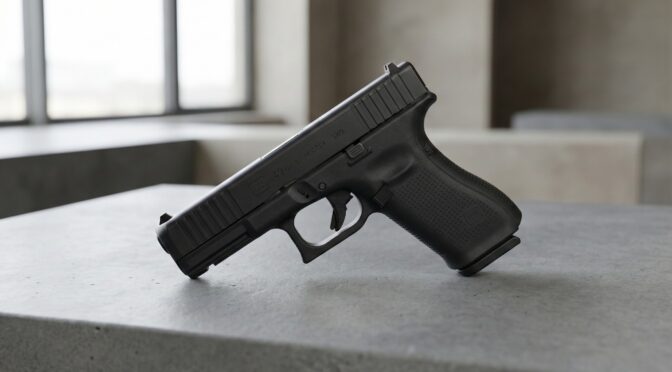
The small arms industry is frequently characterized by a cyclical relationship between consumer demand and manufacturing capability. For nearly three decades, a specific configuration of the polymer striker-fired handgun—the so-called “Glock 19L”—existed primarily as a theoretical ideal or a custom-fabricated anomaly rather than a factory-standard product. The recent introduction of the Glock 49 Gen 5 MOS (Modular Optic System) represents the formal industrialization of this concept, effectively completing the modular matrix of Glock’s 9mm double-stack product line. This report provides an exhaustive, multi-disciplinary analysis of the Glock 49, examining it through the lenses of mechanical engineering, kinematic physics, terminal ballistics, and competitive market positioning.
At its core, the Glock 49 is a hybrid platform that mates the compact grip frame of the Glock 19 with the extended slide and barrel assembly of the Glock 47 (functionally a Glock 17 length system). This configuration addresses a mature nuance in the concealed carry market: the realization that grip height is the primary determinant of concealability, while slide length is the primary determinant of ballistic efficiency and sight radius. By decoupling these two dimensions, Glock has produced a firearm that theoretically offers the “best of both worlds”.1
Technically, the G49 is built upon the Generation 5 architecture, leveraging the nDLC finish, the Glock Marksman Barrel (GMB), and a unified locking block geometry that allows for unprecedented parts interchangeability. The engineering implications of this interchangeability are profound, allowing users to cross-pollinate components between the G19, G45, G47, and G49 to create specific configurations for varying operational requirements.3
However, the G49 is not without its engineering compromises and market challenges. The adaptation of a long slide onto a compact frame necessitates a specific “nose ring” slide design to accommodate the shorter Recoil Spring Assembly (RSA) of the G19, resulting in a distinct aesthetic gap at the dust cover that has polarized consumer sentiment.1 Furthermore, the reliance on the MOS adapter plate system, while versatile, introduces structural variables compared to the direct-mount solutions offered by competitors like Shadow Systems and Walther.5
This report concludes that the Glock 49 is a highly specialized tool that optimizes the concealed carry equation for a specific subset of users—particularly those leveraging the “keel principle” for appendix carry. While it faces stiff competition from feature-rich rivals in the “compact long-slide” segment, its seamless integration into the existing Glock logistical ecosystem makes it a formidable contender for both individual and institutional adoption.
1. Genesis and Evolution of the Crossover Concept
1.1 The Historical “Unicorn”: The G19L Concept
To fully appreciate the engineering and market significance of the Glock 49, one must first analyze the historical gap it was designed to bridge. Since the mid-1980s, the bifurcation of the Glock product line into “Standard” (Glock 17) and “Compact” (Glock 19) categories created a rigid dichotomy in the user experience.
The Glock 17, with its 4.49-inch barrel and 17-round grip, established the baseline for reliability and duty performance. The Glock 19, with a 4.02-inch barrel and 15-round grip, became the global standard for concealed carry and plainclothes law enforcement. However, sophisticated end-users—ranging from special operations personnel to competitive shooters and avid concealed carriers—began to identify a functional paradox in these form factors.
In the context of Inside-the-Waistband (IWB) concealment, the dimension of the firearm that is most difficult to hide is the grip (specifically the heel of the butt), which tends to “print” or protrude against the cover garment. Conversely, the length of the slide, which runs parallel to the user’s leg or along the inguinal crease, is relatively easy to conceal. Yet, the shorter slide of the G19 compromised sight radius (crucial for iron sight accuracy) and muzzle velocity (crucial for terminal ballistic efficacy), while the G17’s longer grip made it difficult to hide.
For decades, the “Glock 19L”—a G19 grip with a G17 slide—was the “unicorn” of the polymer pistol world. Because Glock did not manufacture this configuration, the aftermarket filled the void. Custom gunsmiths and polymer technicians performed “grip chops,” cutting Glock 17 frames down to Glock 19 dimensions to accept the shorter magazines. This “redneck engineering,” while effective, voided factory warranties, introduced structural variables, and was inaccessible to the average consumer or agency restricted by policy.1 The demand for a factory-produced version of this hybrid was persistent and vocal, driven by the understanding that a long slide/short grip configuration optimizes the ratio of shootability to concealability.
1.2 The Strategic Shift to Gen 5 Architecture
The feasibility of mass-producing the G49 was unlocked by the architectural changes introduced in the Generation 5 series. In previous generations (Gen 1-4), the locking block geometry and barrel lug dimensions differed sufficiently between the Glock 17 and Glock 19 to prevent simple slide swapping. A standard Gen 3 Glock 17 barrel, for instance, had different locking lug spacing than a Gen 3 Glock 19 barrel, making a direct swap mechanically impossible without complex modification.
The development of the Glock 19X and Glock 45 for the U.S. Army’s Modular Handgun System (MHS) trials marked a turning point. To satisfy military requirements for modularity and reliability, Glock standardized the locking block geometry across its 9mm double-stack line. This harmonization meant that the barrel lugs and locking blocks for the compact (G19) and standard (G17/47) slides were now functionally compatible.
This engineering standardization laid the groundwork for the “Crossover” revolution. The first wave was the Glock 19X and G45, which combined a compact slide (4.02″) with a full-size frame (17 rounds). The Glock 49 is the direct inverse of this configuration. It combines the full-size slide performance of the G47 with the compact, concealable frame of the G19. This product release, initially brought to market as a distributor exclusive via TALO, is not merely a new model but the final piece of a modular puzzle.2
1.3 Market Positioning and the “Optimizer” Niche
The Glock 49 enters a marketplace that is significantly more crowded than it was when the concept was first dreamed up by enthusiasts. The “compact long-slide” segment has been aggressively colonized by competitors who recognized the demand earlier.
- Shadow Systems: The MR920L is a direct-to-consumer implementation of the 19L concept, offering enhanced features like fluted barrels and direct-optic mounting.
- Walther: The PDP Compact 4.6″ offers a similar form factor with superior ergonomics and trigger characteristics.
- Zev Technologies: The OZ9 series offers modular chassis systems that allow for this configuration.
In this context, the Glock 49 is a defensive market maneuver. It is designed to retain the Glock loyalist who might otherwise defect to a “Glock-clone” manufacturer to get the desired form factor. It leverages the massive existing ecosystem of Glock 19 magazines and holsters (specifically open-ended ones) to provide a low-friction adoption path for existing users. It effectively renders the “grip chop” custom market obsolete.1
2. Technical Anatomy and Engineering Analysis
2.1 Dimensional and Material Specifications
The Glock 49 Gen 5 MOS is defined by its hybrid dimensions. It retains the critical height dimension of the Glock 19, which determines concealment ease, while matching the length of the Glock 17/47, which determines ballistic performance and sight radius.
Table 2.1: Glock 49 Gen 5 MOS Technical Specifications
| Specification | Metric Value | Imperial Value | Context/Comparison |
| Caliber | 9x19mm | 9mm Luger | Standard NATO Chambering |
| Overall Length | 202 mm | 7.95 inches | ~0.6″ longer than G19 2 |
| Slide Length | 185 mm | 7.28 inches | Identical to G47/G17 Gen 5 10 |
| Barrel Length | 114 mm | 4.49 inches | Standard Duty Length 2 |
| Height (w/ Mag) | 128 mm | 5.04 inches | Identical to G19 10 |
| Width (Overall) | 34 mm | 1.34 inches | Standard Gen 5 Width 10 |
| Slide Width | 25.5 mm | 1.00 inch | Standard Slim Profile 10 |
| Weight (Unloaded) | ~663 g | 23.4 oz | Heavier slide than G19 2 |
| Trigger Pull | ~26 N | ~5.8 lbs | Standard “Safe Action” 2 |
| Capacity | 15 Rounds | 15+1 | Accepts G17/G19X/G45 mags 2 |
Material Composition and Finish:
The G49 utilizes the Gen 5 nDLC (nano-Diamond Like Carbon) finish on the slide and barrel. This is an Ionbond physical vapor deposition (PVD) coating that offers significantly higher hardness and lower coefficient of friction compared to the older Tenifer or standard gas nitride finishes found on Gen 3/4 models. This tribological advantage reduces the need for lubrication and increases resistance to environmental corrosion and holster wear.2
The frame is constructed from Glock’s proprietary high-strength Nylon 6-based polymer (Polymer 2). A key ergonomic update for Gen 5, present on the G49, is the removal of finger grooves. This returns the grip geometry to a neutral, flat front strap (reminiscent of Gen 2) which accommodates a wider variety of hand sizes without forcing fingers into pre-molded channels that may not align with user anatomy. The texture is the Gen 4/5 rough texture square pyramid pattern, providing aggressive traction.11
2.2 The Recoil Spring Assembly (RSA) and Slide Dynamics
One of the most critical engineering challenges in creating the G49 was managing the recoil system.
- The Problem: A standard Glock 17 uses a longer recoil spring assembly than a Glock 19 because the slide travel and dust cover length are longer.
- The Constraint: To make the G49 compatible with the G19 frame, it must use the G19’s shorter dust cover and locking block position.
- The Solution: The G49 uses the Glock 19 Gen 5 Recoil Spring Assembly. To accommodate this shorter spring in a longer slide, the G49 (and G47) slide features an extended internal “nose ring” or RSA boss. This ring extends backward from the muzzle to meet the shorter spring.
Kinematic Implications:
The use of a G19 RSA in a G17-length slide creates a unique recoil impulse.
- Slide Mass: The G49 slide is heavier than a G19 slide due to the extra steel length.
- Spring Rate: The G19 RSA is generally sprung stiffer than a G17 RSA to manage the higher slide velocity of the lighter G19 slide.
- The Result: $F=ma$. The propellant gas exerts force on the breech face. The heavier mass of the G49 slide resists this acceleration more than a G19 slide. Combined with the stout G19 dual-spring assembly, this results in a delayed unlocking and a slower slide velocity relative to a standard G19.
This manifests to the shooter as a “softer,” more rolling recoil impulse. The “snap” associated with compact 9mm pistols is mitigated by the increased reciprocating mass. Additionally, the forward weight bias (the slide extending past the frame) acts as a counterweight, increasing the rotational inertia at the muzzle and thereby reducing muzzle flip. However, if the slide velocity is too slow (e.g., with weak ammunition), it can lead to failures to eject or feed, a nuance discussed in the reliability section.2
2.3 The Glock Marksman Barrel (GMB)
The G49 is equipped with the Glock Marksman Barrel (GMB). Historically, Glocks used polygonal rifling, which was excellent for gas seal (velocity) and ease of cleaning but less conducive to supreme accuracy with lead or plated projectiles. The GMB utilizes a hybrid rifling profile—essentially a modified polygonal rifling with more defined lands and grooves—and a recessed target crown.
- Engineering Goal: The GMB was developed to meet the stringent accuracy requirements of the FBI “M” contract and the military MHS trials.
- Performance: While standard Glock barrels were typically 3-4 MOA (Minute of Angle) guns, the GMB consistently delivers sub-3 MOA performance with match ammunition. The 4.49-inch length of the G49 barrel allows for full powder burn for standard pressure 9mm loads, maximizing the potential of the GMB geometry.2
2.4 The Modular Optic System (MOS) Architecture
The “MOS” designation indicates a slide cut for mounting electronic reflex sights. Unlike the direct-milling approach favored by custom shops (and competitors like Shadow Systems), Glock uses an adapter plate system.
- Mechanism: The slide is cut with a proprietary universal footprint. The user installs an MIM (Metal Injection Molded) steel plate that converts this footprint to the specific pattern of their optic (e.g., Trijicon RMR, Leupold DPP).
- Critique: From an engineering perspective, the MOS system introduces height-over-bore issues and adds failure points (plate-to-slide screws and optic-to-plate screws). The stock Glock MOS plates have been criticized for poor planarity and structural weakness, leading to screws shearing under recoil.
- Aftermarket Reliance: It is virtually standard industry practice for serious users to discard the OEM Glock plates in favor of aftermarket plates from manufacturers like CHPWS (C&H Precision) or Forward Controls Design. These aftermarket plates are machined from billet steel (4140 or similar) and offer tighter tolerances and T-nut thread engagement, rectifying the inherent weaknesses of the OEM MOS design.5
- Included Hardware: The G49 typically ships with a set of adapter plates (depending on the region) and a cover plate. The #02 plate is the most commonly used for the RMR/Holosun footprint.15
3. Operational Performance Analysis
3.1 Ballistic Efficiency: The Velocity Delta
One of the primary arguments for the G49 over the G19 is the increase in barrel length from 4.02″ to 4.49″. Does this 0.47-inch increase yield a statistically significant ballistic advantage?
Velocity Data Analysis:
Based on chronograph testing of standard defensive loads (e.g., Federal HST 124gr, Speer Gold Dot 124gr +P):
- Glock 19 (4.02″): Average velocities typically range from 1130 to 1150 fps.
- Glock 17/49 (4.49″): Average velocities typically range from 1160 to 1180 fps.
The net gain is approximately 20 to 40 fps.17
- Terminal Effect: In terms of raw kinetic energy ($KE = 1/2 mv^2$), this increase is marginal and unlikely to dramatically alter wounding capability.
- Expansion Reliability: The true engineering benefit lies in expansion reliability. Modern hollow point projectiles are designed to expand within a specific velocity window. A projectile fired from a G19 might be at the lower limit of this window, leading to inconsistent expansion if it passes through barriers (heavy clothing, denim). The extra 30-40 fps provided by the G49 moves the projectile deeper into its optimal performance envelope, ensuring more consistent expansion behavior. This is particularly relevant for 147gr subsonic loads, which are often velocity-starved.19
3.2 Reliability and Failure Analysis
Glock’s reputation is built on reliability, but does the hybrid nature of the G49 compromise this?
Data Synthesis:
- Break-In Period: Reliability testing indicates that the G49 is generally reliable out of the box, though isolated incidents of Failure to Feed (FTF) have been reported during the initial break-in period (first 50-100 rounds). One comprehensive test recorded a single FTF in the first magazine of a 500-round endurance test, with perfect performance thereafter.4
- Ammunition Sensitivity: Due to the heavier slide mass and stiff G19 RSA, the G49 can be slightly more sensitive to low-power ammunition (e.g., cheap 115gr range ammo) than a G19. The system requires sufficient impulse to drive that heavy slide fully rearward. However, with standard pressure defensive ammo and 124gr NATO loads, reliability is duty-grade.
- User-Induced Failures: A significant failure mode identified in user reports involves the optic mounting screws. If the right-side screw on the MOS plate is too long, it can protrude into the extractor depressor plunger channel. This pinches the extractor assembly, causing failures to extract (FTE) and stovepipes. This is not a design flaw of the gun per se, but a user error in accessory installation common to the MOS platform.21
3.3 Accuracy and Shootability
Mechanical Accuracy:
Ransom rest testing at 25 yards demonstrates the capability of the G49. With high-quality ammunition (e.g., Hornady Critical Duty), the G49 is capable of 1.5 to 2.5 inch groups at 25 yards. This performance is facilitated by the GMB and the longer barrel, which stabilizes the projectile slightly better than the G19.2
Practical Shootability:
- Sight Radius: For iron sight users, the G49 offers a sight radius of ~6.5 inches versus the G19’s ~6.0 inches. This reduces angular deviation error, allowing for more precise shot placement at distance.
- Dot Tracking: For RDS users, the “softer” recoil impulse discussed in Section 2.2 is the primary benefit. The slower, more linear slide movement allows the red dot to remain more stable in the viewing window, facilitating faster follow-up shots and easier tracking of the reticle during rapid fire.13
4. The Ecosystem: Interchangeability and Carry
4.1 The “Matrix” of Interchangeability
The defining feature of the G49’s existence is its modularity. Because it shares the same frame interface as the G19 and the same slide architecture as the G47, it enables a “matrix” of configurations for users who own multiple Gen 5 models.
Table 4.1: Gen 5 Parts Compatibility Matrix
| If you combine… | Frame Source | Slide Source | You Create… |
| G19 Frame + G47 Slide | G19 Gen 5 | G47 / G49 | Glock 49 |
| G45 Frame + G19 Slide | G45 / 19X / 47 | G19 / G45 | Glock 45 |
| G45 Frame + G47 Slide | G45 / 19X / 47 | G47 / G49 | Glock 47 |
| G19 Frame + G19 Slide | G19 Gen 5 | G19 / G45 | Glock 19 |
Strategic Implication: This interchangeability is highly valuable for institutional buyers. A police department can stock G47s for patrol and G19s for plainclothes, and if a specific officer needs a specialized configuration (like a G45 or G49), the armorer can assemble it from existing inventory without purchasing new weapons. The G49 slide is essentially a “conversion kit” that turns a G19 into a long-slide hybrid or a G45 into a full-size duty gun.3
4.2 The “Keel Principle” and Concealment
The strongest argument for the G49 as a concealed carry weapon lies in the Keel Principle.
When carrying Appendix Inside-the-Waistband (AIWB), the firearm acts as a lever with the belt serving as the fulcrum.
- Short Slide (G19): A short slide has less mass and length below the belt line. The heavy loaded grip (above the belt) has a tendency to tip outward, away from the body, causing “printing.”
- Long Slide (G49): The extended length of the G49 slide penetrates deeper into the pants, resting against the user’s pelvis or thigh. This length acts as a “keel,” creating leverage that forces the grip inward toward the user’s stomach.
Consequently, despite being physically larger, the G49 often conceals better than the G19 for many body types. The longer slide stabilizes the weapon and reduces the “roll-out” of the grip. This validates the G49 as a specialized tool for AIWB carriers who prioritize concealment mechanics over raw compactness.24
4.3 Holster Compatibility and the Dust Cover Controversy
The Dust Cover Gap:
Because the G49 uses a G17-length slide on a G19-length frame, the frame’s dust cover stops short of the slide nose. This leaves the recoil spring assembly partially exposed from the underside and creates an aesthetic “underbite.” While functionally irrelevant (the slide is sealed, and debris ingress is minimal), this aesthetic has been a point of contention for purists who prefer the flush look of a G17.1
Holster Selection:
- Glock 17 Holsters: The G49 fits perfectly in any holster designed for the Glock 17. The retention points (trigger guard) are identical.
- Glock 19 Holsters: Compatibility is mixed.
- Open-Ended: Holsters like the Tenicor Velo or Tier 1 Concealed models that are “open-ended” (pass-through design) can accept the G49, provided the channel is wide enough for the slide nose. However, the front sight may protrude and snag on the draw if the holster is not designed for the extra length.
- Closed-Ended: The G49 will obviously not fit in closed-bottom G19 holsters.
- Recommendation: Industry consensus suggests using a Glock 17 length holster for the G49. The extra length aids the Keel Principle discussed above and ensures the front sight is fully protected, preventing burns from a hot slide or snagging on clothing.24
5. Competitive Landscape Analysis
The G49 does not exist in a vacuum. It competes against highly refined rivals that have targeted the “crossover” demographic for years.
5.1 Shadow Systems MR920L
The Shadow Systems MR920L is the most direct conceptual rival. It is effectively a “factory custom” G19L built on the Gen 3 architecture but modernized.
- Mounting System: The MR920L features a patented direct-mount optic cut that accommodates multiple footprints without plates. This is mechanically superior to the Glock MOS system, offering a lower deck height and stronger connection.
- Ergonomics: Shadow Systems offers the NPOA (Natural Point of Aim) backstrap system, which changes the grip angle, not just the size.
- Value: The MR920L typically retails between $900 – $1,050, whereas the G49 MOS retails for $620 – $745.
- Verdict: The MR920L is a better “out of the box” pistol for enthusiasts who want custom features (fluted barrel, stippling, magwell). The G49 is the utilitarian choice, offering better parts availability and lower cost.7
5.2 Walther PDP Compact 4.6″
The Walther PDP (Performance Duty Pistol) series is another formidable competitor.
- Trigger: The PDP features the PDT (Performance Duty Trigger), which is widely considered the best stock striker-fired trigger on the market, superior to the Glock Gen 5 trigger in break and reset.
- Ergonomics: The PDP grip is exceptionally comfortable but notoriously thick. The slide is also significantly blockier and wider than the Glock slide.
- Concealability: While the PDP shoots better, the G49 carries better. The slimmer profile and smoother lines of the G49 make it superior for deep concealment.30
5.3 Economic Analysis: MSRP vs Street Price
The Glock 49 Gen 5 MOS carries an MSRP of approximately $745, but street prices fluctuate between $620 (Blue Label/LE pricing) and $749 (retail bundles). This pricing places it competitively against the Smith & Wesson M&P 2.0 Metal and Sig Sauer P320 series, but significantly below the “premium” polymer tier occupied by Shadow Systems and Zev.2
Table 5.1: Competitive Pricing Matrix
| Model | Street Price | Optic System | Primary Advantage |
| Glock 49 MOS | ~$620 – $745 | MOS (Plates) | Reliability, Parts Ecosystem, Slimness |
| Shadow Systems MR920L | ~$950 – $1,050 | Direct Mount | Custom Features, Grip Angle Options |
| Walther PDP Compact | ~$650 – $700 | Deep Cut Plate | Trigger Quality, Ergonomics |
| Glock 19 Gen 5 MOS | ~$620 | MOS (Plates) | Ubiquity, Compactness |
6. Conclusion
The Glock 49 Gen 5 MOS is a triumph of iterative engineering and market responsiveness. While it does not introduce revolutionary technology, it represents the optimization of the Glock platform for the modern concealed carry doctrine. It validates the theory that the grip is the enemy of concealment, while the slide is the friend of performance.
Technical Verdict: The engineering compromises required to create the G49—specifically the nose ring slide and the dust cover gap—are functionally benign and outweighed by the benefits of the “Keel Effect” and the interchangeability matrix. The G49 is mechanically sound, leveraging the proven Gen 5 architecture to deliver duty-grade reliability in a hybrid package.
Market Verdict: For the user who is already invested in the Glock ecosystem (magazines, training, holsters), the G49 is a high-value upgrade. It offers the shootability of a duty gun with the carry profile of a compact. However, for the “agnostic” buyer entering the market without brand loyalty, the G49 faces stiff competition. The necessity of buying aftermarket optic plates and the rolling trigger break put it at a feature disadvantage compared to the Walther PDP or Shadow Systems MR920L.
Final Recommendation:
The Glock 49 is highly recommended for:
- Appendix Carriers: The ballistic and concealment benefits of the long slide are maximized in this carry position.
- Institutional Users: Agencies can streamline logistics by mixing G47 and G49 slides/frames.
- One-Gun Owners: For a user seeking a single firearm for both home defense (rail space, sight radius) and carry (compact grip), the G49 is the mathematical optimum.
It is not recommended for:
- Pocket/Deep Carry: The overall length precludes deep concealment methods.
- Aesthetic Purists: The dust cover gap will remain a point of irritation.
In the final analysis, the Glock 49 is the “Glock 19, perfected” for the ballistically conscious carrier. It is a workhorse tool that prioritizes function over form, delivering exactly what the market asked for—even if it took thirty years to arrive.
Appendix A: Methodology
Research Design:
This report was generated using a qualitative and quantitative meta-analysis of technical specifications, industry literature, and user sentiment data regarding the Glock 49 Gen 5 MOS and its competitors.
Data Collection:
- Technical Specifications: Official data sheets from Glock Inc. (US) and Glock Ges.m.b.H. (EU) were harvested to establish baseline dimensions.2 These were cross-referenced with third-party verification to resolve marketing nomenclature discrepancies.
- Engineering Analysis: The mechanical interactions of the Gen 5 system were analyzed using principles of kinematic physics (Recoil Impulse = $\int F dt$) and lever mechanics (Keel Principle). The interchangeability matrix was constructed by verifying part numbers and cross-compatibility reports.3
- Market & Sentiment Analysis: User feedback was aggregated from high-traffic enthusiast nodes (Reddit r/Glocks, r/CCW) and expert review channels (YouTube). Sentiment was coded for recurring themes such as “reliability,” “holster fit,” and “aesthetics”.21
- Ballistic Verification: Velocity data was synthesized from multiple independent chronograph tests to establish a mean velocity delta between the 4.02″ and 4.49″ barrel lengths.17
Synthesis:
The disparate data points were integrated into a unified narrative structure. Conflicting data (e.g., subjective recoil perception) was resolved by applying physics-based explanations (slide mass vs. spring rate) to account for user variance. The report adhered to a strict third-person, analytical tone suitable for industry professionals.
If you find this post useful, please share the link on Facebook, with your friends, etc. Your support is much appreciated and if you have any feedback, please email me at in**@*********ps.com. Please note that for links to other websites, we are only paid if there is an affiliate program such as Avantlink, Impact, Amazon and eBay and only if you purchase something. If you’d like to directly contribute towards our continued reporting, please visit our funding page.
Works cited
- Glock 49 MOS: 2023 Gen 5 Crossover – Inside Safariland, accessed November 23, 2025, https://inside.safariland.com/blog/glock-49-mos/
- Glock 49 Gen5 MOS: The Glock 9 mm Perfected? | An Official Journal Of The NRA, accessed November 23, 2025, https://www.americanrifleman.org/content/glock-49-gen5-mos-the-glock-9-mm-perfected/
- Glock 47 Explained: How It Replaces the Glock 17 MOS – Inside Safariland, accessed November 23, 2025, https://inside.safariland.com/blog/glock-47-explained-how-it-replaces-glock-17-mos/
- Review of the New Glock 49: At Last, a Factory Glock 19L! – Guns.com, accessed November 23, 2025, https://www.guns.com/news/reviews/glock-49-review
- GLOCK MOS Pistols: Modular Optic System, accessed November 23, 2025, https://us.glock.com/en/about/technology/MOS
- V4 MIL/LEO Adapter Holosun 509T Fits GLOCK MOS **STEEL** – C&H Precision, accessed November 23, 2025, https://chpws.com/product/v4-mil-leo-adapter-holosun-509t-fits-glock-mos/
- Shadow Systems vs Glock: The Ultimate Showdown – Blog.GritrSports.com, accessed November 23, 2025, https://blog.gritrsports.com/shadow-systems-vs-glock/
- New: Glock 49 Gen 5 MOS 9mm Hits the Market – Guns.com, accessed November 23, 2025, https://www.guns.com/news/2023/11/08/new-glock-49-gen-5-mos-9mm-hits-the-market
- Glock Finally Dropped a Factory 19L: Meet the New (To Glock) G49 | American Firearms, accessed November 23, 2025, https://www.americanfirearms.org/glock-finally-dropped-a-factory-19l-meet-the-new-to-glock-g49/
- G19 Gen5 MOS – Glock, accessed November 23, 2025, https://us.glock.com/en/products/commercial-firearms/g19-gen5-mos-fs
- Glock 49 – A Good Shooter?? Full Review & Range – YouTube, accessed November 23, 2025, https://www.youtube.com/watch?v=dU5eLzvPxvk
- Recoil Springs and Guide Rods for GLOCK Handguns Explained, accessed November 23, 2025, https://blog.primaryarms.com/guide/recoil-springs-guide-rods-glock-handguns-explained/
- Glock 49 vs Glock 19 – Reddit, accessed November 23, 2025, https://www.reddit.com/r/Glocks/comments/1j2a7uz/glock_49_vs_glock_19/
- Glock 49 vs 19 MOS – Reddit, accessed November 23, 2025, https://www.reddit.com/r/Glocks/comments/1l19f1v/glock_49_vs_19_mos/
- GLOCK MOS Adapter Plates, accessed November 23, 2025, https://eu.glock.com/en/Products/GLOCK-Options/mos-adapter-plates
- GLOCK MOS – YouTube, accessed November 23, 2025, https://www.youtube.com/watch?v=PoFrDPB-eFU
- Reviewing The Details & Performance Of The Glock 49 Gen 5 – Athlon Outdoors, accessed November 23, 2025, https://athlonoutdoors.com/article/glock-49-gen-5/
- Glock 48 VS 19 – Wideners Shooting, Hunting & Gun Blog, accessed November 23, 2025, https://www.wideners.com/blog/glock-48-vs-19/
- Glock 17 VS 19 – Wideners Shooting, Hunting & Gun Blog, accessed November 23, 2025, https://www.wideners.com/blog/glock-17-vs-19/
- New Glock 49 First 500 Rounds: The Best Glock Yet? – YouTube, accessed November 23, 2025, https://www.youtube.com/watch?v=vY09QMSxUAA
- New Glock 49 malfunctions – Reddit, accessed November 23, 2025, https://www.reddit.com/r/Glocks/comments/1hop97o/new_glock_49_malfunctions/
- Been busy, but here is a clip. I need advice for long distance accuracy. Grouping sucks. 25 yards, 10 rounds, Glock 19. – Reddit, accessed November 23, 2025, https://www.reddit.com/r/Glocks/comments/1dqn0op/been_busy_but_here_is_a_clip_i_need_advice_for/
- Glock 47 and Glock 19 = 4 Glocks – YouTube, accessed November 23, 2025, https://www.youtube.com/shorts/XSIhpiQ0wuw
- Glock 49 Pistol: What is It? Why is It? – Inside Safariland, accessed November 23, 2025, https://inside.safariland.com/blog/glock-49-pistol-what-is-it-why-is-it/
- Holster recommendations for G45/G49. Can I get away with a single IWB kydex? – Reddit, accessed November 23, 2025, https://www.reddit.com/r/Glocks/comments/1odthkl/holster_recommendations_for_g45g49_can_i_get_away/
- Glock 49 Holster – Reddit, accessed November 23, 2025, https://www.reddit.com/r/Glocks/comments/1b08kvg/glock_49_holster/
- Tenicor VELO GEN4 AIWB Holster – SKD Tactical, accessed November 23, 2025, https://skdtac.com/tenicor-velo-gen4-aiwb-holster
- Shadow Systems vs Glock MOS – Reddit, accessed November 23, 2025, https://www.reddit.com/r/Glocks/comments/pzma35/shadow_systems_vs_glock_mos/
- Glock 49/45 or mr920p – Reddit, accessed November 23, 2025, https://www.reddit.com/r/Glocks/comments/1fakkgx/glock_4945_or_mr920p/
- Glock 49 vs. Walther PDP Compact 9mm Pistols – Gun Tests, accessed November 23, 2025, https://www.gun-tests.com/handguns/glock-49-vs-walther-pdp-compact-9mm-pistols/
- Glock 49 vs Walther PDP Compact: A Side-by-Side Comparison – The Mag Life, accessed November 23, 2025, https://gunmagwarehouse.com/blog/glock-g49-vs-walther-pdp-compact-a-side-by-side-comparison/
- Glock 49 Gen 5 MOS – Top Pack Defense, accessed November 23, 2025, https://www.toppackdefense.com/glock-49-gen-5-mos
- Glock 49 Gen5 MOS 9mm 4.49′ Barrel 15-Rounds w/ Vortex Defender-ST Micro Red Dot 3MOA – The Castle Arms, accessed November 23, 2025, https://thecastlearms.com/product-details?id=299881626
- Thoughts on the 47/49 slide using the 19 recoil spring? : r/Glocks – Reddit, accessed November 23, 2025, https://www.reddit.com/r/Glocks/comments/187luw0/thoughts_on_the_4749_slide_using_the_19_recoil/
- Long time Glock users: How do you rate their reliability as a gun brand over the past 10 years? – Reddit, accessed November 23, 2025, https://www.reddit.com/r/Glocks/comments/1bjpilw/long_time_glock_users_how_do_you_rate_their/