
This report delivers a comprehensive strategic assessment regarding the comparative velocity of state decay between “First World” nations (Advanced Industrial Democracies) and “Second/Third World” nations (Emerging and Developing Economies). Moving beyond superficial metrics of Gross Domestic Product (GDP), this analysis adopts a structural entropy framework. Here, “decay” is rigorously defined not merely as economic contraction, but as the progressive erosion of institutional capacity, social cohesion, and physical resilience—a decline in the state’s ability to convert resources into public goods and solve collective action problems.
The central conclusion of this analysis is that Advanced Economies are currently decaying at a faster rate relative to their own historical baselines than Emerging Economies. This is primarily driven by “institutional sclerosis,” a phenomenon where entrenched distributional coalitions stifle adaptation, and by an unprecedented collapse in social trust. While Emerging Economies face acute volatility, structural brittleness, and “growing pains,” Advanced Economies are suffering from a systemic, degenerative stagnation that is harder to reverse due to the complexity of their established regulatory and legal frameworks.
Our analysis identifies a “Bifurcation of Entropy”:
- The West (Sclerosis): Characterized by high capacity but low flexibility. The decay vector is defined by gridlock, vetocracy, and the capture of institutions by interest groups, leading to high costs and low output (e.g., US healthcare, German rail).
- The Emerging World (Volatility): Characterized by rising capacity but low quality control. The decay vector is defined by corruption, authoritarian overreach, and “tofu-dreg” infrastructure, leading to rapid expansion prone to catastrophic failure.
Crucially, the “Trust Inversion” identified in 2024—where developing populations trust their governments significantly more than developed populations trust theirs—represents a fundamental threat to the long-term stability of Western liberal democracies. Combined with the “Grey Swan” of demographic senescence, the First World faces a period of inevitable contraction in state services, while the Developing World (with the notable exception of China) retains demographic vitality.
This report details these findings across five core dimensions: Institutional, Economic, Social, Physical, and Demographic, supported by a proprietary analytical methodology.
1. Introduction: The Anatomy of State Decay
The geopolitical narrative of the 21st century has largely focused on the “rise of the rest,” presuming a convergence where developing nations catch up to the developed world. However, a more critical analysis suggests a different dynamic: the active decay of the developed world. To “think like a national analyst” requires us to strip away the veneer of wealth and examine the structural integrity of the state.
1.1 Defining “State Decay”
For the purposes of this strategic assessment, we reject the simplified notion of decay as synonymous with recession or poverty. Instead, we define “In a State of Decay” through the lens of political entropy and systems theory:
State Decay is the measurable decline in a nation’s Institutional Capacity (the ability to execute policy), Adaptive Efficiency (the speed of response to new challenges), and Legitimacy (the voluntary compliance of the governed). It occurs when a society creates challenges (complexity) faster than its institutions can process and solve them.
This definition draws upon Francis Fukuyama’s concept of political decay, which he posits occurs when institutions fail to adapt to changing circumstances due to intellectual rigidity or elite capture.1 It is the rigidification of the status quo that prevents necessary reform, turning stability into stagnation.
1.2 The Comparative Matrix of Decay
To rigorously assess whether the “First World” is decaying faster than the “Second” or “Third,” this report utilizes a multi-dimensional analytical matrix. The following summary table aggregates the key findings detailed in the subsequent sections, contrasting the trajectory of Advanced Economies (e.g., USA, UK, Germany, Japan) against Major Emerging Economies (e.g., China, India, Brazil).
Table 1: Comparative Strategic Matrix of National Decay Indicators (2000–2024)
| Dimension | Primary Metric | Advanced Economies (First World) Trend | Emerging Economies (Second/Third World) Trend | Comparative Velocity of Decay |
| Institutional | Legislative Productivity & Gridlock | High Velocity Decay: Systemic paralysis; rise of “vetocracy”; sharp decline in legislative output relative to agenda size.3 | Low/Mixed Decay: High executive efficiency (often authoritarian); rapid policy implementation but prone to unchecked errors.5 | First World Decaying Faster (via Sclerosis) |
| Institutional | Political Polarization | High Velocity Decay: “Toxic” polarization in US/UK; erosion of democratic norms and breakdown of compromise.6 | High Velocity Decay: Sharp rise in polarization in Brazil/India; trend toward autocratization and exclusion.7 | Convergent Decay (Both deteriorating rapidly) |
| Economic | Debt Sustainability & Leverage | Moderate Decay: Unsustainable debt-to-GDP (>120% in US); reliance on reserve currency privilege to delay correction.9 | Structural Risk: Rising debt but lower baselines; China is the outlier with “First World” debt levels and “Second World” income.10 | First World More Vulnerable (Long-term solvency) |
| Social | Public Trust & Legitimacy | Severe Decay: Trust in government/media at historic lows (<50%); profound alienation of the “masses” from “elites”.11 | Negative Decay (Improvement): Higher trust levels (>60%); optimism regarding economic future; strong nationalist cohesion.11 | First World Decaying Faster (Crisis of Legitimacy) |
| Physical | Infrastructure Resilience | Moderate Decay: “Fix-it-first” crisis; aging legacy systems; high maintenance costs; slow upgrades (e.g., German rail).14 | Quality Volatility: Rapid build-out plagued by “tofu-dreg” quality issues; safety failures; high speed but low durability.15 | Qualitatively Different (Senescence vs. Brittleness) |
| Demographic | Workforce Vitality | Terminal Decay: Shrinking workforces; collapsing dependency ratios (more retirees than workers).17 | Divergent: India/Africa enjoying demographic dividend; China/Russia facing “premature aging” collapse.18 | First World Decaying Faster (except China/Russia) |
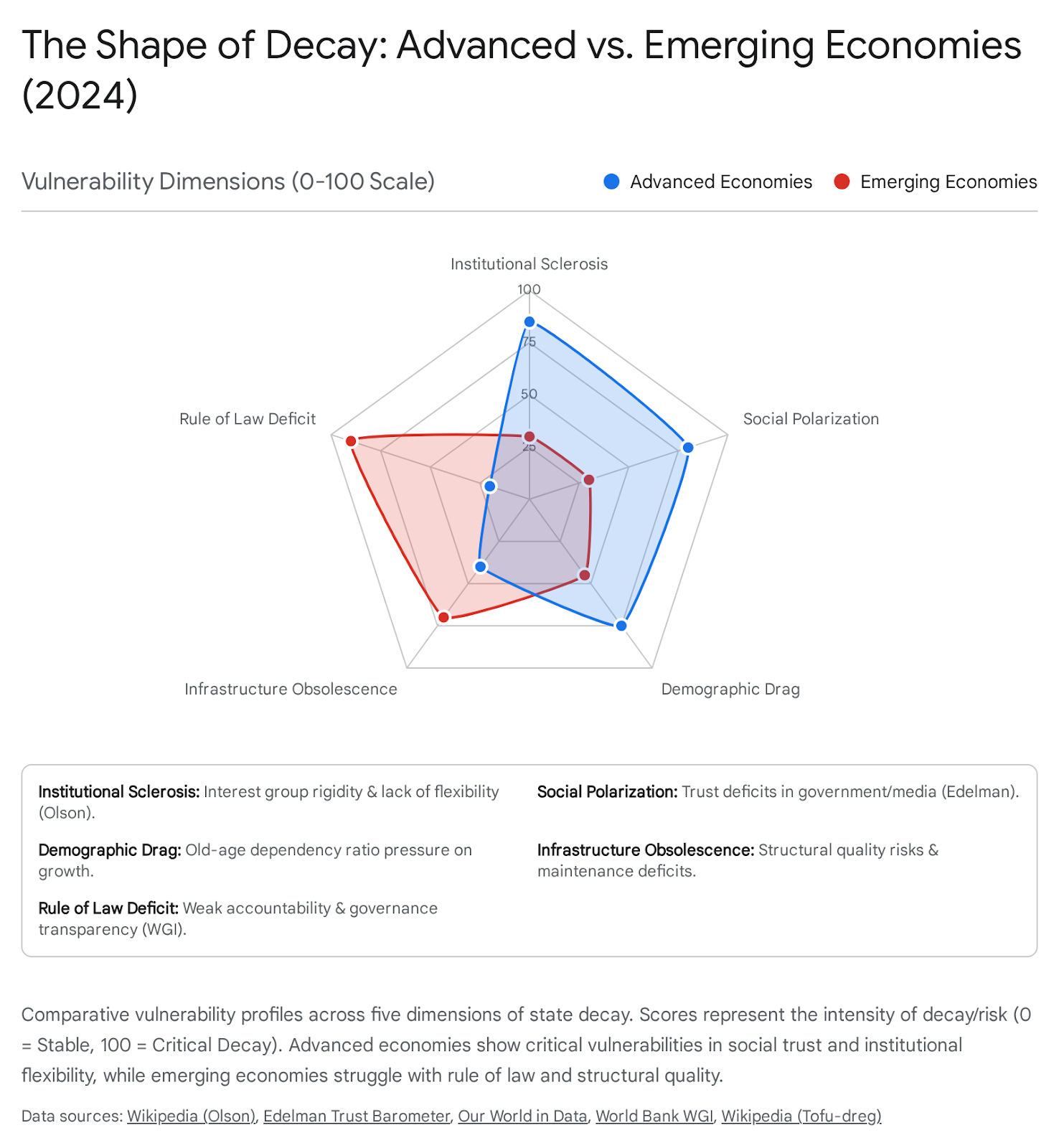
The data suggests a bifurcation in the entropy process: The First World is suffering from Institutional Sclerosis (stiffening joints), while the Emerging World is suffering from Institutional Malformation (weak bones). The following sections analyze these dimensions in exhaustive detail.
2. Theoretical Framework: The Mechanics of Societal Decline
To accurately assess if the First World is decaying faster, we must first establish the theoretical mechanisms of decline. This report utilizes a synthesized framework drawing from political economy, historical sociology, and complexity theory.
2.1 Mancur Olson and Institutional Sclerosis
The primary lens for understanding Western decay is the theory of Institutional Sclerosis, introduced by economist Mancur Olson in The Rise and Decline of Nations (1982). Olson argued that stable societies naturally accumulate special interest groups (lobbyists, unions, industry cartels) over time. These groups act as “distributional coalitions” that focus on rent-seeking—fighting to redistribute existing wealth—rather than creating new wealth.20
- The Mechanism of Decay: As these groups multiply, they capture the legislative and regulatory apparatus. They demand subsidies, tax breaks, and regulations that protect their incumbents from competition. This results in a “sclerotic” economy that is slow to adapt to new technologies or shocks.
- Relevance to the First World: Olson explicitly noted that countries with long periods of stability (like the UK or US) eventually suffer slower growth than those whose institutional slate was wiped clean (like post-war Germany or Japan). Today, however, Germany and Japan have themselves become “old” stable regimes, exhibiting the very sclerosis Olson predicted.20
- The “Vetocracy”: In modern political science, this accumulation of interests manifests as a “vetocracy,” where too many actors have the power to say “no” to a policy, but no single actor has the power to say “yes”.22
2.2 Francis Fukuyama and Political Decay
Expanding on Olson, Francis Fukuyama defines political decay as a function of Institutional Rigidity vs. Social Evolution. Institutions are created to solve the problems of a specific era. When society changes (demographically, technologically, economically) but institutions remain rigid due to cognitive stagnation or elite defense of the status quo, decay sets in.1
Fukuyama identifies “repatrimonialization” as a key vector of decay in advanced democracies. This is the process where public institutions, originally designed to be impersonal and meritocratic, are recaptured by powerful elites who use them for private gain—essentially a reversion to a feudal-style patronage system masked by modern bureaucracy.23
2.3 Peter Turchin and Elite Overproduction
Completing the triad is Peter Turchin’s “Structural-Demographic Theory” (SDT). Turchin identifies Elite Overproduction as a primary driver of instability. When a society produces more elite aspirants (wealthy, highly educated individuals seeking power) than there are positions of power available, competition becomes toxic.24
- Counter-Elites: Frustrated aspirants who are locked out of power turn into “counter-elites,” mobilizing the immiserated masses against the established order. This leads to political fragmentation and violence. Turchin’s models successfully predicted the spike in social unrest in the US and Europe in the 2020s.24
Synthesis: Under this framework, a state is decaying if it has:
- Sclerosis: Too many interest groups blocking adaptation (Olson).
- Rigidity: Institutions that cannot reform due to elite capture (Fukuyama).
- Discord: Intra-elite conflict and mass immiseration (Turchin).
3. Institutional Decay: The Paralysis of Power vs. The Peril of Autocracy
The most profound divergence between the First and Second/Third Worlds lies in the functionality of their political institutions. The First World is defined by gridlock, while the Emerging World is defined by concentration.
3.1 The West: Institutional Sclerosis and the Vetocracy
The United States and Western Europe act as the primary case studies for Institutional Sclerosis. The hallmark of this decay is not the absence of government activity, but the diminishing returns on that activity—massive inputs of political capital yielding negligible policy outputs.
3.1.1 Legislative Productivity and the Gridlock Trap
Quantitative analysis of the US Congress reveals a stark trend of declining functional capacity. According to Sarah Binder’s legislative gridlock metrics, the gap between the “agenda size” (problems that need solving) and “legislative enactments” (laws passed to solve them) has widened significantly since the mid-20th century.4
- The Productivity Paradox: While the number of bills introduced often remains high, the substantive legislative output has cratered. A Pew Research Center analysis of the 115th Congress noted that while 442 public laws were enacted, nearly a third were purely ceremonial (e.g., renaming post offices). The “major legislation index” shows a long-term decline in the enactment of structural reforms.27
- The Mechanism of Failure: This paralysis is structural. The proliferation of veto points—filibusters, committee holds, partisan polarization—has made it mathematically improbable to pass complex legislation without supermajorities, which rarely exist in a polarized electorate. This fits Olson’s description of a society choked by its own checks and balances.20
3.1.2 UK and Germany: The Bureaucratic Quagmire
Institutional sclerosis is not unique to the US.
- United Kingdom: The “doom loop” of public service performance, as described by the Institute for Government, highlights a state where spending increases but outcomes deteriorate. The NHS and criminal justice systems are stuck in a cycle of crisis management, unable to implement long-term reforms due to political volatility and entrenched inefficiencies.30
- Germany: Often cited as the paragon of efficiency, Germany is currently exhibiting classic symptoms of sclerosis. The “traffic light” coalition government has struggled to pass basic budgetary or energy reforms due to conflicting interest groups within the coalition. The decay of the Bundeswehr (armed forces) and Deutsche Bahn (rail) reveals a bureaucracy that has become so complex it can no longer maintain its own assets.14
3.2 The Emerging World: The Trap of Autocratization
In contrast, emerging economies like India, Brazil, and China are not suffering from sclerosis (too many checks) but from the erosion of checks—”autocratization.”
3.2.1 Efficiency at the Cost of Accountability
Autocratic or hybrid regimes can bypass the “vetocracy” that plagues the West. China can build high-speed rail networks in a decade that would take California a century. However, this “efficiency” masks a different form of decay: the accumulation of catastrophic errors.
- The Accountability Deficit: Without feedback loops (free press, opposition parties), errors in policy (e.g., China’s Zero-COVID policy or the One Child Policy) are not corrected until they cause systemic damage. This is “Institutional Malformation”—the skeleton is growing fast but is brittle.5
3.2.2 India and Brazil: Toxic Polarization
V-Dem (Varieties of Democracy) data indicates that political polarization in Brazil and India has reached “toxic” levels, comparable to or exceeding that of the US.
- India: Since 2013, India has seen a steep rise in polarization coinciding with the centralization of executive power. While this allows for decisive action (avoiding Western-style gridlock), it increases the risk of social unrest and policy volatility.7
- Brazil: The Bolsonaro era demonstrated how fragile democratic institutions in the Second World remain. Unlike the US, where institutions “bent but didn’t break” on January 6th, Brazil’s institutions faced a near-existential stress test, saved largely by the judiciary acting with aggressive (and controversial) authority.32
Comparative Insight: The First World’s decay is characterized by inaction (the inability to build or reform due to complexity). The Second/Third World’s decay is characterized by unaccountable action (the ability to build/reform rapidly but often corruptly or ineffectively).
4. Economic Dimensions: Stagnation and the Debt Trap
Economic decay is often misdiagnosed as simple recession. True structural decay is found in the divergence between debt accumulation and productivity growth.
4.1 The Productivity Slump: Secular Stagnation
Since the 2008 financial crisis, advanced economies have entered a period of “secular stagnation.” Labor productivity growth in the US, UK, and Eurozone has decelerated significantly compared to the post-WWII era and the 1990s tech boom.33
- The Innovation Illusion: Despite the hype around AI and tech, Total Factor Productivity (TFP) growth remains sluggish. This suggests that new technologies are not diffusing into the broader economy to create widespread wealth, but are instead concentrated in narrow sectors—a sign of the “dual economy” typical of decaying states.
- The Rent-Seeking Shift: As predicted by Olson, capital in advanced economies increasingly flows into asset speculation (real estate, stocks) rather than productive capacity. This “financialization” extracts value rather than creating it.33
4.2 The Debt Overhang: Buying Time
The most glaring indicator of First World decay is the reliance on public debt to mask this structural stagnation. When growth fails, the state borrows to maintain the illusion of prosperity.
- United States: Public debt-to-GDP has risen from roughly 55.6% in 2000 to over 126.9% in 2024.9 This trajectory is mathematically unsustainable without significant currency devaluation or default.
- United Kingdom: Similarly, UK debt has tripled from 36.6% to 105.9% in the same period.9
- The “Cost of Stagnation”: Visualizing this data reveals a damning trend. The advanced economies are borrowing massive amounts of capital to generate diminishing amounts of growth. This is the definition of diminishing marginal returns on complexity.
4.3 The Emerging Comparison
Emerging Markets exhibit a different profile. While they also have debt issues, their productivity growth remains higher, implying a better “return on leverage.”
- Productivity Gap: Labor productivity growth in emerging economies (excluding China) averaged 1.3-3.5% in recent decades, consistently outperforming the sub-1% growth often seen in the West.34
- The China Exception: China is the outlier. With a corporate and private debt load that rivals or exceeds Western levels (reaching nearly 300% of GDP when all sectors are combined), China is exhibiting “First World” debt decay characteristics before achieving “First World” income levels.10
5. Social Dimensions: The Collapse of Cohesion
Perhaps the most striking evidence that the First World is decaying faster is found in the social fabric. Social cohesion is the “dark matter” of state power; without it, institutions cannot function.
5.1 The Trust Gap: An Inversion of Legitimacy
The 2024 Edelman Trust Barometer reveals a startling geopolitical inversion. Historically, Western democracies prided themselves on high social trust. Today, the opposite is true.
- The Collapse: In the UK, trust in government has fallen to 30%. In the US, it hovers around 40%. Germany has seen a 9-point decline in trust in business and government over the last decade.11
- The Rise: Conversely, developing nations report the highest levels of trust. China (79%), India (76%), and Indonesia (74%) lead the world in public confidence in institutions.11
Insight: This is not merely a reflection of state propaganda in authoritarian regimes (though that plays a role). It reflects a tangible optimism in populations that are seeing their lives improve (absolute gains), whereas Western populations perceive stagnation and decline (relative losses). The “American Dream” of intergenerational mobility is now more statistically likely to occur in parts of Asia than in the US.37
5.2 Social Mobility and the “Class Ceiling”
The Global Social Mobility Index (WEF) and OECD data confirm that the “social elevator” is broken in the West.
- Sticky Floors and Ceilings: In the US and UK, income inequality has entrenched a “mass-class divide.” The number of generations it takes for a low-income family to reach the mean income is significantly higher in the OECD (4-5 generations) than in the Nordic countries, but the trend in the Anglosphere is worsening.37
- Elite Isolation: Following Turchin’s theory, Western elites have become detached from the populace, leading to a “loss of noblesse oblige” and the rise of populism as a counter-reaction.
5.3 Order and Violence
While the First World remains safer on aggregate, the trendline is concerning.
- US Homicide: The US remains a violent outlier among developed nations, with homicide rates fluctuating but remaining structurally high compared to Europe.
- Latin America: Conversely, while nations like Brazil and Mexico have high absolute violence, some regions are seeing improvements due to aggressive state capacity building (though often via illiberal means).39
6. Physical Dimensions: Infrastructure and Demographics
6.1 Infrastructure: The “Fix-It-First” Dilemma
Infrastructure is the physical manifestation of state capacity. Here, the First World suffers from the burden of its own history.
- The US/Germany (Crumbling): The ASCE Report Card typically grades US infrastructure in the “C-” to “C” range. The core issue is maintenance. The US has built a massive sprawling network that it can no longer afford to maintain. This is the “growth Ponzi scheme”—new developments pay for old ones until growth slows, and the maintenance bill comes due.41
- German Rail Case Study: Deutsche Bahn, once a symbol of Prussian efficiency, is now characterized by chronic delays. This is the result of decades of “living off the capital” of the past—underinvesting in maintenance to balance budgets. Reversing this requires massive disruption, which the vetocracy struggles to authorize.14
6.2 The “Tofu-Dreg” Phenomenon
- China (Cracking): China’s infrastructure growth is miraculous in speed but suspect in durability. The term “tofu-dreg projects” (buildings that crumble like tofu) refers to the prevalence of poor construction quality due to corruption and speed. Bridges collapsing and roads washing away are common.15
Comparison: Western infrastructure is decaying due to neglect and high costs (vetocracy). Eastern infrastructure risks decay due to corruption and speed. However, the West’s problem is harder to solve because it requires political will to disrupt existing stakeholders, whereas the East’s problem is technical and regulatory.
6.3 Demographic Decay: The Biological Clock
Demographics act as the “biological” clock of state decay.
- The West: Europe and Japan are in advanced demographic decay. The dependency ratio (workers to retirees) is collapsing. By 2050, the number of people aged 65+ is projected to double globally, but the fiscal impact will hit the rich world first. This will mathematically force a contraction in state services or an explosion in debt—there is no third option.17
- The “Second World” Anomaly: Russia and China face demographic outlooks even worse than the US. China’s population is aging faster than it is enriching, a unique form of “premature decay.” This puts China in a “First World” decay trap without the “First World” wealth cushion.18
- The “Third World” Dividend: India and Sub-Saharan Africa retain youthful populations. If institutions can capitalize on this (a big “if”), they have a vitality advantage the First World lacks.19
7. Synthesis: The Relative Velocity of Decay
To answer the user’s core query, we must distinguish between Absolute Decay and Relative Velocity of Decay.
7.1 The Argument for “Yes” (The First World is Decaying Faster)
- Complexity Trap: Advanced societies have reached a level of complexity where the marginal return on investment in complexity is negative (Joseph Tainter’s theory). Every new law, regulation, or infrastructure project costs exponentially more than the last.4
- Social Entropy: The collapse of shared meaning and trust in the West is more advanced. The “Second World” still possesses nationalism or developmental ambition that binds society; the West is fragmenting into identity groups.1
- Fiscal Exhaustion: The West has promised a welfare state it can no longer afford demographically, leading to a slow-motion insolvency crisis. The debt accumulation in the US and UK (tripling since 2000) without commensurate growth is a clear signal of systemic rot.9
7.2 The Counter-Argument (The Developing World is Fragile)
- Low Baselines: “Decay” in the Third World often looks like catastrophic failure (civil war, state collapse) rather than the slow stagnation of the West. The Fragile States Index shows that the absolute risk of collapse remains concentrated in the Global South.46
- Authoritarian Brittleness: While China creates infrastructure efficiently, its lack of rule of law creates hidden risks (debt bubbles, ghost cities) that could lead to a sudden, nonlinear collapse rather than a slow decline.
7.3 Conclusion: The State of Decay
The evidence strongly supports the conclusion that The First World is decaying faster in terms of institutional adaptability and social cohesion. It is suffering from a “rich man’s disease”—gout and sclerosis. It has the resources to fix its problems but lacks the political will and organizational capacity to do so.
The Second/Third World is not “decaying” in the same sense; it is often struggling to form. Its failures are those of immaturity rather than senescence. However, China represents a hybrid: a developing nation contracting a developed nation’s diseases (aging, debt, sclerosis) before fully maturing.
Final Verdict:
- The First World is in a state of advanced “entropic decay” (gradual decline of capacity).
- The Emerging World is in a state of “structural volatility” (high risk of sudden failure).
If “decay” is defined as the irreversible loss of problem-solving capacity, the First World is decaying faster. Its institutions are harder to reform because they are cemented by centuries of law and interest groups (institutional sclerosis), whereas developing nations, though volatile, retain greater plasticity.
Appendix A: Methodology for Assessing State Decay
A.1 Conceptual Framework
The methodology used in this report integrates three primary theoretical models:
- Olson’s Logic of Collective Action: Measures the accumulation of interest groups and regulatory complexity (Institutional Sclerosis).20
- Fukuyama’s Political Decay: Measures the autonomy and capacity of state bureaucracy versus elite capture.1
- Turchin’s Cliodynamics: Measures “elite overproduction” and immiseration as precursors to instability.24
A.2 Data Sources and Metrics
The analysis relies on a synthesis of quantitative indices and qualitative assessments:
- Governance: World Bank Worldwide Governance Indicators (WGI) – specifically “Government Effectiveness” and “Control of Corruption”.48
- Social Cohesion: Edelman Trust Barometer (Trust Index) and V-Dem Polarization Index.6
- Fiscal Health: IMF Global Debt Database (Public/Private Debt-to-GDP).49
- Demographics: UN Population Division (Dependency Ratios).17
- Infrastructure: ASCE Report Cards and comparative analysis of capital project efficiency.41
A.3 Limitations
- Data Lag: Indices like WGI often lag real-time events by 1-2 years.
- Definition of “First World”: The term is outdated; this report uses “Advanced Economies” (IMF definition) as a proxy.
- Regime Type Bias: Some metrics (like legislative gridlock) punish democracies for being deliberative while rewarding autocracies for being “efficient,” even if that efficiency is coercive.
If you find this post useful, please share the link on Facebook, with your friends, etc. Your support is much appreciated and if you have any feedback, please email me at in**@*********ps.com. Please note that for links to other websites, we are only paid if there is an affiliate program such as Avantlink, Impact, Amazon and eBay and only if you purchase something. If you’d like to directly contribute towards our continued reporting, please visit our funding page.
Sources Used
- accessed December 18, 2025, https://en.wikipedia.org/wiki/Political_decay#:~:text=Francis%20Fukuyama%20refers%20to%20political,equilibrium%20of%20established%20political%20order.
- Political decay – Wikipedia, accessed December 18, 2025, https://en.wikipedia.org/wiki/Political_decay
- Legislative Productivity of the U.S. Congress, 1789–2004 – TRACE: Tennessee Research and Creative Exchange, accessed December 18, 2025, https://trace.tennessee.edu/utk_polipubs/1/
- 3 Charts that Capture the Rise in Congressional Gridlock – Brookings Institution, accessed December 18, 2025, https://www.brookings.edu/articles/3-charts-that-capture-the-rise-in-congressional-gridlock/
- Worldwide Governance Indicators – World Bank, accessed December 18, 2025, https://www.worldbank.org/en/publication/worldwide-governance-indicators
- V-Dem, accessed December 18, 2025, https://www.v-dem.net/
- Political Polarization in Three Regional Powers – Graph of the Week – V-Dem, accessed December 18, 2025, https://v-dem.net/weekly_graph/political-polarization-in-three-regional-powers
- V-DEM Democracy Report 2025 25 Years of Autocratization, accessed December 18, 2025, https://www.v-dem.net/documents/54/v-dem_dr_2025_lowres_v1.pdf
- How Debt-to-GDP Ratios Have Changed Since 2000 – Visual Capitalist, accessed December 18, 2025, https://www.visualcapitalist.com/how-debt-to-gdp-ratios-have-changed-since-2000/
- Countries with Highest Debt-to-GDP 2024 Rankings – Voronoi, accessed December 18, 2025, https://www.voronoiapp.com/debt/Countries-with-Highest-Debt-to-GDP-2024-Rankings-1833
- 2024 Edelman Trust Barometer Supplemental Report Insights for Tech, accessed December 18, 2025, https://www.edelman.com/sites/g/files/aatuss191/files/2024-03/2024%20Edelman%20Trust%20Barometer%20Supplemental%20Report%20Insights%20for%20Tech.pdf
- 2024 Edelman Trust Barometer Global Report, accessed December 18, 2025, https://www.edelman.com/sites/g/files/aatuss191/files/2024-02/2024%20Edelman%20Trust%20Barometer%20Global%20Report_FINAL.pdf
- 2024 Edelman Trust Barometer, accessed December 18, 2025, https://www.edelman.com/trust/2024/trust-barometer
- accessed December 18, 2025, https://monocle.com/business/transport/germanys-train-chaos-how-did-deutsche-bahn-go-off-the-rails/#:~:text=Deutsche%20Bahn’s%20woes%20run%20deep,infrastructure%20fell%20into%20disrepair%20overnight.
- Tofu-dreg project – Wikipedia, accessed December 18, 2025, https://en.wikipedia.org/wiki/Tofu-dreg_project
- India’s infrastructure woes: A closer look at quality vs quantity – The Economic Times, accessed December 18, 2025, https://m.economictimes.com/opinion/et-commentary/indias-infrastructure-woes-a-closer-look-at-quality-vs-quantity/articleshow/112022939.cms
- Old-age dependency ratio, 2023 – Our World in Data, accessed December 18, 2025, https://ourworldindata.org/grapher/age-dependency-ratio-old
- How Severe Are China’s Demographic Challenges? – ChinaPower Project, accessed December 18, 2025, https://chinapower.csis.org/china-demographics-challenges/
- Chapter 2. Aging in the U.S. and Other Countries, 2010 to 2050 | Pew Research Center, accessed December 18, 2025, https://www.pewresearch.org/global/2014/01/30/chapter-2-aging-in-the-u-s-and-other-countries-2010-to-2050/
- Institutional sclerosis – Wikipedia, accessed December 18, 2025, https://en.wikipedia.org/wiki/Institutional_sclerosis
- 8 Absolute and Relative Effects of Interest Groups on the Economy*, accessed December 18, 2025, https://heckeljc.sites.wfu.edu/papers/published/CollectiveChoice8.pdf
- China Ranks 97th out of 142 in Rule of Law Index – World Justice Project, accessed December 18, 2025, https://worldjusticeproject.org/sites/default/files/documents/China_1.pdf
- Understanding Political Decay and Its Effects on Society | by Matt Harder – Medium, accessed December 18, 2025, https://mattharder.medium.com/understanding-political-decay-and-its-effects-on-society-c29be59ce87c
- Social Instability Lies Ahead, Researcher Says – UConn Today, accessed December 18, 2025, https://today.uconn.edu/2016/12/using-social-science-to-predict-the-future/
- Cliodynamics of End Times: Elites, Counter-Elites and the Path of Political Disintegration, accessed December 18, 2025, https://events.ceu.edu/2023-10-25/cliodynamics-end-times-elites-counter-elites-and-path-political-disintegration
- A Quantitative Prediction for Political Violence in the 2020s – Peter Turchin, accessed December 18, 2025, https://peterturchin.com/quantitative-prediction-political-violence-2020s/
- 115th Congress passed more laws than before, but of similar substance, accessed December 18, 2025, https://www.pewresearch.org/short-reads/2019/01/25/a-productivity-scorecard-for-115th-congress/
- Are long weekends reducing Congress’ productivity? – R Street Institute, accessed December 18, 2025, https://www.rstreet.org/commentary/are-long-weekends-reducing-congress-productivity/
- Mancur Olson The Rise And Decline Of Nations – riomaisseguro.rio.rj.gov.br, accessed December 18, 2025, https://riomaisseguro.rio.rj.gov.br/download/browse/mAYIqC/Mancur_Olson_The_Rise_And_Decline_Of_Nations.pdf
- Progress on public services has been slower than hoped | Institute for Government, accessed December 18, 2025, https://www.instituteforgovernment.org.uk/comment/one-year-labour-public-services
- How Labour can fix our broken public services | British Politics and Policy at LSE, accessed December 18, 2025, https://blogs.lse.ac.uk/politicsandpolicy/how-labour-can-fix-our-broken-public-services/
- Democratic Recovery After Significant Backsliding: Emergent Lessons, accessed December 18, 2025, https://carnegieendowment.org/research/2025/04/democratic-recovery-after-significant-backsliding-emergent-lessons?lang=en
- Stagnation and Social Structures of Accumulation – PERI UMASS, accessed December 18, 2025, https://peri.umass.edu/publication/stagnation-and-social-structures-of-accumulation/
- Investing in productivity growth | McKinsey, accessed December 18, 2025, https://www.mckinsey.com/mgi/our-research/investing-in-productivity-growth
- GLOBAL DEBT MONITOR 2024 – International Monetary Fund, accessed December 18, 2025, https://www.imf.org/external/datamapper/GDD/2024%20Global%20Debt%20Monitor.pdf
- 2024 Edelman Trust Barometer Reveals Innovation has Become a New Risk Factor for Trust, accessed December 18, 2025, https://www.edelman.com/news-awards/2024-edelman-trust-barometer
- The Global Social Mobility Report 2020 Equality, Opportunity and a New Economic Imperative, accessed December 18, 2025, https://www3.weforum.org/docs/Global_Social_Mobility_Report.pdf
- Social mobility and equal opportunity – OECD, accessed December 18, 2025, https://www.oecd.org/en/topics/sub-issues/social-mobility-and-equal-opportunity.html
- List of countries by intentional homicide rate – Wikipedia, accessed December 18, 2025, https://en.wikipedia.org/wiki/List_of_countries_by_intentional_homicide_rate
- GLOBAL STUDY ON HOMICIDE – Executive summary – Unodc, accessed December 18, 2025, https://www.unodc.org/documents/data-and-analysis/gsh/Booklet1.pdf
- Infrastructure’s upward momentum reflected in report card – ASCE, accessed December 18, 2025, https://www.asce.org/publications-and-news/civil-engineering-source/civil-engineering-magazine/issues/magazine-issue/article/2025/03/infrastructures-upward-momentum-reflected-in-report-card
- Who Sprawls Most? How Growth Patterns Differ Across the U.S. – Brookings Institution, accessed December 18, 2025, https://www.brookings.edu/articles/who-sprawls-most-how-growth-patterns-differ-across-the-u-s/
- On a turnaround course, Deutsche Bahn significantly reduced losses in 2024, accessed December 18, 2025, https://www.deutschebahn.com/en/presse/press_releases/On-a-turnaround-course-Deutsche-Bahn-significantly-reduced-losses-in-2024-13323564
- China: Multiple Roads And Bridges Collapse Leaving Over 100 Dead, Poor Quality ‘Tofu-dreg’ Infrastructure Comes Under Scrutiny – Swarajya, accessed December 18, 2025, https://swarajyamag.com/infrastructure/china-multiple-roads-and-bridges-collapse-leaving-over-100-dead-poor-quality-tofu-dreg-infrastructure-comes-under-scrutiny
- Leaving No One Behind In An Ageing World – the United Nations, accessed December 18, 2025, https://www.un.org/development/desa/dspd/wp-content/uploads/sites/22/2023/01/2023wsr-chapter1-.pdf
- Indicators | Fragile States Index, accessed December 18, 2025, https://fragilestatesindex.org/indicators/
- Fragile States Index – Wikipedia, accessed December 18, 2025, https://en.wikipedia.org/wiki/Fragile_States_Index
- Worldwide Governance Indicators | DataBank – World Bank, accessed December 18, 2025, https://databank.worldbank.org/source/worldwide-governance-indicators
- Percent of GDP – Global Debt Database – General Government Debt, accessed December 18, 2025, https://www.imf.org/external/datamapper/GG_DEBT_GDP@GDD/CAN/FRA/DEU/ITA/JPN/GBR/USA