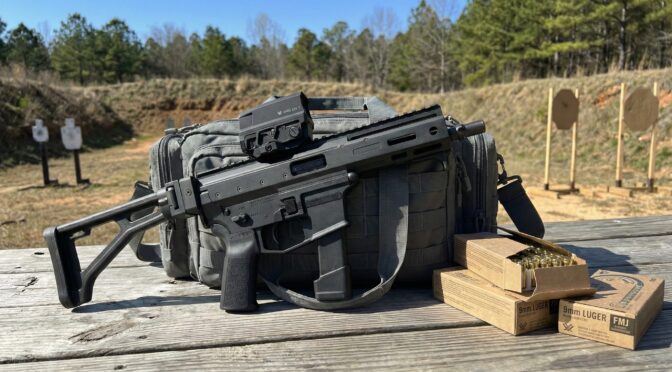
Angstadt Arms, LLC stands as a unique case study within the United States firearms industrial base, representing a successful synthesis of heritage branding and high-technology manufacturing. Established in 2014 in Charlotte, North Carolina, the company differentiates itself through a strategic dual-narrative: it claims the lineage of the 18th-century Angstadt family of master gunsmiths—renowned for the Pennsylvania “Kentucky” Long Rifle—while simultaneously positioning itself at the vanguard of modern sub-compact weapon (SCW) innovation. This juxtaposition of colonial craftsmanship heritage with aerospace-grade engineering has allowed Angstadt Arms to secure a premium position in the competitive Pistol Caliber Carbine (PCC) market.
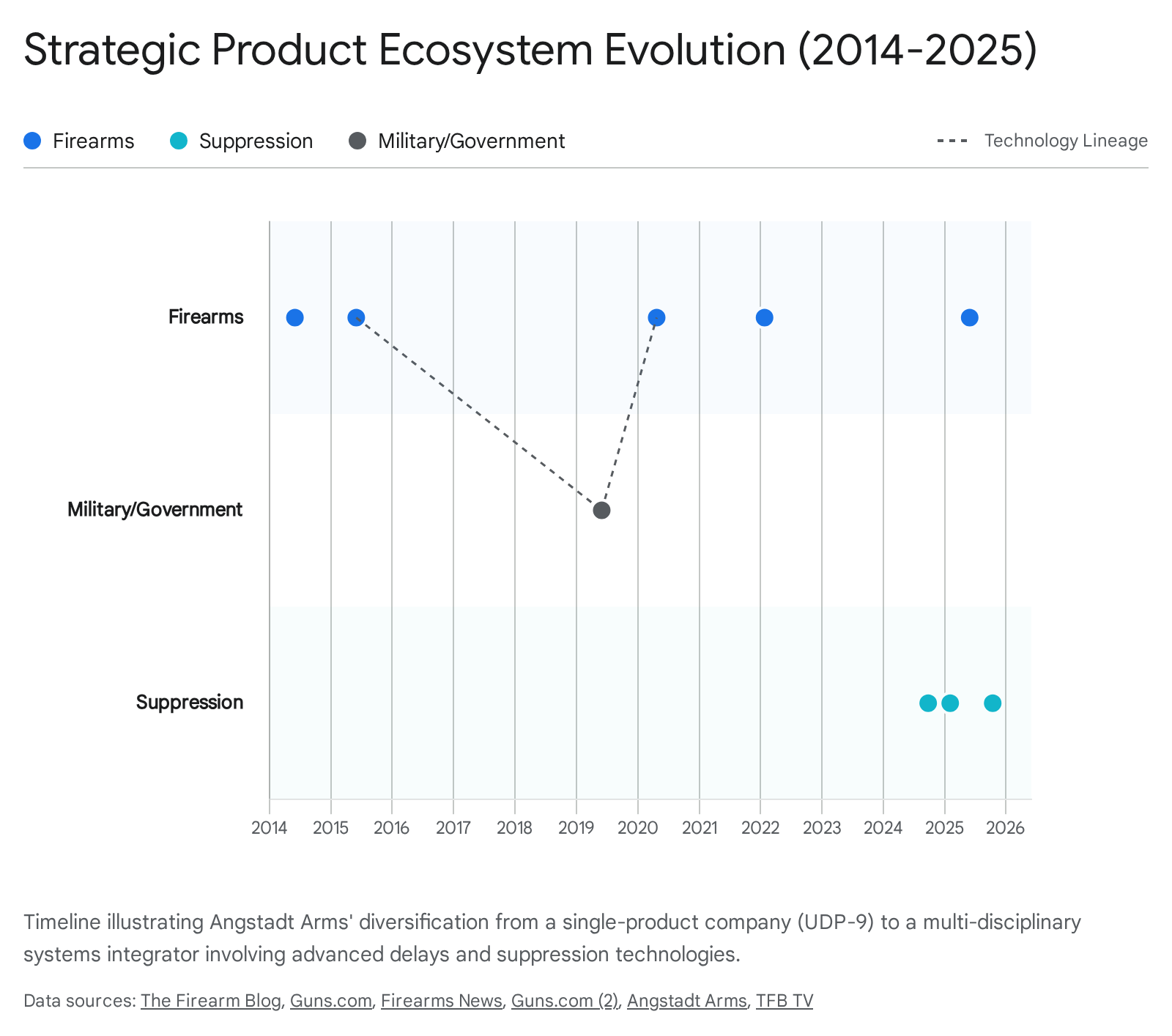
The company’s operational history is defined by three distinct technological epochs: the foundational era of direct blowback systems (UDP-9), the transition to delayed-blowback mechanisms (MDP-9), and the current strategic pivot toward integral suppression and acoustic signature management (Vanquish and Reticent lines). A critical inflection point in the company’s trajectory was its selection in 2018 as one of six finalists for the United States Army’s Sub Compact Weapon (SCW) program. Although the contract was ultimately awarded to B&T USA, Angstadt’s inclusion alongside global defense titans validated its engineering prowess and provided the “military-grade” provenance necessary to justify premium pricing in the civilian sector.
As of 2025, Angstadt Arms has evolved from a boutique rifle builder into a systems integrator. The current product portfolio is anchored by the MDP-9 Gen 2, a roller-delayed platform that addresses the inherent recoil limitations of traditional blowback designs, and the Vanquish system, a baffle-less, integrally suppressed barrel technology designed to eliminate the need for subsonic ammunition. The recent launch of the Reticent suppressor line, utilizing 3D-printed titanium and OptiWave™ technology, signals a clear strategic intent to dominate the “hearing safe” market segment by prioritizing tone optimization over raw decibel reduction.
Market analysis indicates that Angstadt Arms commands strong brand loyalty among enthusiasts who value aesthetics and component quality. However, the brand faces persistent scrutiny regarding price-to-performance ratios and historical reliability challenges with specific ammunition types in early-generation models. The future outlook suggests a continued upward trajectory, driven by the expansion of their proprietary suppression ecosystem and a potential re-engagement with law enforcement contracts, leveraging their matured manufacturing capabilities.
1. Introduction
1.1 The Renaissance of the Pistol Caliber Carbine
The emergence and subsequent success of Angstadt Arms cannot be understood without a deep examination of the market conditions that characterized the United States firearms industry between 2010 and 2015. This period witnessed the “Renaissance of the Pistol Caliber Carbine (PCC).” For decades prior, the PCC was largely viewed as a ballistic compromise—a weapon system that offered neither the concealability of a handgun nor the terminal efficacy of a rifle. However, a confluence of economic, logistical, and regulatory factors reshaped this landscape, creating a fertile ecosystem for a new entrant like Angstadt Arms.
Firstly, the cost of ammunition played a pivotal role. As the price of 5.56x45mm NATO ammunition fluctuated wildly due to geopolitical instability and military demand, the relatively stable and lower cost of 9x19mm Parabellum allowed high-volume shooters to maintain training schedules. Secondly, the urbanization of the shooting sport led to a proliferation of indoor ranges, many of which prohibited high-velocity rifle cartridges but welcomed pistol-caliber carbines. This shift in venue created a demand for rifle-like ergonomics platformed on pistol ballistics. Thirdly, the burgeoning suppressor market—driven by a cultural shift toward “hearing safe” shooting—favored the 9mm cartridge, which is easily suppressed, particularly in its subsonic loadings.
1.2 The Gap in the Market (2014)
In 2014, the PCC market was fragmented and technically immature. The segment was dominated by two extremes: low-cost, aesthetic modifications of standard AR-15s that utilized unreliable magazine block adapters, and extremely high-cost legacy systems like the Heckler & Koch MP5, which were scarce and lacked modern modularity. The middle market—specifically for a dedicated, purpose-built AR-9 that accepted ubiquitous GLOCK magazines—was underserved.
Existing solutions often suffered from significant engineering deficits. Conversions frequently lacked a functional Last Round Bolt Hold Open (LRBHO) mechanism, a critical feature for manual-of-arms consistency with standard rifles. Furthermore, the aesthetics of many early PCCs were disjointed, treating the magazine well as an afterthought rather than an integral design element. It was into this specific gap that Angstadt Arms launched, not merely as an assembler of parts, but as a design house focused on refining the AR-15 platform to seamlessly accommodate pistol cartridges without reliability compromises.
1.3 Scope of Analysis
This research report provides an exhaustive evaluation of Angstadt Arms, LLC. It traces the corporate and biological lineage from the colonial frontier to the modern CNC machine shop. It dissects the physics of their operating systems, contrasting the brute force of direct blowback with the mechanical elegance of roller-delays. It scrutinizes their performance in military trials, analyzes consumer sentiment regarding reliability and value, and projects their future standing in an increasingly crowded marketplace. The analysis relies on a synthesis of primary historical records, technical manuals, patent concepts, professional evaluations, and verified consumer feedback.
2. Corporate Lineage and Heritage
2.1 The Ancestral Foundation: The Angstadt Gunsmiths (1700s–1800s)
While Angstadt Arms is a modern corporate entity, its branding is inextricably linked to a profound historical narrative that predates the founding of the United States. The “Angstadt” surname is legendary within the community of antique arms collectors, specifically concerning the “Kentucky” or “Pennsylvania” Long Rifle—a weapon that is arguably the first truly American technological innovation.
Research into the Angstadt family tree reveals a dynasty of craftsmen operating primarily in the Berks and Lehigh counties of Pennsylvania.1 The lineage includes:
- Peter Angstadt II (1763–1815): Often cited as a foundational figure, Peter Angstadt II’s work exemplifies the transition of the rifle from a European hunting implement to a specialized tool for the American frontier.
- Joseph Angstadt (1765–?): A contemporary of Peter, contributing to the family’s distinct stylistic evolution.
- Jacob Angstadt (1783–1843): Continued the tradition into the 19th century.
- Later Generations: The tradition persisted through Joseph Angstadt II (1817–1872), Abraham Angstadt (1784–1868), Peter Angstadt III (1807–1870), and Adam Angstadt II (1821–1888).1
The “Dutchy” Aesthetic:
The rifles produced by the Angstadt family were not merely utilitarian; they were expressions of the distinct “Pennsylvania Dutch” culture. Historical analysis describes their work as possessing a “Dutchy” characteristic, blurring the line between firearm and folk art. These rifles frequently featured intricate brass patch boxes, silver inlays, and relief carvings depicting motifs such as unusual stars, flowers, lions, and even hex signs—symbols deeply rooted in the localized German-American folklore.1
This historical context serves a critical strategic function for the modern Angstadt Arms. In an industry often criticized for producing “soulless” black aluminum commodities, the Angstadt lineage provides a narrative of provenance. It allows the modern company to frame its high-tech sub-machine guns not as new inventions, but as the latest iteration of a centuries-old family tradition of defending the homestead.2 This “heritage marketing” creates an emotional connection with the consumer, suggesting that by purchasing a UDP-9, they are participating in a lineage of American craftsmanship.
2.2 The Modern Resurrection (2014)
The contemporary resurrection of the brand was orchestrated by Rich Angstadt in 2014. Unlike the founders of many firearms companies who transition directly from military service or mechanical engineering, Rich Angstadt’s background lies in high-level marketing and serial entrepreneurship.
Rich Angstadt’s Professional Background:
Prior to establishing Angstadt Arms, Rich Angstadt was the Founder of Radium LLC, an inbound digital marketing agency. He also held significant positions at Winsper and Dopkins System Consultants.3 He holds an MBA in Marketing from Northeastern University and a B.S. in Accounting/Finance from the University at Buffalo.4
Strategic Implication of Founder’s Background:
This background is pivotal to understanding the company’s rapid ascent. A common failure mode for firearms startups is excellent engineering coupled with poor branding and market positioning. Angstadt Arms avoided this trap. From day one, the company possessed a polished corporate identity, a coherent website, and a clear value proposition. The “UDP” (Ultra Compact Defense Pistol) and “MDP” (Modern Defense Pistol) naming conventions, the sleek logo, and the consistent messaging regarding “innovation and reliability” reflect a sophisticated understanding of brand management that is rare in the small arms sector. The company did not begin as a garage hobby shop but was structured as a scalable enterprise from its inception.
3. Strategic Milestones and Timeline
The growth of Angstadt Arms can be charted through a series of calculated product launches and high-profile industry engagements. The following timeline details the chronological progression of the company.
Table 1: Key Milestones and Corporate Evolution
| Year | Milestone Event | Strategic Context & Impact |
| 1763 | Ancestral Origins | Peter Angstadt II begins the family tradition of gunsmithing in Pennsylvania, establishing the artistic and mechanical lineage.1 |
| 2014 | Corporate Founding | Rich Angstadt establishes Angstadt Arms, LLC in Charlotte, NC, leveraging his marketing background to structure the brand.3 |
| 2015 | Launch of UDP-9 | The flagship UDP-9 is released. It is a direct blowback AR-9 utilizing dedicated billet receivers and GLOCK magazines. This product defines the brand’s entry into the premium sector.3 |
| 2018 | US Army SCW Selection | Angstadt Arms is selected as one of six finalists for the US Army’s Sub Compact Weapon (SCW) program, competing against SIG SAUER, B&T, and Global Ordnance.5 |
| 2019 | Debut of SCW-9 | The select-fire SCW-9 is unveiled at SHOT Show. Although B&T wins the contract, the SCW-9’s presence in the trials validates Angstadt as a defense-grade manufacturer.6 |
| 2019 | Roller-Delay Teaser | The company releases teasers for the MDP-9, signaling a technological pivot away from simple blowback actions toward more sophisticated delayed systems.8 |
| 2020 | MDP-9 Announcement | The MDP-9 is officially announced. It features a roller-delayed action, monolithic upper, and compatibility with GLOCK magazines, positioning it as a modern successor to the MP5.3 |
| 2022 | MDP-9 Production | Full-scale production and availability of the MDP-9 are confirmed at SHOT Show 2022, following delays typical of complex engineering projects.9 |
| 2024 | Vanquish Launch | Introduction of the Vanquish system—an integrally suppressed barrel utilizing ported technology to eliminate the need for subsonic ammo. This marks the entry into the “Systems Integrator” phase.10 |
| 2025 | MDP-9 Gen 2 | Release of the second-generation MDP-9, featuring upgraded controls (Radian Talon), improved feed geometry, and enhanced reliability.12 |
| 2025 | Reticent Suppressors | Launch of the Reticent line of suppressors, utilizing 3D-printed titanium and OptiWave technology to manipulate sound frequency/tone rather than just volume.14 |
4. Technical Evolution: Phase I – The Blowback Era (UDP-9)
4.1 Architecture of the UDP-9
The UDP-9 (Ultra Compact Defense Pistol) represents the foundational technology of Angstadt Arms. Launched in 2015, it was designed to address the reliability and ergonomic shortcomings of converted AR-15s.
Operating System: Direct Blowback
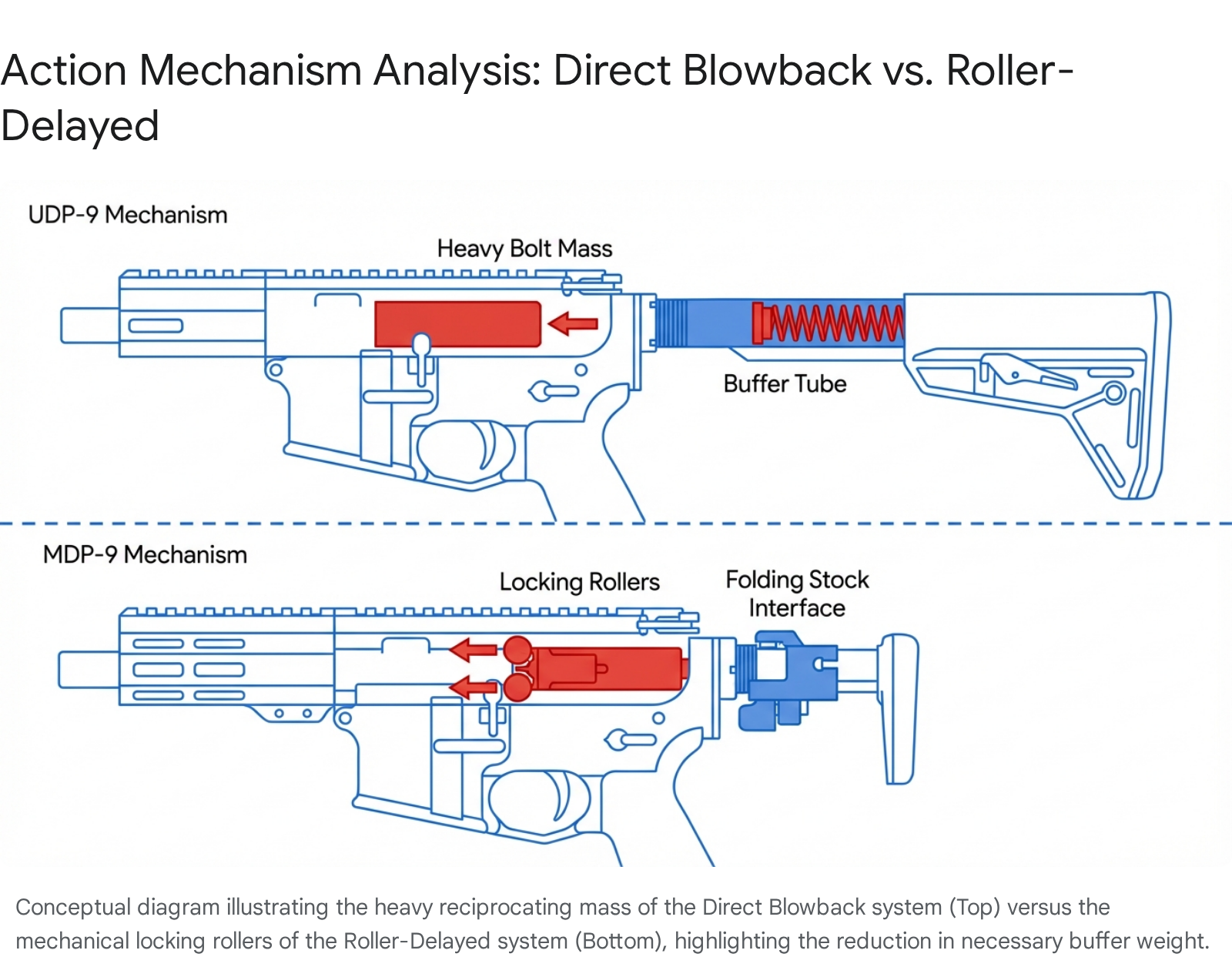
The UDP-9 utilizes a Simple Direct Blowback system. In this configuration, the breech is not mechanically locked at the moment of firing. Instead, the mass of the bolt carrier group (BCG) and the resistance of the buffer spring are the only forces keeping the cartridge case in the chamber. When the round is fired, the expanding gases push the bullet forward and the casing backward simultaneously. The heavy bolt’s inertia delays the opening of the breech long enough for pressures to drop to safe levels.
- Engineering Trade-offs: The advantage of direct blowback is simplicity; there are few moving parts to break. However, the disadvantage is reciprocating mass. To contain the pressure of a 9mm round, the bolt must be heavy, and the spring stiff. This results in a distinct, sharp recoil impulse often described as “snappy,” and necessitates a heavy buffer (typically 5-8 ounces).16
Receiver Construction: Billet 7075-T6
Unlike mass-market competitors who use forged receivers (which are cheaper to produce in high volume), Angstadt Arms manufactures the UDP-9 receivers from 7075-T6 Billet Aluminum. Billet machining allows for more complex geometries and tighter tolerances. This enabled Angstadt to integrate a flared magwell, an integral trigger guard, and a specific aesthetic profile that forged receivers cannot easily replicate. The use of 7075-T6 ensures the receivers have the same strength-to-weight ratio as military-spec M4 carbines.16
4.2 The GLOCK Interface and Bolt Hold Open
A primary differentiator for the UDP-9 was its native compatibility with GLOCK magazines. In 2015, the market was flooded with “adapters” that inserted into a standard 5.56mm magwell to accept pistol mags. These were notoriously unreliable. Angstadt’s dedicated lower receiver was engineered specifically for the feed angle and dimensions of the double-stack, single-feed Glock magazine.18
The LRBHO Challenge:
One of the most difficult engineering challenges in 9mm ARs is the Last Round Bolt Hold Open (LRBHO). Standard AR-15s use a tab on the magazine follower to push up a bolt catch. Glock magazines generally lack a prominent tab positioned correctly for an AR bolt catch. Angstadt Arms engineered a proprietary linkage system—initially housed in the upper receiver and later refined—that reliably transfers the movement of the Glock follower to the AR bolt catch. This feature was a critical selling point for professionals who trained to standard AR-15 manual of arms.16
5. The Turning Point: US Army SCW Program (2018-2019)
5.1 The Strategic Imperative: Why the Army Wanted a Sub-Gun
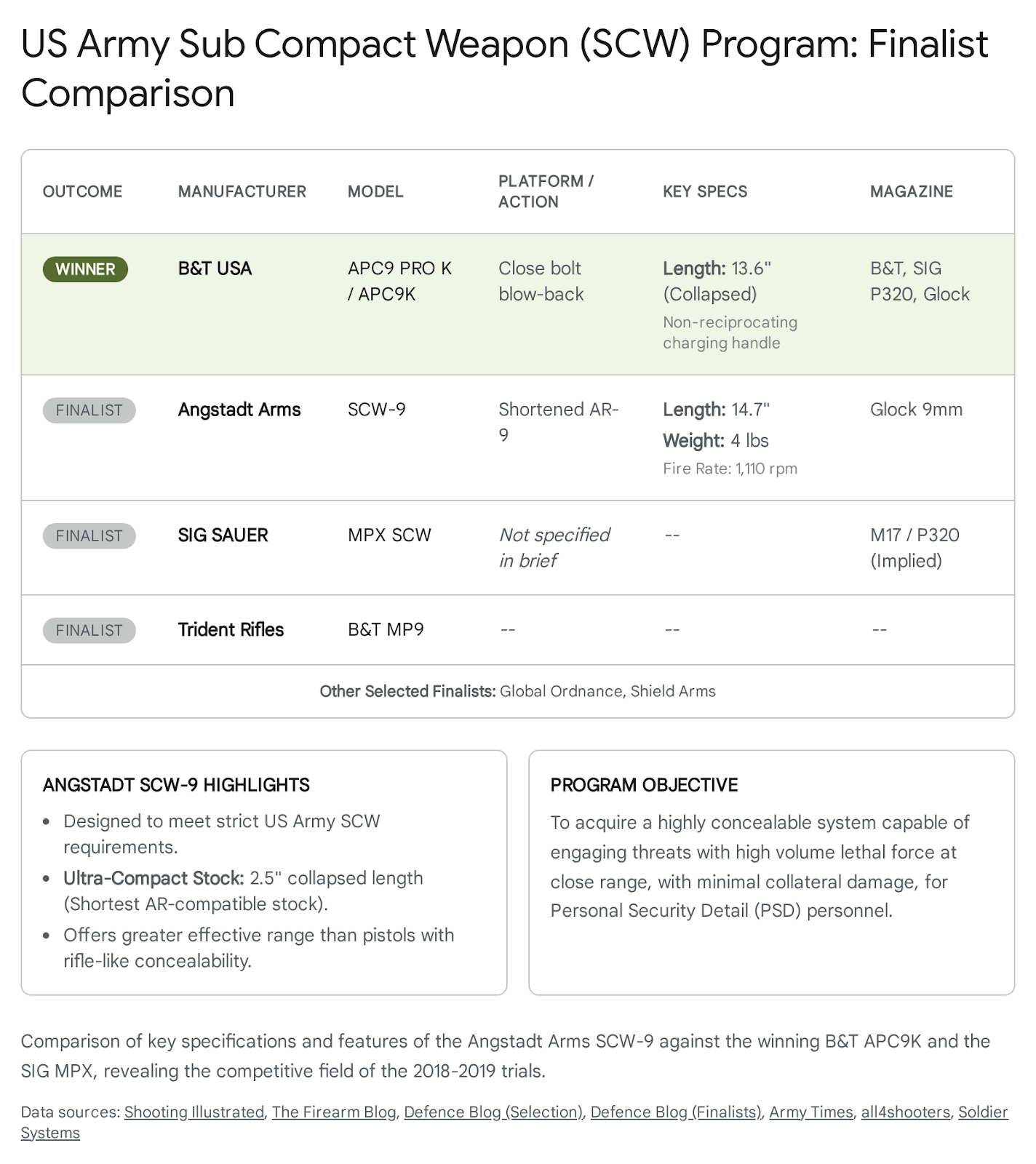
In 2018, the United States Army identified a critical capability gap within its Personal Security Details (PSD). These units, tasked with protecting high-ranking officers and dignitaries in combat zones, required a weapon system that offered greater lethality and magazine capacity than a standard M17 pistol, but was more concealable and maneuverable than an M4 carbine. The program, designated the Sub Compact Weapon (SCW) system, sought a highly concealable firearm capable of engaging threats with a high volume of lethal force at close range with minimal collateral damage.5
5.2 The Angstadt Submission: The SCW-9
Angstadt Arms responded to the solicitation with the SCW-9. This weapon was a highly modified, select-fire evolution of the UDP-9 architecture.
- Modularity: The SCW-9 was designed to accept standard Glock magazines, a logistical advantage as the Army had recently adopted the M17/M18 Modular Handgun System (though the M17 uses Sig magazines, the ubiquity of Glock mags in Special Operations was a factor in broad considerations).19
- Compactness: The defining feature of the SCW-9 was its ultra-short telescoping stock and modified buffer system. This allowed the overall length of the weapon to collapse to just 14.7 inches, significantly shorter than a standard MK18 or M4.19
- Rate of Fire: The weapon boasted a cyclic rate of approximately 1,110 rounds per minute, providing overwhelming suppression capability in close-quarters scenarios.8
5.3 The Competitive Field
The SCW program attracted a crowded field of competitors, which was eventually whittled down to six finalists for testing and evaluation (T&E):
- Angstadt Arms (SCW-9)
- B&T USA (APC9K)
- SIG SAUER (MPX)
- Global Ordnance (Stribog)
- Shield Arms (SA-9)
- Trident Rifles (B&T MP9) 5
The Selection Outcome:
Ultimately, the US Army awarded the contract to B&T USA for the APC9K. Analysts suggest B&T won due to the APC9K’s hydraulic buffer system (which mitigates recoil better than direct blowback) and B&T’s established supply chain for similar weapons.7
Strategic Impact on Angstadt Arms:
While Angstadt did not win the contract, the “loss” was a marketing triumph. By surviving the down-selection process to the final six, Angstadt Arms proved that its manufacturing and engineering standards met the rigorous requirements of US Army testing. This allowed the company to pivot its marketing strategy, presenting its civilian firearms as “candidates for military service,” which significantly elevated the brand’s prestige above hobbyist-grade competitors.
6. Technical Evolution: Phase II – The Roller-Delayed Era (MDP-9)
6.1 The Physics of Delay
Following the SCW program, Angstadt Arms recognized that to compete with high-end platforms like the HK MP5 and Sig MPX, they needed to move beyond direct blowback. The result was the MDP-9 (Modern Defense Pistol), introduced in 2020.
Mechanism: Roller-Delayed Blowback
The MDP-9 utilizes a roller-delayed system, a technology most famously associated with the Heckler & Koch MP5.
- Operation: In this system, the bolt head contains two rollers that protrude into recesses in the barrel extension. When the round is fired, the rearward force of the casing pushes against the bolt face. However, the rollers are mechanically disadvantaged; they must be squeezed inward against a locking piece (wedge) before the bolt can unlock and move rearward.
- Mechanical Advantage: This mechanical disadvantage delays the opening of the breech until the bullet has left the barrel and pressures have dropped.
- Result: Because the rollers do the work of holding the breech closed, the bolt carrier does not need to be as heavy as in a direct blowback gun. This creates a lighter firearm with a significantly softer recoil impulse and less “dot movement” during rapid fire.3
6.2 The Monolithic Advantage
Beyond the operating system, the MDP-9 introduced a monolithic upper receiver design. Unlike the AR-15, which requires a buffer tube extending behind the receiver to house the recoil spring, the MDP-9’s roller-delayed system uses a captured recoil spring assembly located within the upper receiver.
- Picatinny End Cap: This architecture allows the rear of the firearm to feature a vertical Picatinny rail (1913 interface) instead of a buffer tube threads.
- Folding Capability: Consequently, the MDP-9 can be equipped with a side-folding stock or brace, allowing it to fit into extremely small bags (backpacks, messenger bags), fulfilling the “PDW” (Personal Defense Weapon) doctrine more effectively than the UDP-9.3
7. Technical Evolution: Phase III – Acoustic Dominance (Vanquish & Reticent)
In its most recent strategic pivot (2024-2025), Angstadt Arms has moved to capture the market for suppressed firearms, recognizing that the future of tactical shooting is “hearing safe.”
7.1 The Vanquish System: Integral Suppression
The Vanquish system represents a radical departure from traditional “screw-on” suppressors.
- The Problem with Traditional Suppressors: Standard suppressors add 6-9 inches to the length of a rifle. Furthermore, to be quiet, the shooter must purchase expensive subsonic ammunition (147gr or heavier). Standard supersonic ammo (115gr) still creates a loud “sonic crack” even with a suppressor.
- The Vanquish Solution (Ported Barrel): The Vanquish utilizes a precision-ported barrel. As the bullet travels down the barrel, gases are bled off through ports into a surrounding expansion chamber (the suppressor body) before the bullet exits the muzzle.
- Velocity Reduction: This bleeding of gas reduces the velocity of standard, cheap 115-grain supersonic ammo to subsonic levels. This means the user can shoot bulk-pack training ammo and achieve “movie quiet” performance without the sonic crack.
- Baffle-Less Design: The system uses no traditional baffles. This eliminates the risk of “baffle strikes” (where the bullet hits the internal fins) and makes cleaning extremely simple—a crucial feature for.22LR versions, as rimfire ammo is notoriously dirty and leads up conventional suppressors quickly.10
7.2 The Reticent Line: 3D Printed Acoustics
Launched in 2025, the Reticent line indicates Angstadt’s adoption of additive manufacturing (3D printing).
- Material: The suppressors are printed from Grade 5 Titanium. This material offers an exceptional strength-to-weight ratio and heat resistance.
- OptiWave™ Technology: Angstadt markets this as a flow-dynamic design optimized for tone. Rather than simply chasing the lowest decibel number, the internal geometry is designed to shift the frequency of the report to a lower pitch. Human hearing perceives low-frequency sounds as “quieter” and less abrasive than high-frequency cracks, improving the subjective shooting experience.14
8. Current Product Portfolio (2025)
As of early 2025, Angstadt Arms offers a diversified catalog catering to civilians, law enforcement, and competitive shooters.
8.1 Firearm Platforms
- UDP-9 Series: The legacy line. Available as pistols (with braces) or Short Barreled Rifles (SBRs). It remains the “workhorse” option, valued for its proven reliability and lower price point compared to the MDP.16
- MDP-9 Gen 2: The flagship. The Gen 2 iteration (released 2025) includes significant upgrades:
- Controls: Standardized on Radian Talon ambidextrous safeties (45-degree throw).
- Furniture: B5 Systems Type 23 pistol grips.
- Magazines: Ships with OEM GLOCK magazines (2x 17rd) to ensure reliability.
- Reliability: Re-engineered feed geometry to handle a wider variety of ammunition, including hollow points.12
- Vanquish Rifles/Uppers: Available as complete firearms or as upper receiver groups. The Vanquish 9 (9mm) and Vanquish 22 (.22LR) are the primary models. The Vanquish 22 is specifically designed for the Ruger 10/22 platform, allowing users to upgrade their existing rifles.11
8.2 Components and Accessories
- Bolt Carrier Groups (BCG): The UDP-9 BCG is a popular standalone product for home builders.
- Handguards: The “Suppressor Series” handguards are designed with a larger internal diameter to tuck suppressors inside the rail, a popular aesthetic known as the “honey badger” look.25
- SCW Stock: The ultra-compact stock developed for the Army trials is available to civilians, allowing any AR-15 to be shortened significantly.6
9. Market Performance and Consumer Sentiment
9.1 Reliability and Quality Control
Professional reviews and user feedback paint a picture of a brand that has matured significantly.
- Fit and Finish: Across the board, Angstadt Arms is praised for the quality of its machining. The billet receivers are frequently described as “tight,” “clean,” and “premium,” with no visible tool marks or rattle between upper and lower.17
- The “Hollow Point” Issue (Historical): Analysis of forums from the 2018-2021 period reveals a common complaint regarding the feeding of hollow-point (HP) defensive ammunition in the UDP-9. The original barrel feed cones were narrow (military style), causing the wide mouths of HP rounds to hang up. Users often resorted to sending barrels to third-party gunsmiths (e.g., Macon Armory) for re-profiling. However, recent data on the MDP-9 Gen 2 and newer UDP production suggests this geometry has been updated, with reviews citing high reliability with defensive loads.12
9.2 Value Proposition
There is a persistent debate within the community regarding value.
- The Premium Argument: Supporters argue that the flawless Glock magazine integration (LRBHO), the billet construction, and the high-end components (Radian, B5) justify the $1,400+ price tag.
- The Budget Counter-Argument: Critics point to budget competitors like Extar or Foxtrot Mike (FM-9), which offer similar functionality for half the price. The consensus is that Angstadt is a “Buy Once, Cry Once” brand—you pay for aesthetics and refined engineering, whereas budget brands offer raw utility.28
9.3 Customer Service Experience
Feedback on customer support is generally positive, with users reporting that the company is responsive to warranty claims. The “Lifetime Warranty” on suppressors and firearms is a key trust signal for buyers making a significant investment.29
10. Competitive Landscape
Angstadt Arms operates in the “Premium Boutique” stratum of the market. It is positioned above mass-market assemblers but slightly below the ultra-high-end military incumbents in terms of global volume.
10.1 Key Competitors
- B&T (Brugger & Thomet): The primary rival in the high-end space. B&T holds the “Crown Jewel” of the US Army contract. Their APC9 is often seen as the gold standard. Angstadt competes by offering similar compactness (MDP-9) at a slightly lower price point and with better native ergonomics for US shooters familiar with the AR-15.
- SIG SAUER: The SIG MPX is the dominant gas-operated competitor. While the MPX is softer shooting than the UDP-9, it is heavier and notoriously “gassy” when suppressed. The MDP-9 Gen 2 attacks the MPX’s market share by offering a cleaner, lighter suppressed shooting experience.
- CMMG: The CMMG Banshee utilizes a “Radial Delayed Blowback” system. This is a direct technological competitor to the MDP-9’s roller delay. CMMG is often priced slightly lower, but Angstadt is generally perceived to have superior receiver finish and aesthetics.
11. Future Outlook (2025+)
11.1 The “Quiet Company” Strategy
The strategic trajectory of Angstadt Arms is clearly aimed at becoming a dominant player in the suppressed weapon system market. The introduction of the Reticent line and the expansion of the Vanquish system suggest a future where the “unsuppressed” rifle is a secondary product. With the Reticent line expanding to 5.56 and 7.62 calibers, Angstadt is moving to capture the rifle suppressor market, not just the PCC niche.14
11.2 Manufacturing Agility
As a smaller, private entity, Angstadt Arms possesses a speed-to-market advantage over giants like SIG or HK. They can iterate rapidly—as seen with the MDP-9 Gen 2 updates—based on consumer feedback. This agility will be crucial as they navigate the evolving regulatory landscape of pistol braces and NFA items.
11.3 Systems Integration
The future holds a shift from selling “parts” to selling “systems.” The MDP-9 with a dedicated Reticent suppressor or Vanquish barrel creates a proprietary ecosystem. By optimizing the gun and the suppressor to work together (tuning gas ports, buffer weights, and locking piece angles), Angstadt can offer a “turn-key” solution that outperforms mix-and-match builds.
12. Conclusion
Angstadt Arms has successfully transitioned from a marketing-led startup to a validated defense manufacturer. While the loss of the US Army SCW contract was a tactical defeat, it was a strategic victory that provided the brand with the pedigree necessary to command the premium civilian market.
The company’s strength lies in its ability to identify specific user pain points—the reliability of Glock mags, the recoil of 9mm blowback, the length of suppressed rifles—and engineer elegant, purpose-built solutions like the UDP, MDP, and Vanquish. As they move deeper into 2025, their focus on acoustic signature management and the refinement of the roller-delayed platform positions them as a leader in the evolution of the modern sub-machine gun. For the professional or discerning enthusiast, Angstadt Arms represents a synthesis of American frontier heritage and modern tactical innovation.
Appendix A: Methodology
This strategic analysis report was compiled using a robust, multi-source intelligence gathering framework designed to minimize bias and maximize factual accuracy. The methodology employed three primary pillars of verification:
1. Corporate & Historical Archive Analysis:
- Objective: To establish the veracity of the “Angstadt” heritage claims and map the corporate structure.
- Process: Primary sources including historical registries from the Kentucky Rifle Foundation were accessed to verify the existence and timeline of Peter, Joseph, and Jacob Angstadt. Corporate filings and executive biographies (e.g., Rich Angstadt’s background at Radium LLC) were cross-referenced to understand the leadership’s competency profile.
2. Technical Specification Triangulation:
- Objective: To objectively evaluate the engineering claims (e.g., “softer shooting,” “lighter”).
- Process: Technical data points from Angstadt Arms (weight, length, material specs) were compared directly against competitor datasheets (B&T APC9K, SIG MPX) and US Army solicitation requirements. This allowed for a factual comparison of “Power to Weight” and “Compactness” ratios, moving beyond marketing hyperbole.
3. Sentiment & Reliability Forensics:
- Objective: To determine the real-world performance of the products.
- Process: A wide net was cast over “uncontrolled” user feedback channels, specifically Reddit communities (r/AR9, r/NFA) and long-form YouTube reviews (e.g., Honest Outlaw). These were analyzed for recurring keywords (“failure to feed,” “hollow point,” “magazine drop”). This data was then contrasted with “controlled” professional reviews (Recoil, TFB) to identify discrepancies. For instance, where professional reviews praised reliability, user forums highlighted the hollow-point feed ramp issue, providing a more nuanced view of “reliability” that includes ammunition sensitivity.
Limitations:
- Private Financial Data: As a private Limited Liability Company (LLC), Angstadt Arms does not disclose audited financial reports. Revenue and volume estimates are derived from industry aggregate data and comparative analysis of similar-sized competitors.
- Sample Size: While user feedback is valuable, the volume of verified ownership reviews for high-end items (like the $2,000 MDP-9) is lower than for mass-market items, making the data sensitive to small clusters of negative or positive reports.
If you find this post useful, please share the link on Facebook, with your friends, etc. Your support is much appreciated and if you have any feedback, please email me at in**@*********ps.com. Please note that for links to other websites, we are only paid if there is an affiliate program such as Avantlink, Impact, Amazon and eBay and only if you purchase something. If you’d like to directly contribute towards our continued reporting, please visit our funding page.
Sources Used
- Angstadt (Family) – Kentucky Rifle Foundation, accessed December 22, 2025, https://kentuckyriflefoundation.org/angstadt-family/
- AR9 Manufacturer | Angstadt Arms Firearms, accessed December 22, 2025, https://angstadtarms.com/about/
- TFB Behind The Gun Podcast Episode #4: Rich Angstadt – Angstadt Arms – The Firearm Blog, accessed December 22, 2025, https://www.thefirearmblog.com/blog/2020/04/23/rich-angstadt-angstadt-arms/
- Rich Angstadt – President at Angstadt Arms – The Org, accessed December 22, 2025, https://theorg.com/org/angstadt-arms/org-chart/rich-angstadt
- U.S. Army selects 6 companies for Sub Compact Weapon programme – Defence Blog, accessed December 22, 2025, https://defence-blog.com/us-army-selects-6-companies-for-sub-compact-weapon-programme/
- First Look: Angstadt Arms SCW Stock | An Official Journal Of The NRA – Shooting Illustrated, accessed December 22, 2025, https://www.shootingillustrated.com/content/first-look-angstadt-arms-scw-stock/
- US Army Selects B&T for Sub Compact Weapon | Soldier Systems Daily, accessed December 22, 2025, https://soldiersystems.net/2019/04/01/us-army-selects-bt-for-sub-compact-weapon/
- Sneak Peek at the Angstadt Arms MDP-9 | thefirearmblog.com, accessed December 22, 2025, https://www.thefirearmblog.com/blog/2019/12/20/sneak-peek-at-the-angstadt-arms-mdp-9/
- Angstadt Arms MDP-9 at SHOT Show 2022 – Guns.com, accessed December 22, 2025, https://www.guns.com/news/2022/01/25/angstadt-arms-mdp-9-finally-here-for-shot-show-2022
- Integrally Suppressed AR9, 9mm ISR | Angstadt Arms Vanquish, accessed December 22, 2025, https://angstadtarms.com/vanquish/
- Integrally Suppressed 22 LR Barrel | Angstadt Arms Vanquish 22, accessed December 22, 2025, https://angstadtarms.com/vanquish22/
- Angstadt Arms MDP-9 Gen2 PCC Review – Guns.com, accessed December 22, 2025, https://www.guns.com/news/reviews/angstadt-arms-mdp-9-gen2
- Angstadt Arms Updates its Roller-Locked AR-9: Meet the MDP-9 Gen 2 – Guns.com, accessed December 22, 2025, https://www.guns.com/news/2024/05/28/angstadt-arms-updates-its-roller-locked-ar-9-meet-the-mdp-9-gen-2
- New Suppressors for 2025 – Firearms News, accessed December 22, 2025, https://www.firearmsnews.com/editorial/new-suppressors-for-2025/532987
- Light, Tough Titanium Can: Angstadt Reticent Suppressor | SHOT Show 2025 – YouTube, accessed December 22, 2025, https://www.youtube.com/watch?v=n-NoU4kGRBk
- 9mm AR Pistol, 9mm PDW | Angstadt Arms UDP-9, accessed December 22, 2025, https://angstadtarms.com/udp-9/
- MDP-9 Reviews, UDP-9 Reviews – Angstadt Arms, accessed December 22, 2025, https://angstadtarms.com/reviews/
- UDP-9 Pistol – Angstadt Arms, accessed December 22, 2025, https://angstadtarms.com/product/udp-9-pistol-with-sba3-brace/
- Here’s one of the 6 subgun submissions for the Army’s new weapons contract – Army Times, accessed December 22, 2025, https://www.armytimes.com/news/your-army/2018/11/20/heres-one-of-the-6-subgun-submissions-for-the-armys-new-weapons-contract/
- BREAKING: US Army Selects 6 Companies for Sub Compact Weapon Programme, accessed December 22, 2025, https://www.thefirearmblog.com/blog/2018/09/17/breaking-us-army-selects-6-companies-for-sub-compact-weapon-programme/
- B&T USA selected for the US Army Sub Compact Weapon (SCW) program | all4shooters, accessed December 22, 2025, https://www.all4shooters.com/en/shooting/pro-zone/b-t-usa-selected-for-the-us-army-sub-compact-weapon-scw-program/
- [Review] Angstadt Arms MDP-9: Better Than The MP5? – Recoil Magazine, accessed December 22, 2025, https://www.recoilweb.com/angstadt-arms-mdp-9-review-174926.html
- Silencer Saturday #365: New Angstadt Arms Suppressors at SHOT 2025 – The Firearm Blog, accessed December 22, 2025, https://www.thefirearmblog.com/blog/silencer-saturday-365-new-angstadt-arms-suppressors-at-shot-2025-44818696
- Vanquish 22 Suppressed Ruger 10/22 Barrel – Angstadt Arms, accessed December 22, 2025, https://angstadtarms.com/product/vanquish-suppressed-ruger-10-22-barrel/
- Angstadt Arms Products for Sale – Buds Gun Shop, accessed December 22, 2025, https://www.budsgunshop.com/search.php/manu/3751
- Angstadt udp9 ftf issues. HELP : r/AR9 – Reddit, accessed December 22, 2025, https://www.reddit.com/r/AR9/comments/wb5fri/angstadt_udp9_ftf_issues_help/
- Need to send this back to Angstadt won’t cycle HP anything : r/AR9 – Reddit, accessed December 22, 2025, https://www.reddit.com/r/AR9/comments/sszpas/need_to_send_this_back_to_angstadt_wont_cycle_hp/
- I’m interested in an Angstadt Arms udp-9, any helpful info or opinions on this? : r/AR9 – Reddit, accessed December 22, 2025, https://www.reddit.com/r/AR9/comments/10fe820/im_interested_in_an_angstadt_arms_udp9_any/
- Suppressors, Integrally Suppressed Barrels | Angstadt Arms, accessed December 22, 2025, https://angstadtarms.com/suppressors/