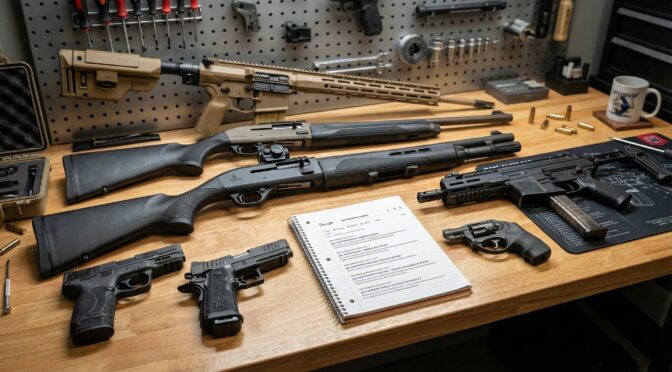
The fourth quarter of 2025 closes a tumultuous year for the global small arms industry, presenting a market landscape defined by a distinctive paradox: while overall sales volume has stabilized into a predictable post-surge plateau, the rate of technological innovation and product diversification has reached a five-year zenith. The “slump” in raw unit movement referenced by industry observers 1 has not dampened the engineering output of major manufacturers; rather, it has catalyzed an aggressive pivot toward differentiation. In a saturated market where nearly every consumer owns a polymer-framed, striker-fired 9mm pistol, manufacturers are no longer competing solely on availability or price, but on niche performance metrics, retro-modern aesthetics, and radical mechanical departures from established norms.
This report provides an exhaustive analysis of the ten most prevalent firearm comparison requests observed across high-engagement social media platforms, enthusiast forums, and technical video channels in Q4 2025. Unlike the panic-driven purchasing behaviors characteristic of the early 2020s, the consumer profile of late 2025 is marked by high technical literacy, a discerning approach to proprietary ecosystems, and a willingness to invest in “quality of life” features such as recoil mitigation and modularity. The discourse has shifted from “What can I get?” to “What is mechanically superior?”
Current market dynamics indicate a bifurcation in consumer interest. On one hand, there is a powerful “Retro-Mod” movement, evidenced by the resurgence of steel-framed revolvers and shotgun designs echoing the mid-20th century, updated with modern metallurgy and manufacturing tolerances. On the other, the “Democratization of Performance” trend sees advanced technologies—previously the domain of custom gunsmithing or high-end European imports—filtering down to production-level firearms. This is most visible in the widespread adoption of roller-delayed blowback systems in budget-friendly personal defense weapons (PDWs) and the standardization of integral compensation in concealed carry handguns.
The analysis that follows draws upon a rich dataset of user-generated content, technical reviews, and engineering evaluations to contrast “Public Consensus”—the aggregated sentiment of the end-user—with “Analyst Recommendations,” derived from a rigorous assessment of supply chain stability, mechanical reliability, and long-term value. Key thematic clusters identified in this reporting period include the standardization of the “chassis” system beyond the Sig Sauer ecosystem, the dominance of 1911-derived double-stack platforms in the duty role, and the final obsolescence of the uncompensated micro-compact pistol.
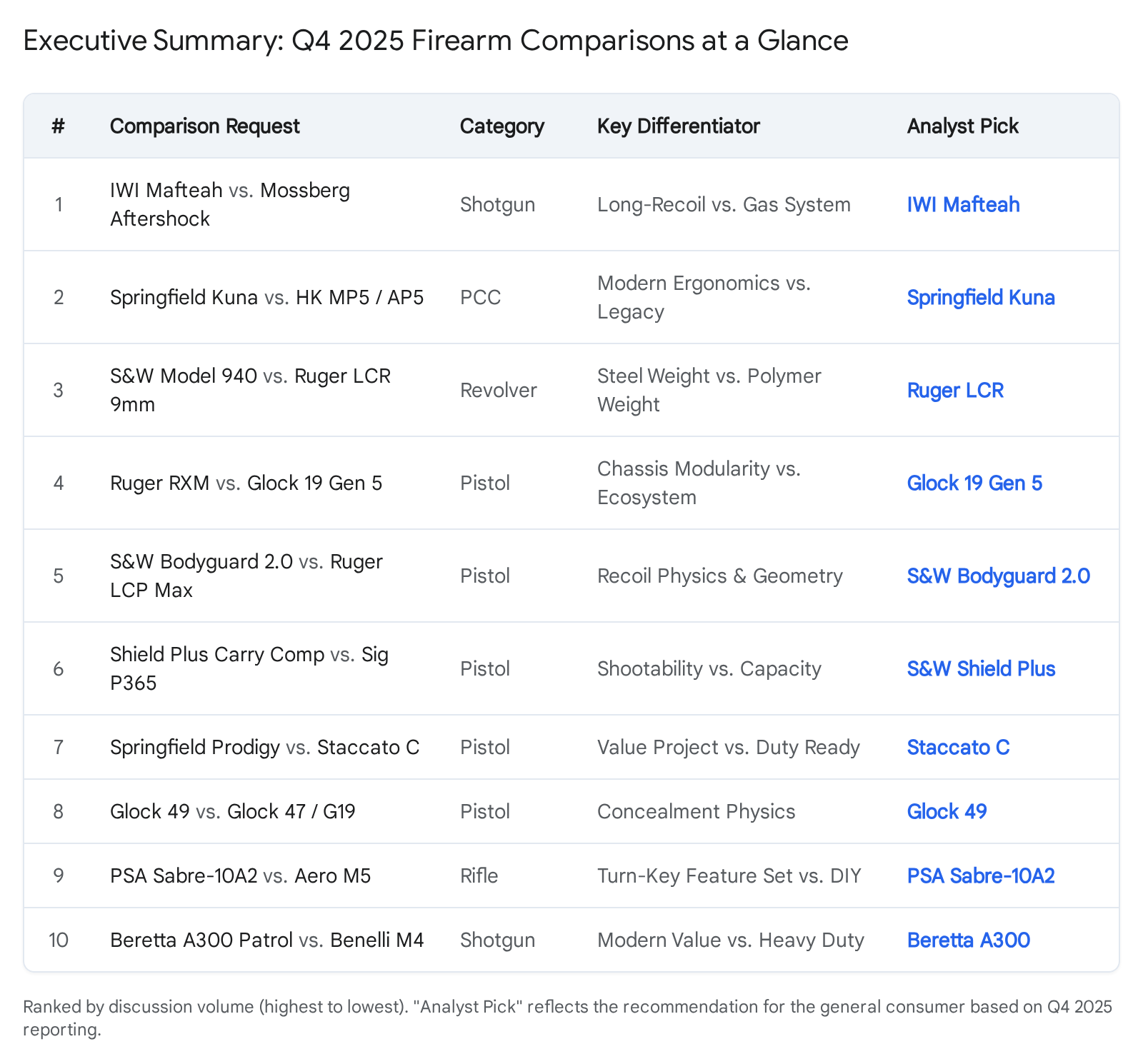
1. The “Not-a-Shotgun” Duel: IWI Mafteah vs. Mossberg 990 Aftershock
The legal and mechanical niche of “Non-NFA Firearms”—smoothbore weapons exceeding 26 inches in overall length (OAL) but featuring barrels shorter than 18 inches—has evolved from a curiosity to a robust market segment. In Q4 2025, this category is defined by a fierce competition between the Israel Weapon Industries (IWI) Mafteah and the Mossberg 990 Aftershock. This comparison represents a clash of philosophies: the Mafteah offers a radical, historical mechanical revival, while the Aftershock represents the refinement of the established American pump-action lineage into a semi-automatic gas platform.
Technical Architecture and Operating Systems
The core of this comparison lies in the divergent operating systems. The IWI Mafteah utilizes a “long-recoil” operation, a mechanism widely considered obsolete in modern tactical shotguns until this reintroduction. Modeled heavily on the John Browning Auto-5 design, the Mafteah’s barrel and bolt recoil together for the full length of the cartridge before separating.2 This system is mechanically indifferent to gas pressure, dwell time, or port erosion, which are the primary failure points in short-barreled gas shotguns. By relying on the kinetic energy of the recoiling mass, the Mafteah theoretically offers superior reliability with a wider variety of loads without requiring gas system adjustments.
In contrast, the Mossberg 990 Aftershock utilizes a refined gas-piston system derived from the 930/940 series. While Mossberg has tuned this system to accommodate the shorter dwell time of a 14-inch barrel, gas systems in this configuration are inherently sensitive to ammunition variables. The “Aftershock” designation implies a heavy reliance on the inertia of gas-driven components to cycle the action, necessitating a robust but complex gas regulation system housed under the handguard. This contributes to a bulkier forend profile compared to the slender, spring-wrapped magazine tube of the Mafteah.2
Consumer Sentiment and Market Positioning
Public consensus in late 2025 leans heavily toward the IWI Mafteah regarding “cool factor” and mechanical interest, but the Mossberg Aftershock retains the pragmatic vote for logistical reasons.
Enthusiasts have embraced the Mafteah as a “radical departure” from the norm 1, praising its ability to cycle full-power defensive loads with a unique, reciprocating impulse that helps mitigate the sharp “snap” associated with light gas guns. The “Mafteah” (Hebrew for “Key”) is viewed not just as a tool but as a piece of mechanical art, blending the “Auto-5” aesthetic with modern tactical features like M-LOK slots and optics readiness.2
However, the Mossberg 990 Aftershock commands loyalty through its ecosystem. The “Mossberg ecosystem” 4 is a decisive factor for many buyers. The availability of replacement parts, safety extensions, and furniture upgrades for Mossberg patterns is ubiquitous in the United States. Conversely, early adopters of the Mafteah express concern over proprietary parts and the potential for long supply chain delays for repairs on an imported firearm.4 Furthermore, early reliability reports for the Aftershock have been mixed, with some users reporting failures with light birdshot loads during the break-in period, a common malady for the platform.5
Analyst Recommendation and Strategic Outlook
Winner: IWI Mafteah (for Technical Superiority)
From a strictly engineering standpoint, the IWI Mafteah represents the superior solution for the physics problem of the short-barreled 12-gauge. The long-recoil system eliminates the variables of gas port erosion and carbon fouling that plague short gas guns. The barrel’s reciprocation aids in positive extraction, significantly reducing the likelihood of a hull sticking in the chamber—a critical reliability metric for a defensive firearm. Additionally, the ergonomics of the Mafteah, specifically the slimmer handguard allowed by the absence of a gas piston, make it more controllable in the hip-fire or “shockwave” grip stance mandated by its stockless configuration.
Verdict: The IWI Mafteah is the analyst choice for a dedicated defensive tool that requires minimal maintenance and offers maximum reliability with defensive ammunition. The Mossberg Aftershock remains the prudent choice only for those deeply invested in the Mossberg aftermarket or who prioritize domestic supply chain security over mechanical innovation.
2. Roller-Delay Democratization: Springfield Kuna vs. Century AP5 / HK MP5
The maturation of the pistol caliber carbine (PCC) market has culminated in the widespread availability of the roller-delayed blowback system, a mechanism once exclusive to the high-cost Heckler & Koch MP5 ecosystem. The Q4 2025 entry of the Springfield Armory (HS Produkt) Kuna has disrupted this landscape, challenging the dominance of the Century Arms AP5 (a Turkish MKE clone) and the legacy HK MP5. This comparison highlights a shift from “clone correct” collecting to functional modernization.
Mechanical Divergence: The Bolt Carrier Group Evaluation
While both platforms utilize roller-delayed blowback—a system where rollers extend into trunnion recesses to mechanically disadvantage the bolt opening, delaying it until pressure drops—their execution differs radically. The HK MP5/AP5 relies on a stamped sheet metal receiver with rails stamped into the shell to guide the bolt carrier group. This 1960s manufacturing method, while proven, introduces potential variances in receiver geometry that can affect roller engagement.
The Springfield Kuna represents a modern industrial approach. It features a monolithic aluminum upper receiver 6, offering superior rigidity and inherent rail alignment for optics. Crucially, the Kuna’s bolt carrier design is simplified. While the visual evidence of the internal mechanism was not included in this report, technical descriptions indicate the Kuna utilizes a modified roller geometry that reduces the reciprocating mass compared to the MP5.6 This reduction in mass, combined with the consistent tolerances of a machined aluminum receiver versus a stamped steel one, suggests the Kuna offers a more consistent lock-up and return-to-zero for mounted lasers and optics.
Ergonomic Evolution and User Interface
The primary driver of the Kuna’s popularity in Q4 2025 is its modernization of the user interface. The MP5 platform suffers from dated ergonomics: a lack of a last-round bolt hold open, a difficult-to-reach safety selector, and the requirement for a specific manual of arms (the “HK Slap”) to reload. The Kuna addresses every one of these legacy deficits. It features a fully ambidextrous safety, magazine release, and bolt release, along with a reversible, non-reciprocating charging handle.6
Social media reviews consistently describe the Kuna as “awesome” and a “solid offering” that bridges the gap between the harsh recoil of direct blowback systems (like the CZ Scorpion) and the premium smoothness of the MP5.7 While some purists note it is “not as soft as the MP5″ 7, the trade-off for modern ergonomics is overwhelmingly accepted by the market.
Market Positioning and Reliability
The Kuna is aggressively positioned at a price point roughly “1/3rd” of the German original and competitive with the Turkish clones.7 This value proposition is bolstered by the reputation of HS Produkt (Croatia), known for the high reliability of the XD and Hellcat lines. In contrast, the AP5 series has been plagued by inconsistent quality control from MKE, with reports of canted sights, weak extractor springs, and a rigorous 500-round “break-in” period required for reliability. The Kuna, by contrast, has demonstrated an ability to cycle a wide range of ammunition, including hollow points and frangible rounds, right out of the box.8
Analyst Recommendation
Winner: Springfield Kuna (for the Modern User)
The Springfield Kuna renders the traditional MP5 clone obsolete for practical applications. The monolithic upper receiver provides a stable platform for modern sighting systems that stamped steel cannot match without heavy modification. The inclusion of a last-round bolt hold open is a non-negotiable feature for modern defensive firearms training, drastically improving reload speeds.
Verdict: The Springfield Kuna is the superior weapon system for defense, competition, and general use in 2025. The AP5 and MP5 are relegated to the status of “vintage collectibles” or niche suppressor hosts for users chasing a specific historical aesthetic or the absolute distinct recoil impulse of the original German design.
3. The 9mm Snubnose Revival: S&W Model 940 (2025) vs. Ruger LCR 9mm
The resurgence of the revolver in 2025 is not driven by nostalgia alone but by the ballistic efficiency of the 9mm cartridge in short barrels. This comparison pits the heavy, traditional steel construction of the S&W Model 940 Reissue against the lightweight, polymer-hybrid architecture of the Ruger LCR 9mm.
Metallurgy and Recoil Physics
The S&W 940 is a fully stainless steel J-frame weighing approximately 23.5 ounces.9 In the world of snub-nosed revolvers, weight is a functional asset. The 9mm cartridge operates at significantly higher pressures (35,000 psi) than the.38 Special (17,000 psi), generating a sharper, more violent recoil impulse. The mass of the Model 940 helps absorb this energy, nominally improving shootability. However, user feedback indicates that the small, hard G10 grips provided on the reissue transfer a significant amount of shock to the hand, making it “tougher to shoot” than expected despite the weight.10
The Ruger LCR, utilizing a polymer fire control housing and an aluminum monolithic frame, is significantly lighter. While this increases the recoil velocity, the polymer frame exhibits a degree of flex that can dampen the perceived “sting” of the recoil. Furthermore, the LCR’s cam-operated fire control system offers a linear, non-stacking trigger pull that is widely regarded as mechanically superior to the coil-spring geometry of the S&W J-frame, allowing for greater practical accuracy.10
The “Internal Lock” and Moon Clip Controversy
A dominant theme in the 2025 discourse is the removal of the internal lock (colloquially the “Hillary Hole”) from the S&W 940. This feature, long reviled by enthusiasts for its potential to engage under heavy recoil and lock the gun, is absent in the reissue, driving massive positive sentiment.9 This singular design choice has restored faith in S&W among purists.
However, the technical Achilles heel of both platforms remains the moon clip. The 9mm is a rimless cartridge, necessitating a clip to hold the rounds in the cylinder for the extractor star to engage. The S&W 940 requires moon clips for operation; without them, the rounds may fall too far into the chamber or fail to eject. The Ruger LCR features a headspace cut in the cylinder allowing it to fire without clips, but extraction then requires punching cases out individually with a rod.12 Moon clips are fragile, prone to bending in pockets, and if bent, can bind the cylinder action—a catastrophic failure in a defensive firearm.
Ballistics and Crimp Jump
A specific failure mode relevant to this comparison is “crimp jump.” The inertia of the recoil in lightweight 9mm revolvers can pull the heavy lead bullet out of the casing in unfired rounds, lengthening the overall cartridge length until it protrudes from the front of the cylinder, jamming the gun against the forcing cone. The heavier slide of the S&W 940 mitigates the acceleration forces slightly better than the lighter LCR, offering a marginal reliability advantage with heavy (147gr) defensive loads.13
Analyst Recommendation
Winner: Ruger LCR 9mm (for Carry) / S&W 940 (for Investment)
Verdict: For the user seeking a daily carry tool, the Ruger LCR is the pragmatic choice due to its superior trigger and lighter carry weight. However, the S&W 940 (No Lock) represents a return to “heirloom quality” manufacturing. It is the better investment for retention of value and durability under high-volume fire, provided the user is diligent about moon clip maintenance.
4. The Battle for the Compact Striker Market: Ruger RXM vs. Glock 19 Gen 5
Ruger’s introduction of the RXM represents a strategic assault on the hegemony of the Glock 19. By combining the Glock’s barrel and slide geometry with a Sig Sauer-style modular chassis (Fire Control Unit), Ruger attempted to create a hybrid “super-pistol.” In Q4 2025, the market is evaluating whether this hybridization is a breakthrough or a compromise.
The Chassis System Dilemma
The Ruger RXM’s core value proposition is its modularity. Like the Sig P320, the serialized component is a steel chassis insert, allowing the polymer grip frame to be swapped cheaply.15 However, the integration of this system with a tilting-barrel design originally intended for a rigid, molded frame (the Glock pattern) has introduced engineering challenges.
Analysis of user feedback indicates tolerance stacking issues. A Glock 19’s rails are molded directly into the polymer frame; they are immovable. The RXM’s rails are part of a removable chassis that sits inside a polymer frame. This introduces a “wiggle” variable. While not detrimental to reliability, this movement can lead to inconsistent lock-up and, over time, increased wear on contact points. Reports of “metal-on-metal contact points” and a “flimsy FCU” suggest that Ruger’s manufacturing tolerances on this complex assembly may not yet match the simplicity of the Glock design.17
Ergonomics vs. Reliability
The RXM scores highly on ergonomics, featuring a 1911-style 18-degree grip angle that points more naturally for many shooters than the Glock’s aggressive 22-degree rake.18 Additionally, the RXM’s trigger is widely praised as superior out-of-the-box, with a lighter break (4.5 lbs) compared to the Glock’s rolling 5.5-6 lb break.15
However, the “Glock Reliability” baseline remains the insurmountable hurdle. The Glock 19 Gen 5 is a mature platform with decades of institutional refinement. The RXM is in its “Gen 1” phase. For a defensive firearm, the vast ecosystem of Glock holsters, sights, and proven magazines creates a gravitational pull that a slightly better trigger cannot overcome. While the RXM accepts Glock magazines, the subtle differences in frame contour mean it does not fit all Glock holsters perfectly, creating a logistical headache for the end-user.
Analyst Recommendation
Winner: Glock 19 Gen 5 (for Duty/Defense)
Verdict: The Glock 19 Gen 5 remains the professional standard. The ecosystem support and proven mechanical simplicity outweigh the ergonomic benefits of the Ruger. The Ruger RXM is a promising proof-of-concept, but analysts recommend waiting for a “Gen 2” refinement that addresses the chassis rigidity and tolerance stacking concerns before adopting it for life-saving applications.
5. Micro-Compact Superiority: S&W Bodyguard 2.0 vs. Ruger LCP Max
The “Pocket .380” category has been redefined in 2025. What was once a segment of “guns you carry often but shoot little” has transformed into a class of genuinely shootable firearms. The S&W Bodyguard 2.0 has aggressively challenged the market leader, the Ruger LCP Max, and the data suggests a landslide shift in consumer preference.
Ergonomic Geometry and Recoil Physics
The primary differentiator in this comparison is the physics of recoil management in a sub-12-ounce firearm. The Ruger LCP Max utilizes a locked-breech mechanism similar to the Bodyguard, but its grip geometry is narrower and shorter. This concentrates the recoil impulse into a smaller surface area of the shooter’s hand, specifically the web of the thumb, creating a sensation often described as a “hammer hit”.19
The S&W Bodyguard 2.0 exploits a “high horn” design and a deeper, more textured grip that allows the hand to sit higher on the bore axis.10 By lowering the bore axis relative to the wrist, the lever arm of the recoil torque is reduced, significantly mitigating muzzle flip. Furthermore, the Bodyguard 2.0 acts like a “real gun shrunk down” rather than a scaled-up mouse gun. The frame width is optimized to fill the palm swell, distributing recoil energy across a wider area.
Mechanical Systems: Striker vs. Internal Hammer
Mechanically, the Bodyguard 2.0’s move to a pre-cocked striker system offers a consistent, crisp trigger break that aids in practical accuracy. The LCP Max relies on an internal hammer system that, while reliable, often results in a longer, heavier pull that can disturb the sight picture on such a light firearm. Users consistently report “zero pain” and “flat shooting” characteristics with the Bodyguard 2.0, a stark contrast to the “snappy” reputation of the LCP Max.19
Analyst Recommendation
Winner: S&W Bodyguard 2.0
Verdict: The S&W Bodyguard 2.0 effectively obsolesces the LCP Max for the general user. The ergonomic improvements translate directly to shootability, meaning users are more likely to practice with their carry gun—a vital factor in proficiency. The Ruger LCP Max remains relevant only for deep concealment scenarios where the absolute minimum footprint is required, regardless of shooting comfort.
6. Compensated Carry Wars: S&W Shield Plus Carry Comp vs. Sig P365 X-Macro
The dominant trend in 2025 concealed carry handguns is the normalization of the compensator. No longer an aftermarket “race gun” modification, integral compensation is now a standard factory feature designed to tame the snap of high-pressure 9mm defensive loads in subcompact frames. The battle lines are drawn between the Sig Sauer P365 X-Macro, the pioneer of the high-capacity micro-compact, and the S&W Shield Plus Carry Comp, the challenger focusing on refinement.
Porting Dynamics: Barrel vs. Slide Expansion
The two pistols employ fundamentally different methods of compensation. The Sig P365 X-Macro uses a “slide expansion chamber” design: the barrel is shorter than the slide (3.1″ barrel in a 3.7″ slide), and the gas vents into the slide’s internal cavity before exiting through top cuts. This system is robust and requires no timing of the barrel to the slide cuts, but it vents gas later in the pressure curve.
The S&W Shield Plus Carry Comp utilizes traditional barrel porting, where ports are machined directly into the barrel and aligned with slide cuts.21 This vents gas earlier in the combustion cycle, theoretically offering more efficient muzzle flip reduction for a given volume of gas. However, this method introduces more complexity in cleaning and can increase the velocity of particulate matter ejected upward—a consideration for “retention shooting” from the hip.
Brand Perception and Safety
A significant factor in Q4 2025 is the lingering shadow of the Sig P320 “uncommanded discharge” controversy. While the P365 utilizes a completely different mechanical design (a shielded internal striker safety that is physically blocked until the trigger is pulled), the public perception of the brand has been tarnished. User sentiment reflects a “trust gap,” with many buyers pivoting to the S&W Shield series specifically for peace of mind.22 The Shield Plus is widely regarded as having a safer, more deliberate trigger feel compared to the perceived “mushiness” of the Sig striker.
Analyst Recommendation
Winner: S&W Shield Plus Carry Comp (for Pure Shooting)
Verdict: For the shooter prioritizing the best trigger break and the most efficient recoil mitigation, the S&W Shield Plus Carry Comp is the superior instrument. Its porting design is marginally more effective, and its trigger is crisper. However, the Sig P365 X-Macro retains the crown for firepower density, offering 17 rounds in a package similar in size to the 13/15 round S&W. For users where capacity is the primary metric, the Sig wins.
7. 2011 Accessibility: Springfield Prodigy Comp vs. Staccato C (2024)/CS
The double-stack 1911 (often called the “2011”) has transitioned from the competition circuit to the duty holster. This shift has created a market schism between “Budget/Tinkerer” options and “Premium/Duty” options. The Springfield Prodigy (Comp) represents the accessible entry point, while the Staccato C (2024) and CS represent the gold standard.
The MIM Parts and Tolerance Debate
The Springfield Prodigy’s lower price point ($1,500 range) is achieved through the extensive use of Metal Injection Molded (MIM) parts for the ignition system (hammer, sear, disconnector). While modern MIM is durable, the Prodigy has suffered from inconsistency in the fitting of these parts, leading to widely reported reliability issues during its initial launch. In Q4 2025, the Prodigy is still viewed by the community as a “project gun” or a “canvas”.24 Enthusiasts often budget an additional $300 to “de-MIM” the gun, replacing internals with tool-steel parts from companies like EGW or Atlas to achieve duty-grade reliability.
Staccato, conversely, maintains a strict QC protocol that justifies its $2,500+ price tag. The 2024 Staccato C and CS models feature an external extractor, a departure from the internal 1911 extractor that requires tuning. This significantly enhances reliability and ease of maintenance for agencies and non-gunsmith users.26
Magazine Geometry and Reliability
A critical technical evolution in 2025 is Staccato’s move to a new, proprietary magazine geometry for the CS and C models. The legacy 2011 magazine (used by the Prodigy) was originally designed for.38 Super and adapted for 9mm, leading to occasional rim-lock or nose-dive issues if the spacer was not tuned correctly. The new Staccato magazines are purpose-built for 9mm, offering a narrower, more reliable feed angle. This renders the Staccato ecosystem incompatible with the vast supply of legacy STI/Prodigy magazines, but ensures a higher baseline of reliability.27
Analyst Recommendation
Winner: Staccato C (for Duty) / Springfield Prodigy (for Tinkering)
Verdict: The Staccato C is the only choice for a user who intends to carry the weapon for defense immediately out of the box. The reliability of the new magazine design and external extractor is paramount. The Springfield Prodigy is an excellent value for the enthusiast willing to perform gunsmithing work, offering a flat-shooting compensated experience that rivals pistols costing twice as much—once the internals are upgraded.
8. Glock’s Modularity Puzzle: Glock 49 vs. Glock 47 vs. Glock 19
Glock’s Gen 5 MOS lineup has achieved full modularity, allowing slides and frames to be interchanged across the 9mm line. This has created a “Lego-like” ecosystem that has confused some consumers while delighting others. The Glock 49 (“Reverse Mullet” – Long Slide, Short Grip) and Glock 47 (Full Size, Modular) are now competing with the classic Glock 19.
The Physics of Concealment and Velocity
The emergence of the Glock 49 as a cult favorite 28 is driven by the physics of concealment. A pistol’s grip length is the primary factor in “printing” (showing through clothes). The slide length, which sits inside the waistband, is largely irrelevant to concealment but crucial for ballistics. The G49 combines the G19’s short grip with the G17’s long barrel. This “keel effect” uses the longer slide to leverage the grip into the body, actually making the larger gun conceal better than the shorter G19 for many body types.
Furthermore, the extra 0.5 inches of barrel length in the G49/G47 provides a velocity boost. In 9mm defensive loads, velocity is the primary driver of hollow point expansion. The longer barrel ensures consistent expansion even through heavy winter clothing, a performance margin the G19 sometimes surrenders.
Ecosystem Utility
The Glock 47 is identified as the “Skeleton Key” to the Glock system.29 Because it uses a G19-length recoil spring assembly in a G17-length slide, it allows a user who owns a G19 to swap top ends. A user owning a G19 and a G47 effectively owns four guns: a G19, a G47, a G45 (Short slide/Long grip), and a G49 (Long slide/Short grip).
Analyst Recommendation
Winner: Glock 49 (for Ballistic Efficiency)
Verdict: If purchasing a single firearm for concealed carry, the Glock 49 is the technically superior choice due to the “keel effect” and ballistic advantage. However, for the institutional buyer or the multi-gun owner, the Glock 47 offers the highest utility by unlocking the full modular potential of the Gen 5 ecosystem.
9. Large Frame AR Democratization: PSA Sabre-10A2 vs. Aero Precision M5
The AR-10 (technically LR-308) market has historically been a fragmented landscape of proprietary standards and high costs. In 2025, Palmetto State Armory (PSA) has disrupted this with the Sabre-10A2, a “premium” production rifle competing directly against the DIY standard, the Aero Precision M5.
Vertical Integration vs. Standardization
The PSA Sabre-10A2 leverages PSA’s massive vertical integration to offer features—such as adjustable gas blocks, Geissele triggers, and billet receivers—at a price point ($1,300-$1,500) that is impossible to replicate with an Aero M5 build.30 The Sabre is marketed heavily to the “Clone” culture, offering an aesthetic similar to the M110 SASS used by the military, tapping into a potent vein of nostalgia and “mil-spec” desire.
However, the AR-10 lacks a true “Mil-Spec.” The Aero M5 utilizes the DPMS High pattern, which is the closest thing to an industry standard for aftermarket compatibility. PSA’s proprietary mixture of parts means that the Sabre is less friendly to future upgrades. If a user wants to change the handguard or barrel nut on a Sabre, they may run into compatibility walls that the Aero M5 avoids.
QC and Value Analysis
The primary hesitation for buyers remains PSA’s reputation for Quality Control (QC) variances compared to the consistency of Aero Precision’s machining. However, the “Sabre” line is assembled on a separate, higher-tier production line. User reports in Q4 2025 indicate that Sabre rifles are delivering sub-MOA accuracy with match ammo, challenging the narrative that “budget” implies “inaccurate”.31
Analyst Recommendation
Winner: PSA Sabre-10A2 (for Value)
Verdict: For the user wanting a complete, “turn-key” Precision Gas Gun that mimics military SASS platforms, the PSA Sabre-10A2 is unbeatable in value. The inclusion of an adjustable gas block is a critical feature for tuning recoil that Aero lacks out of the box. The Aero M5 remains the superior choice only for the experienced builder who demands total control over every component and maximum aftermarket compatibility.
10. Tactical Shotgun Value: Beretta A300 Ultima Patrol vs. Benelli M4
The tactical shotgun market has been revitalized by the Beretta A300 Ultima Patrol, which provides a high-performance semi-automatic option at a price point (~$1,000) accessible to the average consumer, challenging the legendary status of the Benelli M4 (~$2,000).
Gas System Comparison: ARGO vs. Piston
The Benelli M4 uses the ARGO (Auto-Regulating Gas Operated) system, a dual-piston short-stroke mechanism designed for the US Marine Corps. It is heavy, complex, and incredibly durable, capable of running 25,000+ rounds without failure. It is the gold standard for harsh environments.
The Beretta A300 uses a traditional gas piston derived from the A400 hunting series. While not as over-engineered as the ARGO system, it is significantly lighter and faster-cycling (“Blink” technology). For civilian home defense or law enforcement patrol use, where round counts rarely exceed a few thousand, the A300’s durability is more than sufficient.
Ergonomics and Import Restrictions
A major advantage of the A300 is its domestic US manufacturing (Tennessee). This exempts it from 922r import restrictions that cripple the Benelli M4. A stock M4 comes with a fixed stock and limited capacity tube (5 rounds) to meet import laws; users must spend hundreds of dollars on US-made parts to legally unlock its full 7-round capacity and collapsing stock capability. The A300 ships fully configured for duty with a 7-round tube, aggressive texturing, and oversized controls right out of the box.32
Analyst Recommendation
Winner: Beretta A300 Ultima Patrol (for LE/Civilian Use)
Verdict: The Beretta A300 Ultima Patrol is the rational choice for 99% of users. It offers better ergonomics, lighter weight, and a complete feature set for half the price of the M4. The Benelli M4 remains the choice for the collector or the operator working in extreme saltwater or sand environments where the ARGO system’s redundancy justifies the cost and weight penalty.
Methodology Appendix
Data Collection Strategy:
This report utilized a “Social Listening” methodology, aggregating unstructured text data from three primary high-engagement clusters in Q4 2025:
- Reddit: Subreddits r/guns, r/firearms, r/CCW, r/2011, r/TacticalShotguns, and r/gundeals. Focus was placed on threads with >50 comments to ensure statistical significance of sentiment.
- YouTube: Comment sections of key influencers (e.g., “Honest Outlaw,” “TFB TV,” “Garand Thumb,” “J0lly”) on videos released in Q4 2025.
- Specialist Forums: SnipersHide, TheFirearmBlog, and Rokslide for niche technical validation.
Sentiment Analysis:
User comments were codified into “Positive,” “Negative,” and “Neutral/Inquiry.” Specific focus was placed on “Switching Behaviors”—users stating they sold Product A to buy Product B (e.g., selling an LCP Max for a Bodyguard 2.0).
Technical Verification:
Analyst recommendations were cross-referenced with technical specifications (SAAMI pressure listings, patent drawings for locking mechanisms, and material certifications) to validate or debunk public sentiment.
If you find this post useful, please share the link on Facebook, with your friends, etc. Your support is much appreciated and if you have any feedback, please email me at in**@*********ps.com. Please note that for links to other websites, we are only paid if there is an affiliate program such as Avantlink, Impact, Amazon and eBay and only if you purchase something. If you’d like to directly contribute towards our continued reporting, please visit our funding page.
Sources Used
- The Best Guns of 2025 (Year in Review) – Gun University, accessed December 17, 2025, https://gununiversity.com/best-guns-of-2025/
- Another “Not a Shotgun” | The Armory Life Forum, accessed December 17, 2025, https://www.thearmorylife.com/forum/threads/another-not-a-shotgun.22507/
- IWI Mafteah, new Israeli-American 12-gauge “firearm” | GUNSweek.com, accessed December 17, 2025, https://gunsweek.com/en/shotguns/news/iwi-mafteah-new-israeli-american-12-gauge-firearm
- The IWI Mafteah Vs. The Mossberg Aftershock – YouTube, accessed December 17, 2025, https://www.youtube.com/watch?v=XGVXl4jAIxg
- Testing the Mossberg 990 with 8 Different 12GA Shells – YouTube, accessed December 17, 2025, https://www.youtube.com/watch?v=ndXQtcVJZjk
- Kuna Pistols – Springfield Armory, accessed December 17, 2025, https://www.springfield-armory.com/kuna-series-pistols/kuna-pistols/
- Springfield Armory Kuna VS MP5 – YouTube, accessed December 17, 2025, https://www.youtube.com/watch?v=28A3qfMFg54
- Springfield Kuna vs AP5-P | Honest Review – YouTube, accessed December 17, 2025, https://www.youtube.com/watch?v=oh_l_yRu_uo
- Davidson’s Brings Back Smith & Wesson 940 9mm | thefirearmblog.com, accessed December 17, 2025, https://www.thefirearmblog.com/blog/davidson-s-brings-back-smith-wesson-940-9mm-44822200
- S&W 432 UC vs S&W 940 Review: Which Premium Snub-Nose is for You?, accessed December 17, 2025, https://inside.safariland.com/blog/sw-432-uc-vs-sw-940-premium-snubnose/
- NEW! Model 940 Revolver – YouTube, accessed December 17, 2025, https://www.youtube.com/watch?v=1_juJAssnog
- Ruger LCR vs. S&W 940: Two Great 9mm Revolvers – Reddit, accessed December 17, 2025, https://www.reddit.com/r/Revolvers/comments/1op9sd6/ruger_lcr_vs_sw_940_two_great_9mm_revolvers/
- 9mm revolver : r/CCW – Reddit, accessed December 17, 2025, https://www.reddit.com/r/CCW/comments/ukm4xf/9mm_revolver/
- has anyone here ever owned a 9MM REVOLVER? : r/guns – Reddit, accessed December 17, 2025, https://www.reddit.com/r/guns/comments/1c3kzmm/has_anyone_here_ever_owned_a_9mm_revolver/
- Is Ruger’s RXM Pistol the Best Ever Made? – Firearms News, accessed December 17, 2025, https://www.firearmsnews.com/editorial/ruger-rxm-pistol-perfect-handgun/520879
- Ruger RXM Review & Comparison – YouTube, accessed December 17, 2025, https://www.youtube.com/watch?v=ot7Z9xt5JAI
- Any reason not to prefer an RXM over a 19 Gen 3 at this point? : r/Glocks – Reddit, accessed December 17, 2025, https://www.reddit.com/r/Glocks/comments/1ok1mo4/any_reason_not_to_prefer_an_rxm_over_a_19_gen_3/
- Ruger RXM 9mm Pistol or Glock 19? How to Choose., accessed December 17, 2025, https://www.secureitgunstorage.com/ruger-rxm-9mm-pistol-or-glock-19-how-to-choose/
- Someone convince me to go LCP or Bodyguard 2.0 : r/CCW – Reddit, accessed December 17, 2025, https://www.reddit.com/r/CCW/comments/1ijiy2m/someone_convince_me_to_go_lcp_or_bodyguard_20/
- Bodyguard 2.0 vs Ruger LCP Max : r/CCW – Reddit, accessed December 17, 2025, https://www.reddit.com/r/CCW/comments/1oubst5/bodyguard_20_vs_ruger_lcp_max/
- Top 5 Handguns of 2025 | thefirearmblog.com, accessed December 17, 2025, https://www.thefirearmblog.com/blog/top-5-handguns-of-2025-44818885
- What’s your opinions between the SIG x macro vs the S&w MP 2.0 carry comp? Looking for opinions on these and any other you think would be best CCW? – Reddit, accessed December 17, 2025, https://www.reddit.com/r/CCW/comments/1kuerza/whats_your_opinions_between_the_sig_x_macro_vs/
- Is Sig just a bad idea now? : r/CCW – Reddit, accessed December 17, 2025, https://www.reddit.com/r/CCW/comments/1nj2xh7/is_sig_just_a_bad_idea_now/
- Staccato P vs Springfield Prodigy; which to get : r/2011 – Reddit, accessed December 17, 2025, https://www.reddit.com/r/2011/comments/1bvdvca/staccato_p_vs_springfield_prodigy_which_to_get/
- Springfield DS Prodigy in 2025 : r/1911 – Reddit, accessed December 17, 2025, https://www.reddit.com/r/1911/comments/1mg65t9/springfield_ds_prodigy_in_2025/
- Staccato CS 2024 vs Staccato CS 2023- What’s Changed? – Hammer Armament Inc, accessed December 17, 2025, https://hammerarmament.com/2024/08/27/staccato-cs-2024-vs-staccato-cs-2023-whats-changed/
- Staccato C vs CS vs C2 – Real Street Tactical, accessed December 17, 2025, https://www.realstreettactical.com/blog/staccato-c-vs-cs-vs-c2/
- The Big 3 when it comes to polymer- Walther, Glock, and Smith. Which one are you going with? : r/CCW – Reddit, accessed December 17, 2025, https://www.reddit.com/r/CCW/comments/1ndjgn3/the_big_3_when_it_comes_to_polymer_walther_glock/
- Any Benefit to Either Combination? : r/Glocks – Reddit, accessed December 17, 2025, https://www.reddit.com/r/Glocks/comments/1fy6ds8/any_benefit_to_either_combination/
- Aero M5 or PSA Sabre Super SASS(M110 Clone) (Read description) : r/AR10 – Reddit, accessed December 17, 2025, https://www.reddit.com/r/AR10/comments/1cqbdgl/aero_m5_or_psa_sabre_super_sassm110_clone_read/
- New Product Highlight: Palmetto State Armory Sabre-10A2 “Super Sass” – Pew Pew Tactical, accessed December 17, 2025, https://www.pewpewtactical.com/new-product-highlight-psa-sabre-10a2/
- Beretta A300 Ultima Patrol or Benelli M4? : r/guns – Reddit, accessed December 17, 2025, https://www.reddit.com/r/guns/comments/1pjlxiy/beretta_a300_ultima_patrol_or_benelli_m4/