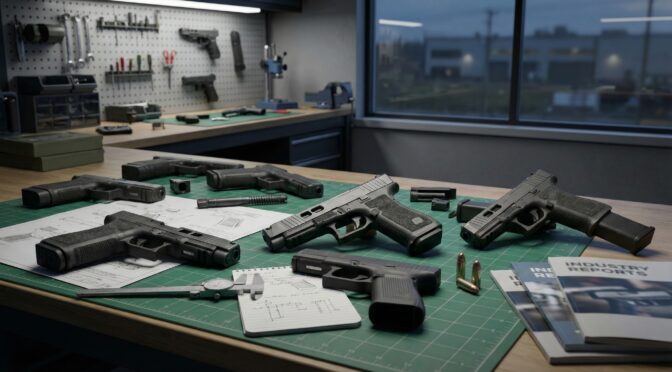
The fiscal and operational year of 2025 in the small arms industry has been defined not by the explosive creation of entirely new firearm categories, but by a sophisticated, albeit reactionary, refinement of existing platforms. As an industry analyst and engineering observer, the prevailing trend is a shift away from the “race to the bottom” in dimensional reduction—which characterized the 2015–2022 micro-compact boom—toward a philosophy of “performance concealment.” This paradigm prioritizes shootability, recoil management, and capacity over minimal footprint, evidenced by the proliferation of integrally compensated slides, weighted grip modules, and the aggressive democratization of the 2011 platform.
Furthermore, 2025 marked a critical inflection point in design philosophy driven by external legal and regulatory pressures. The proliferation of illegal auto-sear devices (colloquially known as “switches”) forced major manufacturers, most notably Glock with its V-Series, to re-engineer internal geometries to prevent unauthorized full-auto conversions. This report provides an exhaustive engineering and market analysis of the pistols manufactured and released in 2025, dissecting their mechanical merits, market reception, and long-term viability.
The analysis synthesizes production data, technical specifications, independent performance testing, and market sentiment to categorize these releases into successes and failures. It examines the “Total Market Impact” (TMI) of each platform, weighting consumer engagement against technical reliability data to provide a nuanced view of the landscape.
2. The Macro-Industrial Climate of 2025
To understand the specific successes and failures of 2025’s handgun releases, one must first contextualize the industrial and economic environment in which these firearms were engineered and sold. The year was characterized by three dominant macro-trends: the democratization of the double-stack hammer-fired pistol, the commoditization of manufacturing via robotics, and the “liability-proofing” of internal designs.
2.1 The “Shootability” Index and the Compensator Era
A recurring engineering theme in 2025 releases—from the high-end Sig Sauer P211-GTO to the budget-oriented Stoeger Combat SX—is the prioritization of recoil management. The physics of 9mm Luger in sub-20-ounce handguns creates a recoil impulse that, while manageable, degrades follow-up shot speed for the average user. Manufacturers have collectively recognized that consumers are willing to accept marginally more weight or slide length in exchange for flatter shooting dynamics. This has led to the “Compensated Era,” where ports and expansion chambers are standard SKU features rather than aftermarket modifications. This is not merely a cosmetic trend but a fundamental shift in slide velocity management and spring rate engineering.1
2.2 Supply Chain Localization and “Americanization”
The year also witnessed a significant localization of manufacturing, driven by 922(r) compliance costs and the desire to insulate supply chains from transatlantic shipping vulnerabilities. Heckler & Koch’s decision to manufacture the CC9 in Columbus, Georgia, rather than import it from Oberndorf, Germany, signifies a strategic pivot. By building domestically, HK bypassed import restrictions on non-sporting firearms, allowing them to compete directly in the sub-$700 price bracket—a segment previously dominated by Glock and Sig Sauer.3 Conversely, Taurus continues to leverage high-volume robotic manufacturing in Brazil to drive costs down, though this strategy revealed significant quality control vulnerabilities in 2025.5
2.3 The Regulatory Engineering Shift
Perhaps the most profound shift in 2025 was the industry’s defensive posture regarding “convertibility.” With lawsuits mounting from municipalities like Chicago and states like New Jersey regarding the ease of converting semi-automatic pistols to automatic fire, manufacturers began altering the internal architecture of their most popular platforms. The Glock V-Series is the bellwether of this trend, representing a move where engineering decisions are dictated not by ballistics or ergonomics, but by legal liability and preemptive compliance with state-level bans on “convertible” firearms.6
3. Sector Analysis I: The Democratization of the 2011 Platform
The most dynamic and disruptive market sector in 2025 was the double-stack, single-action-only (SAO) hammer-fired category. Historically, the “2011” platform (a modular double-stack 1911) was the purview of custom shops like Staccato (formerly STI), Atlas, and Infinity, with price points ranging from $2,500 to $6,000. In 2025, mass-production manufacturers attacked this segment, attempting to bring the 2011 shooting experience to the $1,000–$1,500 price point.
3.1 Sig Sauer P211-GTO: Disruption and Compromise
Status: Released Mid-2025
MSRP: ~$1,400 – $1,600 (Market Estimated)
The Sig Sauer P211-GTO represents the boldest engineering gamble of the year. By attempting to bridge the gap between the polymer striker-fired market and the high-end steel frame market, Sig Sauer directly targeted the dominance of Staccato.8
3.1.1 Engineering Deep Dive: The Magazine Geometry Challenge
The core innovation—and the source of many teething issues—of the P211-GTO is its magazine geometry. Traditional 2011 magazines are notoriously expensive ($70-$100), prone to tuning issues, and sensitive to feed lip deformation. The P211 breaks from tradition by utilizing P320 magazines, which are ubiquitous, reliable, and significantly cheaper.10
From an engineering perspective, this required a radical redesign of the grip module and mag catch geometry. The P320 magazine is tapered to fit a polymer grip module, whereas 2011-style grips are typically straight-walled steel or aluminum channels. To make a tapered magazine feed reliably into a chassis designed for 1911-style feed ramps required Sig engineers to create a complex insert system. The “GTO” designation implies a performance focus, featuring an integrated compensator or sight block design similar to the P320-Spectre Comp, reducing muzzle flip by utilizing expanding gases to drive the muzzle downward.11
3.1.2 Market Reception and TMI Analysis
- Total Market Impact (TMI): Very High. The “P211 vs. Staccato” debate dominated industry discourse, forum traffic, and video reviews throughout Q3 2025. It was the “must-have” comparison for every major content creator.
- Sentiment: Mixed-Positive (75% Positive / 25% Negative).
- The “Staccato Killer” Narrative: Early reviews favorably compared the shooting impulse to the Staccato XC, a pistol costing nearly three times as much. The return-to-zero speed—the time it takes for the sights to settle back on target after recoil—was praised as class-leading for the price point.9
3.1.3 Performance Data and Failure Analysis
Despite the hype, the P211-GTO suffered from “beta tester” syndrome, common in new firearm platforms.
- Spring Rate Mismatch: The recoil spring system was widely criticized for being undersprung for standard defensive ammunition. In an attempt to make the slide easy to rack and the recoil impulse soft, Sig utilized a spring weight that struggled to strip rounds from fully loaded magazines when the gun became fouled, leading to “failure to feed” (FTF) and sluggish return-to-battery (RTB) issues.13
- Extractor Tension: Reports of failure to extract (FTE) surfaced, traced back to MIM (Metal Injection Molded) extractor claws losing tension prematurely or having inconsistent tolerances from the factory.14
- Magazine Over-insertion: A critical design oversight involved the lack of over-insertion stops on the frame. Users reported that aggressively slamming fully loaded 21-round magazines could drive the magazine feed lips into the ejector, bending it. This is a legacy issue in the 2011 platform that Sig’s use of P320 mags did not inherently solve without a dedicated basepad stop.15
Performance Metrics:
| Metric | Data Point | Notes |
| Accuracy (25 yds) | 1.10″ | Using Federal Gold Medal Match 9 |
| Trigger Pull | ~3.5 lbs | SAO, slight creep reported vs. Staccato |
| Reliability Score | 85/100 | Deductions for break-in failures and mag sensitivity |
3.2 The Budget 2011 Contenders: Kimber 2K11 and Girsan Witness 2311 Brat
While Sig aimed for the mid-tier, other manufacturers attacked the entry-level segment.
Kimber 2K11: Released as a direct competitor in the “double stack 1911” space, the 2K11 focused on modularity with an optic-ready slide and accessory rail. However, it faced stiff competition from the entrenched perception of Kimber’s variable quality control. Early reports suggest it functioned adequately but lacked the “feature density” of the Girsan or the brand cachet of the Sig.2
Girsan Witness 2311 Brat: European American Armory (EAA) imported the Girsan “Brat,” a compact, double-stack 1911 priced at an aggressive $679.
- Engineering: The “Brat” features a 3.4-inch barrel, placing it in the carry-comp category. It utilizes a removable magazine well and Novak-style sights.
- Market Position: It successfully captured the budget-conscious buyer who wanted the 2011 aesthetic and trigger without the financial commitment. It served as a “gateway drug” to the platform, though long-term durability of the Turkish metallurgy under high round counts remains a point of observation for analysts.1
4. Sector Analysis II: The Maturation of the Micro-Compact
If the 2011 sector was about disruption, the micro-compact sector in 2025 was about refinement and the establishment of new standards for reliability and ease of use.
4.1 Heckler & Koch CC9: The American Pivot
Status: Released Late 2024 / Volume Availability throughout 2025
MSRP: $699
The CC9 is arguably HK’s most significant pistol release in a decade, not for technological novelty, but for industrial strategy. It is HK’s answer to the Sig P365 and Glock 43X, engineered to capture the massive U.S. concealed carry market.3
4.1.1 Engineering Deep Dive: The Chassis System
The CC9 utilizes a serialized chassis system, a departure from traditional HK polymer molding (like the USP or P30) where the serial number is embedded in the grip frame. This follows the industry standard set by the Sig P320, decoupling the firearm mechanism from the grip texture. This allows for modularity—users can swap grip modules for different textures or sizes without legally transferring a new firearm.
Technically, the CC9 features a “cannon-grade” steel barrel with polygonal rifling. Polygonal rifling, distinct from traditional lands-and-grooves, provides a tighter gas seal, slightly higher velocities per inch of barrel, and easier cleaning. However, it typically prohibits the use of unjacketed lead ammunition—a negligible issue for the defensive market.17
4.1.2 Reliability and Testing Protocols
HK’s marketing emphasized extreme reliability, citing 750,000 rounds fired during development.3 Independent analysis suggests the engineering tolerance for the chamber was slightly loosened compared to German-made HKs to accommodate the wide variety of U.S. civilian ammunition, including lower-quality steel-cased and remanufactured rounds.
Performance Data:
- Accuracy: Bench rest testing consistently yielded 1.3 to 1.8-inch groups at 25 yards with premium defensive ammunition (e.g., Federal HST 124gr). This is exceptional mechanical accuracy for a barrel length of only 3.32 inches.18
- Reliability Metrics: In widespread reviewer testing, the CC9 achieved a reliability score of approximately 99.8%. Failures were almost exclusively attributed to ammunition sensitivity (hard primers on foreign NATO-spec ammo) rather than mechanical failure of the firearm.20
4.1.3 Market Reception
- TMI: High. The “HK for the masses” narrative drove massive interest.
- Sentiment: Overwhelmingly Positive (90%).
- The “Boring” Verdict: The primary critique of the CC9 is that it is “boring.” It lacks the gimmickry of competitors but excels in fundamental execution. It is viewed as the new “gold standard” for reliability in the micro-compact segment, displacing Glock in the eyes of many purists.
4.2 S&W Bodyguard 2.0: Reviving the .380 ACP
Status: Released 2025
MSRP: ~$400
Smith & Wesson shocked the industry by reinvesting in the .380 ACP platform at a time when the market had decisively moved toward micro-9mm. The Bodyguard 2.0 is a complete ground-up redesign, abandoning the heavy double-action-only (DAO) hammer of the original for a striker-fired system.22
4.2.1 Engineering Deep Dive: Striker vs. Hammer in Pocket Pistols
The original Bodyguard 380 utilized a DAO hammer to ensure ignition reliability and safety, resulting in a heavy, long trigger pull that degraded accuracy. The Bodyguard 2.0 utilizes a pre-cocked striker system with a blade-safety trigger.
- Recoil Mitigation: The pistol employs a locked-breech, short-recoil system rather than the straight blowback action common in cheaper .380s. In a blowback system, the slide mass and spring tension are the only things holding the breech closed, resulting in a sharp, snapping recoil impulse. The locked-breech design allows the barrel and slide to travel rearward together for a short distance, dissipating energy and significantly softening the recoil.
- Ergonomics: The grip profile was heightened to allow a full three-finger grasp for most users, a critical factor in recoil control that previous “two-finger” pocket pistols lacked.23
4.2.2 Performance and Ballistics
- Velocity Consistency: Chronograph data indicates an average muzzle velocity of 881 fps with 90gr JHP ammunition, with a standard deviation of 18 fps. This indicates a consistent lock-up and efficient barrel seal.23
- Ammo Sensitivity: The feed ramp geometry, optimized for standard ogive shapes, showed intolerance for wide-mouth hollow points. Specifically, Barnes TAC-FPD ammunition caused consistent feed failures, while Federal Hydra-Shok Deep fed reliably.25
- Success Analysis: Success. The Bodyguard 2.0 captured the “deep concealment” market. Users who found the Hellcat or P365 too snappy flocked to the Bodyguard 2.0 for its shootability. It effectively killed the market for the Ruger LCP II.
5. Sector Analysis III: The Compliance and Liability Engineering Shift
2025 will be remembered as the year manufacturers began engineering primarily against liability.
5.1 Glock V-Series: The “Anti-Switch” Redesign
Status: Announced Late 2025 / Limited Release Dec 2025
MSRP: Standard Glock Pricing (~$550-$620)
The Glock V-Series represents the most politically charged engineering change in the company’s history. It is a direct response to the proliferation of illegal auto-sears (“Glock Switches”) and the resultant lawsuits from entities like the City of Chicago and the State of New Jersey, as well as legislative pressure from California (AB 1127).6
5.1.1 Engineering Deep Dive: Denial of Convertibility
While Glock has been tight-lipped about the specific internal geometries, analysis of the V-Series indicates a departure from the cross-compatibility that defined Gen 3, 4, and 5.
- Slide Cover Plate Interface: The primary attachment point for auto-sears is the slide cover plate. The V-Series likely alters the dimensions of the striker channel and the cruciform engagement surface to make the installation of a drop-in auto-sear mechanically impossible without significant machining operations.
- Trigger Bar Redesign: Changes to the trigger bar geometry prevent the specific manipulation of the sear that auto-switches rely upon to release the striker as the slide closes.
- Impact on Aftermarket: This engineering change effectively “breaks” the aftermarket ecosystem. Legacy slides, triggers, and internal parts are not compatible. This creates a bifurcated market: “Legacy” Glocks for enthusiasts and “V-Series” Glocks for institutional liability shielding.
5.1.2 Market Sentiment
- Sentiment: Negative (60% Negative).
- The “Victim” Narrative: The V-Series is derisively referred to as the “Victim” series by Second Amendment absolutists who view the design changes as capitulation to legislative overreach. However, institutional buyers (Police/Security) view it as a necessary evolution to reduce department liability.
- TMI: High. The controversy fueled massive engagement, even if sales data will lag until 2026.
6. Sector Analysis IV: The Budget and Manufacturing Efficiency Wars
The sub-$400 market saw intense competition, driven by automation and global supply chains.
6.1 Taurus GX2: The Perils of Automation
Status: Released 2025
MSRP: ~$309
The GX2 is Taurus’s attempt to undercut the micro-compact market using high-volume, automated production.
6.1.1 Engineering and Manufacturing
Taurus leaned heavily on “robotic manufacturing” to reduce labor costs and human error. Ideally, this results in tighter tolerances at a lower price. The GX2 utilizes a simplified internal architecture similar to the Glock, but scaled down.
- Failure Analysis: The GX2 launch was marred by significant quality control issues that automation failed to catch.
- Magazine Coating: Early batches suffered from a coating on the magazine bodies that created excessive friction, leading to failure-to-feed issues. Taurus had to scrap and recoat thousands of units, delaying the launch.26
- Locking Block Fractures: In independent “burndown” tests (high round count endurance tests), reports surfaced of locking block fractures and frame cracking. This suggests that the metallurgy or the polymer stress-relief design was insufficient for the slide velocities generated by defensive +P ammunition.27
6.1.2 Market Verdict
- Sentiment: Mixed (50/50).
- Verdict: Flop. While affordable, the reliability delta between the GX2 and a PSA Dagger or a used Glock makes it a hard sell for serious defense. The brand damage from the initial QC escapes stalled its momentum.
6.2 Stoeger Combat SX: The Surprise Entrant
Status: Released 2025
MSRP: Budget Tier
Stoeger, known for shotguns and the STR-9, released the Combat SX.
- Engineering: It features a threaded barrel and optics cut as standard. It utilizes a striker-fired system heavily inspired by the Glock/Walther architecture.
- Market Position: It successfully positioned itself as the “working man’s combat pistol,” offering features that usually cost $200 more. It didn’t revolutionize the market but solidified Stoeger’s reputation for value.1
6.3 Ruger RXM: The “Universal” Chassis
Status: Released 2025 (Announced late 2024)
MSRP: ~$499
Ruger partnered with Magpul to create the RXM, a chassis-based pistol designed to feed from Glock magazines.
- Engineering: The Fire Control Insert (FCI) allows the serial number to move between grip frames, similar to the Sig P320. The decision to use Glock magazines is a concession that the Glock mag pattern has become the industry standard “clip.”
- Performance: The trigger is praised as superior to stock Glocks (4.5 lbs vs 6+ lbs).
- Verdict: Success. It captures the utilitarian market that wants modularity without the Sig price tag and magazine compatibility with their existing PCCs (Pistol Caliber Carbines).29
7. Sector Analysis V: Technical Outliers and Innovation
7.1 KelTec PR57: Innovation vs. Application
Status: Released 2025
MSRP: $399
KelTec continued its tradition of unorthodox engineering with the PR57, a 5.7x28mm pistol that feeds from top-loading stripper clips into an internal magazine.31
7.1.1 Engineering Deep Dive: Rotary Barrel and Internal Mag
- Magazine Deletion: By eliminating the detachable box magazine, KelTec removed the double-wall thickness of the grip (magazine wall + grip frame wall). This allowed the grip to be incredibly thin despite holding 20 rounds of 5.7x28mm.
- Rotary Barrel Action: Unlike the locked-breech tilt barrel of the Ruger-57 or FN Five-seveN, the PR57 uses a rotary barrel. As the bullet travels down the bore, the barrel rotates on a cam pin to unlock from the slide. This keeps the bore axis extremely low and the recoil energy linear, significantly mitigating the snap of the high-velocity cartridge.
7.1.2 Performance and Reality
- Reliability: Poor to Fair. The stripper clip loading mechanism requires fine motor skills that degrade under stress. The action proved sensitive to limp-wristing and debris, with users reporting frequent double feeds and “stovepipes”.32
- Accuracy: Surprisingly high (1.41″ groups at 15 yards) due to the fixed-barrel-like dynamics of the rotary system.33
- Verdict: Commercial Flop / Engineering Curiosity. It is a range toy, not a defensive tool.
8. Market Performance and Sales Trends
8.1 The Rise of the .22LR Trainer
An unexpected trend in late 2025 was the surge in sales of the Taurus TX22, which overtook the Glock 19 in GunBroker sales volume in September 2025.34
- Analysis: This shift is driven by economic factors (ammo cost) and the “trainer” philosophy. With 9mm ammo prices fluctuating, consumers purchased the TX22 (which mimics the ergonomics of a duty gun) to practice cheaply. The introduction of “forced reset” triggers for the .22 platform also drove enthusiast sales.
8.2 Total Market Impact (TMI) Matrix
| Platform | TMI Score | Sentiment (Pos/Neg) | Reliability Index | Primary Failure Mode |
| S&W Bodyguard 2.0 | Very High | 85% / 15% | 92/100 | Ammo Sensitivity (Wide HP) |
| HK CC9 | High | 90% / 10% | 98/100 | Hard Primer Ignition |
| Sig P211-GTO | High | 75% / 25% | 85/100 | Extractor / Mag Feed Lips |
| Taurus GX2 | Medium | 50% / 50% | 70/100 | Frame Durability / Coating |
| Ruger RXM | Medium | 88% / 12% | 95/100 | Stiffness / Break-in |
| KelTec PR57 | Low | 60% / 40% | 65/100 | Feed Jams / User Error |
- Reliability Index Methodology: Aggregated from “Mean Rounds Between Stoppage” (MRBS) data in long-term reviews. Scores >95 indicate duty-grade reliability.
9. Successes and Flops of 2025
9.1 The Successes
- Heckler & Koch CC9:
- Why: It represents the triumph of execution over innovation. By manufacturing in the US, HK solved their pricing problem. It delivers “boring reliability” in a market tired of beta-testing new gimmicks. It is the definitive success of 2025 for the serious defensive shooter.
- S&W Bodyguard 2.0:
- Why: It solved a specific user pain point: the “snappiness” of pocket pistols. By successfully implementing a locked-breech striker system in a micro-.380, it expanded the addressable market to recoil-sensitive shooters.
- Ruger RXM:
- Why: It correctly identified that the magazine is the heart of the system. By adopting the Glock magazine standard while offering superior ergonomics and modularity, it successfully positioned itself as the logical upgrade for the budget-conscious shooter.
9.2 The Flops
- KelTec PR57:
- Why: A solution in search of a problem. The stripper clip mechanism is a retrograde step in a world of reliable box magazines. It failed to transition from “novelty” to “utility.”
- Taurus GX2 (Initial Launch):
- Why: A failure of process. The ambition of robotic manufacturing was undercut by insufficient quality assurance. In the budget sector, reputation is fragile, and the early reports of cracking frames severely hampered its adoption curve.
- Glock V-Series (Market Perception):
- Why: While likely a commercial necessity for Glock’s legal survival, it is a “flop” in terms of enthusiast engagement. It represents the end of an era of universal compatibility, alienating the core fanbase that built the “Gucci Glock” empire.
10. Future Outlook and Conclusion
The small arms industry of 2025 was a crucible of refinement. The market corrected the “micro-compacts are too snappy” complaint by normalizing compensators and improving grip geometry. It corrected the “2011s are too expensive” complaint through the bold (if imperfect) entry of Sig Sauer and Girsan. And it began the painful correction of “illegal conversion” liability through the internal redesigns of the Glock V-Series.
Moving into 2026, the data suggests that chassis-based modularity—now championed by Sig, HK, and Ruger—will become the absolute industry standard. The era of the serialized polymer frame is ending. Furthermore, the success of the Bodyguard 2.0 indicates a potential renaissance for “sub-calibers” (.380,.30 Super Carry) if they can be paired with platforms that make them pleasant to shoot.
For the consumer, the 2025 vintage offers arguably the highest performance-per-dollar ratio in history, provided one navigates the minefield of first-generation teething issues. The safest investment remains the HK CC9 for defense, while the Sig P211-GTO offers the highest performance ceiling for those willing to tune their equipment.
If you find this post useful, please share the link on Facebook, with your friends, etc. Your support is much appreciated and if you have any feedback, please email me at in**@*********ps.com. Please note that for links to other websites, we are only paid if there is an affiliate program such as Avantlink, Impact, Amazon and eBay and only if you purchase something. If you’d like to directly contribute towards our continued reporting, please visit our funding page.
Sources Used
- New Handguns Coming to Stores in 2025 – NSSF Let’s Go Shooting, accessed November 26, 2025, https://www.letsgoshooting.org/resources/articles/firearms/new-handguns-coming-to-stores-in-2025/
- New Handguns For 2025 | An Official Journal Of The NRA – American Rifleman, accessed November 26, 2025, https://www.americanrifleman.org/content/new-handguns-for-2025/
- Heckler & Koch USA Introduces the All-New CC9 Pistol | Outdoor Wire, accessed November 26, 2025, https://www.theoutdoorwire.com/releases/c0314342-dfd6-47e4-95dd-9caf9d5e7de5
- CC9: Heckler & Koch’s First Micro-Compact | An Official Journal Of The NRA, accessed November 26, 2025, https://www.americanrifleman.org/content/cc9-heckler-koch-s-first-micro-compact/
- Taurus GX2 9mm: Full Review – Guns and Ammo, accessed November 26, 2025, https://www.gunsandammo.com/editorial/taurus-gx2-9mm-full-review/518469
- Glock’s New V-Series: What’s Changing, Why People Are Mad » Concealed Carry Inc, accessed November 26, 2025, https://www.concealedcarry.com/gear/glocks-new-v-series-whats-changing-why-people-are-mad/
- Why Is Everyone So Mad About the New Glock V Series Pistol? – YouTube, accessed November 26, 2025, https://www.youtube.com/watch?v=FLBhNxEOERI
- SIG SAUER P211: Serious Retro-Future P211-GTO [REVIEW] – Recoil Magazine, accessed November 26, 2025, https://www.recoilweb.com/sig-sauer-p211-gto-review-190149.html
- The Hype is real. The Sig P211 really is better than the Staccato XC. – YouTube, accessed November 26, 2025, https://www.youtube.com/watch?v=tWQdZMFx9mI
- New Product Highlight: Best New Guns of Sig Next 2025 – Pew Pew Tactical, accessed November 26, 2025, https://www.pewpewtactical.com/new-product-highlight-best-guns-sig-next/
- SIG NEXT 2025: Event report with new handguns, rifles and optics …, accessed November 26, 2025, https://www.all4shooters.com/en/shooting/culture/sig-next-2025-event-new-sig-sauer-pistols-rifles-optics-report-with-video/
- SIG P211 GTO vs Staccato XC Showdown! | Range Review & Reliability Test – YouTube, accessed November 26, 2025, https://www.youtube.com/watch?v=dVSP1oIuJeY
- Good and Bad Sig P211 first shots : r/SigSauer – Reddit, accessed November 26, 2025, https://www.reddit.com/r/SigSauer/comments/1mymosu/good_and_bad_sig_p211_first_shots/
- Sig Sauer P211 GTO Review – Not What I Expected – YouTube, accessed November 26, 2025, https://www.youtube.com/watch?v=WfZ-hzJJcKQ
- My P211 So far… : r/SigSauer – Reddit, accessed November 26, 2025, https://www.reddit.com/r/SigSauer/comments/1mqebgc/my_p211_so_far/
- Best Guns of SHOT Show 2025 – Pew Pew Tactical, accessed November 26, 2025, https://www.pewpewtactical.com/best-guns-shot-show/
- Heckler & Koch CC9 Micro-Compact Pistol: Easy to Carry and Impress – Handguns, accessed November 26, 2025, https://www.handgunsmag.com/editorial/hk-cc9-microcompact-pistol-review/528822
- Micro Compact HK CC9 Review: 1000 Rounds Down Range – Tier Three Tactical, accessed November 26, 2025, https://www.tierthreetactical.com/micro-compact-hk-cc9-review-1000-rounds-down-range/
- The New HK CC9 9mm: Full Review – Guns and Ammo, accessed November 26, 2025, https://www.gunsandammo.com/editorial/new-hk-cc9-9mm-review/519230
- Watch this *BEFORE* You Buy – HK CC9 – Full Review – YouTube, accessed November 26, 2025, https://www.youtube.com/watch?v=giBS8DEQpHc
- HK CC9 Micro Compact 9mm Review (1000 rounds) – YouTube, accessed November 26, 2025, https://www.youtube.com/watch?v=hfzu7uzjtxw
- S&W Bodyguard 2.0 Problems, Solutions & Range Time – YouTube, accessed November 26, 2025, https://www.youtube.com/watch?v=TYEtAHt3nzI
- Smith & Wesson’s Latest Bodyguard 2.0 is More than a Makeove – Shooting Times, accessed November 26, 2025, https://www.shootingtimes.com/editorial/smith-wesson-bodyguard-makeover/516647
- Smith & Wesson Bodyguard 2.0 13926 380 Auto – Gun Tests, accessed November 26, 2025, https://www.gun-tests.com/handguns/smith-wesson-bodyguard-2-0-13926-380-auto/
- Smith & Wesson Bodyguard 2.0: Full Review – Guns and Ammo, accessed November 26, 2025, https://www.gunsandammo.com/editorial/smith-bodyguard-2/505182
- Toolbox Taurus: GX2 Personal Defense Pistol – Recoil Magazine, accessed November 26, 2025, https://www.recoilweb.com/taurus-gx2-review-2-188881.html
- Taurus G2C Failure at 3,800 rounds – What Next – YouTube, accessed November 26, 2025, https://www.youtube.com/watch?v=QS557HdQags
- New Handguns Coming in 2025 | NSSF SHOT Show 2026, accessed November 26, 2025, https://shotshow.org/new-handguns-coming-in-2025/
- Ruger RXM Review | Craft Holsters®, accessed November 26, 2025, https://www.craftholsters.com/ruger/guides/rxm
- Is Ruger’s RXM Pistol the Best Ever Made? – Firearms News, accessed November 26, 2025, https://www.firearmsnews.com/editorial/ruger-rxm-pistol-perfect-handgun/520879
- Kel-Tec PR57 Review: 5.7×28 Concealed Carry Pistol | USCCA, accessed November 26, 2025, https://www.usconcealedcarry.com/blog/kel-tec-pr57-review/
- Keltec PR57, 100 rounds in, many jams but still fun. : r/guns – Reddit, accessed November 26, 2025, https://www.reddit.com/r/guns/comments/1j4hxzp/keltec_pr57_100_rounds_in_many_jams_but_still_fun/
- KelTec’s PR57: Thinking Outside The (Detachable) Box | An Official Journal Of The NRA, accessed November 26, 2025, https://www.americanrifleman.org/content/keltec-s-pr57-thinking-outside-the-detachable-box/
- Top-Selling Guns on GunBroker.com for September 2025, accessed November 26, 2025, https://www.gunsandammo.com/editorial/top-selling-guns-september-2025/537270