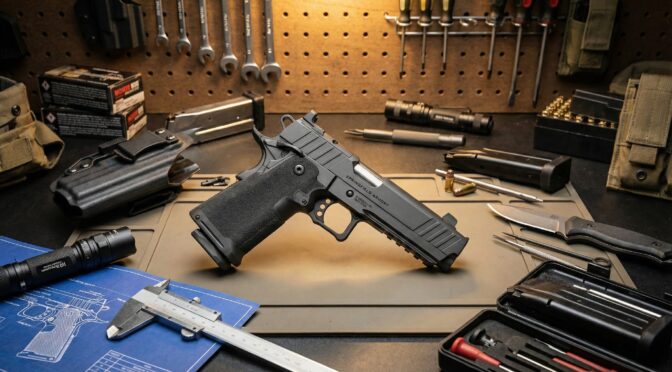
The modern small arms market has witnessed a distinct bifurcation in the last decade: the ubiquity of polymer-framed, striker-fired service pistols and the resurgent, specialized dominance of the 2011 platform—a double-stack evolution of John Moses Browning’s classic 1911 design. Historically, the 2011 architecture was gatekept by high costs and low production volumes, relegated to the holsters of USPSA Grand Masters and elite tactical units. Manufacturers such as STI (now Staccato), Infinity, and Atlas Gunworks dominated this space with units ranging from $2,500 to over $8,000. The introduction of the Springfield Armory 1911 DS Prodigy in late 2022 marked a strategic inflection point. By leveraging mass-production techniques and global supply chains (specifically manufacturing partnership with HS Produkt in Croatia), Springfield Armory attempted to democratize the platform, offering duty-grade capacity and single-action ergonomics at a price point roughly 40-50% lower than the segment leader.1
This report provides an exhaustive engineering and market analysis of the platform, tracing its trajectory from a turbulent initial release—marred by kinematic failures and quality control variances—to its current state in the 2024-2025 fiscal period. The analysis confirms that the “Gen 2” Prodigy, a colloquialism for units featuring substantial rolling engineering updates, represents a fundamentally different value proposition than the launch models. Through slide mass reduction, recoil spring rate optimization, and critical geometry revisions to the disconnector and feed ramps, Springfield Armory has addressed the primary vectors of failure.3
However, the platform remains a distinct product tier below the hand-fitted boutique options. It relies heavily on Metal Injection Molding (MIM) for ignition components, which introduces a variability factor in trigger feel and long-term durability that is absent in billet-machined competitors.4 Despite this, performance data indicates that the Prodigy’s mechanical accuracy is duty-grade, often sub-1 MOA with match ammunition, and its reliability in the current iteration is sufficient for defensive use following a verified break-in protocol.6 This report concludes that the Prodigy has successfully transitioned from a “project gun” to a viable duty platform, provided the end-user understands the maintenance and break-in requirements inherent to tight-tolerance steel firearms.
2. Introduction and Market Context
To fully appreciate the engineering decisions behind the Prodigy, one must contextualize its arrival within the broader “2011” landscape. The term “2011,” originally a trademark of STI International, refers to a modular frame system comprising a steel or aluminum upper receiver (sub-frame) and a polymer grip module. This design allows the use of wide-body magazines that taper to a single feed position, offering capacities of 17, 20, or even 26 rounds of 9mm, while retaining the crisp, linear trigger pull and optimized grip angle of the 1911.2
2.1 The “Post-Patent” Era
With the expiration of key patents surrounding the modular receiver design, the market opened to competitors. Springfield Armory’s entry was aggressive. Rather than targeting the competition sector, which tolerates high maintenance and finicky operation, Springfield targeted the “Tactical/Duty” and “Concealed Carry” sectors—markets accustomed to the “out-of-the-box” reliability of Glock or SIG Sauer. This created a friction point: 1911s generally require hand-fitting and tuning, processes that are antithetical to the high-volume, low-cost manufacturing model required to hit a $1,499 MSRP.9
2.2 The Gen 1 Stumble
The initial 2022 release of the Prodigy revealed the risks of applying mass-production tolerances to a platform that historically relies on hand-fitting. Early adopters reported high rates of Failure to Feed (FTF), Failure to Extract (FTE), and Failure to Return to Battery (FRTB). Industry analysis identified these not as fundamental design flaws, but as kinematic imbalances—specifically, a slide velocity that was insufficient to overcome the friction coefficients of the disconnector, the magazine feed lips, and the heavy Cerakote finish applied to the rails.3 The market perception quickly soured, labeling the Prodigy as a “kit gun” that required $500 in aftermarket parts to function reliably.
2.3 The Gen 2 Response
Springfield Armory’s response was not a formal recall or a distinct “Generation 2” marketing campaign, but rather a silent, aggressive implementation of “rolling changes” on the production line. These changes, observed in units with serial numbers generally exceeding 40,000 (though not officially delineated), addressed the physics of the cycling action directly. The introduction of the Comp models and the 3.5″ Compact in 2024/2025 served as the public debut for these internal engineering revisions.1
3. Architectural Engineering and Metallurgy
The Prodigy is built upon a foundation of materials that are, in many respects, superior to its immediate price-point competitors, though cost-cutting measures are evident in the small parts.
3.1 Receiver and Slide Construction: Forged vs. Cast
The primary structural component of the Prodigy is the receiver (frame). Unlike many budget 1911s or the Girsan Witness series which may utilize cast components or varying grades of steel, the standard 4.25″ and 5″ Prodigy models feature a forged steel receiver and a forged steel slide.2
Forging involves compressive forces that align the grain structure of the steel, significantly increasing its shear strength and resistance to impact fatigue compared to investment casting. In a high-round-count firearm, this prevents the stretching of frame rails and cracking at stress risers like the slide stop pin hole. The result is a heavy, inert platform. The unloaded weight of the 5-inch model approaches 33 ounces, which acts as a massive heat sink and recoil damper.12
For the 2025 3.5″ Compact model, Springfield transitioned the receiver material to forged 7075 aluminum.1 This decision was necessitated by the target demographic: concealed carry. Reducing the weight to 25.5 oz makes the pistol carry-neutral but fundamentally alters the recoil dynamics. Aluminum has a finite fatigue life compared to steel; however, modern alloys used in firearms (typically 7075-T6) usually exceed the operational lifespan of the barrel itself. The challenge with aluminum frames in the 1911 platform is the battering of the feed ramp by the steel follower of the magazine; Springfield utilizes ramped barrels to mitigate this, ensuring the projectile feeds directly into the steel chamber rather than striking the aluminum frame.1
3.2 The Polymer Grip Module: Harmonic Damping
The “DS” architecture relies on a polymer grip module that bolts to the steel receiver. This is not merely a capacity enabler; it is a structural component that influences shootability. The polymer used in the Prodigy is a high-impact, glass-reinforced nylon composite.
From a physics perspective, the polymer grip acts as a harmonic damper. When the slide impacts the frame at the rear of its stroke, a shockwave propagates through the gun. A steel grip (as found on high-end custom 2011s) transmits this high-frequency vibration directly to the shooter’s skeletal structure, which can induce fatigue over long courses of fire. The polymer module absorbs a portion of this high-frequency energy, resulting in a “softer” perceived recoil impulse.13 The “Adaptive Grip Texture” molded into the polymer is a wrap-around pattern designed to provide traction without the abrasive qualities of aggressive stippling or silicon carbide, striking a balance for carry against bare skin.2
3.3 Metallurgy of Small Parts: The MIM Controversy
The most contentious engineering decision in the Prodigy is the extensive use of Metal Injection Molding (MIM). To achieve the $1,499 price point, Springfield utilizes MIM for complex geometries that would be expensive to machine from billet.4
Identified MIM Components:
- Hammer: The impact surface and strut engagement points.
- Sear: The critical edge that holds the hammer at full cock.
- Disconnector: The component that disconnects the trigger from the sear during the cycle.
- Ambidextrous Safety Levers: The user interface for the manual safety.
- Slide Stop: The lever that locks the slide back.
- Magazine Release: The catch mechanism.4
Engineering Analysis of MIM:
MIM involves mixing fine metal powder with a binder, injecting it into a mold, and then sintering it at high heat to fuse the metal and remove the binder. Modern MIM can achieve 96-98% of the density of wrought steel. It is used successfully in aerospace and automotive connecting rods. However, in the 1911 application, the surface finish and hardness depth are critical.
- The Sear/Hammer Interface: A crisp 1911 trigger relies on a perfectly ground, sharp angle between the sear nose and the hammer hooks. MIM parts often have a slightly rounded edge from the molding process or require surface hardening that can be thin. Over time, or with poor quality control, the surface of a MIM sear can degrade, leading to a “mushy” trigger or, in catastrophic failure modes (though rare in modern production), hammer follow.
- The Disconnector Issue: The initial failure of the Prodigy was largely attributed to the MIM disconnector. In Gen 1 models, the head of the disconnector had a sharp, right-angled geometry.3 Because MIM parts can have slightly rougher surface finishes than polished tool steel, this sharp disconnector acted as a gouge or brake on the underside of the slide (the stripper rail). This parasitic friction robbed the slide of the velocity needed to chamber a round.
While MIM is not inherently “bad”—it is used in reliable pistols like Glocks and HKs—the 1911 architecture is less tolerant of the dimensional variances MIM can introduce compared to loose-tolerance striker-fired designs.
4. Kinematic Analysis: The Gen 2 Rolling Changes
The transition from the problematic launch models to the reliable current production units (2024-2025) is a case study in kinematic troubleshooting. The failure of the early Prodigy was a failure of energy management. The slide cycle is a closed energy loop: recoil energy pushes the slide back, compressing the spring; stored spring energy pushes the slide forward, stripping a round and locking into battery.
4.1 Slide Mass Reduction (The “Lightening” Update)
In 2024, analysts and gunsmiths began noting significant changes to the slide machining. Springfield introduced lightening cuts to the underside of the slide.3
- Specifics: Material was removed from both sides of the firing pin channel and extended from the ejection port to the muzzle mating surface.
- Mass Delta: These cuts removed approximately 0.9 oz from the reciprocating mass.3
Physics of the Change:
$$F = ma$$
By reducing the mass ($m$) of the slide, the recoil forces can accelerate ($a$) the slide to a higher velocity for the same given pressure curve. Furthermore, a lighter slide carries less momentum ($p=mv$) when impacting the frame, slightly reducing muzzle dip, but more importantly, it allows the slide to change direction faster. The reduction in mass was a critical tuning step to increase slide velocity, ensuring that the slide had enough kinetic energy to overcome the friction of the disconnector and the magazine spring pressure during the feed cycle.
4.2 The Disconnector Geometry Revision
Visual inspection of “Gen 2” disconnectors reveals a complete reprofiling.
- Gen 1: Sharp, square edges.
- Gen 2: Rounded, ball-nose profile with a polished finish.3
This geometrical change transforms the interaction between the disconnector and the slide’s stripper rail from a collision to a smooth displacement. By reducing the coefficient of friction ($\mu$) at this critical interface, Springfield eliminated the primary source of parasitic energy loss that was causing Failure to Return to Battery (FRTB).
4.3 Recoil Spring Rate Optimization
The Gen 1 Prodigy (especially the 5″ model) was widely criticized for being “undersprung.” It shipped with a recoil spring rated at approximately 9 lbs.16 In the world of 2011s, a 9lb spring is typically reserved for “Minor Power Factor” competition loads (light recoil, fast cycling) used on clean, lubricated guns. It is insufficient for a duty gun that may be fouled with carbon or running standard pressure defensive ammo.
The Update: Current production models and warranty returns are consistently fitted with 11lb to 12lb recoil springs.3
- Energy Storage: The heavier spring creates a greater restoring force ($F = -kx$). When the slide is at the rear, the 12lb spring exerts significantly more force to drive the slide forward.
- Feeding Reliability: The most difficult part of the cycle is stripping the top round from a fully loaded 20-round magazine, where the magazine spring tension is highest. The increased forward energy of the 12lb spring ensures the slide does not stall on the cartridge rim.
4.4 Integral Compensation (The “Comp” Models)
The 2024 introduction of the Prodigy Comp models brought a new variable to the kinematic equation. The Comp utilizes a port cut through the barrel and slide.11
- Gas Vectoring: Upon firing, expanding gases are vented upward before the bullet leaves the barrel. Newton’s Third Law dictates an equal and opposite reaction, pushing the barrel downward and counteracting muzzle rise.
- Backpressure Loss: Venting gas bleeds off pressure that would normally drive the slide rearward. To compensate for this, the Comp models require careful spring tuning. Springfield appears to have successfully balanced the spring rates, as reports indicate the Comp models cycle reliably with standard 115gr range ammo, which is often a struggle for compensated pistols.18
5. Performance Analysis
The theoretical engineering improvements must be validated by empirical performance data. The following section analyzes accuracy, reliability, and shootability based on instrumental testing and long-term endurance logs.
5.1 Mechanical Accuracy (Ransom Rest Protocol)
Despite the early reliability reputation, the Prodigy has consistently been praised for its barrel fit and accuracy. The bull barrel design, which eliminates the barrel bushing, provides a consistent lock-up at the muzzle, while the link system secures the breach.
Data aggregated from Ransom Rest testing—which secures the pistol in a machine vice to eliminate human error—demonstrates the platform’s capability. Testing was conducted at a distance of 25 yards.
Table 1: Springfield Prodigy 4.25″ Accuracy Data (25 Yards) 6
| Ammunition Brand/Load | Bullet Weight | Type | Smallest Group (in) | Average Group (in) |
| Federal American Eagle | 115 gr | FMJ | 0.70 | 1.02 |
| SIG V-Crown | 124 gr | JHP | 0.97 | 1.20 |
| Winchester Active Duty | 115 gr | Ball | 1.02 | 1.06 |
| Remington HTP | 147 gr | JHP | 1.10 | 1.27 |
| Federal Hydra-Shok Deep | 135 gr | JHP | 1.06 | 1.18 |
| Hornady Critical Defense | 115 gr | FTX | 1.50 | 2.06 |
Analysis:
The data reveals that the Prodigy is capable of sub-1-inch groups at 25 yards with specific ammunition (Federal American Eagle and SIG V-Crown). This performance is exceptional for a mass-produced handgun, rivaling custom firearms costing significantly more. The 5-inch model, with its longer sight radius (if using irons) and slightly longer dwell time, theoretically offers even greater stability, though the mechanical accuracy is primarily a function of the barrel-to-slide fit, which appears consistent across barrel lengths.
5.2 Reliability and Mean Rounds Between Stoppage (MRBS)
Reliability is the single most critical metric for the Prodigy given its history.
- The “Break-In” Factor: A consensus exists among high-volume shooters and engineers that the Prodigy requires a break-in period of approximately 200-500 rounds.10 This is largely due to the Cerakote finish. Unlike DLC or Nitride, which penetrate the metal, Cerakote is a sprayed-on ceramic layer that adds dimension (thickness). In tight-tolerance areas like the slide rails, this excess coating creates friction. The break-in period effectively laps the slide to the frame, wearing down the high spots of the Cerakote to create a smooth bearing surface.
- Gen 2 Reliability: Post-update models (Comp/Compact) demonstrate significantly higher reliability out of the box. The combination of the heavier springs and the polished/rounded disconnector allows the gun to power through the initial Cerakote friction that stalled earlier models.10
- Magazine Sensitivity: Long-term endurance tests (10,000 rounds) have highlighted that the magazines, rather than the gun, are often the weak link. The Duramag/Springfield magazines can accumulate carbon debris which increases follower friction, leading to failures to lock back on empty. Regular cleaning of magazine tubes is required to maintain high MRBS.7 Additionally, early magazines had rough feed lips that scratched brass; this has been polished in later batches.3
5.3 Recoil Impulse and “Shootability”
The “shootability” of the Prodigy—how easy it is to track the sights and fire rapid follow-up shots—is its primary market advantage over polymer striker-fired guns.
- 5″ Model: The heavy steel slide results in a slow, “loping” recoil impulse. The mass absorbs the snap, making it ideal for new shooters or precision work.
- 4.25″ Model: Cycles faster due to reduced mass. The recoil is snappier but the slide returns to battery quicker, preferred by aggressive shooters who drive the gun hard.
- Comp Model: The integral compensator significantly alters the physics. By forcing the muzzle down, it keeps the dot within the window of the optic during rapid fire. However, the blast noise and concussion are increased, which is a consideration for indoor use or home defense.18
6. The Optical Interface: Agency Optic System (AOS)
In the modern era, the red dot sight is the primary sighting system. Springfield Armory partnered with Agency Arms to develop the Agency Optic System (AOS), which is arguably the most robust plate system in the production 1911 market.
6.1 Engineering of the AOS
Unlike many “optic ready” systems that are mere cuts in the slide, the AOS is a comprehensive plate system machined from billet steel.1
- Rigidity: Because the plate is steel (matching the slide material), the thermal expansion coefficients are identical. This prevents the loosening of screws that can occur when mounting aluminum plates to steel slides during thermal cycling (heating up from firing).
- Integral Sights: The rear iron sight is machined directly into the optic plate. This ensures that the co-witness is preserved even if the optic is swapped.
- Footprint Versatility: The system supports RMR, DeltaPoint Pro, Shield RMSc, and Acro footprints. This future-proofs the gun, allowing the user to migrate to new optic standards (like the enclosed emitter trend) without machining the slide.
6.2 Comparison to Direct Milling
While direct milling (cutting the slide for a specific optic) offers the lowest possible mounting height and fewest failure points (screws), it locks the user into one footprint. The AOS sits slightly higher than a direct mill but lower than most competitor plate systems. The “Gen 2” production has also addressed issues with plates arriving loose; factory thread locker application appears to be more consistent.22
7. Competitive Landscape and Market Analysis
The Prodigy exists in a fiercely competitive “entry-level 2011” segment. It must fend off the premium incumbent (Staccato) while battling aggressive import challengers (Bul Armory, Girsan).
Table 2: Technical Specification & Market Comparison 13
| Feature | Springfield Prodigy (Gen 2) | Staccato P | Bul Armory SAS II TAC | Girsan Witness 2311 |
| Approx. Street Price | $1,350 – $1,500 | $2,500 – $2,600 | $1,750 – $1,900 | $900 – $1,000 |
| Frame Material | Forged Steel (Aluminum on Compact) | Forged Steel (or Aluminum) | Stainless Steel | Aluminum / Steel Upper |
| Grip Module | Polymer (Adaptive Texture) | Polymer (Proprietary Texture) | Polymer | Polymer |
| Ignition Parts | MIM (Sear, Hammer, Disconnector) | Billet / Tool Steel | Tool Steel / Machined | MIM / Cast Mix |
| Optic System | AOS (Agency Optic System) | Dawson Precision Plate | Direct Mount or Plate | RMSc Footprint (Direct) |
| Magazine Compatibility | Standard 2011 (Duramag) | Standard 2011 (Staccato) | Proprietary (Modified 2011) | Standard 2011 |
| Recoil System | 2-Piece Guide Rod (Tool req.) | Tool-less Guide Rod | Tool-less Guide Rod | Full Length Guide Rod |
| Warranty | Lifetime (High turnaround) | Lifetime (Premium) | 1 Year (Variable service) | Limited Lifetime |
7.1 Deep Dive: Staccato P vs. Prodigy
The Staccato P is the benchmark. It is the “control group” for reliability in the 2011 space.
- Quality Delta: The Staccato features a hand-lapped slide-to-frame fit and tool steel internals. This results in a trigger that is crisp, consistent, and durable over tens of thousands of rounds without degradation.23
- Value Equation: The Prodigy offers 90% of the shootability for 60% of the price. However, the “Staccato Tax” buys peace of mind. A Staccato runs out of the box. A Prodigy likely runs out of the box (in Gen 2) but may require tuning. For duty users where budget is secondary to absolute reliability, Staccato remains the choice. For users willing to tinker, the Prodigy is the smarter financial move.
7.2 Deep Dive: Bul Armory SAS II TAC
The Israeli-made Bul Armory is the “enthusiast’s choice.”
- The Trigger: Bul Armory is renowned for shipping guns with incredibly light, crisp triggers straight from the factory, often superior to stock Staccatos and far superior to the stock Prodigy.13
- The Flaw: The proprietary magazine. The SAS II uses a magazine geometry that is slightly different from the standard STI/2011 pattern. This means the user cannot share magazines with friends or utilize the vast ecosystem of MBX or Atlas magazines. Furthermore, supply chains from Israel can be sporadic, leading to parts droughts.27
7.3 Deep Dive: Girsan Witness 2311
The Girsan is the “budget floor.”
- Construction: While it offers the capacity, the refinement is lacking. The fit and finish are utilitarian, and the optic cut is often specific (RMSc) rather than a robust plate system like AOS. It is a “beater” gun, whereas the Prodigy is a “base for customization”.25 The Girsan utilizes a mix of cast and MIM parts that are generally considered lower quality than Springfield’s MIM.
8. The Customization Ecosystem
A significant portion of the Prodigy’s value lies in its potential. It is viewed by many as a “chassis” to be built upon. The widespread compatibility with standard 2011 parts makes it the “Glock of the double-stack world.”
8.1 Ignition Kit Upgrades
The most common upgrade is the replacement of the MIM ignition components. Companies like EGW (Evolution Gun Works), Atlas Gunworks, and Cylinder & Slide produce kits containing a hammer, sear, disconnector, and sear spring machined from tool steel.14
- Performance Gain: Installing an EGW kit can drop the trigger pull from the factory ~4.5-5.5 lbs to a crisp, glass-rod 2.5-3.0 lbs. It removes the “creep” associated with MIM surface imperfections.
- Durability: Tool steel parts hold their engagement angles longer, ensuring the trigger pull remains safe and consistent over high round counts.
8.2 Guide Rod Systems
The stock Prodigy uses a 2-piece guide rod which requires an Allen wrench to disassemble. A common complaint is that this rod can unscrew itself during firing if not properly torqued or Loctited.20
- The Upgrade: Users frequently swap this for a Tool-less Guide Rod from Dawson Precision or Atlas.29 These rods feature a lever that captures the spring, allowing for field stripping without tools—a critical capability for a duty or competition pistol.
8.3 Magazine Optimization
While the Prodigy ships with Duramag magazines (which have been improved in Gen 2 with polished feed lips), reliability can be maximized by using premium magazines.
- Atlas Gunworks Magazines: Known for perfect follower geometry and strong springs, these eliminate nosedive malfunctions.8
- MBX Extreme: The gold standard for competition, offering maximum capacity (up to 29 rounds in 170mm tubes) and reliability, albeit at a high cost (~$100+ per magazine).
- Staccato Gen 3: Fully compatible and widely available, these are a middle-ground upgrade for duty use.
9. Conclusion and Strategic Recommendations
The Springfield Armory Prodigy (Gen 2) represents a successful course correction in product lifecycle management. By identifying the kinematic root causes of the Gen 1 failures—specifically the friction-to-energy imbalance caused by the sharp disconnector, heavy Cerakote, and light springs—Springfield has engineered a platform that now delivers on its initial promise.
The “rolling changes” have transformed the gun from a gamble into a solid investment. The slide lightening cuts and 12lb recoil springs in the current production models ensure reliable cycling with defensive ammunition. The ball-nose disconnector removes the notorious “hangups.” The introduction of the Comp and Compact models shows a commitment to expanding the line to meet modern carry trends.
Is the Prodigy worth buying?
YES, in the following scenarios:
- The Enthusiast/Tinkerer: If the user is capable of minor gunsmithing (tuning extractor tension, swapping springs, polishing feed ramps), the Prodigy offers the highest value ceiling in the market. With ~$300 in aftermarket parts (EGW Ignition, Dawson Guide Rod), it can rival the performance of a $2,500 pistol.
- The Competitive Shooter (USPSA/IDPA): For Limited Optics or Carry Optics divisions, the heavy forged steel frame and bull barrel offer a massive stability advantage over polymer striker-fired guns. The accuracy potential (sub-1 inch at 25 yards) is more than sufficient for competitive play.
- The Budget-Conscious Duty User: It can be used for duty, but only after a verified 500-1,000 round break-in period and, ideally, the installation of a tool steel ignition kit to eliminate MIM failure points. The Gen 2 reliability is high, but the break-in is non-negotiable due to the Cerakote tolerances.
NO, in the following scenarios:
- The “Out-of-the-Box” Appliance User: If the user expects the maintenance-free, loose-tolerance reliability of a Glock immediately upon unboxing, the Prodigy is not the correct tool. It requires lubrication, break-in, and an understanding of 1911 mechanics.
- Zero-Tolerance for Warranty: If the user cannot tolerate the possibility (however reduced in Gen 2) of a warranty return trip to tune a tight extractor or ream a chamber. In this case, the premium for a Staccato is the price of guaranteed QC.
Final Verdict:
The Prodigy Gen 2 is the “working man’s 2011.” It bridges the chasm between the $500 polymer pistol and the $3,000 race gun. It is imperfect, relying on MIM parts to hit its price point, but it is structurally sound, accurate, and now, with the engineering updates, reliable enough to be taken seriously.
Appendix A: Methodology
This report was compiled using a multi-vector analysis approach to ensure technical accuracy and market relevance.
1. Data Collection:
- Primary Sources: Official press releases and technical specifications from Springfield Armory were utilized to establish baseline engineering data (materials, dimensions, spring rates).1
- Secondary Sources: Expert reviews from established industry publications (American Rifleman, Gun Tests, The Armory Life) were analyzed for empirical data, specifically Ransom Rest accuracy testing and chronograph results.6
- Tertiary Sources (Sentiment Analysis): User feedback was aggregated from high-traffic enthusiast forums (r/2011, 1911 Addicts) and long-term YouTube review logs. This provided longitudinal data on reliability over high round counts (5,000 – 10,000 rounds) and identified common failure points (magazines, MIM parts).3
2. Technical Verification:
- Claims regarding “Gen 2” updates were verified by cross-referencing visual evidence of internal part changes (lightening cuts, disconnector shape) provided by gunsmiths and end-users.3
- Kinematic theories (slide velocity vs. spring weight) were applied to the reported failure modes (FRTB) to deduce the root causes and validate the efficacy of Springfield’s engineering fixes.
3. Comparative Analysis:
- Competitor data (Staccato, Bul, Girsan) was standardized to create a “features-per-dollar” matrix, allowing for an objective value assessment.
4. Limitations:
- This analysis relies on reported data and visual inspection of media; physical metallurgical testing (Rockwell hardness testing) of the specific MIM components was not performed by the author.
- “Gen 2” is an industry colloquialism; Springfield Armory implements rolling changes, meaning specific serial number ranges for updates are not publicly defined.
If you find this post useful, please share the link on Facebook, with your friends, etc. Your support is much appreciated and if you have any feedback, please email me at in**@*********ps.com. Please note that for links to other websites, we are only paid if there is an affiliate program such as Avantlink, Impact, Amazon and eBay and only if you purchase something. If you’d like to directly contribute towards our continued reporting, please visit our funding page.
Sources Used
- New For 2025: Springfield Armory 1911 DS Prodigy 3.5″ Compact | An Official Journal Of The NRA – American Rifleman, accessed November 23, 2025, https://www.americanrifleman.org/content/new-for-2025-springfield-armory-1911-ds-prodigy-3-5-compact/
- 1911 DS Prodigy™ Handguns – Springfield Armory, accessed November 23, 2025, https://www.springfield-armory.com/1911-ds-series-handguns/1911-ds-prodigy-handguns/
- Springfield Prodigy 1911 DS recent production changes: lightened slide, heavier spring, polished mag, rounded edge – Reddit, accessed November 23, 2025, https://www.reddit.com/r/2011/comments/136y193/springfield_prodigy_1911_ds_recent_production/
- Springfield DS Prodigy Reliability and Performance Improvements – Complete Guide, accessed November 23, 2025, https://www.youtube.com/watch?v=ZnE4WZDVkoU
- Why do people think MIM parts are no good? | The Armory Life Forum, accessed November 23, 2025, https://www.thearmorylife.com/forum/threads/why-do-people-think-mim-parts-are-no-good.16510/
- Review: Springfield Prodigy 1911 DS AOS | An Official Journal Of …, accessed November 23, 2025, https://www.americanrifleman.org/content/review-springfield-prodigy-1911-ds-aos/
- Springfield Prodigy 10,000-Round Review – YouTube, accessed November 23, 2025, https://www.youtube.com/watch?v=StTXjM872V4
- Springfield Prodigy Magazine Upgrade with Atlas Premium Magazines, accessed November 23, 2025, https://atlasgunworks.com/blog/atlas-mags-for-progigy
- Continuous Precision Custom 1911 DS Prodigy – The Armory Life, accessed November 23, 2025, https://www.thearmorylife.com/continuous-precision-custom-1911-ds-prodigy/
- Springfield Prodigy still having issues? : r/liberalgunowners – Reddit, accessed November 23, 2025, https://www.reddit.com/r/liberalgunowners/comments/1jt2eds/springfield_prodigy_still_having_issues/
- Springfield Armory® Announces Launch of 1911 DS Prodigy™ Comp AOS 9mm Pistols, accessed November 23, 2025, https://www.springfield-armory.com/intel/press-releases/springfield-armory-announces-launch-of-1911-ds-prodigy-comp-aos-9mm-pistols/
- Springfield Prodigy Compact: Complete Guide to Features and Performance, accessed November 23, 2025, https://www.cyasupply.com/blogs/articles/springfield-prodigy-compact-complete-guide-to-features-and-performance
- Comparison of the Springfield DS Prodigy 4.25 and Bul Armory SAS II TAC 5, accessed November 23, 2025, https://ownguardsolutions.com/personal-safety/comparison-springfield-ds-prodigy-bul-armory-sas-ii-tac/
- Springfield Prodigy Upgrades & Performance Parts | EGW – Evolution Gun Works, accessed November 23, 2025, https://egwguns.com/springfield-prodigy-parts/
- Springfield Prodigy Disconnector Ramp – YouTube, accessed November 23, 2025, https://www.youtube.com/watch?v=2ZGKo6lbZ8k
- Springfield Prodigy Questions | Page 2 | The Armory Life Forum, accessed November 23, 2025, https://www.thearmorylife.com/forum/threads/springfield-prodigy-questions.12614/page-2
- Prodigy 5″Comp | The Armory Life Forum, accessed November 23, 2025, https://www.thearmorylife.com/forum/threads/prodigy-5-comp.22450/
- Springfield Adds Comp Version to Prodigy Pistol Lineup – Guns.com, accessed November 23, 2025, https://www.guns.com/news/2024/07/29/springfield-adds-prodigy-comp-version
- Springfield Armory 1911 DS Prodigy 4.25 AOS PH9117AOS 9mm …, accessed November 23, 2025, https://www.gun-tests.com/handguns/pistols/springfield-armory-1911-ds-prodigy-4-25-aos-ph9117aos-9mm-luger/
- Notes on making a Springfield Prodigy reliable and nice : r/2011 – Reddit, accessed November 23, 2025, https://www.reddit.com/r/2011/comments/xllh6a/notes_on_making_a_springfield_prodigy_reliable/
- Springfield Armory® 1911 DS Prodigy™ Takes On 10000-Round Torture Test, accessed November 23, 2025, https://www.springfield-armory.com/intel/press-releases/springfield-armory-1911-ds-prodigy-takes-on-10000-round-torture-test/
- Prodigy Round 2: Redemption? : r/2011 – Reddit, accessed November 23, 2025, https://www.reddit.com/r/2011/comments/17k0yl8/prodigy_round_2_redemption/
- Stacatto vs Springfield Prodigy…really worth the $? : r/2011 – Reddit, accessed November 23, 2025, https://www.reddit.com/r/2011/comments/13lgk1d/stacatto_vs_springfield_prodigyreally_worth_the/
- Compare Staccato P, Springfield Prodigy, and Bul Tac 425. – Boss Components, accessed November 23, 2025, https://www.bosscomponents.com.au/blogs/practical-shooting/comparative-analysis-staccato-p-vs-springfield-armory-prodigy-vs-bul-armory-tac-425
- A Closer Look at the New EAA Girsan Witness 2311 – Guns.com, accessed November 23, 2025, https://www.guns.com/news/2023/12/14/a-closer-look-at-the-new-eaa-girsan-witness-2311
- Staccato P, accessed November 23, 2025, https://staccato2011.com/products/staccato-p
- Bul Armory USA LLC’s Customer Service is IMO Terrible. : r/2011 – Reddit, accessed November 23, 2025, https://www.reddit.com/r/2011/comments/1bk1222/bul_armory_usa_llcs_customer_service_is_imo/
- SPRINGFIELD PRODIGY PARTS – Ben Stoeger Pro Shop, accessed November 23, 2025, https://benstoegerproshop.com/gun-parts/springfield-prodigy/
- Springfield Prodigy 5K round long-term review : r/CompetitionShooting – Reddit, accessed November 23, 2025, https://www.reddit.com/r/CompetitionShooting/comments/1c2ci2u/springfield_prodigy_5k_round_longterm_review/