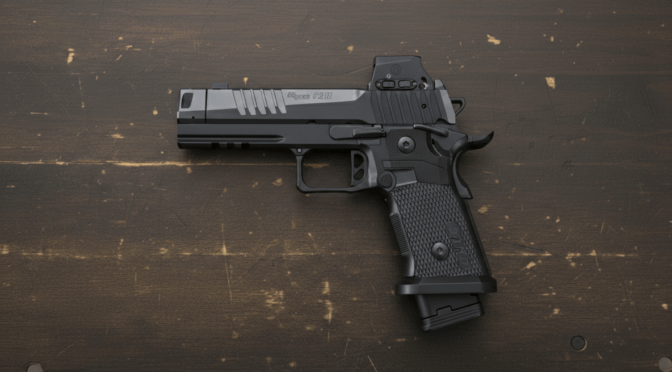
The introduction of the Sig Sauer P211 series represents a pivotal moment in the trajectory of the modern handgun market, signaling the definitive democratization of the high-performance “2011” platform. For decades, the double-stack 1911—a modular firearm architecture combining the crisp single-action trigger of the classic 1911 with a high-capacity magazine and separate grip module—was the exclusive domain of competitive shooting sports and high-end custom gunsmithing. Brands such as STI International (now Staccato), Infinity, and Atlas Gunworks dominated this niche, creating instruments of precision that commanded prices ranging from $4,000 to over $8,000. These systems, while performant, were historically plagued by magazine unreliability and maintenance requirements that precluded them from widespread duty or tactical adoption.
The Sig Sauer P211 fundamentally disrupts this paradigm through three strategic engineering choices: the utilization of the ubiquitous P320 magazine ecosystem, the application of industrial-scale additive manufacturing for recoil mitigation, and an aggressive pricing strategy that undercuts the market incumbent, the Staccato XC, by nearly $2,000.1 This report finds that the P211 GTO, the flagship compensated model, achieves near-parity in recoil management and shootability with platforms costing significantly more, leveraging a proprietary “Mach3D” Inconel compensator to virtually eliminate muzzle rise.2
However, the platform’s entry into the market has not been without significant engineering friction. A critical material selection failure regarding the recoil spring plug—a component subjected to intense shear and impact forces—led to catastrophic failures in early production units, necessitating an immediate aftermarket and factory response.5 Furthermore, the platform’s industrial design, characterized by a utilitarian and somewhat disjointed aesthetic, has polarized the enthusiast community, sparking debate regarding the balance between form and function.7
Despite these teething issues, the P211 establishes a new baseline for value in the performance handgun sector. By decoupling the “race gun” experience from the bespoke price tag and the unreliable legacy magazine architecture, Sig Sauer has created a product that serves as a bridge between the polymer striker-fired duty world and the elite single-action competition world. This report provides a granular analysis of the platform’s engineering, market positioning, operational performance, and long-term viability.
2. Market Genesis: The Convergence of Duty and Competition
To understand the significance of the P211, one must first contextualize the shifting landscape of the handgun market. For the past forty years, the dichotomy between “duty” and “competition” firearms was rigid. Duty weapons, epitomized by the Glock 17 and later the Sig P320, prioritized reliability, low weight, and cost-effectiveness, typically utilizing polymer frames and striker-fired actions with pull weights in the 5-6 pound range. Competition weapons, conversely, utilized steel frames, hammer-fired actions with sub-2 pound triggers, and hand-fitted tolerances to maximize speed and accuracy, often at the expense of reliability in harsh environments.
2.1 The “Duty 2011” Phenomenon
This dichotomy began to erode in the late 2010s. Law enforcement agencies, facing increasingly complex engagement scenarios and a decline in recruit marksmanship scores, began seeking firearm platforms that offered “mechanical advantages”—specifically, the forgiveness of a lighter, shorter trigger and the recoil absorption of a heavier frame. The Staccato P (formerly the STI Tactical) became the pioneer in this space, securing approval from over 1,500 law enforcement agencies, including the prestigious US Marshals SOG.9 This proved that the 2011 platform could be hardened for duty use.
This shift created a “Blue Ocean” market opportunity. A significant demographic of civilian shooters, influenced by the tactical-competition crossover, began demanding the shooting characteristics of a 2011 without the fragility of a pure competition gun. However, the barrier to entry remained high: the average “reliable” 2011 cost north of $2,500, and magazines cost $70-$100 each.
2.2 Sig Sauer’s “Trojan Horse” Strategy
Sig Sauer’s entry into this arena is not merely a reaction but a calculated logistics play. The primary weakness of the traditional 2011 platform is not the gun, but the magazine. The legacy STI-pattern magazine was originally designed for the.38 Super cartridge and adapted for 9mm, leading to decades of reliability issues necessitating “tuning” of feed lips.
The P211 leverages the P320 magazine.1 This is the platform’s “Trojan Horse.”
- Logistical Ubiquity: Following the US Military’s adoption of the M17/M18 (a variant of the P320), the P320 magazine has become one of the most common magazines in the world.
- Geometry: The P320 magazine was designed from the ground up for the 9mm Luger cartridge with modern tapered geometry, offering superior reliability with varied projectile profiles compared to the straight-walled legacy 2011 tubes.
- Economic Impact: By utilizing a magazine that retails for ~$35-$45 (and can be found for less) versus the ~$75-$100 standard for 2011 magazines, the P211 significantly lowers the long-term cost of ownership.1 For an agency or a competitor requiring 10+ magazines, this represents a savings of over $500 in support gear alone.
3. Technical Architecture: The Chassis and Slide
The P211 is not a “clone” of the 1911 in the strictest sense; it is a modernization of the architecture that incorporates manufacturing efficiencies and modularity lessons learned from the P320 program. The construction methodology reflects a hybrid approach, blending the solid steel feel of a classic firearm with the modular versatility of modern manufacturing.
3.1 Frame and Grip Module Construction
The chassis system is the foundation of the P211’s recoil management characteristics. Unlike the P320, which uses a polymer grip module housing a steel Fire Control Unit (FCU), the P211 follows the 2011 architecture of a two-part frame.
- Upper Receiver (Frame): The serialized component is a full-length stainless steel frame.10 This is a critical distinction from lighter polymer competitors. On the GTO and GT5 models, this frame features a full-length dust cover (the portion of the frame extending under the barrel). This design choice places significant non-reciprocating mass at the most forward point of the pistol possible. In physics terms, this increases the moment of inertia against muzzle flip, passively stabilizing the weapon before the slide even begins to cycle.9
- Lower Grip Module: In a departure from the entry-level 2011 norm (e.g., the Springfield Prodigy or standard Staccato P which use polymer grips), the P211 GTO and Equinox models utilize a precision-engineered alloy grip module.15 This metal-on-metal construction creates a rigid, dense feel in the hand that is typically associated with custom pistols costing north of $5,000. This rigidity eliminates the “flex” found in polymer grips, ensuring that all recoil energy is transmitted linearly rather than being dissipated unpredictably.
- Grip Panels: The alloy module accommodates interchangeable G10 grip panels.9 This allows the end-user to customize the texture aggressiveness and grip circumference without replacing the entire module—a feature common on single-stack 1911s but rare on double-stacks, which usually feature permanently molded textures.
3.2 The SIG-LOC Optic System
The slide of the P211 is engineered for the modern era of electro-optics. It features the SIG-LOC PRO footprint.18
- Mechanical Interface: The SIG-LOC system is engineered to address the shearing forces exerted on optic screws during slide cycling. It utilizes five points of contact—two recoil bosses, the front and rear of the optic cut pocket, and the screws themselves—to isolate the optic body from reciprocal motion.19
- Multi-Footprint Compatibility: A recurring frustration in the handgun market is the proliferation of proprietary optic cuts. The SIG-LOC PRO footprint is designed with native support for the Sig Romeo-X and Romeo1Pro, but crucially, also accommodates the Leupold DeltaPoint Pro (DPP) and Trijicon RMR footprints.20 While RMR mounting requires a filler plate and specific 6-40 screws to ensure reliability, the fact that the slide does not require milling or permanent modification to accept the three most common professional optic standards is a significant flexibility advantage for agencies and competitors with mixed inventories.
4. Propulsion and Recoil Management: The Mach3D Compensator
The defining feature of the P211 GTO, and its primary claim to technical superiority over similarly priced competitors, is the Mach3D Compensator.4 This component is not merely a ported barrel or a machined weight; it is a showcase of Sig Sauer’s investment in advanced manufacturing.
4.1 Additive Manufacturing Application
The Mach3D compensator is manufactured using Direct Metal Laser Sintering (DMLS), a form of 3D printing, likely utilizing Inconel or a high-strength precipitating-hardening stainless steel superalloy. DMLS allows for the creation of internal geometries—specifically curved internal gas channels and expansion chambers—that are physically impossible to create using traditional subtractive CNC machining.4
4.2 Fluid Dynamics and Gas Vectoring
The operational principle of the Mach3D differs from traditional “baffle” compensators. Traditional comps work by simply trapping expanding gas against a flat vertical surface (a baffle) to pull the gun forward. The Mach3D utilizes a more complex vectoring system:
- Dual Lower Chambers: The design features a “dual lower chamber” architecture.4 High-pressure gas following the bullet is diverted into these chambers.
- Vectoring: The internal geometry redirects over 80% of this gas. A portion is vented vertically through top ports to exert a downward force on the muzzle (counteracting the primary torque moment). Uniquely, the Mach3D also vents gas laterally (to the sides) through optimized ports. This lateral venting acts to stabilize the horizontal torque often induced by the shooter’s grip biomechanics.4
- Outcome: Sig Sauer claims a 45% reduction in muzzle rise compared to a standard pistol. Independent reviewers corroborate this, describing the recoil impulse as “flat” and noting that the dot of the optic barely leaves the window during rapid fire.2
4.3 Compliance and Integration
Mechanically, the compensator attaches to the 4.4″ bull barrel via a proprietary lug or taper system, not traditional threads.1 This is a critical design choice for the US market. By avoiding a threaded barrel, the P211 GTO remains legal in jurisdictions that ban threaded barrels as “assault weapon” features (e.g., California, New York, subject to roster approval), broadening its addressable market.
5. Fire Control and Human Interface
The “interface” of the weapon—the trigger, the safeties, and the controls—is where the 2011 platform traditionally shines. Sig Sauer’s approach here balances the crispness required for competition with the safety redundancies required for duty, a compromise that has sparked discussion among purists.
5.1 Series 80 vs. Series 70 Architecture
The P211 utilizes a modified Series 80 action.20 In 1911 nomenclature, a “Series 70” action relies solely on the manual safety and grip safety, offering the cleanest possible trigger break as there is no mechanical linkage interfering with the sear. A “Series 80” action incorporates a firing pin block—a plunger in the slide that physically prevents the firing pin from moving forward unless the trigger is depressed.
- Duty Necessity: For a modern duty pistol, drop safety is non-negotiable. Agencies and departments will rarely approve a single-action pistol without a firing pin block. By choosing Series 80, Sig ensures the P211 is eligible for departmental rosters.20
- Trigger Characteristics: The trade-off is often a heavier or “grittier” trigger pull due to the extra linkage lifting the plunger. However, reports indicate that the P211 manages this well. The factory trigger is a straight-pull, flat-faced skeletonized shoe breaking between 3.5 and 4.0 lbs.23 While some reviewers note a slight “grit” compared to hand-polished $6,000 custom guns, it is described as “crisp” and superior to any striker-fired option.20
5.2 The Recoil Spring Plug Failure Analysis
Despite the robust engineering of the frame and compensator, the P211 launch was marred by a critical failure in the slide assembly, specifically regarding the Recoil Spring Plug (also known as the Reverse Plug).
In early production units of the GTO, Sig Sauer utilized a polymer (plastic) or Metal Injection Molded (MIM) component for the recoil spring plug.5
- Engineering Context: In a reverse-plug system common to bull-barrel pistols, this plug captures the recoil spring against the slide. During the cycling operation, specifically when the slide returns to battery, this plug impacts the frame dust cover (or guide rod head depending on design) and arrests the spring’s forward energy. It is a high-stress node subjected to repetitive impact and shear forces.
- Failure Mode: Under the high slide velocities inherent to compensated 9mm pistols (where the comp delays unlocking but the slide still moves violently), the shoulder of the polymer plug proved insufficient. Users reported the shoulder shearing off, causing the recoil spring to launch out the front of the gun or bind the slide, resulting in a “catastrophic failure” that rendered the weapon inoperable.5
- Root Cause: This appears to be a material selection error, likely a weight-saving or cost-saving measure that failed to account for the peak dynamic loads of the system.
- Remediation: The aftermarket responded almost instantly. Companies like Fdez Werx, Aquila Arsenal, and Dawson Precision released CNC-machined stainless steel and aircraft-grade aluminum plugs.25 Sig Sauer subsequently acknowledged the issue implicitly by overnighting metal replacement plugs to affected customers and phasing the plastic part out of production.27
Critical Advisory: Potential buyers of the P211 must inspect this component immediately. If the plug is black polymer, it is a liability and must be replaced with a steel component prior to serious use.
6. The P211 Variant Ecosystem
Sig Sauer has rapidly expanded the P211 SKU list to cover distinct market segments. This segmentation suggests a desire to dominate not just the “tactical” niche but also the concealed carry and competition markets where compensators may be restricted.
6.1 P211-GTO (The Flagship)
- Intended Role: Open/Limited Optics Competition, Tactical SWAT.
- Configuration: 4.4″ Bull Barrel + Mach3D Compensator (Total length approx. 5.0″ slide equivalent).
- Distinguishing Features: Fiber optic front sight, standard magwell. This is the “speed” model designed for maximum split times.16
6.2 P211-GTO Combat
- Intended Role: Law Enforcement Duty, Home Defense.
- Configuration: Identical mechanicals to the GTO.
- Distinguishing Features: Coyote Brown frame/grip with Black slide (two-tone). Ships with XRAY3 Night Sights instead of fiber optics, prioritizing low-light visibility over competition precision. The finish is reportedly more durable to withstand holster wear.16
6.3 P211-GTO Equinox
- Intended Role: Collector, BBQ Gun.
- Configuration: Custom Works aesthetic package.
- Distinguishing Features: Polished slide flats (two-tone steel), Nickel-plated controls, and custom “GridLOK” G10 grip panels. Mechanically identical to the GTO but commands a premium price for the finish work.30
6.4 P211-GT4 and GT5 (The Non-Compensated Line)
Launched at SHOT Show 2026, these models address specific regulatory and competition rulebook constraints (e.g., IDPA divisions where comps are prohibited).14
- P211-GT5 (Full Size): Features a 5.0″ Bull Barrel and a full-length dust cover. Without the compensator, recoil management relies on static weight. The 5″ slide offers a longer sight radius for iron sight shooters and increased velocity.32
- P211-GT4 (Carry): Features a 4.2″ Bull Barrel and a carry-length dust cover. It utilizes a low-profile magwell to reduce printing (concealability). This model is positioned as a direct competitor to the Staccato C2 or CS.33
- Suppressor Readiness: A key advantage of the GT line is the standard barrel configuration. Unlike the integrated comp of the GTO, the GT models can theoretically accept aftermarket threaded barrels, making them the only viable P211 hosts for sound suppressors.33
7. Operational Performance Analysis
7.1 Recoil Impulse and “Flatness”
The primary value proposition of the P211 GTO is its shooting behavior. In high-speed photography analysis and user testing, the Mach3D compensator demonstrates remarkable efficiency.
- Vertical Displacement: Compared to a standard 9mm service pistol (e.g., Sig P320 or Glock 17), the P211 GTO exhibits a 30-45% reduction in muzzle flip.4
- Dot Tracking: For users of red dot sights, this translates to the dot never leaving the window of the optic during recoil. This allows for “predictive” shooting rather than “reactive” shooting, where the shooter waits for the sight to settle.
- Comparison: Independent side-by-side testing against the market benchmark, the Staccato XC ($4,300), reveals that the P211 GTO is functionally indistinguishable in terms of muzzle rise.2 While the Staccato action feels “slicker” when racked by hand due to hand-lapping of rails, the live-fire experience is effectively identical for 99% of shooters.
7.2 Accuracy and Precision
The P211 utilizes a bull barrel system, where the barrel lockup is achieved via the barrel’s expanded diameter at the muzzle fitting tightly into the slide, eliminating the need for a barrel bushing. This system typically enhances consistency.
- Bench Results: Testing with match-grade ammunition (Wilson Combat) has yielded 1.5-inch groups at 25 yards.20 This level of precision is well beyond the mechanical requirements of defensive shooting and qualifies the pistol for upper-echelon competition use.
- Practical Accuracy: The light, crisp SAO trigger facilitates the practical application of this inherent accuracy, making difficult shots (e.g., A-zone hits at 50 yards) significantly easier for the average shooter compared to striker-fired platforms.
7.3 Reliability and the “Break-In”
Like many tight-tolerance metal firearms, the P211 is not “loose” out of the box.
- Break-In Period: Reviewers and users consistently report a mandatory break-in period of approximately 200 rounds.20 During this phase, the mating surfaces of the slide and frame rails burnish together.
- Spring Tuning: The pistol ships with two recoil springs: a heavy “duty” spring installed and a lighter “competition” spring in the box. Users shooting standard 115gr range ammunition often experience short-stroking (failure to eject or feed) with the heavy spring during the break-in. The solution is to either swap to the lighter spring or use 124gr NATO/147gr ammunition for the first 200 rounds.20 Once broken in, the system is reported to run reliably with diverse ammunition types.
8. Competitive Landscape
The P211 disrupts the market by attacking the price-performance gaps of its competitors.
8.1 P211 GTO ($2,400) vs. Staccato XC ($4,300)
The Staccato XC is the gold standard for compensated 2011s.
- The Delta: The XC features an “island barrel” comp (cut into the slide), a DLC finish, and exquisite hand-fitting. The P211 uses a threadless attached comp and mass-production finishes (Nitron).
- The Verdict: The P211 delivers 95% of the performance for 55% of the price. The XC is a luxury item; the P211 is a workhorse. For the price difference, a user can buy the P211, a top-tier optic (Romeo-X), a weapon light (SureFire X300), a holster, and 2,000 rounds of training ammunition.
8.2 P211 GTO ($2,400) vs. Springfield Prodigy ($1,500)
The Prodigy attempted to bring the 2011 to the masses but stumbled with quality control (MIM parts failure, tight chambers).
- The Delta: To make a Prodigy run reliably often requires $500+ in aftermarket parts (Ignition kit, extractor, tuning). The P211 (post-plug fix) is reliable out of the box. Additionally, the P211 includes a compensator and magwell, features absent on the base Prodigy.
- The Verdict: The P211 is a superior turnkey solution. The Prodigy remains viable only as a “project gun” chassis for gunsmiths.
9. Customer Sentiment and Aesthetic Reception
9.1 The “Ugly” Debate
A significant portion of online discourse surrounds the P211’s industrial design.
- The Criticism: The transition between the slide and the compensator, the aggressive and blocky slide serrations, and the abrupt lines of the dust cover have been described as “disjointed” and “ugly” by traditionalists.7 It lacks the classic Browning lines of a 1911.
- The Counterpoint: Supporters argue that form follows function. The blocky design adds necessary weight, and the aesthetics are consistent with Sig’s modern “techno-industrial” language seen in the MCX Spear.
9.2 The “P210” Identity Crisis
Sig Sauer’s naming convention—P211—invoked comparisons to the legendary P210, a single-stack pistol renowned for Swiss-watch precision and elegance.
- The Disappointment: Enthusiasts hoped for a “Double Stack P210″—a gun with the P210’s unique internal slide rails and exquisite trigger mechanism. Instead, the P211 is mechanically a 2011 (external rails, 1911 lockwork). This created a sentiment of “marketing betrayal” among collectors who felt the P210 name was used solely for brand cachet rather than mechanical lineage.31
10. Conclusion
The Sig Sauer P211 series is a landmark release that alters the economics of the performance handgun market. It effectively bridges the chasm between the $600 duty polymer pistol and the $5,000 custom race gun. By leveraging the P320 magazine ecosystem, Sig Sauer has removed the single greatest logistical barrier to 2011 adoption, making the platform viable for high-volume shooters and agencies alike.
Technically, the Mach3D compensator is a triumph of manufacturing, delivering recoil mitigation that rivals the best in the world. However, the recoil spring plug failure serves as a stark reminder that even advanced engineering can be undermined by poor material selection on a $0.30 part.
Final Verdict:
- Buy: For the competitor or tactical enthusiast who wants Staccato XC performance but cannot justify the $4,300 price tag. The P211 GTO is the best “value” in the high-performance segment today.
- Mandatory Action: Budget $40 immediately for a stainless steel recoil spring plug. Do not trust the factory polymer plug.
- Pass: For the aesthete or collector who values the classic lines of a 1911. The P211 is a tool, not a piece of art.
Appendix A: Methodology
Research Scope:
This report aggregates and synthesizes data from 129 discrete research snippets sourced from diverse media channels within the firearms industry. The data collection period covers the initial launch window of the P211 GTO through the subsequent release of the Combat, Equinox, GT4, and GT5 models.
Data Sources & Classification:
- Primary Technical Documentation: Official specifications were derived from Sig Sauer product pages, operator manuals, and press releases to establish baseline data for dimensions, weight, and features.16
- Independent Performance Testing: Live-fire performance data (accuracy, reliability, recoil impulse) was sourced from credible third-party reviewers including The Firearm Blog, Recoil Web, and independent video analysts.2
- User Failure Reports: Reliability data, specifically regarding the recoil spring plug, was aggregated from user reports on forums (Reddit r/SigSauer, Brian Enos Forums) and verified against aftermarket manufacturer product announcements which confirmed the specific failure mode.5
- Sentiment Analysis: Qualitative assessment of aesthetics and market reception was derived from high-engagement social media threads and comment sections to gauge the “voice of the customer”.7
Analytical Approach:
- Cross-Reference Validation: Claims of reliability were cross-referenced; for example, a “flawless” review from a sponsored influencer was balanced against forum reports of break-in failures to determine the “200 round break-in” consensus.
- Engineering First Principles: Mechanical failures (MIM plug) were analyzed through first-principles engineering (shear stress on polymer vs. steel) rather than simply reporting the failure, providing context on why it occurred.
If you find this post useful, please share the link on Facebook, with your friends, etc. Your support is much appreciated and if you have any feedback, please email me at in**@*********ps.com. Please note that for links to other websites, we are only paid if there is an affiliate program such as Avantlink, Impact, Amazon and eBay and only if you purchase something. If you’d like to directly contribute towards our continued reporting, please visit our funding page.
Sources Used
- SIG Finally Did It: The P211-GTO is SIG’s 2011 Pistol – YouTube, accessed January 25, 2026, https://www.youtube.com/watch?v=IcLGv3u0A-o
- Why Sig’s New 2011 is a Problem [SIG P211 Review] – YouTube, accessed January 25, 2026, https://www.youtube.com/watch?v=oZ6nsY3alZs
- Staccato XC vs Sig Sauer P211 Comparison – YouTube, accessed January 25, 2026, https://www.youtube.com/watch?v=WFZqNM9Ri_I
- The Mach3D Compensator | SIG SAUER – YouTube, accessed January 25, 2026, https://www.youtube.com/watch?v=4J_D-EdVTjQ
- SIG P211 GTO CATASTROPHIC FAILURE : r/handguns – Reddit, accessed January 25, 2026, https://www.reddit.com/r/handguns/comments/1p1bguf/sig_p211_gto_catastrophic_failure/
- SIG P211 GTO CATASTROPHIC FAILURE – $$$ Gun Destroyed by 30¢ Plastic Part | Watch Before You Buy – YouTube, accessed January 25, 2026, https://www.youtube.com/watch?v=OppCixcZrgM
- Not as ugly as the first pic looked. Still kind of ugly. : r/2011 – Reddit, accessed January 25, 2026, https://www.reddit.com/r/2011/comments/1lelvz8/not_as_ugly_as_the_first_pic_looked_still_kind_of/
- P211-GTO : r/2011 – Reddit, accessed January 25, 2026, https://www.reddit.com/r/2011/comments/1le4491/p211gto/
- SIG SAUER P211: Serious Retro-Future P211-GTO [REVIEW] – Recoil Magazine, accessed January 25, 2026, https://www.recoilweb.com/sig-sauer-p211-gto-review-190149.html
- P211-GTO – Sig Sauer, accessed January 25, 2026, https://www.sigsauer.com/p211-gto.html
- SIG Sauer P211-GTO: Revolutionary Double-Stack 1911 Innovation – Black Basin Outdoors, accessed January 25, 2026, https://blackbasin.com/news/sig-sauer-p211gto-revolutionary-doublestack-1911-innovation/
- Two New P211-GTO Pistols. One Unmatched Standard. – FOG HORN, accessed January 25, 2026, https://twobirdsflyingpub.com/2025/12/11/two-new-p211-gto-pistols-one-unmatched-standard/
- SIG P211-GTO for Sale | Buy Online at GunBroker, accessed January 25, 2026, https://www.gunbroker.com/sig-p211-gto/search?keywords=sig%20p211-gto&s=f&cats=3026
- SIG SAUER P211 GT4 & GT5 | New Double-Stack 1911 Performance Pistols, accessed January 25, 2026, https://www.sigsauer.com/blog/sig-sauer-introduces-the-p211-gt4-and-gt5
- Sig Sauer P211 GTO 9mm Luger Pistol 4.4 Barrel 10+1 Round Nitron Slide – MidwayUSA, accessed January 25, 2026, https://www.midwayusa.com/product/1028753374
- P211-GTO COMBAT – Sig Sauer, accessed January 25, 2026, https://www.sigsauer.com/p211-gto-combat.html
- SIG SAUER P211 GTO SAO Full-Size Pistol | Cabela’s, accessed January 25, 2026, https://www.cabelas.com/p/sig-sauer-p211-gto-sao-full-size-pistol
- SIG Sauer SIG-LOC Handgun Optic Mounting – Optics Force, accessed January 25, 2026, https://opticsforce.com/blogs/news/sig-sauer-sig-loc-handgun-optic-mounting
- SIG-LOC™ Mounting Interface | SIG SAUER Electro-Optic Innovation, accessed January 25, 2026, https://www.sigsauer.com/sig-loc
- TFB Review: SIG P211 – 5,000 Rounds Later | thefirearmblog.com, accessed January 25, 2026, https://www.thefirearmblog.com/blog/tfb-review-sig-p211-5-000-rounds-later-44823619
- Best Holosun Red Dot Sights for the Sig Sauer P211 + How to Mount with – Freedom Gorilla, accessed January 25, 2026, https://freedomgorilla.com/blogs/news/best-holosun-red-dot-sights-for-the-sig-sauer-p211-how-to-mount-with-filler-plates
- Staccato HD P4.5 vs Sig p211 GTO : r/Staccato_STI – Reddit, accessed January 25, 2026, https://www.reddit.com/r/Staccato_STI/comments/1n13yer/staccato_hd_p45_vs_sig_p211_gto/
- Sig Sauer P211-GTO – Xtreme Guns And Ammo, accessed January 25, 2026, https://xtremegunsandammo.com/shop/pistols/sig-sauer-pistols-for-sale/sig-sauer-p211/sig-sauer-p211-gto/
- P211 issues : r/SigSauer – Reddit, accessed January 25, 2026, https://www.reddit.com/r/SigSauer/comments/1nqktw3/p211_issues/
- Replacement Spring Plug/Reverse Plug for Sig P211-GTO, Aircraft Aluminum, by Dawson Precision, accessed January 25, 2026, https://dawsonprecision.com/replacement-spring-plug-reverse-plug-for-sig-p211-gto-aircraft-aluminum-by-dawson-precision/
- P211 Stainless Steel guide rod plug – Fdez Werx, accessed January 25, 2026, https://fdezwerx.com/p211-stainless-steel-guide-rod-plug/
- SIG CALLED! Broken P211 GTO Getting Replacement Part Tomorrow – YouTube, accessed January 25, 2026, https://www.youtube.com/shorts/TROiWGuZ6eo
- SIG gave me a metal plug! : r/P211_GTO – Reddit, accessed January 25, 2026, https://www.reddit.com/r/P211_GTO/comments/1q9k7ig/sig_gave_me_a_metal_plug/
- POTD: P211-GTO Equinox & Combat: SIG’s Custom Works Goes To Action, accessed January 25, 2026, https://www.thefirearmblog.com/blog/potd-p211-gto-equinox-combat-sigs-custom-works-goes-to-action-44824444
- P211-GTO EQUINOX – Sig Sauer, accessed January 25, 2026, https://www.sigsauer.com/p211-gto-equinox.html
- [SHOT 2026] SIG Sauer Introduces Additional P211 Options! | thefirearmblog.com, accessed January 25, 2026, https://www.thefirearmblog.com/blog/shot-2026-sig-sauer-introduces-additional-p211-options-44825746
- SIG Sauer unveils the P211-GT4 and P211-GT5 pistols | all4shooters, accessed January 25, 2026, https://www.all4shooters.com/en/shooting/pistols/sig-sauer-p211-gt4-and-p211-gt5/
- SIG Sauer Will Release the P211 GT4 & GT5 Non-Comped Pistols – Blog.GritrSports.com, accessed January 25, 2026, https://blog.gritrsports.com/new-sig-sauer-p211-gt4-gt5-non-comped-pistols/
- I just want a damn doublestack P210 : r/SigSauer – Reddit, accessed January 25, 2026, https://www.reddit.com/r/SigSauer/comments/1les58y/i_just_want_a_damn_doublestack_p210/
- SIG SAUER P211®, accessed January 25, 2026, https://www.sigsauer.com/media/sigsauer/resources/OPERATORS_MANUAL_P211_5100230-01_REV_00_WEB_FILE.pdf