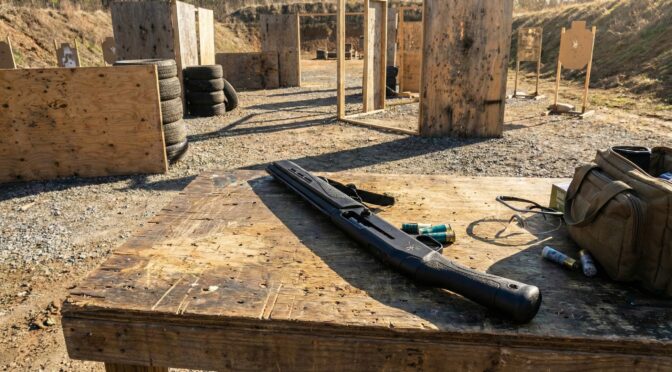
The introduction of the Mafteah by Israel Weapon Industries (IWI) US represents a calculated expansion of the company’s portfolio into the specialized “Non-NFA Firearm” market segment. Historically dominated by pump-action platforms such as the Mossberg 590 Shockwave and Remington 870 Tac-14, this category has recently evolved toward semi-automatic operation, driven by consumer demand for higher rates of fire and reduced manual operation under stress. The Mafteah, distinct in its engineering, enters this space not merely as a competitor but as a technological pivot point, challenging the prevailing gas-operated orthodoxy established by the Remington V3 Tac-13 and the newly released Mossberg 990 Aftershock.
This comprehensive analysis evaluates the Mafteah through the dual lenses of small arms engineering and market dynamics. Technically, the platform utilizes a short-recoil operating system with the return spring situated concentrically around the magazine tube.1 This design choice is critical; it eliminates the need for a receiver extension (buffer tube) found in AR-pattern shotguns or standard inertia systems like the Benelli M4, thereby enabling the compact “bird’s head” grip configuration essential for maintaining the sub-28-inch overall length while preserving a 14-inch barrel.3 The engineering trade-off for this mechanical simplicity and cleanliness is a distinct sensitivity to ammunition selection, favoring high-velocity defensive loads over low-dram equivalent target loads.4
Market analysis indicates that the Mafteah is positioned as a premium “prosumer” option. With an MSRP of approximately $1,000 and a street price hovering near $920, it undercuts high-end tactical imports while commanding a premium over Turkish-manufactured clones.2 Customer sentiment has been cautiously optimistic, with high praise directed at the integrated Glock MOS optics cut—a feature that addresses the chronic height-over-bore issues plaguing this class of firearm.6 However, the platform has faced early Quality Assurance (QA) challenges, specifically regarding the retention of furniture under the intense harmonic vibration characteristic of recoil-operated 12-gauge systems.6
The report concludes that the IWI Mafteah serves a specific operational niche: it is an optimal solution for users requiring a compact, low-maintenance defensive tool for vehicle or home defense, provided they adhere to a strict diet of full-power ammunition. It is less suitable for recreational shooters seeking a “plinker” for light loads, for whom gas-operated competitors offer superior versatility.
1. Introduction: The Evolution of the Compact Smoothbore
The genesis of the IWI Mafteah cannot be understood without first dissecting the unique legal and tactical landscape that necessitated its creation. In the United States, the classification of firearms is governed by the National Firearms Act (NFA) of 1934 and the Gun Control Act (GCA) of 1968. These statutes created rigid definitions for “shotguns,” “pistols,” and “rifles,” leaving a narrow regulatory interstices for weapons that fit none of these traditional descriptions.
1.1 The “Firearm” Classification and the Shockwave Doctrine
Under federal law, a “shotgun” is defined as a weapon designed or redesigned, made or remade, and intended to be fired from the shoulder. Consequently, a smoothbore weapon that is manufactured without a stock—and has never had a stock attached—cannot be legally classified as a shotgun.3 Furthermore, if such a weapon possesses an overall length (OAL) greater than 26 inches, it is not considered “concealable on the person,” and therefore does not fall under the “Any Other Weapon” (AOW) category, which would require a $5 tax stamp and registration.
This legal syllogism gave rise to the “Shockwave” class of firearms. By combining a 14-inch barrel with an elongated “bird’s head” grip, manufacturers could produce a 12-gauge weapon with an OAL of roughly 26.5 inches that required no NFA paperwork. For years, this segment was dominated by pump-actions. However, the manual operation of a pump-action without a stock presents significant ergonomic challenges; the user must cycle the action violently while supporting the weapon solely with their wrists, leading to “short-stroking” under stress.
1.2 The Semi-Automatic Imperative
The limitations of pump-action “firearms” created a market vacuum for semi-automatic variants. A semi-auto action absorbs a portion of the recoil energy to cycle the bolt, ostensibly reducing the impulse transmitted to the shooter’s wrist and eliminating the risk of short-stroking.6 Remington attempted to fill this void with the V3 Tac-13, utilizing their Versa Max gas system. However, the subsequent bankruptcy of Remington and the inconsistent availability of the Tac-13 left the market open.7
IWI US, recognizing this gap, introduced the Mafteah in 2025. Unlike their previous shotgun offering, the Tavor TS12—a complex, high-capacity bullpup designed for maximum firepower—the Mafteah was designed for maximum compactness and mechanical simplicity.8 It represents a strategic pivot for IWI, moving from specialized military bullpups into the broader American home defense market with a platform that is ostensibly simpler, lighter, and more adaptable to the modern optic-centric doctrine of usage.
2. Comprehensive Engineering Analysis
The IWI Mafteah is distinguished from its peers not by its aesthetic, which closely mirrors the industry-standard “black tactical” motif, but by its internal operating mechanism. While competitors like the Mossberg 990 Aftershock and Remington V3 rely on gas operation, the Mafteah utilizes a form of recoil operation.1 This decision dictates every aspect of the weapon’s performance, from its maintenance cycle to its recoil impulse.
2.1 Operating System Kinematics: Recoil vs. Inertia
The terminology used in IWI’s technical documentation describes the system as “recoil operated” with a “recoil spring around the magazine tube”.1 To the small arms engineer, this warrants precise disambiguation, as “recoil operation” can refer to distinct mechanical principles.
Long Recoil (The Auto-5 Paradigm):
Historically, the most famous shotgun with a spring around the magazine tube is the Browning Auto-5. In this “Long Recoil” system, the barrel and bolt recoil together for the full length of the cartridge. The barrel then returns forward, ejecting the shell, followed by the bolt returning to chamber a new round. This system is robust but produces a complex “double-shuffle” recoil impulse and involves significant reciprocating mass.
Inertia Operation (The Benelli Paradigm):
Modern “Inertia” systems (Benelli/Breda) utilize a floating bolt carrier that remains stationary relative to the gun during the initial moment of recoil. The rearward movement of the gun compresses a stiff spring inside the bolt carrier, which then rebounds to unlock the bolt. This system is cleaner and lighter but typically requires a recoil spring housed in the stock (the “rat tail”), which is impossible in a stockless “bird’s head” firearm without a receiver extension.
The Mafteah Hybrid Solution:
The Mafteah appears to utilize a Short Recoil or Hybrid Inertia system. By placing the return spring around the magazine tube rather than in a stock extension, IWI engineers solved the critical packaging problem of the “Non-NFA Firearm.” There is no buffer tube protruding from the rear of the receiver, allowing for the flush-fit installation of the pistol grip.1
- Operational Cycle: Upon firing, the kinetic energy of the recoil forces the bolt carrier group rearward. The spring encircling the magazine tube is compressed. Unlike gas systems, there are no ports in the barrel to bleed off pressure. This means the propellant gases remain entirely behind the wad and exit the muzzle, keeping the action essentially free of carbon fouling.
- Dwell Time and Reliability: The 14-inch barrel presents a challenge for this system. In a recoil/inertia gun, the system needs a specific amount of resistance (the “inertia weight”) and time to cycle. The short barrel reduces the “dwell time” (the time the shot is in the barrel generating recoil force). To compensate, the springing must be tuned aggressively, which explains the platform’s preference for high-velocity ammunition.
2.2 Receiver Architecture and the Optic Interface
The receiver of the Mafteah is machined from aluminum, likely a 7075-T6 alloy, providing a balance of strength and weight savings.2 However, the most significant innovation in the receiver design is the integration of the optics mount.
The Height-Over-Bore Problem:
Traditional shotgun receivers are drilled and tapped for a Picatinny rail. Mounting a red dot sight on top of a rail raises the optical axis significantly above the bore axis. On a stocked shotgun, the user can raise the comb of the stock to achieve a cheek weld. On a stockless “firearm” like the Mafteah, the user cannot rest their cheek on anything. A high optic forces the shooter to “float” their head in space, leading to inconsistent sight acquisition and slower follow-up shots.
The MOS Solution:
IWI machined a cut directly into the top of the receiver compatible with Glock MOS adapter plates.2 This lowers the optic by several millimeters, bringing it closer to the plane of the barrel rib.
- Implication: This allows the shooter to maintain a more natural alignment. It also reduces the weapon’s vertical profile, making it easier to store in compact spaces or vehicle racks. The decision to use the Glock MOS footprint is strategic; it instantly grants the Mafteah compatibility with the vast majority of micro-red dots (RMR, Holosun, Shield) already on the market without requiring proprietary IWI mounts.
2.3 Barrel Metallurgy and Ballistics
The Mafteah employs a 14-inch smoothbore barrel constructed from 4140 Chrome-Moly steel.1
- Material Choice: 4140 steel is the industry standard for high-pressure barrels due to its excellent tensile strength and resistance to heat-induced deformation. In a 14-inch barrel, the pressure curve of a 12-gauge shell is still near its peak when the wad exits the muzzle. The barrel must withstand violent pressure spikes, particularly with 3-inch magnum loads.
- Ballistics of the 14-inch Tube: Users must be aware that a 14-inch barrel results in a slight velocity loss compared to an 18.5-inch standard barrel. However, in 12-gauge terminal ballistics, this loss is negligible for defensive ranges (0-25 yards). The spread of the shot pattern (unless choked) will be wider at shorter distances, necessitating a cylinder bore choke optimized for buckshot. The Mafteah is cylinder choked 3, which is ideal for slugs and buckshot but poor for bird hunting—consistent with its tactical categorization.
2.4 Ergonomics and User Interface
The “furniture”—the stock and forend—is constructed from reinforced polymer.
- Forend Design: The forend features M-LOK slots, a modern necessity for mounting weapon lights.1 Crucially, it includes an integrated hand strap.3 In a recoil-operated semi-automatic, the forend does not move (unlike a pump). The strap is a safety feature to prevent the support hand from slipping in front of the muzzle during rapid fire, but it also serves a recoil management function, allowing the shooter to apply forward tension.
- Controls: The charging handle is reversible, and the safety is a cross-bolt type located in the trigger guard.1 While the cross-bolt safety is a traditional, arguably outdated design compared to an AR-style thumb safety, it is familiar to shotgun users. The reversible charging handle is a significant ergonomic win, acknowledging that in a stockless configuration, users may need to manipulate the bolt with their dominant or non-dominant hand depending on their “push-pull” grip technique.6
3. Operational Performance Evaluation
The theoretical engineering capabilities of the Mafteah translate into a distinct operational profile in the field. Analysis of user reports and independent testing reveals a weapon that is high-performing within its design envelope but unforgiving outside of it.
3.1 Reliability and Ammunition Sensitivity
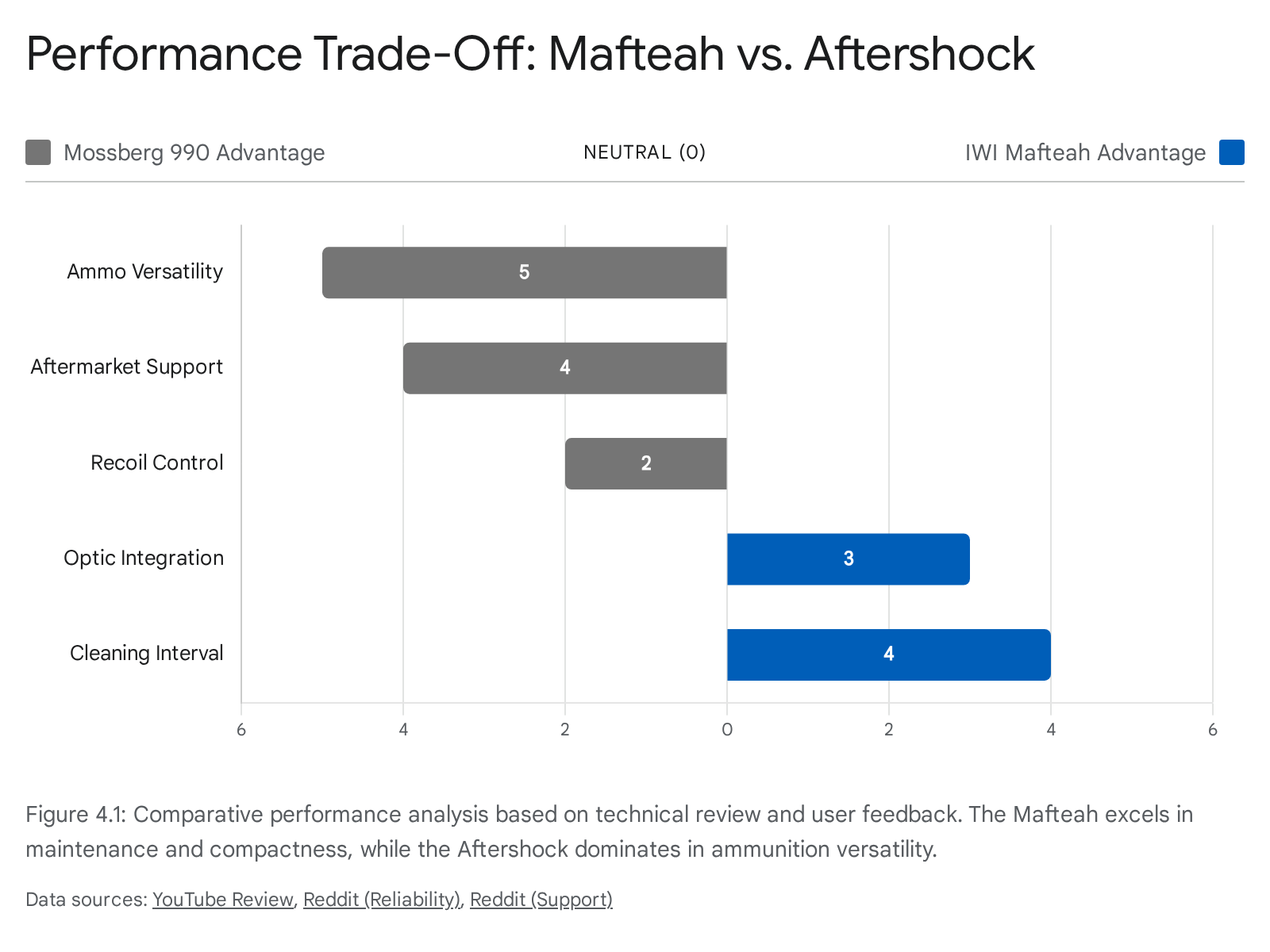
The single most critical differentiator between the Mafteah and its primary competitor, the gas-operated Mossberg 990 Aftershock, is ammunition tolerance.
The Physics of Failure:
Gas systems are self-regulating; they bleed gas to cycle the piston. If a load is light (low pressure), the system can often still scavenge enough gas to cycle. Inertia/Recoil systems rely on the equal and opposite reaction of the projectile accelerating.
- Heavy Loads: With 3-inch magnums or high-velocity defensive buckshot (1300+ fps), the Mafteah cycles violently and reliably. The recoil impulse provides ample energy to compress the heavy action spring.6
- Light Loads: With “trash” birdshot or low-recoil target loads (sub-1100 fps), the Mafteah often fails to cycle. The rearward energy is insufficient to fully compress the spring and strip the next round from the magazine.4
- Operational Consequence: This makes the Mafteah a poor choice for high-volume recreational shooting with cheap ammunition. It is a duty weapon that demands duty ammunition.
The Cleanliness Advantage:
Conversely, the lack of a gas system means the Mafteah runs exceptionally clean. Gas guns blow carbon and unburnt powder directly into the action, necessitating cleaning intervals of approximately 500 rounds to maintain reliability.4 The Mafteah, sealing the gas in the barrel, can run for thousands of rounds without significant carbon buildup in the receiver. This is a massive logistical advantage for a defensive weapon that may sit in a cruiser or safe for months between cleanings.
3.2 Recoil Management Dynamics
Recoil in a sub-6-pound 12-gauge is, by the laws of physics, substantial.
- Subjective Experience: Users report that the semi-automatic action “soaks up” recoil compared to a locked-breech pump action.6 The movement of the bolt carrier spreads the recoil impulse over a longer duration (milliseconds), transforming a sharp “kick” into a smoother “shove.”
- Rate of Fire: Testing indicates that competent shooters can achieve split times (time between shots) of approximately 0.8 seconds with the Mafteah, matching the performance of gas-operated competitors.4 This rapid follow-up capability is the primary tactical advantage of the platform over the pump-action Shockwave.
3.3 Durability and Harmonic Vibration
A concerning trend identified in early adopter reports is the loosening of components due to harmonic vibration.6
- The Issue: Recoil-operated guns vibrate intensely. Reports cite furniture (handguards) and internal latches coming loose within the first 50 rounds.
- The Mitigation: This suggests that the factory assembly torque or thread-locking compound application may be insufficient on early production units.
- Engineering Context: This is not a catastrophic design flaw but a quality control (QC) escape. It necessitates a “pre-flight” inspection by the user: applying Blue Loctite to non-captive screws is a mandatory step for ensuring reliability in this platform.
4. Market Analysis and Competitive Landscape
The Mafteah enters a crowded and highly competitive market. To determine its value, we must compare it directly against the incumbents: the Mossberg 990 Aftershock, the legacy Remington V3 Tac-13, and the budget-tier Turkish imports.
4.1 Competitive Data Matrix
The following data summarizes the key specifications and operational characteristics of the primary contenders in the “Non-NFA Firearm” semi-automatic category.
| Feature | IWI Mafteah | Mossberg 990 Aftershock | Remington V3 Tac-13 | Black Aces Pro Series S |
| Operating System | Recoil / Inertia Hybrid | Gas Operated | Gas Operated (Versa Max) | Gas / Inertia clones |
| Barrel Length | 14.0″ | 14.75″ | 13.0″ | 14.0″ |
| Overall Length | 27.75″ | 27.5″ | 26.5″ | 26.5″ |
| Weight (Empty) | 5 lbs 11 oz | ~6.5 lbs | ~6 lbs | ~5.5 lbs |
| Capacity | 5+1 (2.75″) | 5+1 (2.75″) | 5+1 | 4+1 or 5+1 |
| Optic Mount | Direct Cut (Glock MOS) | Drilled Receiver / Rail | Drilled Receiver / Rail | Rail |
| Maintenance | Low (Runs Clean) | High (Gas fouling) | Moderate (Self-cleaning gas) | Variable |
| Ammo Appetite | Picky (Likes Heavy Loads) | Versatile (Eats All) | Versatile | Hit or Miss |
| Approx. Price | ~$920 – $1,000 | ~$900 – $1,120 | Discontinued / High Secondary | ~$400 |
| Source | 1 | 10 | 7 | 13 |
4.2 Competitor Deep Dive
Mossberg 990 Aftershock (The Gas Contender):
The Mossberg 990 is the primary rival. Its gas system allows it to cycle virtually any ammunition, including the trendy “mini-shells” (1.75-inch shells) that offer higher capacity and lower recoil.4 This makes the 990 superior for recreational use. However, the gas system introduces complexity and fouling. A user who neglects to clean the 990 after a heavy range session risks malfunctions—a liability in a defensive firearm. The Mafteah, while pickier about ammo, is more forgiving of maintenance neglect.
Remington V3 Tac-13 (The Fallen King):
The V3 Tac-13 was widely regarded as the best-in-class for recoil mitigation due to the Versa Max gas system, which uses gas ports in the chamber to self-regulate based on shell length.14 However, following the dissolution of Remington Outdoor Company, the availability of the Tac-13 has become sporadic under the new “RemArms” ownership, and prices on the secondary market have skyrocketed.7 The Mafteah offers a warrantied, currently-produced alternative that fills the same role.
Turkish Imports (The Budget Option):
Firearms like the Black Aces Tactical Pro Series compete on price ($300-$400). However, metallurgical analysis and user reports often cite inconsistent heat treatment of stress-bearing parts (locking blocks, extractors) leading to premature failure.6 For a professional or defensive user, the $600 premium for the IWI Mafteah purchases superior Israeli metallurgy (4140 steel) and rigorous quality assurance protocols, reducing the probability of catastrophic failure at a critical moment.
5. Customer Sentiment and Quality Assurance
A critical component of this analysis is the aggregation of “Voice of the Customer” data. This data provides insights into the ownership experience that laboratory testing often misses.
5.1 The “Fun Factor” vs. Expectation Management
Sentiment regarding the Mafteah is heavily bifurcated based on user expectations.
- The Informed User: Buyers who understand the limitations of inertia/recoil systems (i.e., the need for high-velocity ammo) report high satisfaction. They praise the weapon’s lightweight handling, the “snappy” cycling, and the intelligent integration of the MOS cut.6 These users view the Mafteah as a specialized tool and use it accordingly.
- The Casual User: Buyers expecting a “do-it-all” shotgun that can cycle cheap birdshot in the backyard often report frustration with Failure to Eject (FTE) malfunctions. This negative sentiment is not a reflection of mechanical failure, but of a mismatch between product design and user application. IWI’s marketing must clearly communicate the ammunition requirements to mitigate this sentiment.
5.2 The “Proprietary Part” Friction
A significant source of negative sentiment is the proprietary nature of the Mafteah’s rear receiver geometry.
- The Issue: Many American gun owners enjoy modifying their weapons. The Mossberg 590 platform has decades of aftermarket support (stocks, braces, adapters). The Mafteah, utilizing a unique receiver cut to eliminate the buffer tube, is currently incompatible with existing aftermarket stocks.16
- Implication: Users who wish to legally register the Mafteah as a Short Barreled Shotgun (SBS) and add a stock are currently limited by a lack of options. The market is waiting for IWI or third-party manufacturers (like Magpul or Mesa Tactical) to release compatible stock adapters. Until then, the weapon is “locked” into its pistol-grip configuration, which limits its appeal to the “tactical builder” demographic.18
5.3 QA Incidents: The Loose Furniture Phenomenon
As noted in the engineering section, the issue of furniture loosening has appeared in multiple user reports.6
- Specifics: Users have reported the forend becoming loose and the action bars binding due to screws backing out under recoil.
- Analysis: This is a classic “teething issue” for a new platform. It indicates that the harmonic vibrations of the recoil action were perhaps underestimated in the final assembly protocols.
- Resolution: IWI Customer Service has been responsive, issuing Return Material Authorizations (RMAs) and fixing the issues promptly.6 However, for a premium product, the expectation is that the weapon should not require a factory trip within the first 50 rounds. This is a reputational risk IWI must address through tightened assembly line QC.
6. Tactical Application Scenarios
Defining the “use case” is essential for determining the value of the Mafteah. It is not a general-purpose shotgun; it is a specialized instrument.
6.1 Home Defense in Confined Spaces
The primary utility of the Mafteah is home defense within the architectural constraints of modern housing.
- Maneuverability: A standard 18.5-inch shotgun has an overall length of nearly 40 inches. The Mafteah, at 27.75 inches, is dramatically easier to maneuver through doorways, around corners, and in narrow hallways.3
- One-Handed Operation: In a home defense scenario, the user may need one hand to open a door, hold a phone, or herd family members. A pump-action firearm requires two hands to cycle the action. The semi-automatic Mafteah allows the user to fire effectively (albeit with significant recoil) with one hand if absolutely necessary.
- Optics Advantage: The MOS cut allows the user to keep a red dot sight always on (with modern battery life) and acquire a sight picture instantly in low light, without the parallax issues of a high-mounted optic.
6.2 Vehicle Operations (“Truck Gun”)
The “Firearm” classification allows the Mafteah to be carried loaded in vehicles in jurisdictions where loaded long guns (rifles/shotguns) are prohibited.
- Compact Storage: Its short length and lack of a bulky stock allow it to fit in discreet bags or under seats.
- Durability: The parkerized/anodized finish and polymer furniture are resistant to the temperature fluctuations and humidity found in vehicle environments.
- Cleanliness: Its ability to sit for months without lubrication migrating or carbon hardening (unlike a gas gun) makes it an excellent “set it and forget it” emergency tool.
7. Conclusion and Recommendation
The IWI Mafteah is a triumph of specific engineering over general utility. It is not designed to be the “everyman’s shotgun.” Instead, it is a tool designed for a specific set of tactical problems: compactness, cleanliness, and optical integration.
The Verdict:
The Mafteah is a BUY for the professional or serious defensive user who understands the physics of the platform. It offers a unique combination of semi-automatic firepower in a package that requires no NFA tax stamp, all while maintaining the high metallurgical standards associated with Israeli weapons manufacturing.
Buyer Profile Recommendations:
- Ideally Suited For:
- Home Defense: Users needing a compact weapon for tight interiors who prioritize maneuverability.
- Vehicle Carry: Users needing a robust, low-maintenance firearm for mobile security.
- Optics Users: Shooters who intend to utilize a red dot sight and value a low height-over-bore.
- High-Power Ammo Users: Those willing to stick to standard velocity buckshot and slugs.
- Not Suited For:
- Recreational Plinkers: Users wanting to shoot cheap birdshot or mini-shells will find the platform unreliable compared to the Mossberg 990.
- Modders: Users who want to immediately customize stocks and grips will find the current aftermarket support lacking.
- Recoil Shy: While softer than a pump, the recoil of a 5.5lb 12-gauge is still significant and requires proper technique to manage.
Final Engineering Assessment:
The Mafteah’s “spring-over-tube” recoil system is an elegant solution to the packaging constraints of the “Non-NFA Firearm.” It allows for a robust, clean-running action without the bulk of a buffer tube. While it lacks the ammunition versatility of a gas system, its mechanical simplicity and rugged construction make it a superior choice for a dedicated defensive implement, provided the user performs the requisite break-in and fastener checks.
Appendix A: Research Methodology
1. Objective
The objective of this report was to conduct a rigorous, multi-faceted analysis of the IWI Mafteah firearm platform. The goal was to synthesize technical engineering data, market positioning strategies, and raw customer sentiment to provide a definitive “Buy/No-Buy” recommendation for professional peers in the small arms industry.
2. Data Collection Strategy
To ensure the analysis was not swayed by marketing bias, a triangulation method was employed, sourcing data from three distinct tiers:
- Tier 1: Primary Manufacturer Data. Official technical manuals 19, product specification pages 1, and press releases were analyzed to establish the “baseline claims” of the product (e.g., weight, materials, operating system).
- Tier 2: Expert & Industry Analysis. Reports from established industry publications such as American Rifleman 3 and GunsWeek 2 were reviewed to validate feature sets and provide historical context regarding the “Non-NFA” classification.
- Tier 3: User Sentiment & Field Reports. Unfiltered user feedback was harvested from high-traffic enthusiast forums (Reddit r/IWI_Firearms, r/Shotguns) and video review comment sections.6 This tier was critical for identifying real-world failure points (e.g., loose furniture, ammo sensitivity) that are rarely mentioned in curated reviews.
3. Analytical Framework
- Kinematic Analysis: The “Recoil Operated” claim was deconstructed by comparing the described mechanism (spring over tube) with known historical designs (Browning Auto-5, Benelli M4) to accurately classify the system’s behavior (Short Recoil/Inertia Hybrid).
- Sentiment Coding: User comments were coded into categories: “Reliability” (FTE/FTF), “Ergonomics” (Grip, Strap), and “Quality Control” (Loose parts). Trends were identified based on the frequency of these codes.
- Comparative Matrix: A direct comparison was constructed against key competitors (Mossberg 990, Remington V3) using objective metrics (OAL, Weight, Capacity) and subjective metrics (Recoil impulse, maintenance needs).
4. Limitations
- Long-Term Durability Data: As the Mafteah is a 2025 release, data regarding high-round-count durability (5,000+ rounds) is currently sparse. The analysis relies on the known material properties of 4140 steel and aluminum to project likely durability.
- Sample Size: The number of detailed field reports is lower than for legacy platforms.
- QA Variance: The report assumes the “loose furniture” issue is a batch-specific QC issue rather than a systemic design flaw, based on the ease of the fix (Loctite).
5. Verification
All legal claims regarding the classification of the firearm were cross-referenced with current ATF definitions of “Shotgun,” “Firearm,” and “AOW” to ensure the advice provided is legally sound within the United States.
If you find this post useful, please share the link on Facebook, with your friends, etc. Your support is much appreciated and if you have any feedback, please email me at info@roninsgrips.com. Please note that for links to other websites, we are only paid if there is an affiliate program such as Avantlink, Impact, Amazon and eBay and only if you purchase something. If you’d like to directly contribute towards our continued reporting, please visit our funding page.
Sources Used
- MAFTEAH 12GA Shotgun Series | IWI US, accessed December 19, 2025, https://iwi.us/firearms/mafteah-shotgun-series/
- IWI Mafteah, new Israeli-American 12-gauge “firearm” | GUNSweek.com, accessed December 19, 2025, https://gunsweek.com/en/shotguns/news/iwi-mafteah-new-israeli-american-12-gauge-firearm
- New For 2025: IWI Mafteah | An Official Journal Of The NRA – American Rifleman, accessed December 19, 2025, https://www.americanrifleman.org/content/new-for-2025-iwi-mafteah/
- The IWI Mafteah Vs. The Mossberg Aftershock – YouTube, accessed December 19, 2025, https://www.youtube.com/watch?v=XGVXl4jAIxg
- IWI US Mafteah Semi Automatic 12 Ga Shotgun 14 Black Barrel Black – MidwayUSA, accessed December 19, 2025, https://www.midwayusa.com/product/1028576526
- Mafteah QA/QC issues / Review : r/IWI_Firearms – Reddit, accessed December 19, 2025, https://www.reddit.com/r/IWI_Firearms/comments/1nyajg2/mafteah_qaqc_issues_review/
- Remington V3 TAC-13 Review + Photos [2025] – Gun Made, accessed December 19, 2025, https://www.gunmade.com/remington-v3-tac-13-review/
- IWI Expands Smoothbore Portfolio with 2025 Mafteah Release – Black Basin Outdoors, accessed December 19, 2025, https://blackbasin.com/news/iwi-expands-smoothbore-portfolio-with-2025-mafteah-release/
- MAFTEAH 12Ga 14″ – IWI US, accessed December 19, 2025, https://iwi.us/firearms/mafteah-shotgun-series/mafteah-12ga-14/
- 990 AfterShock™ – Others – Firearms O.F. Mossberg & Sons, accessed December 19, 2025, https://www.mossberg.com/firearms/others/990-aftershock.html
- Mossberg 990 Aftershock 12 Gauge Semi-Automatic with 14 Inch Barrel, accessed December 19, 2025, https://www.sportsmansoutdoorsuperstore.com/products2.cfm/ID/338699/83001/mossberg-990-aftershock-12-gauge-semi-automatic-with-14-inch-barrel
- Remington V3 TAC-13 for Sale | Buy Online at GunBroker, accessed December 19, 2025, https://www.gunbroker.com/remington-v3-tac-13/search?keywords=remington%20v3%20tac-13&s=f
- What do we know about Black Aces tactical ? : r/Shotguns – Reddit, accessed December 19, 2025, https://www.reddit.com/r/Shotguns/comments/1kofx0z/what_do_we_know_about_black_aces_tactical/
- Gas vs. Inertia: Which Semiauto Shotgun is Best? – Outdoor Life, accessed December 19, 2025, https://www.outdoorlife.com/story/guns/gas-vs-inertia-which-semiauto-shotgun-is-best/
- Remington TAC-13 : r/WAGuns – Reddit, accessed December 19, 2025, https://www.reddit.com/r/WAGuns/comments/1lvs5pc/remington_tac13/
- I sent IWI questions about the Mafteah. This was its response. : r/IWI_Firearms – Reddit, accessed December 19, 2025, https://www.reddit.com/r/IWI_Firearms/comments/1k6g465/i_sent_iwi_questions_about_the_mafteah_this_was/
- Mafteah : r/IWI_Firearms – Reddit, accessed December 19, 2025, https://www.reddit.com/r/IWI_Firearms/comments/1l580lx/mafteah/
- If THE bill passes… what semi-auto shotgun for SBS? | Sniper’s Hide Forum, accessed December 19, 2025, https://www.snipershide.com/shooting/threads/if-the-bill-passes%E2%80%A6-what-semi-auto-shotgun-for-sbs.7261297/
- MAFTEAH Shotgun – IWI, accessed December 19, 2025, https://iwi.us/wp-content/uploads/2025/05/IWI-Mafteah-Manual-V5.21.25.pdf