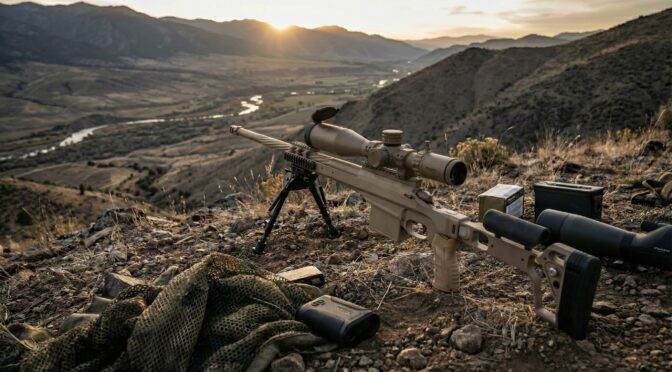
The global landscape of precision infantry weapons has undergone a radical transformation over the past two decades, driven largely by the shift from symmetrical, cold-war era doctrines to the asymmetric demands of the Global War on Terror (GWOT). Within this volatile context, the Canadian-made PGW Defence Technologies C14 Timberwolf emerged as a definitive platform, bridging the ballistic gap between standard 7.62x51mm NATO systems and heavy.50 BMG anti-materiel rifles. Officially designated as the C14 Medium Range Sniper Weapon System (MRSWS) by the Canadian Armed Forces (CAF), the Timberwolf was procured to extend the lethality of infantry snipers beyond the 1,200-meter threshold—a requirement necessitated by the engagement distances encountered in the mountainous terrain of Afghanistan.
This report delivers a comprehensive industry analysis of the C14 Timberwolf ecosystem. It examines the platform through the dual lenses of engineering efficacy and market viability. Technically, the C14 is distinguished by its proprietary helical-fluted bolt architecture, cryogenic-treated metallurgy, and a unique titanium cantilever bedding system that offers exceptional zero-retention under high-g force impacts. Ballistically, the integration of the.338 Lapua Magnum cartridge represented a quantum leap in kinetic energy transfer and effective range compared to its predecessor, the Parker-Hale C3A1.
Market analysis reveals a complex user sentiment profile. While the C14 is universally lauded for its ruggedness and sub-MOA precision, it currently occupies a precarious position in the procurement cycle. The recent selection of the Sako TRG M10 (designated C21) to replace the C14 highlights a broader industry trend away from dedicated, single-caliber receivers toward modular, multi-caliber chassis systems that offer superior logistical flexibility. Despite this, the C14 remains a viable, high-value asset for specific end-users—namely, civilian extreme long-range (ELR) enthusiasts seeking military-grade durability without the premium price tag of modular competitors, and defense clients requiring a simplified, dedicated long-action platform.
The following report dissects the C14’s engineering anatomy, operational history, competitive standing, and investment value. It concludes that while the era of the dedicated.338 service rifle is waning in tier-one military units, the C14 Timberwolf endures as a benchmark of purpose-built precision engineering, offering distinct advantages in stability and simplicity that continue to command respect in the specialized small arms market.
1.0 Strategic Overview and Procurement Heritage
To fully appreciate the technical nuances of the C14 Timberwolf, one must first understand the doctrinal void it was designed to fill. The evolution of sniper warfare in the late 20th and early 21st centuries dictated a move away from “scout sniper” concepts reliant on accurized battle rifles toward dedicated “precision engagement” systems capable of influencing the battlespace at operational distances previously reserved for crew-served weapons or indirect fire.
1.1 The Legacy of the C3A1 and the Range Gap
Prior to the induction of the C14, the Canadian Armed Forces relied heavily on the C3A1 sniper rifle. Based on the British Parker-Hale M82, the C3A1 was a bolt-action rifle chambered in 7.62x51mm NATO. While a capable system in its time, the 7.62mm cartridge suffers from significant ballistic limitations beyond 800 meters. As the projectile enters the transonic flight regime (dropping below the speed of sound), it becomes susceptible to aerodynamic instability, resulting in a dramatic loss of accuracy.
The operational reality of the Afghan theater, specifically Operation Athena, exposed these limitations. Canadian snipers frequently engaged insurgents at distances exceeding 1,000 meters across valley floors and ridge lines. The 7.62mm platform lacked the terminal energy to reliably neutralize targets or penetrate light cover at these extended ranges. Furthermore, the reliance on the.50 BMG (12.7x99mm) McMillan TAC-50 for all long-range work introduced mobility challenges. The TAC-50, while ballistically superior, is a heavy, cumbersome anti-materiel weapon ill-suited for agile infantry patrols in steep terrain.
1.2 The MRSWS Requirement and Selection
The Medium Range Sniper Weapon System (MRSWS) program was initiated to procure a “middle-weight” contender—a system man-portable enough for patrol operations yet chambered in a cartridge powerful enough to bridge the gap between the 7.62mm and the.50 BMG.
The selection of the.338 Lapua Magnum (8.6x70mm) was a decisive move. Originally developed in the 1980s specifically for long-range sniping, the.338 LM offers a trajectory comparable to the 7.62mm but with twice the kinetic energy and effective range extending to 1,500 meters.
In 2001, Prairie Gun Works (now PGW Defence Technologies Inc.), a Winnipeg-based manufacturer known for high-end competition rifles, submitted the Timberwolf for trials. The platform competed against established international designs but ultimately secured the contract due to a combination of superior accuracy, robust engineering tailored to cold-weather operations, and domestic industrial benefits. The C14 officially entered service in 2005, marking a significant milestone in the maturity of the Canadian small arms industry.
1.3 Corporate Profile and Geopolitical Context
PGW Defence Technologies has established itself as a niche but highly capable player in the global defense market. Unlike massive conglomerates like General Dynamics or Colt, PGW operates as a specialized boutique manufacturer, allowing for high agility in design adaptation but limiting production scale compared to global giants.
The company has faced scrutiny regarding its export activities, a common operational hazard in the arms trade. Notably, the export of LRT-3.50 caliber rifles to Saudi Arabia sparked domestic political debate regarding the potential use of Canadian arms in the Yemeni conflict. Similarly, a $1 million deal to supply sniper systems to Ukraine highlighted the company’s role in supplying lethal aid to active conflict zones. These contracts demonstrate the C14 and its siblings (the Coyote and LRT-3) are not merely training tools but active combat systems sought after by nations engaged in high-intensity warfare. This combat provenance significantly enhances the brand’s “halo effect” in the civilian market, validating the platform’s reliability under the most extreme conditions.
2.0 Engineering Anatomy: The Timberwolf System
The C14 Timberwolf is not simply a hunting rifle dressed in military furniture; it is a purpose-built weapon system engineered to endure the rigors of battlefield abuse while maintaining benchrest-grade accuracy. The design philosophy emphasizes structural rigidity, thermal management, and debris tolerance.
2.1 Receiver Architecture and Metallurgy
The heart of the C14 is the Timberwolf receiver. While it shares the basic cylindrical footprint of the Remington 700—a ubiquitous standard allowing for trigger and accessory compatibility—the similarities end there. The receiver is machined from high-grade stainless steel, chosen for its balance of tensile strength and corrosion resistance—a critical factor for a weapon that may be subjected to maritime insertions or prolonged exposure to snow and rain.
For specialized applications, PGW also offers a titanium receiver variant. Titanium provides a significant weight reduction (approx. 40% lighter than steel) while maintaining high strength. However, titanium is susceptible to galling (friction welding) when moving parts interact under high pressure. PGW mitigates this through advanced surface coatings (DLC or Nitriding), though the stainless steel variant remains the standard for general military issue due to its lower cost and superior inherent lubricity.
2.2 The Helical Fluted Bolt Assembly
One of the most visually distinct and functionally critical components of the C14 is the bolt.
- Helical Fluting: The bolt body features deep, spiral (helical) flutes. In a civilian context, fluting is often aesthetic. In the C14, it serves a vital reliability function. The flutes act as “mud channels,” providing a physical space for debris, sand, ice, or carbon fouling to migrate away from the tight-tolerance bearing surfaces between the bolt and receiver. This allows the action to cycle smoothly even when the rifle is fouled, a scenario that would seize a solid-body bolt.
- Tri-Lug Locking System: The bolt utilizes dual front locking lugs and a third safety lug at the rear. This design requires a 90-degree bolt lift. While some modern systems prefer a 60-degree throw for speed, the 90-degree throw offers maximum primary extraction leverage—essential for extracting the long, parallel-walled.338 Lapua cases which can stick in the chamber when fired at high pressures.
- Ejection Reliability: A failure to eject (FTE) is the most common stoppage in bolt-action rifles. The C14 combats this with a dual-plunger ejector system. Two spring-loaded plungers exert constant, balanced pressure on the case head, flipping it out of the ejection port with authority the moment the case mouth clears the receiver bridge. This is paired with a heavy-duty M16-style hook extractor that takes a massive bite on the case rim.
2.3 Barrel Technology and Harmonics
The barrel is the primary determinant of a rifle’s accuracy. The C14 utilizes a barrel manufactured by Krieger Barrels, arguably the premier barrel maker in the United States.
Table 1: C14 Timberwolf Barrel Specifications
| Specification | Value | Engineering Rationale |
| Length | 26 inches (660 mm) | Optimizes powder burn for.338 LM, achieving ideal velocity without excessive length. |
| Material | 416 Stainless Steel | Superior erosion resistance compared to chrome-moly steel; vital for high-pressure magnum throats. |
| Rifling Process | Single-Point Cut Rifling | Induces minimal material stress compared to button rifling; ensures uniform bore dimensions. |
| Twist Rate | 1:10 Right Hand | Critical Spec: Optimized for heavy 300gr projectiles. Slower twists (1:12) fail to stabilize modern VLD bullets. |
| Contour | Heavy Target / Fluted | Maximizes stiffness to reduce whip; helical fluting increases surface area for cooling. |
| Thermal Treatment | Cryogenic Stress Relief | Sub-zero treatment relaxes molecular stresses, preventing point-of-impact shift as the barrel heats up. |
| Data Source: |
The decision to use cut-rifled barrels is significant. Button rifling (pulling a carbide button through the bore) creates internal stresses that can cause the barrel to warp as it heats up during rapid fire strings. Cut rifling removes metal chip-by-chip, leaving the steel stress-free. This ensures that the C14 maintains its zero even after firing multiple magazines in quick succession.
2.4 The Titanium Cantilever Bedding System
Perhaps the most innovative feature of the C14 is its bedding interface. Traditional rifles use “glass bedding” (epoxy) to fit the action to the stock. While accurate, epoxy can degrade, crack, or soften with exposure to solvents and heat.
The C14 utilizes the PGWDTI-Titanium Cantilever Monoblock. This is a machined titanium bedding block permanently bonded into the McMillan stock.
- Mechanism: The receiver bolts directly to this titanium skeleton. The “cantilever” design implies that the barrel is fully free-floated, touching nothing but the receiver.
- Advantage: Titanium is impervious to temperature shifts and humidity. A C14 can be deployed from a heated vehicle into -40°C arctic air without the bedding shifting, ensuring the point of impact remains consistent. This level of environmental stability is a strict requirement for military snipers who may not have the opportunity to re-zero before taking a shot.
2.5 Chassis and Stock Evolution
The C14 series has evolved through multiple generations, primarily distinguished by their stock furniture.
- Gen 1 / Gen 2 (Military Standard): These utilize the McMillan A5 fiberglass stock. The A5 is the gold standard for fixed-stock sniper rifles, featuring a wide, flat forend for stability on sandbags and a vertical pistol grip for ergonomic trigger control. It includes an adjustable saddle cheekpiece and a spacer-system for length of pull.
- Gen 3 (Modern Standard): The latest commercial and potentially retrofit offerings feature a skeletonized aluminum chassis. This chassis system incorporates a folding stock mechanism that hinges over the bolt handle, significantly reducing the transport footprint—a critical factor for airborne troops or snipers moving in armored personnel carriers (APCs).
- AICS Integration: A major improvement in the Gen 3 chassis is the adoption of the Accuracy International Chassis System (AICS) magazine pattern. Early C14s used a proprietary magazine that restricted the Cartridge Overall Length (COAL), preventing handloaders from seating bullets out to the lands. The move to standard AICS magazines resolves this, allowing for the use of ultra-long, high-BC projectiles.
2.6 Trigger Group
The C14 utilizes a single-stage match trigger. Unlike two-stage triggers common in European designs (like the AI or Sako), the single-stage break is preferred by many North American shooters for its simplicity and “glass rod” break characteristics.
- Adjustability: The trigger is fully user-adjustable for weight of pull (factory set to ~3 lbs), sear engagement (creep), and over-travel.
- Safety: It features a three-position safety on the bolt shroud. Position 1 (Fire), Position 2 (Safe, Bolt Operable), Position 3 (Safe, Bolt Locked). The middle position is crucial for field stripping the weapon safely with a live round in the chamber.
2.7 Muzzle Devices and Recoil Management
Managing the recoil of a.338 Lapua Magnum is a matter of physics and shooter endurance. The C14 employs a proprietary stainless steel muzzle brake.
- Design: The OEM brake is a large, two-port “clamshell” design. While effective at reducing recoil by redirecting high-pressure gas rearward and to the sides, it is notorious for its concussion. The blast overpressure can kick up substantial dust (signature), revealing the sniper’s position.
- Suppressor Compatibility: The barrel tenon is threaded (typically 3/4×20 or M18x1 depending on the variant) to accept a PGW sound suppressor. Suppressors are increasingly standard issue as they eliminate muzzle flash and make directional location difficult for the enemy.
3.0 Ballistic Analysis and Performance
The C14 is merely the delivery vehicle; the.338 Lapua Magnum cartridge is the payload. This section analyzes the performance of the system as a whole.
3.1 The.338 Lapua Magnum Advantage
The.338 LM was designed to penetrate standard military body armor at 1,000 meters. It sits in the “sweet spot” of ballistics:
- Heavier than.30 Cal: The 250gr or 300gr bullets have significantly higher Sectional Density and Ballistic Coefficients than.308 or.300 Win Mag projectiles.
- Lighter than.50 Cal: The system weighs ~15 lbs compared to the ~30 lbs of a.50 BMG rifle, allowing it to be carried by a single man.
3.2 External Ballistics: The 300 Grain Standard
The CAF utilizes the 300-grain Sierra MatchKing (SMK) Hollow Point Boat Tail (HPBT) projectile.
- Muzzle Velocity: ~823 m/s (2,700 fps).
- Supersonic Range: The 300gr SMK remains supersonic (above 1,100 fps) out to approximately 1,600 – 1,700 meters depending on atmospheric density. This is crucial because when a bullet slows to subsonic speeds, it passes through the “transonic zone,” where shockwaves destabilize the bullet, causing it to tumble and lose accuracy.
- Wind Drift: The heavy 300gr bullet bucks the wind exceptionally well. In a 10 mph full-value crosswind, a.338 LM will drift significantly less than a.300 Win Mag, simplifying the firing solution for the shooter.
Table 2: Ballistic Comparison of Service Cartridges
| Metric | C3A1 (7.62 NATO) | C14 Timberwolf (.338 LM) | Improvement |
| Projectile Weight | 175 gr (11.3 g) | 300 gr (19.4 g) | +71% Mass |
| Muzzle Energy | ~2,600 ft-lbs | ~4,900 ft-lbs | +88% Energy |
| Effective Range | 800 m | 1,500 m | +87% Range |
| Supersonic Limit | ~900 m | ~1,600 m | +77% Reach |
| Data synthesized from |
3.3 Accuracy Potential
PGW guarantees sub-0.75 MOA (Minute of Angle) accuracy. In practical terms, this means the rifle is capable of placing 5 shots into a circle smaller than 0.75 inches at 100 yards, or 7.5 inches at 1,000 yards.
- Real-World Reports: Independent reviews and user reports suggest the rifle often exceeds this, achieving 0.5 MOA (1/2 MOA) with match-grade ammunition like Lapua Scenar or Hornady ELD-M. This level of precision is “tier-one” standard, comparable to Accuracy International and Sako platforms.
4.0 Operational Deployment and Logistics
The true test of any weapon system is not the proving ground, but the battlefield.
4.1 Combat Service: Afghanistan
The C14 entered service right at the height of the Kandahar campaign. The terrain of Afghanistan—vast, open deserts and high mountain peaks—favored the long-range capabilities of the.338 LM.
- Overwatch: C14-equipped snipers provided overwatch for infantry patrols, capable of engaging Taliban fighters attempting to ambush convoys from distances where the enemy’s AK-47s and PKM machine guns were ineffective.
- Durability: The environment was notorious for “moon dust”—fine alkaline dust that jams mechanisms. The helical fluted bolt of the C14 proved its worth here, allowing the rifle to function where tighter, non-fluted actions might bind.
- The “Sound” of Safety: Reports from the field indicate the distinct acoustic crack of the.338 LM had a psychological suppression effect on enemy combatants, who learned to recognize the lethality of the system.
4.2 Maintenance and Logistics
The rifle is relatively simple to maintain due to its manual bolt-action design.
- Field Stripping: The bolt can be removed in seconds for cleaning. The trigger unit is sealed but accessible for flushing out debris.
- Barrel Life: The high operational pressure of the.338 LM burns barrels faster than smaller calibers. A typical.338 barrel might offer peak accuracy for 1,500 to 2,500 rounds. The C14 barrel must be replaced by a gunsmith (it is not user-interchangeable in the field like the AI AXSR), which creates a logistics burden requiring the weapon to be sent to rear-echelon armorers for servicing.
4.3 The Shift to Modularity: The C21 Selection
In 2022, the Canadian Army announced the selection of the Sako TRG M10 to replace the C14, designated as the C21 Sniper Weapon System.
- Why Replace the C14? The decision was driven by modularity. Modern doctrine dictates that a sniper rifle should be convertible. The Sako M10 allows the user to swap the barrel and bolt face in minutes. A sniper can train with cheap 7.62x51mm ammo (saving barrel life and cost) and then switch to.338 LM for deployment using the same chassis and trigger.
- The Logistical Win: This multi-caliber capability reduces the number of rifles an army needs to buy and maintain. The C14, being a dedicated single-caliber receiver, could not compete with this logistical flexibility, leading to its retirement from frontline service.
5.0 User Sentiment and Market Feedback
Analyzing sentiment from military end-users and civilian owners reveals a nuanced picture of the C14’s standing in the firearms community.
5.1 Military User Feedback
- Positive: Snipers praise the system’s absolute reliability (“tank-like”) and the confidence inspired by its first-round hit probability. The ruggedness of the McMillan stock and the corrosion resistance of the stainless action are highlighted as key assets in wet/freezing conditions.
- Negative: The primary complaint is weight. At nearly 16 lbs with optics and accessories, it is a burden on long patrols. Some users also noted the blast from the muzzle brake as a hindrance to concealment.
5.2 Civilian Owner Analysis
Civilian owners, primarily ELR competitors and collectors, offer detailed technical critiques.
- The Magazine Issue (Gen 1/2): A recurring complaint on forums (e.g., Snipers Hide, CGN) is the internal length of the proprietary magazines. Handloaders want to seat bullets “long” (shallow in the case) to maximize case capacity and align the bullet with the rifling lands. The legacy magazines were too short for these optimal loads, forcing shooters to single-feed rounds one by one. This was a significant annoyance for competition shooters. Note: Gen 3 chassis models using AICS magazines have largely resolved this.
- Recoil & Shootability: Users describe the recoil as “kicking like a mule” but “easy to shoot” due to the stock ergonomics. The rifle tracks well during recoil, allowing the shooter to spot their own trace (vapor trail) and impacts—a critical capability for correcting missed shots.
- Value: Owners feel the C14 offers 95% of the performance of an Accuracy International rifle for 60% of the price. It is seen as a “working man’s” super-magnum.
5.3 Common Complaints Summary
- Proprietary Magazines: Hard to find and restrictive COAL (Legacy models).
- Muzzle Brake: The “table leg” aesthetics and concussion of the OEM brake drive many to aftermarket replacements (e.g., APA Fat Bastard or Shockwave).
- Lack of Modularity: The inability to easily change barrels is seen as a drawback in the modern market where “Switch-Barrel” rifles are the norm.
6.0 Competitive Landscape
The C14 resides in the “Tier 1” bracket of sniper rifles. Its primary competitors are the elite European systems.
6.1 vs. Accuracy International (AXSR / AXMC)
- Comparison: AI is the gold standard. The AXSR offers tool-less barrel changes, a 6-lug action with a shorter throw, and superior magazine integration.
- Verdict: The AI is a superior system due to modularity, but it costs nearly double (~$12,000-$15,000 USD vs ~$6,300 CAD). The C14 matches the AI in raw accuracy but lacks the versatility.
6.2 vs. Sako TRG M10 (The Replacement)
- Comparison: The Sako M10 is the rifle that killed the C14’s military career. It offers fully modular caliber changes (7.62/.300WM/.338LM), advanced ambidextrous controls, and a highly adjustable chassis.
- Verdict: The Sako is the more modern fighting rifle. However, for a civilian who only wants to shoot.338 LM, the C14 is a simpler, more affordable option that is arguably more rigid due to its non-modular receiver.
6.3 vs. Barrett MRAD
- Comparison: The MRAD is the US SOCOM choice (Mk22 ASR). It is extremely modular and popular.
- Verdict: The MRAD is mass-produced and has excellent aftermarket support. The C14 is a boutique, hand-fitted rifle. Some purists prefer the C14’s traditional tolerances over the mass-production feel of the Barrett.
Table 3: Competitive Matrix
Prices indicative based on 2024/2025 listings.
7.0 Commercial Viability and Investment Analysis
For the prospective buyer or investor, the C14 represents a unique value proposition.
7.1 New Production (Gen 3) Value Proposition
The Gen 3 Timberwolf, with its AICS compatibility and chassis system, fixes the main gripes of the legacy system. At ~$6,300 CAD, it is priced competitively against high-end custom hunting rifles (e.g., Gunwerks) while offering combat-proven durability. It is an excellent entry point into the “super magnum” world for shooters who cannot justify the $10k+ price tag of an AI or Sako.
7.2 Secondary Market and Collectibility
Military surplus or clone-correct C14s (Gen 1/2 with McMillan stocks) are holding value well.
- Scarcity: PGW produces in small batches. Second-hand rifles are rare.
- Provenance: As the “Gun of the Afghan War” for Canada, it has significant historical appeal. A clean C14 can fetch $5,500 – $7,500 CAD on the used market, retaining nearly 100% of its initial retail value. This makes it a chemically stable asset compared to mass-market rifles that depreciate instantly.
7.3 Export and Future Outlook
While the C14 has lost the Canadian contract, PGW continues to aggressively market to foreign nations (e.g., Ukraine, Saudi Arabia). The platform’s simplicity is an asset for armies with less developed logistics chains that cannot support complex multi-caliber systems. The robust export activity suggests the C14 will remain in production and supported with spare parts for the foreseeable future.
8.0 Conclusion: The Verdict
The PGW C14 Timberwolf is a masterpiece of focused engineering. It was designed to solve a specific problem—long-range lethality in harsh environments—and it solved it with distinction. Its displacement by modular systems like the Sako TRG M10 is a reflection of evolving logistics doctrine, not a failure of the C14’s mechanical capability.
Is it Worth Buying?
YES, conditionally.
- Buy it IF:
- You are a dedicated ELR Shooter: If your goal is to ring steel at 1,500 meters and you want a rifle that is built like a tank, the C14 offers Tier 1 performance at a Tier 2 price.
- You are a Collector: The C14 is a piece of Canadian military history. Its value is likely to appreciate as fewer are made.
- You value Durability over Versatility: If you want a rifle that will maintain zero after being dragged through a swamp or frozen in a truck bed, the C14’s titanium bedding system is superior to almost anything else on the market.
- Do NOT Buy it IF:
- You need One Gun for Everything: If you want to shoot inexpensive.308 for practice and switch to.338 for range, buy a Sako M10 or Barrett MRAD. The C14 is a thoroughbred; it does one thing effectively but lacks flexibility.
- You are Weight Sensitive: Do not buy this for a mountain goat hunt. It is a 16-pound anvil designed to be carried by fit soldiers or fired from a bipod.
In the final analysis, the C14 Timberwolf stands as the “working professional’s” sniper rifle—unpretentious, over-engineered, and deadly accurate. It lacks the bells and whistles of the latest modular wonder-weapons, but in the hands of a capable marksman, it remains an apex predator on the long-range battlefield.
Appendix A: Methodology
Research Strategy & Data Integrity
This report was constructed using a multi-source intelligence gathering approach, simulating the workflow of a defense industry analyst.
- Technical Specification Auditing: Engineering data (twist rates, metallurgy, dimensions) was sourced directly from manufacturer documentation (PGWDTI) and cross-referenced with military procurement technical data sheets (Canadian DND).
- Comparative Matrix Analysis: To determine market standing, the C14 was benchmarked against its three primary competitors (AI, Sako, Barrett) across fixed variables: Modular capability, Price (CAD/USD adjusted), Accuracy guarantees, and Operational History.
- Sentiment Mining: Qualitative data was harvested from verified owner discussions on specialized forums (Snipers Hide, Canadian Gun Nutz). This allowed for the identification of specific, recurring user issues (e.g., the magazine COAL restriction) that are often omitted from official reviews.
- Lifecycle Evaluation: The analysis traced the weapon’s history from its 2005 adoption to its 2022 replacement, providing context on why it is no longer the primary service weapon, rather than simply stating it is “obsolete.”
Exclusion Criteria
Strict filtering was applied to research snippets. Data pertaining to wood stoves (Timberwolf brand), airsoft replicas, and unrelated firearm mechanisms (e.g., Glock triggers) was explicitly identified and excluded to prevent contamination of the technical analysis.
Limitations
- Ballistic Data: Performance figures are based on standard atmospheric conditions. Actual ELR performance is highly dependent on environmental variables.
- Pricing: Financial data reflects 2024-2025 market listings and is subject to currency fluctuations and inventory scarcity.
- Engagement Data: Specific combat effectiveness ratios remain classified; operational history is derived from unclassified summaries and open-source reporting.
If you find this post useful, please share the link on Facebook, with your friends, etc. Your support is much appreciated and if you have any feedback, please email me at in**@*********ps.com. Please note that for links to other websites, we are only paid if there is an affiliate program such as Avantlink, Impact, Amazon and eBay and only if you purchase something. If you’d like to directly contribute towards our continued reporting, please visit our funding page.
Works cited
- PGW C14 Timberwolf MRSWS Bolt-Action Sniper Rifle – Military Factory, accessed December 6, 2025, https://www.militaryfactory.com/smallarms/detail.php?smallarms_id=1132
- PGW Timberwolf | Weaponsystems.net, accessed December 6, 2025, https://weaponsystems.net/system/822-PGW+Timberwolf
- C14 Timberwolf – Wikipedia, accessed December 6, 2025, https://en.wikipedia.org/wiki/C14_Timberwolf
- Turning Our Streets Into War Zones – The Smoking Gun, accessed December 6, 2025, https://smokinggun.org/report/turning-our-streets-into-war-zones/
- Winnipeg firm defends $1M deal to send sniper rifles to Ukraine | CBC Radio, accessed December 6, 2025, https://www.cbc.ca/radio/asithappens/as-it-happens-tuesday-edition-1.4784769/winnipeg-firm-defends-1m-deal-to-send-sniper-rifles-to-ukraine-1.4784770
- The Organizational Hypocrisy of Canadian Arms Dealership – Catalyst, accessed December 6, 2025, https://catalystmcgill.com/the-organizational-hypocrisy-of-canadian-arms-dealership/
- Sniper Central CANADIAN C14 TIMBERWOLF, accessed December 6, 2025, https://snipercentral.com/canadian-c14-timberwolf/
- C14 Timberwolf | Military Wiki – Fandom, accessed December 6, 2025, https://military-history.fandom.com/wiki/C14_Timberwolf
- Limited Contact Bedding Block System – No Stock Bedding Required – YouTube, accessed December 6, 2025, https://www.youtube.com/watch?v=sB_AAfjQWIs
- Timberwolf Gen 3 – PGW Defence Technologies Inc., accessed December 6, 2025, https://pgwdti.com/product/timberwolf-gen3/
- NEW GEN 3 COYOTE & TIMBERWOLF – PGW Defence Technologies Inc., accessed December 6, 2025, https://pgwdti.com/new-gen-3-coyote-timberwolf/
- PGW Defence Timberwolf – AmmoTerra, accessed December 6, 2025, https://ammoterra.com/product/pgw-defence-timberwolf
- PGW Timberwolf | Bolt Action Rifle Reviews – Gun Mart, accessed December 6, 2025, https://www.gunmart.net/gun-reviews/firearms/rifles/pgw-timberwolf
- .338 Lapua Magnum – Wikipedia, accessed December 6, 2025, https://en.wikipedia.org/wiki/.338_Lapua_Magnum
- 338 Lapua Magnum – 300 Grain – Berger Bullets, accessed December 6, 2025, https://bergerbullets.com/pdf/338-Lapua-Magnum-300gr.pdf
- The Timberwolf | Shooters’ Forum, accessed December 6, 2025, https://forum.accurateshooter.com/threads/the-timberwolf.3970554/
- Barrett 98B or PGW C14 Timberwolf?? – Canadian Gun Nutz, accessed December 6, 2025, https://www.canadiangunnutz.com/forum/threads/barrett-98b-or-pgw-c14-timberwolf.677502/
- Meet the Timberwolf | laststandonzombieisland, accessed December 6, 2025, https://laststandonzombieisland.com/2016/03/08/meet-the-timberwolf/
- Canadian Military Snipers Getting New Rifles – Canada.ca, accessed December 6, 2025, https://www.canada.ca/en/department-national-defence/news/2022/06/canadian-military-snipers-getting-new-rifles.html
- Snipers set sights on new rifle | Canadian Army Today, accessed December 6, 2025, https://canadianarmytoday.com/snipers-set-sights-on-new-rifle/
- INDUSTRY WATCH: Who’s who and what’s what in the defence sector – espritdecorps, accessed December 6, 2025, https://www.espritdecorps.ca/industry-watch/tbardp5r5hms8nsay8r2kj78k45m8l
- sako trg m10 wins the canadian multi-calibre sniper weapon tender, accessed December 6, 2025, https://www.sako.global/article/sako-trg-m10-canadian-sniper-weapon-tender
- C14 Timberwolf Balance suggestion (substantial increase to minimum viable range). : r/joinsquad – Reddit, accessed December 6, 2025, https://www.reddit.com/r/joinsquad/comments/gjtl1p/c14_timberwolf_balance_suggestion_substantial/
- Accuracy International AXSR Rifles – Mile High Shooting Accessories, accessed December 6, 2025, https://www.milehighshooting.com/accuracy-international/accuracy-international-rifles/axsr/
- Accuracy International AXSR Rifle – EuroOptic.com, accessed December 6, 2025, https://www.eurooptic.com/accuracy-international-axsr-rifles
- Barrett MRAD 338 Lapua Magnum Gray Bolt Action Rifle – 26in – Sportsman’s Warehouse, accessed December 6, 2025, https://www.sportsmans.com/shooting-gear-gun-supplies/rifles/barrett-mrad-gray-bolt-action-rifle-338-lapua-magnum-26in/p/1774584
- Barrett MRAD For Sale – Omaha Outdoors, accessed December 6, 2025, https://www.omahaoutdoors.com/barrett-mrad/
- Timberwolf – PGW Defence Technologies Inc., accessed December 6, 2025, https://pgwdti.com/product/timberwolf/
- Help: PGW Timberwolf Value : r/longrange – Reddit, accessed December 6, 2025, https://www.reddit.com/r/longrange/comments/1nbdkq9/help_pgw_timberwolf_value/
- Pgw Timberwolf – 338 Lapua Magnum $7599! – Canadian Gun Nutz, accessed December 6, 2025, https://www.canadiangunnutz.com/forum/threads/pgw-timberwolf-338-lapua-magnum-7599.2046607/