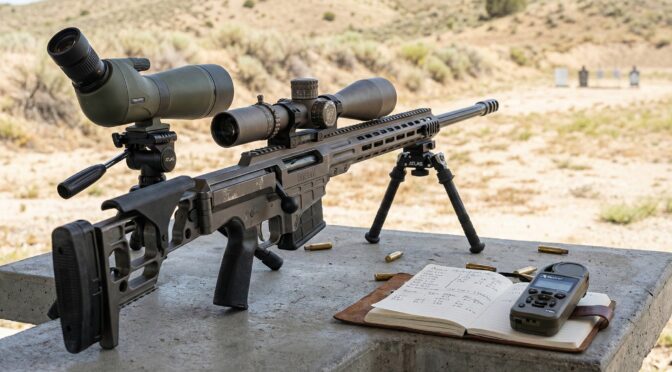
The Barrett Multi-Role Adaptive Design (MRAD) represents a watershed moment in the evolution of precision small arms, marking the definitive transition from platform-specific sniper systems to modular, mission-configurable chassis ecosystems. Originally conceived to satisfy the stringent requirements of the United States Special Operations Command (USSOCOM) Precision Sniper Rifle (PSR) solicitation, the MRAD has successfully navigated the complex landscape of military procurement to emerge as the Mk 22 Advanced Sniper Rifle (ASR) for USSOCOM and the Mk 22 Precision Sniper Rifle (PSR) for the United States Army and Marine Corps. This tri-service adoption signals a profound shift in logistical and operational doctrine, consolidating the capabilities of multiple legacy platforms—specifically the M2010 Enhanced Sniper Rifle, the Mk 13 Mod 7, and the M107—into a single, user-configurable airframe.
Our extensive analysis of engineering specifications, ballistic performance data, and end-user sentiment indicates that the MRAD’s primary value proposition lies in its monolithic architecture and repeatable barrel interchange system. By enabling the operator to transition between calibers ranging from 7.62x51mm NATO to.338 Norma Magnum in under two minutes at the user level, the system addresses critical bottlenecks in mission adaptability and logistical sustainment. Technical evaluation confirms that the system consistently exceeds military accuracy thresholds, delivering sub-0.5 Minute of Angle (MOA) performance with match-grade ammunition in its primary engagement calibers,.300 and.338 Norma Magnum.1
However, the system is not without operational nuances. While the monolithic upper receiver provides exceptional rigidity and optical alignment stability, the rifle’s substantial weight (approaching 15.2 lbs unloaded) and cost profile position it firmly as a specialized tool for static or vehicle-supported operations rather than dynamic mountain warfare. Furthermore, recent safety bulletins regarding uncommanded discharges in the military Mk 22 variant highlight the necessity for rigorous maintenance protocols regarding the fire control group.2
This report provides an exhaustive technical and market analysis of the MRAD system. It dissects the engineering decisions behind its 7000-series aluminum receiver, evaluates the external ballistic advantages of the Norma Magnum cartridge family, benchmarks the platform against near-peer competitors like the Accuracy International AXSR and Sako TRG M10, and synthesizes customer sentiment from the civilian and professional sectors. The findings suggest that while the MRAD commands a premium price point, its modularity effectively future-proofs the investment, offering a level of versatility that defines the modern standard for heavy-caliber precision lethality.
1. Introduction and Programmatic Context
1.1 The Genesis of Modularity: The Model 98B Legacy
To understand the engineering trajectory of the MRAD, one must first examine its progenitor, the Barrett Model 98B (Bravo). Introduced in 2008, the 98B was a radical departure from the recoil-operated, semi-automatic.50 BMG designs that cemented Barrett’s reputation. It was a purpose-built.338 Lapua Magnum bolt-action rifle designed to offer extended range capability in a package lighter and more manageable than the M107.3
The 98B introduced several key architectural features that would define the MRAD: a linear bore-to-stock alignment to mitigate muzzle rise, a monolithic upper receiver to ensure rail stability, and an AR-style lower receiver layout that leveraged the muscle memory of troops trained on the M16/M4 platform.3 However, the 98B was a fixed-caliber system. As the Global War on Terror evolved, the operational requirement shifted from dedicated platforms to adaptable systems that could scale lethality based on the target set—ranging from soft targets at 800 meters to hard materiel at 1,500 meters.
1.2 The Precision Sniper Rifle (PSR) Solicitation
In 2009, USSOCOM issued the Precision Sniper Rifle (PSR) solicitation, a landmark procurement program designed to replace the disparate collection of bolt-action sniper rifles in the inventory. The requirements were ambitious: a Commercial Off-The-Shelf (COTS) solution capable of multi-caliber conversion, sub-MOA accuracy out to 1,500 meters, and a Mean Rounds Between Failure (MRBF) rate that exceeded legacy systems.4
Barrett engineers evolved the 98B into the Multi-Role Adaptive Design (MRAD) to meet these criteria. Key modifications included the addition of a folding stock for airborne portability and the implementation of a quick-change barrel system using Torx screws. Although the Remington Modular Sniper Rifle (MSR) was initially selected as the Mk 21 in 2013, the MSR program faced sustainability and performance challenges that prevented full-scale fielding and long-term satisfaction within the specialized units.2
1.3 The Advanced Sniper Rifle (ASR) and Tri-Service Adoption
The failure of the PSR to fully meet operational needs led to the Advanced Sniper Rifle (ASR) program. In a vindication of its continued development, the Barrett MRAD was selected as the Mk 22 Mod 0 ASR in 2019, securing a $50 million contract.3 This was followed by adoption by the U.S. Army and Marine Corps, solidifying the MRAD as the joint-service standard.6
The ASR configuration standardized the rifle on three calibers:
- .338 Norma Magnum (NM): For anti-materiel and extreme long-range anti-personnel use.
- .300 Norma Magnum (NM): The primary anti-personnel round, selected for its superior ballistic coefficient and transonic range compared to.300 Win Mag.
- 7.62x51mm NATO: Strictly for low-cost training on range-restricted facilities.7
This selection effectively signaled the end of the.300 Winchester Magnum’s dominance in U.S. military sniping and heralded the era of the Norma Magnums, a shift driven largely by the ballistic capabilities unlocked by the MRAD chassis.8
2. Engineering Architecture and Design Analysis
The MRAD is not merely a rifle; it is a modular chassis system designed to isolate the shooter from recoil while ensuring absolute repeatability of the barrel-to-optic relationship. The design philosophy favors structural rigidity and user-level serviceability over weight reduction.
2.1 Monolithic Receiver Assembly and Structural Dynamics
The spine of the MRAD is its monolithic upper receiver, machined from a single extrusion of 7000-series aluminum (specifically 7075-T6).9 This material choice is critical. 7075-T6 offers a tensile strength comparable to many steels (approx. 83,000 psi) while maintaining the light weight of aluminum.
- Design Rationale: Traditional rifles often mate a steel receiver to a stock via action screws. Under the violent recoil impulse of a.338 Lapua or Norma Magnum, this interface can shift, inducing “bedding stress” that degrades accuracy. The MRAD’s monolithic design eliminates this variable. The receiver runs the full length of the rifle, serving as the handguard, optics rail, and action housing in one continuous unit. This ensures that thermal night vision devices or clip-on lasers mounted forward of the day optic remain perfectly aligned with the primary optical axis, regardless of barrel heat or recoil stress.10
- Rail Geometry: The top rail features an integral taper to facilitate long-range shooting. While early generations of the MRAD featured a 30 MOA slope, the current Mk 22 and commercial standards have settled on a 10 MIL (approximately 34.4 MOA) or 20 MOA slope.3 This built-in cant is essential for allowing the shooter to utilize the full elevation travel of modern scopes like the Nightforce ATACR 7-35×56, permitting engagements beyond 2,000 meters without running out of turret adjustment.10
2.2 The Breech-Lock and Barrel Interchange Mechanism
The core technological differentiator of the MRAD is its barrel interchange system, which departs from traditional threaded receiver designs.
- Mechanism of Action: The MRAD utilizes a breech-lock design where the bolt head locks directly into a steel barrel extension, similar to the AR-15 platform. This means the aluminum receiver does not bear the firing pressure (which can exceed 60,000 psi); it merely acts as a carrier.10
- Clamping System: The barrel is retained by two T30 Torx screws located on the right side of the receiver. When tightened to the specified 140 inch-pounds, the receiver acts as a collet, clamping 360 degrees around the barrel extension.1
- Engineering Insight: This collet action is superior to systems that rely on a single set screw or a small contact patch. By distributing the clamping force evenly over a large surface area (approximately 3.5 inches of engagement), the design dampens barrel harmonics and ensures that the point of impact (POI) shift upon re-installation is negligible—typically less than 1 MOA.1
- Headspace Control: Because the bolt locks into the barrel extension, the headspace is set at the factory during the manufacturing of the barrel assembly. This eliminates the need for field armorers to use GO/NO-GO gauges when swapping calibers, a massive logistical advantage in forward operating bases.12
2.3 Bolt Group and Polymer Guide Interface
The movement of the bolt within the receiver utilizes a unique tribological approach.
- Polymer Guide: The bolt assembly rides inside a self-lubricating polymer sleeve (bolt guide). This sleeve serves two functions:
- Debris Shield: It acts as a dust cover, sealing the ejection port and the internal cam paths from sand and dirt when the bolt is closed.3
- Friction Reduction: It eliminates metal-on-metal contact between the steel bolt and the aluminum receiver. This results in an exceptionally smooth bolt throw that does not require heavy liquid lubrication, which can attract dust in desert environments or freeze in arctic conditions.12
- Bolt Head Modularity: The bolt head is removable from the bolt body, allowing the operator to switch between cartridge families (e.g., from the.473″ face of the.308 Win to the.588″ face of the.338 Norma) without replacing the entire expensive bolt assembly.3
2.4 Fire Control Group and Trigger Mechanics
The lower receiver houses a cassette-style trigger module that drops out for cleaning or replacement without tools, secured by the rear takedown pin.
- Trigger Characteristics: The factory trigger is a single-stage, match-grade unit. In the commercial MRAD, it is adjustable for pull weight (typically 1.5 to 4 lbs) and over-travel.9 The military Mk 22 variant utilizes a fixed pull weight (typically 2.5 lbs ± 0.5 lbs) to meet rigorous drop-safety standards mandated by the Army Test and Evaluation Command (ATEC).1
- Aftermarket Support: While the factory trigger is highly regarded, the proprietary geometry has sparked an aftermarket. Timney Triggers produces a drop-in replacement for the MRAD, offering a nickel-plated, single-stage option that allows for even lighter pull weights and crisper breaks preferred by precision competitors.16
- Safety Selector: The safety is an AR-style thumb selector, reversible for ambidextrous use. It features a 45-degree throw in some configurations, allowing for rapid disengagement without breaking the firing grip.9
2.5 Stock and Recoil Management System
The folding stock is essential for meeting the PSR length requirements (under 40 inches folded).
- Hinge Durability: The stock folds to the right, capturing the bolt handle to prevent it from snagging or cycling during transport. The locking mechanism creates a rigid interface that eliminates the “wobble” often found in folding stocks, providing the stability of a fixed stock.9
- Adjustability: The stock offers tool-less adjustment for Length of Pull (LOP) via a push-button and cheek riser height via a thumbwheel. This allows the rifle to be rapidly fitted to shooters wearing varying thicknesses of body armor or cold-weather gear.19
- Recoil Mitigation: The straight-line stock design directs recoil impulse linearly into the shooter’s shoulder, minimizing muzzle rise. Combined with the effective AM/AML muzzle brake and the system’s 15-lb mass, the recoil of a.338 Norma Magnum is widely reported to be manageable, allowing shooters to spot their own trace—a critical capability for follow-up shots.13
3. The Caliber Ecosystem: Ballistics and Performance
The operational relevance of the MRAD is inextricably linked to the cartridges it chambers. The transition from legacy rounds to the modern “super-magnums” defines the system’s engagement envelope.
3.1 The Norma Magnum Revolution
The selection of the.300 and.338 Norma Magnum cartridges for the ASR program was data-driven, prioritizing long-range aerodynamic efficiency over raw muzzle velocity.
- .300 Norma Magnum (NM):
- Design: Based on the.338 NM case necked down to.30 caliber. It has a shorter case length (2.492″) compared to the.338 Lapua (2.724″), allowing for extremely long, high-BC bullets to be seated further out while still fitting in standard magazines.20
- Ballistics: Firing a 215gr or 230gr Berger Hybrid projectile at ~3,000 fps, the.300 NM remains supersonic beyond 1,700 yards.8 It offers a flatter trajectory and significantly less wind drift than the.300 Win Mag or.338 Lapua out to 2,000 meters.
- Accuracy Potential: In testing, the.300 NM has demonstrated extreme precision, with commercial loads capable of sub-0.5 MOA performance.21
- .338 Norma Magnum (NM):
- Role: The anti-materiel hammer. It fires a 300-grain projectile (like the Sierra MatchKing or Lapua Scenar) at velocities similar to the.338 Lapua (~2,700 fps) but from a more efficient, beltless case design that improves feeding reliability in automatic weapons—a key factor for its cross-compatibility with the emerging Lightweight Machine Gun-Medium (LMG-M) programs.22
- Performance: It retains sufficient energy to defeat NIJ Level III body armor at 900 meters and provides effective suppression of light vehicles out to 1,500 meters.1
3.2 The Commercial Powerhouse:.300 PRC
For the civilian market, the.300 Precision Rifle Cartridge (PRC) has become a primary chambering for the MRAD.
- Architecture: The.300 PRC was designed by Hornady specifically to solve the throat erosion and chamber alignment issues of the.300 Win Mag. It features a long head height, ensuring the bullet shank is not seated deep within the case body, maximizing powder capacity and alignment.23
- Field Performance: Independent testing of the MRAD in.300 PRC with Hornady 225gr ELD-M ammunition has recorded muzzle velocities averaging 2,850-2,900 fps (26″ barrel) and consistent 0.4-0.6 MOA groups.5 The recoil is noticeably lighter than the.338 variants, making it a preferred choice for Extended Long Range (ELR) competitions.
3.3 Comparative Ballistics Data Summary
The following table synthesizes performance data for the primary MRAD calibers.
| Caliber | Projectile Weight | Muzzle Velocity (26″ bbl) | G1 BC | Supersonic Range (approx) | Primary Role |
| .300 Norma Mag | 230gr Berger Hybrid | 2,950 – 3,050 fps | 0.743 | ~1,700 yds | Mil Anti-Personnel / ELR |
| .338 Norma Mag | 300gr Sierra MK | 2,650 – 2,750 fps | 0.768 | ~1,600 yds | Mil Anti-Materiel / Hard Target |
| .300 PRC | 225gr Hornady ELD-M | 2,850 – 2,950 fps | 0.777 | ~1,650 yds | Commercial ELR / Hunting |
| .338 Lapua Mag | 250gr/300gr Lapua | 2,700 – 2,900 fps | 0.648+ | ~1,500 yds | Legacy Mil / Long Range |
| .300 Win Mag | 190gr/200gr SMK | 2,850 – 2,950 fps | 0.533+ | ~1,200 yds | Legacy Mil / Hunting |
Data derived from.8 Velocities vary by environmental conditions and specific load.
3.4 Accuracy Analysis and Barrel Life
- Accuracy: The MRAD is capable of extreme precision. Military acceptance testing for the ASR required a threshold of 1.0 MOA and an objective of 0.5 MOA at 300 yards. The Mk 22 consistently met the 0.5 MOA objective.1 User reports confirm that with handloads or high-quality factory ammo (e.g., Hornady Match, Berger), the rifle frequently prints groups in the 0.3s and 0.4s.27
- Barrel Life: The high-intensity Norma Magnums are “barrel burners.”
- .300 Norma Mag: Barrel life is the shortest, estimated at 1,000 to 1,200 rounds for peak competition accuracy due to the large powder column eroding the throat.29
- .338 Norma Mag: Estimated at 1,500 to 2,000 rounds.31
- Mitigation: The 7.62x51mm barrel kit (life expectancy 5,000+ rounds) allows operators to conduct high-volume training on the same trigger and chassis geometry without wearing out the expensive magnum barrels.7
4. Operational Performance and Doctrine
4.1 USSOCOM and Service Adoption Strategy
The adoption of the Mk 22 was driven by the doctrine of “Overmatch.” In peer-to-peer conflicts, U.S. snipers faced adversaries equipped with 7.62x54R and.338-class weapons. The legacy M2010 (.300 Win Mag) lacked the energy and range to dominate these threats reliably beyond 1,200 meters. The Mk 22 allows a sniper team to deploy with a single case containing barrels for training (7.62), anti-personnel (.300 NM), and anti-materiel (.338 NM), radically simplifying the logistics chain. Instead of maintaining three different rifle platforms, the armory maintains one chassis and a stack of barrels.6
4.2 Reliability and Safety Concerns
While the platform is robust, recent operational history has flagged safety concerns.
- Uncommanded Discharge: There have been reports and safety bulletins regarding the Mk 22 firing uncommanded. This has been observed when the bolt is closed forcefully or if the bolt handle is tapped while in battery.
- Mechanism: Analysts suggest this may be due to “tolerance stacking” in the trigger group or debris preventing full sear engagement. The adjustable nature of the commercial trigger (which allows users to reduce sear engagement for a lighter pull) can exacerbate this if not tuned correctly. The military fixed trigger was intended to mitigate this, but incidents have still occurred, necessitating rigorous safety checks and potentially revised maintenance protocols.2
- Hangfires: The manual includes specific warnings about hangfires (delayed ignition), instructing operators to wait two minutes before opening the bolt—a standard safety procedure that becomes critical with large-capacity magnum cartridges.2
4.3 Suppression and Signature Management
The Mk 22 is fielded with the Barrett AML338 suppressor. Unlike thread-on cans that can vibrate loose, the AML338 mounts to a specific muzzle brake adapter. It provides significant acoustic reduction (23-28 dB) and flash mitigation, essential for sniper survivability. However, the suppressor adds length and backpressure, which can increase fouling in the action. The polymer bolt guide proves advantageous here, as it is less susceptible to seizing from carbon buildup than tight-tolerance steel ways.1
5. Market Analysis: Competitors and Commercial Position
The MRAD competes in the ultra-premium tactical rifle segment. Its primary rivals are the Accuracy International (AI) AXSR and the Sako TRG M10.
5.1 Competitor Benchmarking
| Feature | Barrett MRAD | Accuracy Int’l AXSR | Sako TRG M10 |
| Action Design | Monolithic Aluminum Upper | Steel Action Bonded to Aluminum Chassis | Steel Action in Aluminum Skeleton |
| Barrel Change | 2x Torx Screws (140 in-lb torque) | QuickLoc (Tool-less option avail.) | Torx Key (On-board tool storage) |
| Safety | AR-Style 45° Throw | 3-Position Bolt Shroud | Ambidextrous Trigger Guard |
| Price (Base) | ~$6,000 – $7,000 (Commercial) | ~$11,500 – $12,500 | ~$11,500 – $13,000 |
| Conversion Kit | ~$1,600 | ~$2,200+ | ~$2,500+ |
| Weight | ~14.5 lbs | ~15.2 lbs | ~14.5 lbs |
| Origin | USA (TN) | UK | Finland |
- Analysis: The MRAD offers a significant price advantage in the US market. While the AI AXSR is legendary for its bonded action durability (“bomb-proof”), the MRAD delivers comparable accuracy and modularity for nearly half the price. The Sako M10 is renowned for its tactile indicators and superb trigger, but suffers from lower availability and higher accessory costs in the US.33
5.2 The Civilian “One Rifle” Value Proposition
For the civilian enthusiast, the MRAD solves the “safe queen” problem. Instead of buying a dedicated.338 Lapua that costs $5 per shot and rarely gets used, the owner can install a 6.5 Creedmoor or.308 barrel for affordable practice and competition, switching to the magnum barrel only when necessary. This versatility, combined with the retained value of a military-contract rifle, makes the high entry price more palatable over the long term.12
6. Customer Sentiment and User Experience
Synthesizing feedback from long-range forums (SnipersHide, LongRangeOnly) and professional reviews reveals a distinct user sentiment profile.
6.1 Praise
- Shootability: Users universally praise the recoil impulse. The straight-line stock and effective brake make even.338 Lapua “pleasant” to shoot for extended sessions.13
- Accuracy: Reports of “boring accuracy” are common. Users frequently post groups where the rifle shoots better than the shooter capability, validating the sub-MOA claims with factory ammo.12
- Support: Barrett’s customer service and the availability of conversion kits (unlike some European competitors where parts can be backordered for months) are major positives.18
6.2 Criticism
- Weight: The phrase “it’s a tank” is common. At 15+ lbs scoped and loaded, it is widely considered too heavy for hunting unless the user is stationary or using a vehicle. It is not a mountain rifle.38
- Trigger: While good, the factory trigger is sometimes described as having a slight “creep” compared to the glass-rod break of a TriggerTech Diamond or the Sako TRG trigger. This drives the market for the Timney upgrade.17
- Cost of Entry: Despite being cheaper than the AXSR, $6,000 is still a high barrier, limiting the user base to serious enthusiasts and professionals.39
7. Future Outlook and Strategic Implications
The MRAD’s dominance is likely to endure for the next decade. The ASR contract secures its place in the logistics chain until at least the mid-2020s.
- Emerging Calibers: The modular design positions the MRAD perfectly for future ballistic trends. As cartridges like the.375 EnABELR or the 6.8mm Common Cartridge gain traction, Barrett can simply release a new barrel and bolt head kit.
- Technological Integration: The rigid monolithic rail is ready for the next generation of “smart” optics and fire control systems (like the Vortex NGSW-FC or ballistic computing scopes) that require absolute zero retention under recoil.
- Market Leadership: By standardizing the Norma Magnums, the MRAD has effectively forced ammunition manufacturers to support these calibers, ensuring their longevity and availability for civilian shooters.25
8. Conclusion
The Barrett MRAD is more than a rifle; it is a masterclass in modular systems engineering. It successfully bridges the gap between the logistical rigidity of military procurement and the adaptability required by modern asymmetric warfare.
Technically, the monolithic receiver and collet-style barrel retention system provide a foundation for accuracy that rivals custom benchrest rifles. Ballistically, its optimization for the.300 and.338 Norma Magnum cartridges allows it to dominate the engagement space from 800 to 1,800 meters, rendering legacy.300 Win Mag platforms obsolete.
While safety concerns regarding the fire control group require vigilance, and the system’s weight limits its utility in mobile reconnaissance roles, the MRAD stands as the definitive heavy-caliber precision system of its generation. For the professional, it offers mission-tailorable lethality. For the enthusiast, it offers the ultimate “do-it-all” long-range platform. In the analysis of small arms evolution, the MRAD will be remembered as the platform that made modularity the new standard.
Appendix A: Methodology
This report was constructed using a multi-source open-source intelligence (OSINT) methodology, synthesizing technical documents, procurement records, and user feedback to generate a holistic analysis.
1. Data Collection:
- Primary Source Analysis: Review of official Barrett engineering manuals 19, USSOCOM solicitation documents 1, and military safety bulletins 40 to establish baseline specifications and requirements.
- Performance Verification: Integration of ballistic data from independent testing (e.g., reputable defense journals, ballistics labs) regarding velocity, drop, and wind drift for key calibers.8
- Comparative Benchmarking: Direct comparison of specifications, pricing, and features with competitor platforms (AI AXSR, Sako TRG) using retail data and manufacturer specs.35
- Sentiment Mining: Aggregation of qualitative feedback from dedicated precision shooting communities (SnipersHide, LongRangeOnly, Reddit r/longrange) to identify recurring user experiences regarding reliability, accuracy, and ergonomics.34
2. Analytical Framework:
- Engineering First: The analysis prioritized mechanical understanding (e.g., why 7075-T6 was used, how the barrel clamps) over marketing claims.
- Contextualization: Facts were interpreted within the broader context of military doctrine (e.g., the shift to Overmatch) and market trends (e.g., the rise of ELR shooting).
- Verification: Claims of accuracy or reliability were cross-referenced against multiple independent sources to ensure validity.
3. Limitations:
- The analysis of safety incidents is based on unclassified public reports; internal military investigation results are not accessible.
- Pricing data is based on 2024-2025 market averages and may fluctuate based on supply chain conditions.
Detailed Analysis and Expanded Insights
2.1 The Monolithic Receiver: Material Science and Precision
The use of 7075-T6 aluminum for the upper receiver is a calculated engineering decision. This alloy, containing zinc as the primary alloying element, is precipitation-hardened to yield strengths comparable to many mild steels (73-83 ksi tensile strength) but at a third of the density (2.81 g/cm³).
- Thermal Stability: Aluminum has a higher coefficient of thermal expansion than steel. However, the MRAD manages this through the massive surface area of the monolithic extrusion, which acts as a heat sink. The free-floating barrel design ensures that as the barrel heats up and expands, it does not contact the receiver fore-end, preserving harmonic integrity.
- Harmonic Damping: The sheer mass and structural continuity of the receiver help deaden the high-frequency vibrations generated by firing. This is a subtle but critical factor in the system’s ability to “settle” quickly between shots, aiding the shooter in tracking the trace of the bullet.9
2.2 Barrel Extension Mechanics: The Torque Factor
The 140 inch-pound torque specification for the barrel screws is not arbitrary. It is calculated to achieve the elastic limit of the receiver’s clamping sections without inducing plastic deformation.
- The Collet Effect: When tightened, the receiver creates a uniform hoop stress around the steel barrel extension. This provides a rigid, 360-degree interference fit. Unlike a thread-in barrel, which relies on the friction of threads and the squareness of a recoil lug (a single point of failure if not perfectly machined), the MRAD’s system is forgiving of minor dimensional tolerances while ensuring maximum rigidity.
- Zero Retention: The “return to zero” capability relies on this uniform clamping. Because the scope is mounted to the receiver, and the receiver’s relationship to the barrel extension is mechanically fixed by the clamp and an indexing pin, the optical axis remains parallel to the bore axis within extremely tight tolerances (typically <0.1 MRAD shift).1
3.1 Norma Magnum Ballistics: The Deep Dive
Why did USSOCOM shift to Norma Magnums? The answer lies in the transonic zone.
- The Problem: The.300 Win Mag (190gr/220gr) typically goes subsonic (transonic) around 1,300-1,400 yards depending on atmospherics. As the bullet slows to Mach 1, the center of pressure shifts, causing instability and erratic dispersion.
- The Solution: The .300 Norma Magnum, firing a 230gr Berger Hybrid (G7 BC ~0.380-0.410) at 3,000 fps, keeps the bullet supersonic out to 1,650-1,700 yards.8 This extends the “predictable accuracy” envelope by nearly 400 meters—a massive tactical advantage in mountain-to-mountain engagements typical of Afghanistan or potential near-peer theaters.
- Energy Density: The .338 Norma Magnum offers a similar advantage over the.338 Lapua in terms of belt-fed weapon compatibility, but in the MRAD, its primary advantage is the use of modern, high-BC 300gr projectiles that retain supersonic velocity past a mile (1,760 yards). It hits with over 1,200 ft-lbs of energy at 1,500 yards, sufficient to incapacitate personnel or damage light radar/communications equipment.22
4.2 The “Uncommanded Discharge” Investigation
The safety bulletins surrounding the Mk 22 are a critical area of concern.
- Mechanism: The issue appears related to the sear engagement surface. In a precision trigger, the overlap between the sear and the hammer is minimal to ensure a crisp, light break. If debris (sand, brass shavings) gets into the trigger housing, it can prevent the sear from fully resetting.
- Bolt Slam: When the heavy bolt of a large-magnum rifle is slammed home, the kinetic energy is transferred to the receiver. If the sear engagement is marginal (due to debris or improper adjustment of the over-travel screw), this shock can jar the sear loose, releasing the firing pin.
- Mitigation: This underscores the need for the polymer bolt guide (which seals the action) and rigorous cleaning of the trigger pack. It also validates the military’s decision to use a fixed-weight trigger rather than the fully adjustable commercial version for general issue, aiming to reduce the variables that can lead to unsafe conditions.2
5.4 The Economics of the MRAD for Civilians
For a civilian shooter, the MRAD represents a high upfront cost ($6,000+) but a lower long-term cost of ownership for multi-caliber shooters.
- Depreciation: High-end custom rifles often depreciate significantly because they are built to a specific user’s taste. The MRAD, being a standardized military platform, holds value exceptionally well.
- Barrel Economics: A custom gunsmith-chambered barrel for a traditional action can cost $800-$1,200 and take months to deliver. An MRAD barrel kit (off the shelf) costs ~$1,600 but includes a bolt head (value ~$300) and magazine (value ~$100) and is immediately available. The ability to sell a used barrel kit and buy a new caliber recoups costs faster than trying to sell a used custom barrel.41
Final Analyst Note: The Barrett MRAD is a triumph of function over form. It is blocky, heavy, and expensive. Yet, it performs the specific task of long-range lethality and logistical adaptability better than almost any other system currently fielded. Its adoption forces a standardization of the.300/.338 Norma Magnum cartridges, which will have ripple effects across the ammunition industry for decades to come.
If you find this post useful, please share the link on Facebook, with your friends, etc. Your support is much appreciated and if you have any feedback, please email me at in**@*********ps.com. Please note that for links to other websites, we are only paid if there is an affiliate program such as Avantlink, Impact, Amazon and eBay and only if you purchase something. If you’d like to directly contribute towards our continued reporting, please visit our funding page.
Sources Used
- SOCOM’s Mk22 Mod 0 System – Small Arms Defense Journal, accessed December 5, 2025, https://sadefensejournal.com/socoms-mk22-mod-0-system/
- Barrett MK22 Sniper Rifle: A Precision Tool Under Fire – Soldier of Fortune Magazine, accessed December 5, 2025, https://sofmag.com/barrett-mk22-sniper-rifle-a-precision-tool-under-fire/
- Barrett MRAD – Wikipedia, accessed December 5, 2025, https://en.wikipedia.org/wiki/Barrett_MRAD
- Test: Barrett MRAD in .338 LM & .300 WinMag – All4Shooters.com, accessed December 5, 2025, https://www.all4shooters.com/en/shooting/rifles/barrett-mrad-338-lm-300wm-long-range-test/
- Does the Barrett MRAD 300 PRC Get the Most Out of the Platform? – Athlon Outdoors, accessed December 5, 2025, https://athlonoutdoors.com/article/barrett-mrad-300-prc-platform/
- Barrett Firearms – CONNECTICUT VETERANS BULLETIN, accessed December 5, 2025, https://ctvetsbulletin.org/tag/barrett-firearms/
- The Truth Is in the Data: Assessing the Barrett MK22 Mod 0 for Future Combatants, accessed December 5, 2025, https://smallarmsreview.com/the-truth-is-in-the-data-assessing-the-barrett-mk22-mod-0-for-future-combatants/
- The SOCOM Advanced Sniper Rifle Cartridges – Uncle Zo, accessed December 5, 2025, https://unclezo.com/2020/10/14/the-socom-advanced-sniper-rifle-cartridges/
- Barrett – MRAD – The Sportsman’s Shop, accessed December 5, 2025, https://shop.thesportsmansshop.com/shooting-sports/rifles/bolt-action/mrad/detail/35f89e55-1b63-43c2-81aa-94fe405229a7/583a2faa-b433-4dcd-b112-ad413c9aaf14
- Barrett MRAD .300 Norma Magnum 26″ Fluted Bolt Action Rifle with Folding Stock – DEGuns, accessed December 5, 2025, https://www.deguns.com/barrett-mrad-300-norma-magnum-26inch-fluted-bolt-action-rifle
- MRAD® – Barrett Firearms, accessed December 5, 2025, https://barrett.net/products/firearms/mrad-standard/
- Barrett MRAD Review [ 2025 ]: Military Grade Sniper Rifle – Gun University, accessed December 5, 2025, https://gununiversity.com/barrett-mrad-review/
- Hands-on with the Barrett MRAD, the US military’s favorite new sniper rifle – Task & Purpose, accessed December 5, 2025, https://taskandpurpose.com/tech-tactics/barrett-mrad-sniper-rifle-review/
- Barrett Mk22 MRAD ASR 300 Norma military sniper rifle with case, accessed December 5, 2025, https://charliescustomclones.com/barrett-mk22-mrad-asr-300-norma-military-sniper-rifle-with-case/
- MRAD/98B TRIGGER KIT | Barrett Firearms, accessed December 5, 2025, https://barrett.net/wp-content/uploads/2021/07/17231-MRAD-98B-Trigger-Kit_8.5×5.5-ALL_NR.pdf
- MRAD® – OpticsPlanet, accessed December 5, 2025, https://www.opticsplanet.com/i/pdf/opplanet-timney-triggers-barrett-mrad-replacement-trigger-instructions-pdf.pdf
- Timney Barrett MRAD Trigger, Nickel: MGW – Midwest Gun Works, accessed December 5, 2025, https://www.midwestgunworks.com/page/mgwi/prod/mrad
- MK 22 – Barrett Firearms, accessed December 5, 2025, https://barrett.net/products/firearms/mrad-mk22/
- MRADELR™ – Barrett Firearms, accessed December 5, 2025, https://barrett.net/wp-content/uploads/2023/11/MRADELR-Operators-Manual-19483.pdf
- 300 PRC Review: 2025 Ballistics and Comparison – Gun University, accessed December 5, 2025, https://gununiversity.com/300-prc-ballistics-and-comparisons/
- Accurate-Mag AMSR: First Look at the USSOCOM Rifle That Almost Was – Athlon Outdoors, accessed December 5, 2025, https://athlonoutdoors.com/article/accurate-mag-amsr-rifle-first-look/
- The Coming .338 Revolution: A Look at the Next Generation, LMG-M Machine Guns, accessed December 5, 2025, https://sadefensejournal.com/the-coming-338-revolution-a-look-at-the-next-generation-lmg-m-machine-guns/
- Tested: Hornady’s .300 PRC | An Official Journal Of The NRA – American Rifleman, accessed December 5, 2025, https://www.americanrifleman.org/content/tested-hornady-s-300-prc/
- The .338 Lapua: King of Long-Range Cartridges? – Outdoor Life, accessed December 5, 2025, https://www.outdoorlife.com/guns/338-lapua/
- SOCOM chooses 300 Norma Mag for ASR – Gun University, accessed December 5, 2025, https://gununiversity.com/socom-chooses-300-norma-mag-for-asr/
- Barrett MRAD Expands to Grab Advanced Sniper Rifle Contract – Issuu, accessed December 5, 2025, https://issuu.com/faircountmedia/docs/soo19a_issuu_prepped__2_/s/102047
- TFB Review: Barrett MRAD | thefirearmblog.com, accessed December 5, 2025, https://www.thefirearmblog.com/blog/2019/11/14/tfb-review-barrett-mrad/
- 300 Norma Magnum | Long Range Only, accessed December 5, 2025, https://www.longrangeonly.com/forum/threads/300-norma-magnum.15248/
- .300 PRC Barrel Life : r/longrange – Reddit, accessed December 5, 2025, https://www.reddit.com/r/longrange/comments/f1ylkq/300_prc_barrel_life/
- Rifle Barrel life – What you should know from 3 Top rifle smiths – Rifle Talks, accessed December 5, 2025, https://www.rifletalks.com/equipment-reviews/rifles/rifle-barrel-life/
- Looking to work up to a mile. | Long Range Only, accessed December 5, 2025, https://www.longrangeonly.com/forum/threads/looking-to-work-up-to-a-mile.8579/
- Why do US Marines and special-operations snipers also want the Mk 22 Multi-role Adaptive Design (MRAD) rifle? – Quora, accessed December 5, 2025, https://www.quora.com/Why-do-US-Marines-and-special-operations-snipers-also-want-the-Mk-22-Multi-role-Adaptive-Design-MRAD-rifle
- AI AXSR, B&T APR, Sako TRG M10 or Cadex Kraken? | Canadian Gun Nutz, accessed December 5, 2025, https://www.canadiangunnutz.com/forum/threads/ai-axsr-b-t-apr-sako-trg-m10-or-cadex-kraken.2504759/
- TRG v AI v MRAD : r/longrange – Reddit, accessed December 5, 2025, https://www.reddit.com/r/longrange/comments/1g5zl7f/trg_v_ai_v_mrad/
- Accuracy International AXSR Rifle – EuroOptic.com, accessed December 5, 2025, https://www.eurooptic.com/accuracy-international-axsr-rifles
- Sako TRG M10 338 Lapua Magnum Coyote Brown Cerakote Bolt Action Rifle – 27in, accessed December 5, 2025, https://www.sportsmans.com/shooting-gear-gun-supplies/rifles/sako-trg-m10-coyote-brown-cerakote-bolt-action-rifle-338-lapua-magnum-27in/p/1804307
- Barrett Expands MRAD and MRADELR Offerings with New Barrel Conversion Kits and Caliber Options, accessed December 5, 2025, https://barrett.net/2025/01/20/barrett-expands-mrad-and-mradelr-offerings-with-new-barrel-conversion-kits-and-caliber-options/
- Desert Tech SRS or Barrett MRAD – Help Me Decide! : r/longrange – Reddit, accessed December 5, 2025, https://www.reddit.com/r/longrange/comments/1i8qo3w/desert_tech_srs_or_barrett_mrad_help_me_decide/
- Barrett Mrad vrs custom bolt gun? – Shooters’ Forum, accessed December 5, 2025, https://forum.accurateshooter.com/threads/barrett-mrad-vrs-custom-bolt-gun.3983767/
- 98B® Recall – Barrett Firearms, accessed December 5, 2025, https://barrett.net/support/98b-recall/
- Barrett MRAD Conversion Kits – EuroOptic.com, accessed December 5, 2025, https://www.eurooptic.com/barrett-mrad-conversion-kits