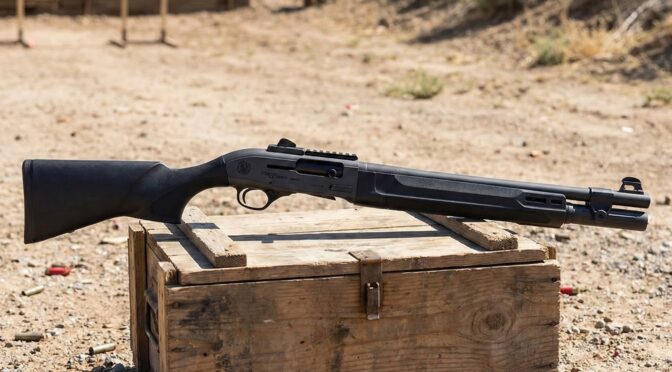
The modern small arms market, specifically the sector dedicated to semi-automatic 12-gauge shotguns, has historically been stratified into two distinct tiers: the high-cost, duty-grade tier dominated by Italian imports like the Benelli M4 and Beretta 1301, and the budget tier saturated with Turkish clones and aging pump-action designs. The introduction of the Beretta A300 Ultima Patrol represents a calculated disruption of this dichotomy. By leveraging the legacy architecture of the A300 sporting lineage and domesticating manufacturing to Gallatin, Tennessee, Beretta USA has attempted to capture the “prosumer” and law enforcement patrol market segments that are price-sensitive yet demand reliability metrics exceeding those of budget competitors.
This report provides an exhaustive technical and market analysis of the A300 Ultima Patrol. It evaluates the platform’s gas-operated engineering, material composition, ergonomic philosophy, and reliability profiles under high-stress conditions. Furthermore, it contrasts the platform against its primary competitors—the Mossberg 940 Pro Tactical and the Beretta 1301 Tactical—to determine its viability as a primary defensive tool. The analysis suggests that while the A300 Ultima Patrol suffers from specific cost-saving compromises in polymer quality and component sourcing, it offers a price-to-performance ratio that is currently unrivaled in the semi-automatic sector, making it a highly recommended acquisition for specific user profiles.
2.0 Historical Context and Platform Lineage
To fully appreciate the technical nuances of the A300 Ultima Patrol, one must first dissect the lineage from which it descends. The A300 series is not a novel invention birthed from a clean slate; rather, it is a modern iteration of a gas system architecture that has been in continuous refinement since the mid-20th century. This genealogy informs both its reliability profile and its inherent limitations.
2.1 The Evolution of the A300 Series
The A300 designation generally refers to Beretta’s mid-tier semi-automatic line, which traditionally utilized a falling block locking system and a gas piston design distinct from the premium “B-Link” system found in the A400 and 1301 series.1 The original A300 sporting shotguns were engineered primarily for field use—hunting waterfowl and upland game. These environments demand reliability with varying load weights but do not typically subject the firearm to the rapid-fire heat cycles, high-volume buckshot usage, or abusive handling characteristics of tactical environments.
The progression toward the “Ultima” line marked a significant aesthetic and functional refresh. The standard A300 Ultima sporting shotguns introduced updated polymer compounds, improved recoil reduction technologies (specifically the Kick-Off system, though implementation varies by model), and more aggressive texturing suited for adverse weather conditions. The “Patrol” variant represents a further militarization of this architecture. Engineers shortened the barrel to 19.1 inches, extended the magazine tube to flush with the muzzle, and significantly enhanced the control interfaces for defensive manipulation under stress.2 This adaptation signifies a shift in Beretta’s global strategy: rather than strictly engineering a tactical shotgun from the ground up—as was done with the 1301—they have adapted a proven sporting chassis to reduce overhead and retail price, effectively creating a “crossover” utility weapon.
2.2 The Strategic Shift to US Manufacturing
A critical differentiator for the A300 Ultima Patrol, and a primary driver of its competitive pricing, is its origin of manufacture. Unlike the 1301 Tactical, which is manufactured in Italy and imported, the A300 Ultima Patrol is produced in the United States at Beretta’s facility in Gallatin, Tennessee.3 This localization serves three distinct strategic purposes that directly benefit the end-user:
First, it addresses 922(r) Compliance. Under US federal law, specifically Title 18 USC § 922(r), imported semi-automatic shotguns are prohibited from having certain “non-sporting” features—such as magazine capacities exceeding five rounds—unless they contain a specific number of US-made parts. The Italian-made 1301 Tactical, for example, typically enters the country in a restricted configuration (often 5-round tubes) and requires the end-user or dealer to install US-made aftermarket parts to legally unlock its full 7+1 capacity potential. By manufacturing the A300 Patrol domestically, Beretta bypasses these complex import restrictions entirely. The shotgun can be sold in a 7+1 configuration out of the box without requiring aftermarket parts swapping to meet federal compliance.5
Second, Cost Reduction is achieved by eliminating import tariffs, trans-Atlantic shipping logistics, and the administrative overhead of importation. This allows the unit to retail near the $1,000 mark, significantly undercutting its Italian sibling.2
Third, Government Contracts become more accessible. A US-made firearm is significantly more palatable to domestic Law Enforcement Agency (LEA) procurement officers, particularly those utilizing grant money that may have stipulations prioritizing domestic production. This positions the A300 Patrol as a direct competitor to the Mossberg 930/940 series for department-level contracts.
3.0 Engineering and Technical Analysis
The core competency of any semi-automatic shotgun lies in its operating system. The A300 Ultima Patrol utilizes a gas-operated piston system that differs mechanically from the premium 1301, and understanding these differences is crucial for the technical analyst.
3.1 The Modified Gas Operating System
The A300 employs a gas piston system with a compensating exhaust valve, a design choice that balances reliability with ammunition versatility.6
3.1.1 Mechanism of Action
When a round is fired, expanding high-pressure gases travel down the barrel behind the wad and projectile. Upon reaching the gas ports located midway down the barrel, a portion of these gases is bled off into a gas cylinder. This gas pressure drives a piston rearward. The piston, in turn, pushes an operating rod sleeve and the bolt assembly rearward to unlock the action, extract the spent casing, and compress the recoil spring.7
3.1.2 The Compensating Valve
A critical feature of this system is the “compensating exhaust valve.” Tactical shotguns often face a dilemma: they must cycle light birdshot loads for training (which generate lower pressure) while also withstanding the high pressures of full-power buckshot and slugs without battering the receiver. The A300’s valve solves this by bleeding off excess pressure. When heavy magnum loads are fired, the valve opens to vent the surplus gas out of the forend, regulating the bolt velocity.7 This allows the shotgun to cycle a wide spectrum of ammunition without manual adjustment, a critical requirement for a tactical shotgun that may be loaded with varying ammunition types in a “scramble” scenario.
3.1.3 Piston Design and Maintenance
The piston itself includes an elastic seal with a rough finish designed to scrape carbon deposits from the cylinder walls during cycling.7 Beretta marketing materials frequently refer to this as a “self-cleaning” system. However, engineering analysis and field reports confirm that “self-cleaning” is a misnomer; it is more accurately “self-scraping.” Lead and carbon buildup is inevitable, particularly when firing rifled slugs or unplated buckshot. This necessitates maintenance intervals of approximately 200 to 500 rounds for peak reliability, specifically to remove lead deposits that can fuse to the piston and cylinder walls.6 Neglecting this maintenance can lead to sluggish cycling or failure to eject.
3.2 Comparison to the B-Link System (1301)
It is imperative to distinguish the A300 gas system from the 1301’s B-Link system to understand the performance delta.
- 1301 (B-Link): Utilizes a rotating bolt head that locks directly into the barrel extension. This system is optimized for speed, cycling rounds nearly 36% quicker than standard gas systems.8 The rotation of the bolt head assists in primary extraction, breaking the seal of the fired shell casing against the chamber walls more effectively.
- A300 (Falling Block): Uses a tilting bolt (or falling block) mechanism. The locking block tilts upward into a recess in the barrel extension to lock the action. Upon firing, the gas piston drives the carrier back, causing the locking block to drop (fall) out of the recess, unlocking the bolt.9 While slower than the B-Link, the cycle speed difference is largely academic for defensive applications, becoming apparent only in high-level competitive shooting where split times are measured in hundredths of a second.
3.3 Barrel Metallurgy and Construction
Conflicting data has historically existed regarding the barrel construction of the A300 Patrol, specifically regarding chrome lining. Early market skepticism suggested the lower price point precluded chrome lining. However, definitive analysis of the current production “Patrol” models confirms the presence of a chrome-lined bore.10
3.3.1 Chrome Lining
The presence of chrome lining is a significant value-add for a defensive shotgun. Chrome lining provides a hard, durable surface that resists corrosion—a vital feature for a weapon that may be stored in a patrol car trunk subject to humidity and temperature fluctuations. Furthermore, chrome lining reduces friction and makes cleaning significantly easier, particularly when removing plastic residue deposited by shotgun wads.11
3.3.2 Material Selection
The barrel is constructed from standard carbon steel. This contrasts with the 1301, which utilizes Beretta’s proprietary “Steelium” tri-alloy steel and a cold-hammer forging process.8 While Steelium barrels are theoretically more durable and offer marginal ballistic consistency improvements due to the stress-relieving manufacturing process, the standard steel barrel of the A300 is more than adequate for the duty lifecycle of a patrol shotgun.
3.3.3 Choke System
The barrel utilizes the MobilChoke system.13 This is an older standard compared to the Optima HP chokes found on the 1301 and A400 series. While MobilChokes are less sophisticated in terms of shot deformation prevention (due to steeper forcing cone angles within the choke), they are widely available, inexpensive, and supported by a massive aftermarket ecosystem. This supports the platform’s value proposition, allowing users to easily acquire breeching chokes or turkey chokes without paying the premium associated with Optima HP tubes.
3.3.4 Forcing Cone Geometry
The A300 features a shorter standard forcing cone compared to the lengthened forcing cones of the 1301.1 A lengthened forcing cone provides a smoother transition for the shot column from the chamber into the bore, theoretically resulting in less pellet deformation and tighter patterns. While the A300 lacks this refinement, field testing with modern wadded ammunition (like Federal FliteControl) minimizes this variance, producing patterns that are practically identical at defensive distances.15
3.4 Receiver and Bolt Assembly
The receiver is machined from 7075-T6 aircraft-grade aluminum, providing a high strength-to-weight ratio comparable to the AR-15 platform.2 The finish is typically anodized or Cerakoted (in gray/tiger stripe models) for environmental protection.
3.4.1 Bolt Carrier Group Differences
The bolt carrier on the A300 is physically smaller and lacks the chrome plating found on the 1301’s bolt carrier.16 The absence of chrome plating on the carrier suggests a lower lubricity coefficient and potentially higher susceptibility to carbon fouling adhesion. This reinforces the need for stricter maintenance schedules compared to the 1301, which can run dirtier for longer periods.
3.4.2 Recoil Spring Location
A critical design divergence is the location of the recoil spring. The A300 houses the recoil spring within the stock (tail style), whereas newer 1301 Mod 2 models and competitive shotguns often house it in the forend or around the magazine tube.1 This design choice on the A300 complicates the installation of folding stocks, as the buffer tube assembly is integral to the cycling operation. A user cannot simply slap a folding mechanism on the receiver; the operating rod must have a path to compress the spring. This limits the “truck gun” compactness potential of the A300 compared to the 1301 or specialized pump actions.
3.5 Trigger Group and Safety Architecture
The trigger group housing is constructed from polymer, a standard industry practice for weight reduction and cost savings.18 While polymer trigger guards are durable and corrosion-proof, they do introduce different failure modes compared to aluminum.
3.5.1 Trigger Assembly Reliability
Analysis of high-round-count units indicates potential weaknesses in the trigger assembly pins and hammer struts. Isolated but documented reports exist of the hammer strut washer failing or trigger pins walking out, leading to failure to fire or failure to feed issues.19 In some cases, misalignment of the trigger group caused the bolt to lock back or jam. Beretta customer service has been responsive in replacing these assemblies 20, but it highlights a potential Quality Control (QC) vulnerability in the US supply chain that is less prevalent in the Italian-made counterparts.
3.5.2 Safety Placement
The cross-bolt safety is located at the front of the trigger guard.21 This contrasts with the rear-guard placement on the Remington 870 or the tang-mounted safety on the Mossberg 590/940. While the button itself is oversized and triangular for easy engagement 22, the placement requires a training adaptation for shooters transitioning from other platforms. Ergonomically, the front safety is generally considered faster to disengage than a rear safety but slower than a tang safety for most hand sizes.
3.6 Technical Specifications Summary Table
The following table summarizes the core technical specifications verified through the research analysis:
| Feature | Specification | Engineering Implication |
| Action | Gas-Operated Semi-Auto | Recoil reduction; requires cleaning. |
| Locking Mech | Tilting Bolt / Falling Block | Slower than rotating bolt; proven reliability. |
| Receiver | 7075-T6 Aluminum | High strength; lightweight (7.1 lbs). |
| Barrel Length | 19.1 inches | Compact for CQB; slightly longer than 18.5″ std. |
| Bore | Chrome-Lined | Corrosion resistance; ease of maintenance. |
| Capacity | 7+1 (2.75″ shells) | Excellent firepower density without extensions. |
| Choke | MobilChoke (MC) | Widely available; older tech than Optima HP. |
| LOP | 13.0 inches | Ideal for body armor/tactical squaring. |
| Sights | Ghost Ring Rear / Fiber Optic Front | Rapid acquisition; robust construction. |
4.0 Ergonomics and Human Factors Engineering
Beretta excelled in the human factors engineering of the A300 Ultima Patrol, often surpassing more expensive competitors in out-of-the-box usability. The design philosophy clearly prioritized the “modern shooter” demographic, focusing on tactical manipulation rather than sporting aesthetics.
4.1 Stock and Length of Pull (LOP)
The A300 Patrol ships with a 13-inch Length of Pull (LOP).2 This is a significant deviation from the industry standard of 14+ inches found on most sporting shotguns and older tactical adaptations.
- Tactical Advantage: A 13-inch LOP is crucial for modern defensive shooting. It allows the operator to square their chest to the target (utilizing a modern isosceles stance) rather than blading their body. This stance maximizes the protective coverage of body armor plates and provides a more stable platform for recoil management.
- Recoil Management: The stock integrates a high-density recoil pad, which, combined with the gas system, makes 12-gauge recoil manageable for smaller-statured shooters.23 Some variants may utilize Beretta’s “Kick-Off” technology, but the standard Patrol stock relies on the pad and the inherent softness of the gas action.
4.2 Controls and Manipulation
Beretta recognized that fine motor skills degrade under stress. Consequently, the A300 Patrol features enlarged controls as standard equipment, eliminating the immediate need for aftermarket upgrades:
- Charging Handle: The charging handle is oversized and cylindrical, facilitating operation with gloved hands or utilizing the palm-slap method.22 This is a distinct improvement over the small, hooked handles found on legacy sporting guns.
- Bolt Release: An elongated, paddle-style release replaces the small buttons found on sporting models.24 This ensures positive engagement during emergency reloads (port loads) where the shooter must drop a shell into the chamber and slap the release to send the bolt home.
- Loading Port: The receiver features a deeply beveled and excavated loading port.17 This “scalloping” allows for smoother quad-loading or twin-loading techniques, which are popular in competition and useful for rapid topping-off in defensive scenarios. It also significantly reduces the risk of “thumb bite”—catching the thumb between the lifter and receiver—a common injury with standard loading ports.
4.3 Forend and Accessory Integration
The forend is slender, deviating from the bulbous forends of the Mossberg 940 series. It features aggressive texturing that provides high traction without being abrasive to bare skin.22
- M-LOK Integration: The forend includes M-LOK slots at the 3, 6, and 9 o’clock positions. This allows for the direct mounting of weapon lights and lasers without bulky Picatinny rail adapters.
- Barrel Clamp Utility: A custom barrel clamp secures the magazine extension and provides additional M-LOK slots and QD (Quick Detach) sling sockets.2 This integrated approach streamlines the setup, theoretically reducing the need for third-party mounts.
- Mounting Issues: Despite the utility, the barrel clamp is a polymer component utilizing a friction fit. Reports indicate it can “walk” or migrate forward under heavy recoil, potentially misaligning accessories or impacting accuracy.25 Furthermore, the polymer M-LOK slots on the clamp may not hold zero for laser aiming devices as reliably as aluminum counterparts, suggesting that lasers should be mounted to the forend or receiver rail instead.
5.0 Operational Performance and Reliability
Performance analysis is derived from multiple “burndown” tests, user reports, and comparative evaluations, painting a picture of a robust platform with specific sensitivities.
5.1 Cycling Reliability
The A300 Patrol demonstrates high reliability with standard defensive loads (00 Buckshot, Slugs).
- Light Loads: The system is tuned for defensive ammunition but generally cycles light target loads (1 1/8 oz, 1200 fps) reliably after a break-in period.26 However, extremely light “low recoil” birdshot (sub-1150 fps) may cause short-stroking, a common characteristic of tactical shotguns sprung to handle magnum loads. The recoil spring needs time to “set” and the surfaces need to mate.
- Mixed Loads: The compensating exhaust valve effectively manages mixed magazines. In testing, users have loaded tubes with alternating birdshot, buckshot, and slugs, and the firearm cycled without malfunction.27 This adaptability is a key selling point for users who may not have a consistent ammunition supply.
5.2 Accuracy and Patterning
The ghost ring sight system is robust and effective.
- Slug Precision: The adjustable ghost ring rear sight allows for precise zeroing. Users consistently report the ability to hit steel silhouette targets at 75-100 yards with slugs.15
- Buckshot Patterns: With Federal FliteControl wads, the A300 produces tight patterns, often keeping all pellets within an A-zone or fist-sized group at 15 yards.15 The shorter forcing cone does not appear to negatively impact the performance of premium self-defense ammunition significantly.
- Optic Mounting: The receiver is drilled and tapped. Installing a red dot sight (RDS) usually requires a Picatinny rail (included) or an aftermarket plate (e.g., GG&G) for lower co-witness.28 Unlike the Mossberg 940, the A300 does not feature a direct-mount optic cut. This results in a higher height-over-bore for optics, forcing the shooter to adopt a “chin weld” rather than a “cheek weld” if using the rail.
5.3 Durability and Thermal Management
- Heat Dissipation: The thin profile of the polymer handguard brings the operator’s hand close to the gas system. Under rapid fire (50+ rounds), the handguard becomes uncomfortably hot.30 The gas bleed-off vents are located near the front, expelling hot gas.
- Heat Shield Compatibility: While heat shields are a logical upgrade, manufacturing variances have caused issues. Specifically, defects in the molding of the handguard on certain batches of A300 Patrols have prevented the proper installation of aftermarket heat shields like those from Langdon Tactical.32
- Component Fatigue: While the bolt and receiver are durable, the polymer barrel clamp and trigger group assembly are points of potential failure. The clamp can loosen, and the trigger group has seen isolated manufacturing defects.19
6.0 Competitive Landscape Analysis
The A300 Ultima Patrol does not exist in a vacuum. Its market success is defined by its position relative to the Beretta 1301 and the Mossberg 940 Pro Tactical.
6.1 Beretta A300 Patrol vs. Beretta 1301 Tactical
This is the primary cannibalization concern for Beretta.
| Feature | A300 Ultima Patrol | Beretta 1301 Tactical | Advantage |
| Price (Street) | ~$950 – $1,050 | ~$1,600 – $1,800 | A300 (Value) |
| Operating System | Gas Piston (Tilting Bolt) | B-Link (Rotating Bolt) | 1301 (Speed/Cleaning) |
| Barrel | Standard Steel (Chrome Lined) | Steelium (Cold Hammer Forged) | 1301 (Longevity) |
| Controls | Enlarged (Plastic/Metal mix) | Enlarged (Premium feel) | Tie |
| Stock | Fixed (Recoil spring in stock) | Interchangeable (Recoil spring in tube – Gen dependent) | 1301 (Customization) |
| Sights | Ghost Ring | Ghost Ring | Tie |
Insight: The 1301 is the superior engineering feat, offering a faster cycle rate and higher grade materials (Steelium barrel). However, for 95% of users, the performance delta does not justify the $700 premium. The A300 provides 90% of the capability for 60% of the cost.1
6.2 Beretta A300 Patrol vs. Mossberg 940 Pro Tactical
The Mossberg 940 is the direct domestic competitor.
| Feature | A300 Ultima Patrol | Mossberg 940 Pro Tactical | Advantage |
| Safety | Cross-bolt (Front) | Tang (Rear) | Mossberg (Ambidextrous) |
| Optic Mount | Rail/Plate required | Direct Cut (RMSc) | Mossberg (Lower bore axis) |
| Ergonomics | Slim, aggressive texture | Bulkier forend | A300 (Handling) |
| Reliability | High | Moderate (Spring issues in early models) | A300 |
| Manufacturing | USA (Italian Design) | USA | Tie |
| Maintenance | Self-cleaning piston | Gas system needs frequent cleaning | A300 |
Insight: The A300 feels like a more refined, cohesive product. The Mossberg feels bulkier and front-heavy.21 While the Mossberg’s optic cut is superior, the A300’s reliability track record and ergonomics give it the edge in the “duty” category.
7.0 Customer Sentiment and Quality Assurance Analysis
Sentiment analysis reveals a generally enthusiastic customer base tempered by specific quality control (QC) concerns related to the US manufacturing plant.
7.1 Positive Sentiment Clusters
- Value Proposition: The overwhelming sentiment is that the A300 is the “category killer” for sub-$1000 semi-autos, rendering Turkish clones obsolete.33
- Ergonomics: Users consistently praise the aggressive texturing and the short 13-inch LOP, noting it fits a wider range of body types than the standard A300 sporting stocks.13
- Aesthetics: The Tiger Stripe and Gray Cerakote options are highly popular, driving sales beyond simple utility.34
7.2 Negative Sentiment and Failure Modes
- Barrel Clamp Migration: A frequent complaint is the polymer barrel clamp sliding under recoil, scratching the barrel or magazine tube and loosening sling mounts.25 Users have resorted to applying electrical tape or Loctite to secure it.
- Handguard Heat: Users complain that the slim handguard transfers heat rapidly. Aftermarket solutions (heat shields) have faced compatibility issues due to molding defects in the Beretta handguard.32
- Loading Difficulty: New users report difficulty loading the magazine tube. This is often attributed to the stiffness of the shell stop, requiring the user to push the shell deep into the tube to prevent it from bouncing back onto the lifter (ghost loading jam).35
- Trigger Group Failures: Isolated but serious reports of trigger pins walking out or breaking, leading to dead triggers or bolt jams.19 This indicates a potential QC oversight in the small parts binning or assembly process.
8.0 Overall Conclusion and Recommendation
The Beretta A300 Ultima Patrol is a triumph of product placement and manufacturing strategy. By militarizing a proven sporting shotgun and manufacturing it in the US, Beretta has effectively cornered the mid-tier tactical market. It renders budget pumps less attractive by offering semi-auto firepower for a reachable premium, while simultaneously undercutting high-end semi-autos.
However, it is not a “perfect” firearm. It lacks the absolute bomb-proof refinement of the 1301 or Benelli M4. The reliance on polymer for structural interface components (clamp, trigger group) and the tilting bolt design place it a tier below the “World Class” designation.
8.1 Buy / No-Buy Scenarios
| Decision | Scenario / User Profile | Rationale |
| BUY | Law Enforcement (Department Purchase) | Meets budget constraints for fleet replacement; US-made for grants; reliable enough for patrol car duty. |
| BUY | Home Defense (Civilian) | The 13″ LOP and light weight make it ideal for clearing structures. Reliability with buckshot is excellent. |
| BUY | First Time Semi-Auto Owner | Best entry point into gas guns. Avoids the frustration of unreliable Turkish imports. |
| NO BUY | High-Level 3-Gun Competitor | The gas system is slower than the 1301/Benelli. Loading port, while good, is not “competition ready” compared to the 1301 Comp Pro. |
| NO BUY | “Apocalypse” Prepper | If the budget allows, the 1301 or Benelli M4 offers superior long-term durability, chrome-plated operating components, and field-repairability. |
| NO BUY | Optic-Primary Shooter | If you demand the lowest possible optic height, the Mossberg 940 Pro Tactical’s direct cut is mechanically superior to the A300’s rail/plate system. |
Final Verdict: The Beretta A300 Ultima Patrol is the Best Value Tactical Shotgun currently on the market. It is a “must-buy” for anyone seeking a serious defensive tool under $1,100, provided they are willing to potentially upgrade the barrel clamp and monitor the trigger group pins.
Appendix A: Research Methodology
Objective: To conduct a comprehensive engineering and market analysis of the Beretta A300 Ultima Patrol to determine its viability for professional and civilian defensive use.
Data Collection:
Data was aggregated from a diverse range of sources (N=127 snippets) including:
- Official Manufacturer Specifications: Beretta US and Italy product sheets, user manuals, and exploded diagrams to verify dimensions, materials (7075-T6, Chrome Lining), and operating mechanics.
- Expert Reviews: Analysis from reputable industry voices (e.g., Langdon Tactical, American Rifleman, Garand Thumb) to gauge performance in controlled environments.
- User Sentiment Analysis: Aggregation of forum discussions (Reddit r/TacticalShotguns, Benelli Forums, Beretta Forums) to identify recurring failure points (clamp migration, heat issues) and real-world reliability data (2,000+ round counts).
- Comparative Data: Technical specifications of competitor models (Mossberg 940, Beretta 1301) were cross-referenced to establish relative market value.
Analysis Techniques:
- Technical Decomposition: Breaking down the firearm into subsystems (Gas, Bolt, Trigger, Furniture) to analyze failure modes.
- Sentiment Clustering: Grouping user feedback into “Positive” (Ergonomics, Value) and “Negative” (Heat, Clamp) to identify trends.
- Gap Analysis: Identifying the engineering differences between the A300 and 1301 to explain the price differential.
Limitations:
- Long-term durability data (>10,000 rounds) is limited due to the platform’s relatively recent release (2023).
- Variability in QC from the Tennessee plant creates some inconsistency in user reports regarding finish and fitment.
If you find this post useful, please share the link on Facebook, with your friends, etc. Your support is much appreciated and if you have any feedback, please email me at in**@*********ps.com. Please note that for links to other websites, we are only paid if there is an affiliate program such as Avantlink, Impact, Amazon and eBay and only if you purchase something. If you’d like to directly contribute towards our continued reporting, please visit our funding page.
Sources Used
- WHAT IS THE DIFFERENCE BETWEEN THE BERETTA 1301 AND THE BERETTA A300 ULTIMA PATROL? – Langdon Tactical Technology Help Center, accessed November 23, 2025, https://langdontacticaltechnology.zendesk.com/hc/en-us/articles/36355893769875-WHAT-IS-THE-DIFFERENCE-BETWEEN-THE-BERETTA-1301-AND-THE-BERETTA-A300-ULTIMA-PATROL
- A300 Ultima Patrol – Beretta, accessed November 23, 2025, https://www.beretta.com/en-us/product/a300-ultima-patrol-FA0007
- BERETTA A300 ULTIMA PATROL 12 GA 19″ BARREL SEMI AUTO SHOTGUN BLACK/GREY 7+1 – Freedom Outdoors, accessed November 23, 2025, https://freedomoutdoors.us/beretta-a300-ultima-patrol-12-ga-19-barrel-semi-auto-shotgun-black-grey-7-1/
- The Beretta A300 Ultima Patrol Thread – GunSite South Africa, accessed November 23, 2025, https://www.gunsite.co.za/forums/showthread.php?109385-The-Beretta-A300-Ultima-Patrol-Thread
- Benelli M4 or Beretta 1301/A300 Ultima Patrol? Why one versus the other?, accessed November 23, 2025, https://forums.benelliusa.com/topic/27524-benelli-m4-or-beretta-1301a300-ultima-patrol-why-one-versus-the-other/
- shotgun – user manual – Beretta, accessed November 23, 2025, https://www.beretta.com/content/dam/beretta-usa/user-manuals/Beretta%20USA%20Semiauto%20Manual.pdf
- The Ultimate Crossover: Beretta’s A300 Ultima Patrol | An Official Journal Of The NRA, accessed November 23, 2025, https://www.americanrifleman.org/content/the-ultimate-crossover-beretta-s-a300-ultima-patrol/
- Shotgun Showdown: Beretta A300 Ultima Patrol Vs 1301 Tactical – Athlon Outdoors, accessed November 23, 2025, https://athlonoutdoors.com/article/beretta-a300-ultima-patrol/
- Beretta A300 Ultima Patrol: This Is My Boomstick [Hands-On Review] – Recoil Magazine, accessed November 23, 2025, https://www.recoilweb.com/beretta-a300-ultima-patrol-review-179743.html
- Beretta A300 Patrol: Tactical Shotgun Perfection – Keystone Shooting Center, accessed November 23, 2025, https://keystoneshootingcenter.com/blog/beretta-a300-patrol-tactical-shotgun-perfection
- Beretta A300 Ultima Patrol Shotgun: Full Review – Guns and Ammo, accessed November 23, 2025, https://www.gunsandammo.com/editorial/beretta-a300-ultima-patrol-shotgun-full-review/480909
- Beretta A300 Patrol Realtree Trace Blue Limited Edition 12 GA 19″ Shotgun – Charlie’s Custom Clones, accessed November 23, 2025, https://charliescustomclones.com/beretta-a300-patrol-realtree-trace-blue-limited-edition-12-ga-19-shotgun/
- Review: Beretta A300 Ultima Patrol | An Official Journal Of The NRA – Shooting Illustrated, accessed November 23, 2025, https://www.shootingillustrated.com/content/review-beretta-a300-ultima-patrol/
- Beretta 24″ Field/Competition Barrel for A300 Ultima (AGS), accessed November 23, 2025, https://www.beretta.com/en-us/product/beretta-24-field-competition-barrel-for-a300-ultima-ags-JB300U1224AGS
- Beretta A300 Ultima Patrol Review – ProArmory.com, accessed November 23, 2025, https://proarmory.com/blog/reviews/beretta-a300-ultima-patrol-review-2/
- 1301 VS A300 Breakdown. read captions : r/beretta1301 – Reddit, accessed November 23, 2025, https://www.reddit.com/r/beretta1301/comments/114lhug/1301_vs_a300_breakdown_read_captions/
- Beretta Battle: 1301 Tactical vs. A300 Ultima Patrol [Which Should You Buy?], accessed November 23, 2025, https://www.pewpewtactical.com/beretta-1301-tactical-vs-a300-ultima-patrol/
- Beretta A300 Ultima Trigger Assembly, 12ga.: MGW – Midwest Gun Works, accessed November 23, 2025, https://www.midwestgunworks.com/page/mgwi/prod/ud8a0628
- Beretta A300 UP Experience at 1000 Rounds : r/Tacticalshotguns – Reddit, accessed November 23, 2025, https://www.reddit.com/r/Tacticalshotguns/comments/1jh5tn5/beretta_a300_up_experience_at_1000_rounds/
- Beretta A300 Ultima Issues | What to do about it? – YouTube, accessed November 23, 2025, https://www.youtube.com/watch?v=yVpcMck9zGc
- Mossberg 940 vs Beretta A3 Patrol: 2025 – Gun University, accessed November 23, 2025, https://gununiversity.com/mossberg-940-vs-beretta-a3-patrol/
- A300 Ultima Patrol Multicam – Beretta, accessed November 23, 2025, https://www.beretta.com/en-us/product/a300-ultima-patrol-multicam-FA0142
- Beretta A300 Ultima Black Synthetic – Reduced Recoil, Easy Handling, accessed November 23, 2025, https://www.beretta.com/en-us/product/a300-ultima-black-synthetic-FA0005
- Beretta A300 Ultima Patrol Review: Is This Semi-Auto Shotgun Worth It? – ProArmory.com, accessed November 23, 2025, https://proarmory.com/blog/reviews/beretta-a300-ultima-patrol-review/
- Beretta Ultimate Patrol Barrel Clamp moving : r/Tacticalshotguns – Reddit, accessed November 23, 2025, https://www.reddit.com/r/Tacticalshotguns/comments/1lojqr6/beretta_ultimate_patrol_barrel_clamp_moving/
- Will the beretta a300 ultima patrol run Walmart target load? : r/Tacticalshotguns – Reddit, accessed November 23, 2025, https://www.reddit.com/r/Tacticalshotguns/comments/1apna9p/will_the_beretta_a300_ultima_patrol_run_walmart/
- Beretta A300 Ultima Patrol: Bringing the law enforcement shotgun back (and better than ever) – Police1, accessed November 23, 2025, https://www.police1.com/police-products/firearms/shotguns/beretta-a300-ultima-patrol-bringing-the-law-enforcement-shotgun-back-and-better-than-ever
- GG&G Beretta A300 Red Dot Scope Mount for Trijicon RMR Footprint, Black – Bereli.com, accessed November 23, 2025, https://www.bereli.com/ggg-3226/
- Optic for Beretta A300 Ultima Patrol : r/Tacticalshotguns – Reddit, accessed November 23, 2025, https://www.reddit.com/r/Tacticalshotguns/comments/1349bdh/optic_for_beretta_a300_ultima_patrol/
- Beretta A300 Patrol Shotgun Torture Test – YouTube, accessed November 23, 2025, https://www.youtube.com/watch?v=BZfk99LZQNc
- Heat shield question for A300 UP : r/Tacticalshotguns – Reddit, accessed November 23, 2025, https://www.reddit.com/r/Tacticalshotguns/comments/1kkklrb/heat_shield_question_for_a300_up/
- LTT HEAT SHIELD INSTALLATION INSTRUCTIONS – Langdon Tactical Technology Help Center, accessed November 23, 2025, https://langdontacticaltechnology.zendesk.com/hc/en-us/articles/34456219105939-LTT-HEAT-SHIELD-INSTALLATION-INSTRUCTIONS
- 1301 Tactical vs A300 Ultimate Patrol : r/Shotguns – Reddit, accessed November 23, 2025, https://www.reddit.com/r/Shotguns/comments/14ldmt6/1301_tactical_vs_a300_ultimate_patrol/
- (New to me) Beretta A300 Ultima Patrol | The Armory Life Forum, accessed November 23, 2025, https://www.thearmorylife.com/forum/threads/new-to-me-beretta-a300-ultima-patrol.22596/
- Help with Beretta A300 Ultima Patrol…loading issues. : r/Tacticalshotguns – Reddit, accessed November 23, 2025, https://www.reddit.com/r/Tacticalshotguns/comments/17wstcg/help_with_beretta_a300_ultima_patrolloading_issues/
- A300 Patrol Firing issues. Hammer wont strike the firing pin. : r/Shotguns – Reddit, accessed November 23, 2025, https://www.reddit.com/r/Shotguns/comments/18r8r97/a300_patrol_firing_issues_hammer_wont_strike_the/