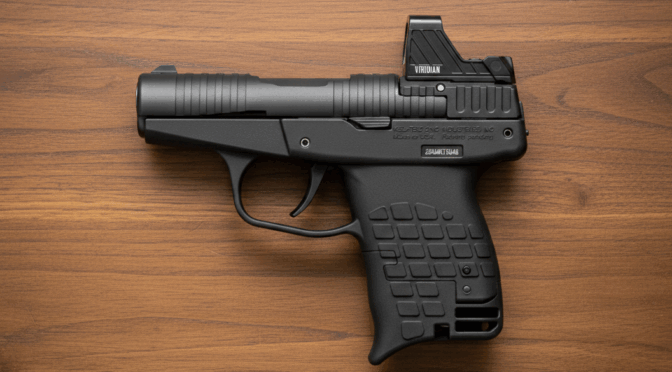
Executive Summary
The landscape of concealed carry weaponry is defined by an eternal engineering compromise: the inverse relationship between concealability and shootability. For over two decades, the Kel-Tec P-3AT has stood as the primary reference point for this compromise, essentially creating the modern “pocket pistol” genre in 2003. This report provides an exhaustive industry analysis and engineering review of the P-3AT platform, tracing its trajectory from a market-disrupting innovation to a legacy artifact, and finally, to its radical 2026 evolution, the PR-3AT.
Our analysis, grounded in technical specifications, market data, and longitudinal sentiment tracking, reveals that the P-3AT achieved market dominance not through perfection of finish or ease of use, but through the ruthless prioritization of dimensional minimalism. By successfully adapting a locked-breech mechanism into a sub-9-ounce polymer chassis, Kel-Tec rendered the blowback .380s of the 20th century obsolete. However, this engineering aggression came at a cost: a reputation for spotty reliability, a dependency on user-performed finishing (the “fluff and buff”), and a punishing recoil impulse that polarized the consumer base.
The discontinuance of the P-3AT in 2022 and the subsequent introduction of the PR-3AT at SHOT Show 2026 marks a paradigm shift in the sector. The PR-3AT abandons the modified Browning tilting barrel of its predecessor in favor of a rotary-barrel, top-loading ecosystem derived from the PR-5.7. This shift addresses the primary ballistic complaints of the legacy system—recoil management and capacity—while introducing a controversial manual of arms reliant on stripper clips.
This report concludes that while the legacy P-3AT remains a viable, if demanding, option for deep concealment in the secondary market, the PR-3AT represents a superior engineering solution for the modern threat environment, offering a ballistic density (firepower per ounce) that currently has no equal in the industry. The transition from box magazines to internal capacity represents a calculated risk by Kel-Tec, betting that the civilian defender prioritizes carry comfort and initial capacity over the tactical dogma of rapid reloading.
1. Historical Genesis and Market Disruption
To evaluate the Kel-Tec P-3AT, one must first contextualize the stagnation of the personal defense market at the turn of the millennium. The late 1990s were dominated by the “Wonder Nine” double-stack service pistols, yet the civilian concealed carry market was severely underserved regarding true pocket portability. The available options in .380 ACP (Automatic Colt Pistol) were predominantly blowback-operated designs such as the Walther PPK, the SIG Sauer P230, or the Bersa Thunder.
1.1 The Blowback Stagnation
The blowback mechanism relies purely on the mass of the slide and the strength of the recoil spring to delay the opening of the breech until chamber pressure has dropped to safe levels.1 In the context of the .380 cartridge, this necessitated a heavy steel slide. Consequently, pistols were heavy (often exceeding 20 ounces) and transmitted a sharp, direct recoil impulse to the shooter’s hand, as there was no unlocking action to dissipate energy.
1.2 The Kellgren Doctrine
George Kellgren, the founder of Kel-Tec and the lead designer behind the P-3AT, approached this problem with a distinct engineering philosophy: mass reduction through locked-breech geometry. By utilizing a modified Browning short-recoil system, where the barrel and slide move rearward together before unlocking, the slide no longer needed to be a massive inertial weight.3 This allowed for the use of lighter materials and a significant reduction in overall mass.
The proof of concept arrived in 1999 with the P-32, chambered in.32 ACP. It was an instant commercial success, validating the demand for ultra-lightweight polymer pistols. However, the American market maintained a skepticism regarding the lethality of the.32 ACP cartridge. The engineering challenge, therefore, was to scale this architecture to the more potent.380 ACP without significantly increasing the footprint.
1.3 Launch and Market Hegemony (2003-2008)
The P-3AT (Pistol, .380 Auto) was released in 2003. The specifications were revolutionary for the time: a locked-breech .380 weighing only 8.3 ounces unloaded and measuring just 0.77 inches in width.3 This product effectively created the “Micro.380” category. For five years, Kel-Tec enjoyed a virtual monopoly in this segment. The firearm was not merely a product; it was an enabler of a new lifestyle of “always-on” carry.
The impact of the P-3AT cannot be overstated. It forced major competitors, who had previously ignored the budget polymer pocket sector, to pivot their R&D resources. This culminated in 2008 with the release of the Ruger LCP, a firearm so mechanically similar to the P-3AT that it sparked widespread industry debate regarding design intellectual property and the ethics of “cloning” unpatented innovations.6
2. Technical Anatomy of the P-3AT
The P-3AT is a study in minimalist efficiency, where every component serves multiple functions to reduce part count and weight. It is comprised of 36 parts, a relatively low number for a semi-automatic pistol.8
2.1 Chassis Architecture
Unlike traditional pistols where the serialized “firearm” is the entire frame, the P-3AT utilizes a 7075-T6 aluminum block (the receiver) that houses the firing mechanism. This block is pinned into a glass-filled nylon grip module.3 This hybrid construction was key to achieving the 8.3-ounce weight. The polymer grip takes no structural stress from the firing cycle; it merely serves as the interface for the shooter’s hand and the magazine well.
2.2 The Modified Browning Short-Recoil System
The heart of the P-3AT is its locking mechanism.
- The Locking Block: The barrel features a squared-off shoulder that locks into the ejection port of the slide.
- The Camming Action: Instead of a swinging link (like a 1911), the P-3AT uses a kidney-shaped cam cut on the barrel lug. Upon firing, the barrel and slide move rearward together for approximately 5mm. The cross-pin in the frame interacts with the cam cut, pulling the barrel downward.
- Unlocking: This downward movement disengages the barrel shoulder from the slide, halting the barrel’s movement while the slide continues rearward to extract the spent casing and compress the recoil springs.4
This system creates a “dwell time” where pressure drops before the breech opens, preventing case ruptures without the need for heavy slide mass. However, the lightness of the slide (approximately 6 ounces) means the slide velocity is incredibly high, necessitating a very stiff dual-recoil spring arrangement.4
2.3 Trigger Mechanism (Double Action Only)
The P-3AT utilizes a hammer-fired, Double Action Only (DAO) system. There is no manual safety lever; the long, relatively heavy trigger pull (approx. 5-6 lbs) serves as the primary safety mechanism.5
- Hammer Block: An internal hammer block prevents the hammer from striking the firing pin unless the trigger is fully depressed, making the pistol drop-safe.3
- Trigger Dynamics: The trigger bar pulls the hammer back and then releases it. The reset is long, requiring the trigger to be released almost fully forward. This design is intentional for a pocket pistol, reducing the likelihood of a negligent discharge under stress, but it makes rapid, accurate fire difficult for inexperienced shooters.9
2.4 Extractor and Ejector
The extraction system is an external spring-loaded claw. The ejector is a fixed protrusion on the aluminum sub-frame.4 Due to the miniaturization of these parts, the extractor spring tension is critical. If the spring is too weak, the claw jumps the rim (Failure to Extract). If too strong, it can prevent the slide from closing (Failure to Feed). This delicate balance is a frequent source of reliability issues discussed in technical forums.10
3. Operational Performance and Reliability Analysis
Reliability in micro-compact pistols is a complex equation involving firearm physics, ammunition consistency, and shooter biomechanics. The P-3AT is widely regarded in technical circles as a “high-maintenance” platform that requires a knowledgeable operator.
3.1 The “Limp Wrist” Phenomenon
The physics of the P-3AT make it susceptible to “limp wristing.” Because the frame is so light, it has very little inertia. If the shooter’s grip is not rigid, the frame moves rearward with the slide during recoil, effectively shortening the slide’s travel relative to the frame.2 This robs the slide of the energy needed to fully eject the casing and strip a new round, leading to stovepipe jams. This is not strictly a mechanical failure, but a system failure where the shooter is an integral structural component of the recoil cycle.12
3.2 The “Smiley” Feed Geometry
One of the most documented behaviors of the P-3AT is the “Smiley.” The distance from the top of the magazine to the chamber is extremely short, and the feed angle is steep. When the slide drives a round forward, the nose of the bullet often strikes the feed ramp with significant force before sliding up into the chamber.
- Deformation: This impact can indent the soft lead nose or copper jacket of the bullet, creating a smile-shaped depression.
- Ballistic Consequence: While often cosmetic, severe deformation can alter the aerodynamics of the projectile or, more critically, clog the hollow point cavity, preventing expansion upon impact.13
3.3 The “Fluff and Buff” Culture
Perhaps unique to Kel-Tec products of this era is the concept of the “Fluff and Buff.” This term refers to a series of user-performed polishing operations considered mandatory by the enthusiast community to ensure reliability out of the box.
- The Cause: To maintain a low price point (MSRP ~$340), Kel-Tec minimized post-machining hand-finishing. This often left tool marks on the feed ramp and friction on the slide rails.5
- The Procedure: Users typically use 600-grit sandpaper or a Dremel polishing wheel to smooth the feed ramp (to fix the Smiley/feed issues) and the interface between the hammer and the slide (to smooth the trigger pull).13
4. The 2026 Paradigm Shift: The PR-3AT
In January 2026, Kel-Tec unveiled the successor to the P-3AT: the PR-3AT. This launch at SHOT Show 2026 signaled a complete departure from the design lineage of the previous two decades. While the P-3AT was defined by its locked-breech tilting barrel and box magazine, the PR-3AT is defined by its rotary barrel and internal magazine.15
4.1 Engineering the Rotary Barrel System
The decision to implement a rotary barrel in a micro-compact .380 is a sophisticated engineering maneuver aimed at the platform’s biggest weakness: recoil.
- Mechanics: In the PR-3AT, the barrel does not tilt. Instead, a lug on the barrel rides in a helical track within the frame. As the bullet exits and the slide begins to recoil, the barrel is forced to rotate on its longitudinal axis to unlock from the slide.17
- Recoil Attenuation: Physics dictates that energy cannot be destroyed, only converted. The rotary mechanism converts a portion of the linear recoil energy into angular momentum (rotational torque). This conversion effectively “bleeds off” some of the rearward force that would otherwise be transmitted directly to the shooter’s hand. For a lightweight .380, which is notoriously “snappy” due to the rapid slide velocity, this promises a flatter, softer shooting experience.16
- Radial Dissipation: Furthermore, the friction generated by the rotation itself acts as a delaying mechanism, smoothing out the pressure curve. This allows the use of slightly lighter recoil springs, which in turn makes the slide easier to rack—a critical feature for shooters with weaker hand strength.16
4.2 The Magazine-less Chassis Concept
The most radical aspect of the PR-3AT is the elimination of the detachable box magazine.
- Volumetric Optimization: A traditional magazine requires four walls (two for the mag, two for the grip). By removing the magazine, Kel-Tec utilizes the entire internal volume of the grip for ammunition. This allows the PR-3AT to hold 13+1 rounds of .380 ACP in a grip that is only 0.944 inches wide.17
- Structural Rigidity: The grip frame is a continuous, closed loop. This increases the torsional rigidity of the frame, potentially enhancing accuracy by providing a more stable platform for the firing mechanism.
4.3 The Stripper Clip Manual of Arms
The trade-off for this capacity and thinness is the reload method. The PR-3AT is top-loaded via 7-round stripper clips (or “chargers”).
- The Procedure: The user locks the slide to the rear, inserts a charger into the ejection port guide, and presses the rounds down into the internal reservoir.
- Cognitive Load Analysis: While this system is mechanically efficient, it introduces a high training barrier. Reloading with a stripper clip is a fine motor skill that requires precise alignment. In a high-stress defensive scenario, fumbling a stripper clip is a catastrophic failure mode compared to the gross motor skill of inserting a box magazine.
- Tactical Philosophy: This design shift suggests a change in tactical doctrine. The PR-3AT is designed with the assumption that 14 rounds is sufficient to resolve a civilian defensive encounter without reloading. It prioritizes “carry capacity” over “sustained fire” capabilities.15
5. Comparative Analysis: PR-3AT vs. Modern Competitors
The P-3AT operated in a vacuum for years, but the PR-3AT enters a saturated market dominated by “Micro-9s” and high-capacity .380s. The primary competitors in 2026 are the Ruger LCP Max and the Smith & Wesson Bodyguard 2.0.
5.1 Density Analysis: The Firepower Ratio
The critical metric for 2026 is “Firepower Density”—how many rounds can be carried per ounce of weight and inch of width.
Data Comparison:
- Kel-Tec PR-3AT: 13+1 Capacity / 9.66 oz Weight / 0.944″ Width.17
- Ruger LCP Max: 10+1 Capacity / 10.6 oz Weight / 0.81″ Slide Width (0.97″ Grip Width).19
- S&W Bodyguard 2.0: 10+1 Capacity / 9.8 oz Weight / 0.88″ Width.21
Analysis:
The data indicates a distinct engineering victory for the Kel-Tec PR-3AT regarding pure efficiency. It offers a 30% increase in standard capacity (13 vs 10) while weighing less than the LCP Max and arguably the same as the Bodyguard 2.0.
- Width Nuance: While the LCP Max lists a slide width of 0.81″, the grip swells to 0.97″ to accommodate the double-stack magazine. The PR-3AT achieves a 13-round capacity with a maximum width of 0.944″, making it dimensionally superior in the grip area where printing is most likely to occur.17
5.2 Trigger Characteristics
- PR-3AT: The trigger remains a Double Action Only (DAO) pull, rated at 4.5 lbs. However, reports from SHOT Show 2026 describe it as “smooth” with “no stacking,” akin to a refined revolver trigger. This is a significant improvement over the legacy P-3AT’s heavy 6-8 lb pull.9
- Bodyguard 2.0: S&W utilizes a striker-fired system with a crisp, flat-faced trigger that breaks around 4.5 lbs. This is generally preferred by modern shooters accustomed to Glock-style triggers.24
- LCP Max: Ruger employs a single-action internal hammer system (Secure Action) that provides a short, crisp break.
Synthesis: The PR-3AT’s trigger is likely its most polarizing feature relative to competitors. While smoother than its predecessor, the long DAO pull is mechanically slower than the striker/single-action systems of S&W and Ruger.
6. Ballistic Efficacy of the Platform
The P-3AT and PR-3AT are chambered in.380 ACP (9x17mm). The effectiveness of this cartridge in a barrel length of ~2.75 inches is a subject of intense ballistic scrutiny.
6.1 Velocity and Expansion Thresholds
Standard .380 ACP ballistics are often measured from 3.75-inch test barrels. When fired from the 2.75-inch barrel of a P-3AT, significant velocity loss occurs.
- The 900 FPS Barrier: Many 90-grain hollow point projectiles require a minimum velocity of 900-950 feet per second (fps) to initiate reliable expansion. From a P-3AT, standard pressure loads often clock in at 850-900 fps.
- Failure Mode: If the bullet fails to expand, it behaves like a Full Metal Jacket (FMJ) round, over-penetrating the target with a narrow wound channel. Conversely, if it expands too aggressively at low velocity, it may under-penetrate (failing to reach the FBI minimum of 12 inches in gel).
6.2 Ammunition Selection Strategy
Given these constraints, ammunition selection is not optional; it is critical.
- Modern Engineering: Loads such as the Federal Hydra-Shok Deep and Hornady Critical Defense are specifically engineered for short-barrel performance, utilizing propellants that burn faster to maximize velocity in the limited bore length.9
- The Penetration Priority: Due to the marginal energy, many P-3AT users deliberately choose FMJ or “flat nose” ammunition to guarantee penetration, sacrificing expansion for reliability and depth.11
7. Customer Sentiment and Brand Perception
7.1 The “Beta Tester” Narrative
Kel-Tec has cultivated a unique brand identity: “High Innovation, Low Refinement.”
- Sentiment Analysis: Analysis of forum threads from 2008 to 2026 reveals a consistent pattern. Users praise Kel-Tec for “daring” designs (P-3AT, KSG, RFB) but frequently criticize the execution. There is a pervasive sentiment that Kel-Tec owners are essentially “beta testers” for concepts that are later refined by other companies (e.g., Ruger copying the P-3AT to make the LCP).7
- The “Fluff and Buff” Acceptance: Remarkably, the community has normalized the need to finish the gun themselves. This speaks to the unique value proposition: users are willing to perform labor to obtain a gun that is lighter and thinner than anything else on the market.
7.2 Reception of the PR-3AT (2026)
Initial reactions to the PR-3AT at SHOT Show 2026 have been a mix of confusion and excitement.
- The “Clip” Controversy: The return to stripper clips has generated significant skepticism. Users question the viability of carrying spare ammo on a plastic strip in a pocket versus a durable magazine.
- The Capacity Win: However, the 13+1 capacity in a sub-1-inch frame is universally applauded. For users in jurisdictions with magazine capacity limits (10 rounds), the PR-3AT 10 model offers a compliant option that is even smaller (3.93″ height), appealing to the “deep cover” demographic.16
8. Strategic Conclusion and Buying Recommendations
The Kel-Tec P-3AT lineage represents the bleeding edge of portability. It is not a platform for the casual shooter; it is a specialized tool for specific threat profiles.
8.1 Recommendation: The Legacy P-3AT (Secondary Market)
- Verdict: Conditional Buy.
- Use Case: Ideal for non-permissive environments (e.g., jogging, formal events, beach carry) where the absolute minimum footprint is required. It disappears where even an LCP Max might print.
- Caveats: It is essential that the buyer is willing to perform a reliability inspection (check for the “Smiley,” polish the feed ramp) and validate the gun with at least 200 rounds of the specific defensive ammo intended for carry. It is not recommended for novice shooters due to the recoil and maintenance requirements.
8.2 Recommendation: The New PR-3AT (2026 Model)
- Verdict: High-Value Innovation.
- Use Case: The PR-3AT is the superior choice for users who prioritize capacity density. If the goal is to have the maximum amount of firepower in the smallest possible package, the PR-3AT (13 rounds / 9.6 oz) has no rival. The rotary barrel makes it more shootable than its predecessor, mitigating the recoil complaint.
- Caveats: The user must accept the limitations of the top-loading system. This is a gun designed to end a fight with what is in the gun. It is not designed for sustained firefights requiring rapid tactical reloads.
8.3 Final Assessment
Is the Kel-Tec P-3AT (and PR-3AT) worth buying? Yes, but only if you understand its nature. It is an expert’s tool disguised as a budget gun. It trades comfort and ease of use for the tactical advantage of being present when other guns are left at home. In the equation of survival, the gun you have with you is infinitely superior to the one you left in the safe, and by that metric, the P-3AT platform remains one of the most effective defensive tools ever engineered.
Appendix A: Methodology
1. Research Scope and Data Sources
This report synthesizes data from a diverse array of sources to construct a holistic view of the P-3AT platform.
- Technical Documentation: Manufacturer specifications (Kel-Tec, Ruger, S&W), owner’s manuals 8, and patent filings were analyzed to determine physical dimensions, operating mechanisms, and material composition.
- Market Intelligence: Industry news from SHOT Show 2026 15, historical pricing trends, and competitor product launch data were used to map the strategic landscape.
- User Sentiment Mining: Qualitative data was harvested from high-traffic enthusiast communities (Reddit r/Guns, r/KelTec, r/CCW, The Firearm Blog).7 This “voice of the customer” data was categorized into sentiment clusters (e.g., “Reliability,” “Ergonomics,” “Value”).
2. Analytical Frameworks
- Dimensional Normalization: To compare firearms of varying sizes, we utilized a “Density Index” (Capacity / Volume) and “Weight Efficiency” (Rounds / Ounce). This allows for an objective comparison between the single-stack P-3AT and the high-capacity PR-3AT.
- Tribological Assessment: Analysis of failure modes (FTE/FTF) was conducted through the lens of tribology (friction and wear), specifically examining the aluminum-steel interface and feed ramp geometry to explain the “Fluff and Buff” phenomenon scientifically.
3. Limitations
- PR-3AT Data Maturity: As the PR-3AT is a 2026 release, long-term reliability data (10,000+ round endurance tests) is not yet available. Reliability assessments for this model are projections based on the similar PR-5.7 architecture and initial hands-on reports from industry events.
- Ammunition Variability: Performance data (velocity/expansion) is highly sensitive to specific ammunition batches. Ballistic conclusions are generalities based on standard pressure curves for the.380 ACP cartridge in short barrels.
If you find this post useful, please share the link on Facebook, with your friends, etc. Your support is much appreciated and if you have any feedback, please email me at in**@*********ps.com. Please note that for links to other websites, we are only paid if there is an affiliate program such as Avantlink, Impact, Amazon and eBay and only if you purchase something. If you’d like to directly contribute towards our continued reporting, please visit our funding page.
Sources Used
- The Science Behind Recoil Reduction Systems: Do They Really Work?, accessed January 23, 2026, https://www.rainierarms.com/blog/the-science-behind-recoil-reduction-systems-do-they-really-work.html
- Recoil – Wikipedia, accessed January 23, 2026, https://en.wikipedia.org/wiki/Recoil
- KelTec P3AT Review: The Original Lightweight .380 Pocket Pistol – Alien Gear Holsters, accessed January 23, 2026, https://aliengearholsters.com/blogs/news/keltec-p3at-review
- Review: Kel-Tec P3AT | An Official Journal Of The NRA – American Rifleman, accessed January 23, 2026, https://www.americanrifleman.org/content/review-kel-tec-p3at/
- P3AT Pistol | Six Leading Innovations, One Powerful Pistol – KelTec, accessed January 23, 2026, https://www.keltecweapons.com/discontinued/p3at/
- Kel Tec P3AT vs Ruger LCP: Which is the Best Budget-Friendly CCW? – Vedder Holsters, accessed January 23, 2026, https://www.vedderholsters.com/blog/kel-tec-p3at-vs-ruger-lcp/
- Ruger LCP and the Kel Tec P-3AT, What’s the difference, who bought what, and why is the LCP (seemingly) more popular? : r/guns – Reddit, accessed January 23, 2026, https://www.reddit.com/r/guns/comments/1q5dk8/ruger_lcp_and_the_kel_tec_p3at_whats_the/
- KEL-TEC-P3AT-Owners-Manual.pdf – M*CARBO, accessed January 23, 2026, https://www.mcarbo.com/.Owners%20Manuals/KEL-TEC-P3AT-Owners-Manual.pdf
- KelTec P3AT .380 Pistol Review – Guns.com, accessed January 23, 2026, https://www.guns.com/news/reviews/keltec-p3at-concealed-carry-micro-380-pistol-review
- Kel Tec P3AT: Fail-a-Thon – Jams Galore! – YouTube, accessed January 23, 2026, https://www.youtube.com/watch?v=8ZlXylQSaBM
- Kel Tec P3AT bit me. First time at the range with it. : r/guns – Reddit, accessed January 23, 2026, https://www.reddit.com/r/guns/comments/pgg6f/kel_tec_p3at_bit_me_first_time_at_the_range_with/
- Need advice P-3AT : r/keltec – Reddit, accessed January 23, 2026, https://www.reddit.com/r/keltec/comments/1q8gs8w/need_advice_p3at/
- Need advice P-3AT : r/keltec – Reddit, accessed January 23, 2026, https://www.reddit.com/r/keltec/comments/1q8gs6g/need_advice_p3at/
- My Kel-Tec P3AT, 12 Years, One Repair and Amazing Customer Service. : r/guns – Reddit, accessed January 23, 2026, https://www.reddit.com/r/guns/comments/7mvgdf/my_keltec_p3at_12_years_one_repair_and_amazing/
- [SHOT 2026] 14 Rounds in the Palm of Your Hand – KelTec’s PR-3AT – The Firearm Blog, accessed January 23, 2026, https://www.thefirearmblog.com/blog/shot-2026-14-rounds-in-the-palm-of-your-hand-keltecs-pr-3at-44825440
- KelTec Did It Again: Meet the PR-3AT .380 Carry Pistol – Gritr Range, accessed January 23, 2026, https://range.gritrsports.com/blog/new-keltec-pr-3at-380-carry-pistol/
- PR-3AT™ – KelTec, accessed January 23, 2026, https://www.keltecweapons.com/firearm/pistols/pr-3at/
- Rotary-Barrel Pistols: A Design That Has Come Full-Circle | An Official Journal Of The NRA, accessed January 23, 2026, https://www.americanrifleman.org/content/rotary-barrel-pistols-a-design-that-has-come-full-circle/
- Ruger® LCP® MAX Centerfire Pistol Model 13716, accessed January 23, 2026, https://ruger.com/products/lcpMax/specSheets/13716.html
- Ruger LCP vs LCP Max: Which One You Should Use? – Wright Leather Works, accessed January 23, 2026, https://www.wrightleatherworks.com/blogs/article/ruger-lcp-vs-lcp-max
- SMITH & WESSON Bodyguard 2.0 380 ACP 2.75″ 10/12rd Pistol w/ Manual Safety – Black, accessed January 23, 2026, https://www.kygunco.com/product/smith-wesson-bodyguard-2.0-380-acp-2.75-10-12rd-pistol-w-manual-safety-black
- S&W Bodyguard vs. Bodyguard 2.0: What’s New? | The Mag Shack, accessed January 23, 2026, https://themagshack.com/sw-bodyguard-vs-bodyguard-2-0/
- The PR-3AT: KelTec’s Magazine-Free .380 | An Official Journal Of The NRA, accessed January 23, 2026, https://www.americanrifleman.org/content/the-pr-3at-keltec-s-magazine-free-380/
- Smith & Wesson Bodyguard 2.0: Full Review – Guns and Ammo, accessed January 23, 2026, https://www.gunsandammo.com/editorial/smith-bodyguard-2/505182
- How do we feel about the Keltec PR-3AT : r/H3VR – Reddit, accessed January 23, 2026, https://www.reddit.com/r/H3VR/comments/1qhlvjc/how_do_we_feel_about_the_keltec_pr3at/
- KelTec PR-3AT vs S&W Bodyguard 2.0 Which is the better deal? : r/CCW – Reddit, accessed January 23, 2026, https://www.reddit.com/r/CCW/comments/1qika7s/keltec_pr3at_vs_sw_bodyguard_20_which_is_the/