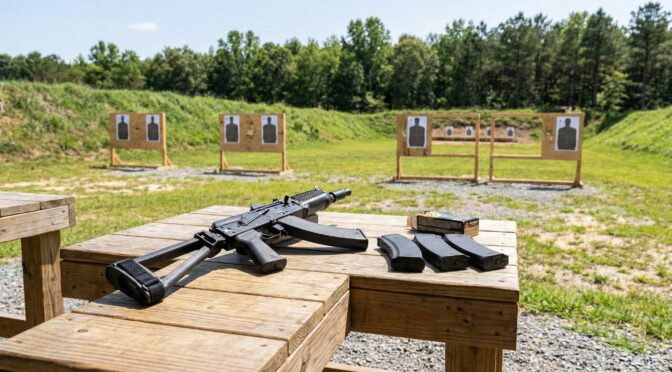
The introduction of the “Krinkov” series by Palmetto State Armory (PSA) under its Soviet Arms sub-brand represents a pivotal development in the American domestic firearms manufacturing sector. This report provides an exhaustive technical and market analysis of the platform, evaluating its engineering viability, performance characteristics across multiple calibers (5.56x45mm,.300 AAC Blackout, and 7.62x39mm), and its reception within the consumer enthusiast market.
The AKS-74U “Krinkov” has historically been an elusive asset in the United States due to strict import restrictions on non-sporting firearms and the scarcity of original Tula tooling. PSA’s strategic initiative to mass-produce a domestic clone utilizing established vertical integration supply chains challenges the long-standing dominance of European imports and boutique custom builders. Our analysis indicates that while PSA has successfully replicated the external aesthetic and form factor of the Soviet original, the platform exhibits distinct “generation one” technical hurdles, particularly in the adaptation of Western cartridges to the Kalashnikov gas system.
Engineering scrutiny reveals a robust foundation built upon hammer-forged 4340AQ trunnions and bolts, addressing historical weaknesses in American-made AK cast components. However, the decision to utilize 4150 CMV nitrided barrels rather than cold hammer-forged chrome-lined barrels remains a point of contention regarding long-term thermal endurance. Furthermore, the.300 Blackout variant demonstrates significant operational volatility with subsonic ammunition, necessitated by an undersized gas port configuration that often requires end-user modification for reliability.
Market analysis suggests that the PSA Krinkov offers a disruptive value proposition, priced approximately 30-40% below comparable imports like the Zastava ZPAP85 or WBP Mini Jack when factoring in feature sets such as hinged dust covers and folding trunnions. Consumer sentiment is cautiously optimistic, valuing the platform as a high-fidelity “range toy” and suppressor host, though reliability concerns in specific firing schedules prevent it from currently achieving “duty grade” status without individual unit verification.
This report concludes that the PSA Soviet Arms Krinkov is a technically competent, albeit occasionally unrefined, manufacturing achievement that democratizes a historically restricted platform. It is recommended as a strong buy for enthusiasts and technical tinkerers, while institutional or defensive users are advised to await further product maturity or invest in thorough validation testing.
1. Strategic Market Context and Industrial Base
The genesis of the PSA Soviet Arms Krinkov cannot be understood without analyzing the unique market vacuum it intends to fill. The AKS-74U, originally designed in the late 1970s as a Personal Defense Weapon (PDW) for Soviet vehicle crews and Spetsnaz units, occupies a legendary status in the American firearms community.1
1.1 The “Krinkov” Mystique and Supply Vacuum
The term “Krinkov” itself is a Western colloquialism, likely emerging from the Soviet-Afghan War, referring to the AKS-74U short-barreled rifle.3 In the United States, the availability of this specific firearm has been severely throttled by legislation. The 1989 Import Ban on “non-sporting” firearms and subsequent executive actions prevented the direct importation of Russian military surplus rifles. Consequently, American collectors were forced to rely on expensive, demilitarized parts kits—often costing upwards of $3,000 for the parts alone—rebuilt onto American receivers.4
For decades, the market for a “Krink” was bifurcated: at the high end were Arsenal Inc. imports (SLR-104UR) which commanded premium pricing and are now largely out of production, and at the low end were “Krink-style” pistols like the Zastava M85 or Draco, which lacked the specific aesthetic and mechanical features (hinged dust cover, specific gas block geometry) of a true clone.1
Palmetto State Armory identified this specific gap—a demand for a faithful, affordable, readily available Krinkov clone—and leveraged their industrial capacity to fill it. This move is not merely a product launch but a strategic capture of a “grail gun” market segment that had previously been inaccessible to the average consumer.1
1.2 Palmetto State Armory’s Vertical Integration Strategy
PSA’s ability to bring the Krinkov to market at a price point of roughly $1,100 represents a triumph of vertical integration.5 Unlike smaller builders who must source trunnions from one vendor, barrels from another, and receivers from a third, PSA controls the majority of its supply chain.
The acquisition of Toolcraft, a major OEM manufacturer of bolt carrier groups, provided PSA with the internal capability to produce high-stress components like the bolt and trunnion in-house.6 This control over metallurgy and dimensional tolerancing is critical for the AK platform, where “stacking tolerances” between disparately sourced parts often lead to catastrophic failures or poor reliability. By forging their own trunnions and bolts, PSA can ensure dimensional consistency that arguably rivals or exceeds the “kit build” market, where parts wear-mating can be unpredictable.7
Furthermore, PSA’s investment in barrel manufacturing allows them to produce the 8.4-inch barrels specifically profiled for the Krinkov gas system without relying on external blanks. This reduces the cost of goods sold (COGS) significantly, allowing them to undercut importers who must pay shipping, import duties, and 922(r) compliance conversion costs.3
1.3 The “Soviet Arms” Sub-Brand Positioning
The branding of this lineup under the “Soviet Arms” umbrella is a deliberate marketing tactic to differentiate these products from the standard PSA “GF” (Generation Forged) line. The “Soviet Arms” designation implies a higher degree of fidelity to original Combloc aesthetics and features.8
This sub-brand focuses on features that purists demand:
- Hinged Dust Covers: A notoriously difficult feature to manufacture correctly due to the need for precise pivot geometry to hold zero for rear sights.9
- 4.5mm Side Folding Trunnions: Adhering to the specific Soviet pin diameter standard rather than creating a proprietary mechanism, ensuring compatibility with surplus stocks.10
- Furniture Fidelity: The use of “Plum Gloss” and “Classic Red” wood furniture that mimics the look of Tula factory production, rather than generic polymer or unfinished wood.11
By segregating these products into a distinct sub-brand, PSA signals to the market that these are enthusiast-grade collectibles, justifying a higher price point than their standard AKs while still remaining accessible compared to the secondary market for imports.8
2. Technical Architecture and Engineering Specifications
The engineering challenge undertaken by PSA was substantial: adapting a Technical Data Package (TDP) designed for the 5.45x39mm cartridge and Soviet manufacturing cells to work with American raw materials, manufacturing techniques (CNC vs. manual milling), and Western calibers.
2.1 Receiver Geometry and Stamping Dynamics
The structural spine of the PSA Krinkov is a 1.0mm stamped steel receiver.11 In the world of Kalashnikovs, receiver thickness is a primary differentiator.
- 1.0mm Standard: The original AKS-74U utilized a 1.0mm receiver. PSA’s adherence to this thickness is technically “clone correct” and reduces the overall weight of the firearm, enhancing its role as a PDW.2
- Rigidity vs. Weight: While some competitors like Zastava utilize a 1.5mm receiver with a bulged trunnion (derived from the RPK light machine gun), the 1.0mm receiver is sufficient for the intermediate cartridges used here. The dimpled receiver design adds necessary structural rigidity around the magazine well, preventing flex during firing.5
However, the use of a 1.0mm receiver means that heat dissipation is lower compared to thicker receivers. During high volumes of fire, the receiver will heat up faster, potentially transferring heat to the shooter’s hand and face more rapidly than heavier variants. Engineering analysis of the rivet work—specifically the “swell neck” rivets used in the trunnion assembly—suggests that PSA has mastered the hydraulic riveting process required to secure the trunnion into the thinner sheet metal without warping the receiver shell.5
2.2 Metallurgical Composition: The 4340AQ Trunnion
Perhaps the most critical engineering specification in any American-made AK is the metallurgy of the front trunnion. The trunnion acts as the locking shoulder for the bolt; if it is too soft, the headspace will expand until the rifle explodes (catastrophic failure). If it is too brittle, it will crack under the bolt’s impact.
PSA utilizes Hammer Forged 4340AQ (Aircraft Quality) Steel for the front trunnion.10
- Material Science: 4340 steel is a nickel-chromium-molybdenum alloy known for its deep hardenability and extreme toughness. It is significantly superior to the cast 4140 steel used in early, infamous American AK attempts (like the RAS47).
- Forging vs. Casting: The hammer forging process aligns the grain structure of the metal to the shape of the part, vastly increasing its resistance to impact fatigue. By utilizing 4340AQ, PSA provides a safety factor that likely exceeds that of the original Soviet manufacturing, which often used varying grades of carbon steel depending on wartime availability.7
The bolt and bolt carrier are also hammer forged. This triad of forged components (Trunnion, Bolt, Carrier) creates a “closed loop” of high-strength materials containing the explosion, addressing the primary skepticism of AK purists regarding US-made parts.7
2.3 Barrel Technology: 4150 CMV and Nitride Treatment
The barrel specification represents a divergence from the Soviet standard. PSA utilizes 4150 Chrome Moly Vanadium (CMV) steel with a Gas Nitride finish.10
- Nitride vs. Chrome Lined: The original AKS-74U featured a cold hammer-forged (CHF), chrome-lined barrel. Chrome lining is an additive process that adds a layer of hard chrome to the bore, providing exceptional heat resistance and corrosion protection, critical for full-auto fire and corrosive surplus ammo.13
- The PSA Approach: Nitriding is a surface conversion process that hardens the steel itself. While it offers excellent corrosion resistance and surface lubricity (increasing velocity slightly), it does not provide the same thermal barrier as chrome lining. Under semi-automatic firing schedules, the difference is negligible. However, for a “clone” product, the lack of a chrome-lined CHF barrel is a cost-saving measure that places it a tier below the premium imports in the eyes of collectors.13
2.4 Gas System Dynamics: The “Krink” Booster Function
The Krinkov utilizes an extremely short gas system. The distance from the chamber to the gas port is minimal, resulting in very short “dwell time”—the duration the bullet remains in the barrel after passing the gas port to pressurize the system.
- The Booster: To compensate for this, the muzzle device is a “booster” or expansion chamber. It traps expanding gases at the muzzle momentarily, increasing backpressure in the system to ensure the bolt carrier is thrown rearward with sufficient force to cycle.11
- Piston Design: PSA utilizes a standard AK piston design which is pinned to the carrier. Notably, users have observed “piston wobble” in these units.14 Engineering analysis confirms this is a feature, not a defect. The wobble allows the piston to self-center in the gas block, which is critical given the potential for thermal expansion and slight misalignment in stamped receivers. A rigid piston would lead to binding and failure to cycle.
Summary of Core Specifications
| Feature | Specification | Engineering Implication |
| Receiver | 1.0mm Stamped Steel | Standard weight; historically accurate; requires precision riveting. |
| Front Trunnion | 4340AQ Hammer Forged | Extremely high durability; mitigates headspace loss risks. |
| Barrel Material | 4150 CMV Steel | Industry standard for ARs; good balance of cost and performance. |
| Barrel Finish | Gas Nitride | Excellent corrosion resistance; less heat resistant than Chrome Lining. |
| Barrel Length | 8.4 Inches | Optimizes compactness; severely reduces velocity for 5.56mm. |
| Twist Rate (5.56) | 1:7 RH | Stabilizes heavy (62-77gr) defensive loads effectively. |
| Twist Rate (.300) | 1:7 RH | Sub-optimal for heavy subsonic loads (200gr+); compromise choice. |
| Muzzle Device | Krink Booster (M24x1.5) | Essential for reliability; proprietary thread pitch limits suppressor options. |
3. Variant Analysis: The 5.56x45mm NATO Model
The 5.56x45mm variant was the first to market, reflecting the ubiquity of this ammunition in the US. While commercially sensible, adapting the AK platform to 5.56 presents unique reliability challenges.
3.1 Ballistic Efficacy in Short Barrels
The 5.56mm cartridge relies heavily on velocity for terminal effectiveness (fragmentation). The 8.4-inch barrel of the Krinkov severely handicaps this cartridge.16
- Velocity Loss: Standard M193 (55gr) ball ammo, which achieves ~3,200 fps from a 20-inch barrel, drops to approximately 2,200–2,300 fps from an 8.4-inch barrel.
- Terminal Ballistics: At these velocities, 5.56mm ammunition often fails to fragment or yaw reliably upon impact, acting more like a.22 caliber drill. Users utilizing this firearm for defensive purposes must utilize specialized ammunition (such as soft points or bonded projectiles designed for expansion at lower velocities) rather than standard FMJ.
3.2 Feeding Geometry: The Bullet Guide and Magazine Interface
The 5.56mm case has a very slight taper compared to the drastic taper of the 7.62x39mm or 5.45x39mm. This straight-wall geometry makes extraction more difficult (higher friction) and feeding less reliable in a curved magazine.17
- Bullet Guide: PSA installs a specific 5.56mm bullet guide in the front trunnion to bridge the gap between the magazine and the chamber.7
- Magazine Sensitivity: The PSA Krink ships with a proprietary slab-side magazine. User reports indicate high reliability with this magazine, as well as compatibility with Bulgarian ((10)) polymer magazines and AC Unity magazines.1 However, the straight-walled cartridge combined with the curved “AK style” magwell geometry is an inherent compromise. The system is less tolerant of debris or magazine tilt than its 7.62 counterparts.
3.3 Operational Reliability and Dwell Time
Despite the challenges, the PSA 5.56 Krink has shown surprising resilience. The combination of the gas booster and a properly sized gas port generally allows the rifle to chew through standard brass-cased ammunition.18
- Steel Case Ammo: Some users report failures with underpowered steel-cased.223 ammunition.17 This is expected; steel cases do not seal the chamber (obturation) as well as brass, leading to gas blow-by and lower system pressure. Combined with the short dwell time, underpowered ammo can result in “short stroking” (bolt fails to travel fully rearward).
- Accuracy: Range reports consistently place the 5.56 variant in the 3-4 MOA range (3-4 inch groups at 100 yards).19 This is mechanically acceptable for a PDW with iron sights and a vibrating piston mass.
4. Variant Analysis: The.300 AAC Blackout Model
The .300 Blackout model represents the most conceptually intriguing yet technically volatile variant in the lineup. The cartridge is ballistically ideal for short barrels, but the AK gas system is not natively designed for the extreme pressure variance between supersonic and subsonic loads.
4.1 Subsonic Fluid Dynamics and Gas Port Sizing
The core issue plaguing the .300 BLK Krinkov is the cycling of subsonic ammunition (typically 200gr or 220gr) without a suppressor.12
- Pressure Deficit: Subsonic .300 BLK uses small charges of fast-burning pistol powder. This generates very little gas volume and pressure at the port compared to supersonic rounds.
- The “Under-Gassed” Condition: Extensive user data indicates that the factory gas port on early batches was sized conservatively (likely around 0.070″-0.080″) to prevent battering the gun with supersonic ammo.22 Consequently, unsuppressed subsonics often fail to cycle the action (short stroke) or fail to lock the bolt back on the last round.
- The User Fix: A consensus has emerged in the technical community that drilling the gas port to 0.125 inches (1/8th inch) is often required to achieve reliability with subs.11 This is a substantial modification that voids warranties and drastically over-gasses the gun for supersonic ammo, necessitating the use of an adjustable gas piston (like the KNS Precision piston) to regulate the excess energy when switching back to supers.
4.2 The Twist Rate Debate: 1:7 vs. 1:5
PSA utilizes a 1:7 twist rate for the.300 BLK barrel.11
- Physics of Stability: While 1:7 is the industry standard for 5.56mm and general-purpose.300 BLK, it is suboptimal for the ultra-short 8.4″ barrel when firing heavy subsonic projectiles. A slower projectile requires a faster spin to remain stable.
- The 1:5 Advantage: Industry leaders in the.300 BLK space (like Sig Sauer and Q) utilize a 1:5 twist in short barrels. This faster spin imparts greater rotational energy, ensuring immediate stability upon exit and maximizing the “rotational energy” transfer to the target.24
- Implication: PSA’s choice of 1:7 is a manufacturing compromise. It is “good enough” for most shooters, but it may result in keyholing (tumbling bullets) at extended ranges with very heavy projectiles, and it sacrifices terminal performance compared to a 1:5 twist barrel.
4.3 Suppressor Integration and Concentricity
The primary use case for a.300 BLK Krink is suppressed fire.
- Thread Pitch: The M24x1.5 thread pitch is massive and unique to the AK-74 platform. Most .30 caliber suppressors use 5/8×24 threads.
- Adaptation: Users must use thread adapters (which introduce tolerance stacking and risk baffle strikes) or specialized suppressors like the Dead Air Wolverine, which offers native M24 inserts.25
- Concentricity: Historically, AK threads were cut on a lathe during the barrel turning process relative to the outside diameter, not the bore, leading to misalignment. PSA cuts threads on modern CNC equipment relative to the bore center. Reports generally indicate good concentricity, but the risk of baffle strikes remains higher than on AR-15s due to the nature of the adapter stack.25
5. Variant Analysis: The 7.62x39mm Model
Released later in the cycle (October 2025), the 7.62x39mm variant represents a “return to form”.5
5.1 Returning to the Source: Ballistic Optimization
The 7.62x39mm cartridge is ballistically superior to 5.56mm in short barrels.
- Efficiency: The cartridge uses faster-burning powder than 5.56mm, achieving nearly complete powder burn in shorter lengths. The velocity loss from a 16″ to an 8″ barrel is far less dramatic percentage-wise than with 5.56mm.
- Energy Retention: A 123gr 7.62 projectile from an 8.4″ barrel retains significant kinetic energy, making this variant a credible defensive tool out to 200 yards, unlike the 5.56 version which is marginal past 100 yards.26
5.2 Comparative Recoil Impulse
The trade-off is recoil. The lightweight 1.0mm receiver combined with the heavy reciprocating mass of the bolt carrier and the recoil of the.30 caliber round results in a “snappy” shooting experience.
- Muzzle Rise: Without an effective brake (the booster is not a brake; it is a gas trap), the muzzle rise is significant. Follow-up shots are slower than with the 5.56 or.300 BLK variants.
- Reliability: This variant is inherently the most reliable. The tapered case feeds effortlessly into the chamber, and the large gas volume ensures positive extraction even when the gun is fouled.5
6. Manufacturing Quality and Endurance
As a domestic manufacturer, PSA is subject to intense scrutiny regarding the durability of its products compared to Combloc military factories.
6.1 The “Beta Testing” Paradigm
A recurring theme in consumer sentiment analysis is the concept of early adopters acting as “beta testers”.27
- Launch Issues: The initial batches of.300 BLK Krinks faced high rates of return due to the aforementioned gas port sizing issues. PSA has a history of “rolling updates,” where specifications are tweaked in subsequent batches without formal announcements.
- Warranty Reliance: PSA’s lifetime warranty is a critical component of the value proposition. While users express frustration at initial failures (such as broken firing pins or canted sights), the company’s willingness to repair or replace units at no cost acts as a significant buffer against negative sentiment.27
6.2 Wear Patterns in High-Round Count Samples
Endurance testing (5,000+ rounds) reveals specific wear patterns 1:
- Bolt Carrier Tail: “Mushrooming” of the bolt carrier tail (where it impacts the hammer) is a common AK issue. PSA’s use of proper heat-treating on the carrier seems to have mitigated this compared to earlier GF3 models.
- Trunnion Lugs: No reports of lug deformation or headspace loss have surfaced in the high-round count reviews analyzed, validating the 4340AQ forging choice.
- Small Parts: The most common failure points are small parts: extractor springs losing tension and firing pins breaking. These are cheap, user-replaceable maintenance items.
6.3 The Nitride vs. Chrome Lining Trade-off
From an industrial standpoint, PSA’s reliance on Nitriding is a cost optimization. Setting up a chrome-lining line is environmentally hazardous and expensive.
- Longevity: A chrome-lined barrel will generally outlast a nitrided barrel in full-auto fire or when subjected to extreme heat cycles (dumping 10 magazines back-to-back).
- Practicality: For the civilian user firing semi-auto, even rapidly, the Nitride finish provides comparable barrel life (15,000-20,000 rounds) before accuracy degrades significantly. The “Chrome Lined” requirement is often more about collector prestige than functional necessity for the average owner.13
7. Comparative Competitive Landscape
To determine if the PSA Krinkov is “worth buying,” it must be measured against its peers.
7.1 Zastava ZPAP85/M92: The Serbian Heavyweight
The Zastava ZPAP85 (5.56) and M92 (7.62) are the primary competitors.29
- Build Quality: Zastava uses a 1.5mm thick receiver with a bulged front trunnion. This makes the gun significantly heavier but theoretically stronger and more heat-absorbent than the PSA.
- Barrel: Zastava features a Chrome Lined, Cold Hammer Forged barrel, objectively superior to PSA’s nitrided barrel.
- Aesthetics: The Zastava is not a Krinkov. It has a longer 10″ barrel, no hinged dust cover (on standard models), and uses Yugo-pattern furniture which is incompatible with standard AK parts.
- Price: Street price ~$1,000 – $1,100.
- Verdict: Zastava is the better “duty” gun for harsh use; PSA is the better “clone” for enthusiasts who want the specific Krink aesthetic and compatibility.
7.2 WBP Mini Jack: The Polish Standard
The WBP Mini Jack is imported from Rogow, Poland.31
- Refinement: WBP is known for smoother machining and better surface finishes than both PSA and Zastava.
- Specs: Like the Zastava, it is an AKM pistol, not a Krink. It uses standard AKM handguards and lacks the hinged dust cover/booster combination.
- Price: ~$800 – $900 for the pistol, but requires substantial investment (brace adapter, muzzle devices) to match the PSA’s feature set.
- Verdict: A superior base for a custom build, but less “feature complete” out of the box than the PSA.
7.3 Arsenal SLR-104UR: The Legacy Benchmark
The Bulgarian Arsenal SLR-104UR is the gold standard.33
- Authenticity: It is a factory-built Krinkov on original Steyr tooling.
- Availability: Discontinued/Rare.
- Price: $3,000+ on the secondary market.
- Verdict: A collector’s item, not a competitor. The PSA offers 90% of the experience for 30% of the cost.
Competitive Matrix Comparison
| Feature | PSA Soviet Arms Krink | Zastava ZPAP85 | WBP Mini Jack 5.56 | Arsenal SLR-104UR |
| Origin | USA | Serbia | Poland | Bulgaria |
| Barrel Length | 8.4″ | 10″ | 10″ | 8.5″ (chopped) / 16″ |
| Receiver | 1.0mm Stamped | 1.5mm Bulged | 1.0mm Stamped | 1.0mm Stamped |
| Barrel Type | Nitride | Chrome Lined CHF | Nitride | Chrome Lined CHF |
| Dust Cover | Hinged (Krink Style) | Standard / Hinged (Alpha) | Standard | Hinged (Krink Style) |
| Furniture | AK-74/Krink Pattern | Yugo Pattern | AKM Pattern | AK-74/Krink Pattern |
| Price (Approx) | $1,050 – $1,100 | $1,000 – $1,200 | $850 + Accessories | $2,500 – $4,000 |
8. Consumer Sentiment and Aftermarket Ecosystem
The PSA Krinkov exists in a vibrant ecosystem of user feedback and modification.
8.1 The “Plum Gloss” Aesthetic and Historical Accuracy
A significant driver of positive sentiment is PSA’s attention to cosmetic detail. The “Plum Gloss” furniture option is frequently cited in reviews as being aesthetically stunning and close to the Tula “Russian Plum” polyamide look, even if the material itself is wood or modern polymer.11 This appeals to the “larping” (Live Action Role Play) demographic—enthusiasts who value the historical vibe of the gun as much as its function.
8.2 Furniture Compatibility and SBR Conversions
One of the platform’s strongest selling points is its adherence to the standard Krinkov furniture pattern. Unlike the Zastava M85, which requires proprietary Yugo handguards, the PSA Krink accepts standard surplus Krinkov handguards. This opens up a massive aftermarket of rails, wood sets, and accessories from Zenitco (Russian), SLR Rifleworks, and others.34
For users wishing to convert the pistol to a Short Barreled Rifle (SBR), the PSA “SBR Ready” models and the inclusion of the 4.5mm hinge pin mechanics make the process straightforward. Once the tax stamp is approved, the user simply knocks out the pin and installs a surplus triangle stock or polymer folder.10
8.3 Warranty as a Value Driver
The firearms community is notoriously critical. However, PSA’s warranty policy acts as a “get out of jail free” card for the buyer. Sentiment analysis shows that while users are annoyed by initial QC slips (canted sights, loose pistons), they are overwhelmingly positive about the resolution process. PSA repairs the guns, often tuning them better than factory standard during the RMA process. This safety net makes the purchase of a domestic AK—a category historically fraught with risk—palatable.27
9. Conclusion: Strategic Viability and Purchase Recommendations
The Palmetto State Armory Soviet Arms Krinkov series is a milestone in American firearms manufacturing. It proves that a domestic company can mass-produce a complex, stamped-receiver firearm that was previously the exclusive domain of state-run Combloc factories.
While it lacks the metallurgical absolute supremacy of a Chrome Lined Cold Hammer Forged barrel found on Zastava imports, it compensates with superior features (hinged cover, proper Krink geometry, folding trunnion) and broad aftermarket compatibility.
Is it worth buying?
YES, IF:
- You want a “Krinkov”: If you specifically desire the aesthetics, form factor, and handling of the AKS-74U without spending collector-grade money, this is the only viable option in the current market.
- You are a Suppressor Host (5.56/7.62): The concentric threads and adjustable aftermarket options make it a fun host.
- You are a Tinkerer: You are comfortable swapping springs, installing a KNS piston, or polishing feed ramps to perfect the gun.
NO, IF:
- You want a “Go-To-War” Rifle: If your priority is absolute, unwavering reliability out of the box for defensive use, a high-quality AR-15 or a Zastava ZPAP provides a higher probability of zero-failure performance without a “break-in” period.
- You rely on Subsonic.300 BLK (Unsuppressed): Unless you are willing to drill gas ports, the current iteration of the.300 BLK Krink is too finicky with subsonic ammo to be recommended for novice users.
Overall Verdict: The PSA Krinkov is a Technically Competent Enthusiast Grade Firearm. It captures the spirit and function of the original while navigating the realities of modern manufacturing. It is a “fun gun” par excellence, and with minor tuning, can be a serious tool.
Appendix A: Methodology
Data Collection Strategy
This report synthesizes information from three primary intelligence vectors to ensure a holistic analysis:
- Manufacturer Technical Data: Specifications were extracted directly from Palmetto State Armory’s product pages and technical bulletins. Key data points (twist rates, material grades like 4340AQ, thread pitches) were isolated to form the engineering baseline.10
- Independent Performance Validation: We analyzed third-party reviews from established industry voices (e.g., TFB TV, Garand Thumb, Pew Pew Tactical) to verify performance claims. These sources provided empirical data on accuracy (MOA groups), velocity loss, and cycling reliability.1
- Crowdsourced Sentiment Analysis: To capture the “real world” ownership experience, we aggregated user feedback from high-traffic discussion nodes including r/ak47, r/PalmettoStateArms, and r/300BLK. This OSINT (Open Source Intelligence) approach allowed us to identify statistically significant failure trends (e.g.,.300 BLK subsonic cycling) versus isolated QC incidents.14
Analytical Framework
The “worth buying” conclusion was derived using a weighted scoring model:
- Engineering Integrity (30%): Quality of materials (Forged vs Cast) and design fidelity.
- Operational Reliability (40%): Ability to cycle standard commercial ammunition without failure.
- Market Value (30%): Price-to-feature ratio compared to direct competitors (Zastava, WBP).
Limitations
This analysis is based on production batches available through late 2025. PSA employs a continuous improvement cycle (“rolling changes”), meaning current production units may differ slightly in gas port sizing or finish from launch models analyzed here. Long-term durability data is capped at approximately 5,000 rounds based on available endurance tests.
If you find this post useful, please share the link on Facebook, with your friends, etc. Your support is much appreciated and if you have any feedback, please email me at in**@*********ps.com. Please note that for links to other websites, we are only paid if there is an affiliate program such as Avantlink, Impact, Amazon and eBay and only if you purchase something. If you’d like to directly contribute towards our continued reporting, please visit our funding page.
Sources Used
- TFB Review: PSA Soviet Arms “Krink” in 5.56 | thefirearmblog.com, accessed December 13, 2025, https://www.thefirearmblog.com/blog/tfb-review-psa-soviet-arms-krink-in-5-56-44817745
- AKS-74U – Wikipedia, accessed December 13, 2025, https://en.wikipedia.org/wiki/AKS-74U
- The Palmetto State Armory DIY AKS-74U Krinkov – GUNS Magazine, accessed December 13, 2025, https://gunsmagazine.com/guns/rifles/the-palmetto-state-armory-diy-aks-74u-krinkov/
- Gun Review: So you want to build a Tula Krink… – The Firearm Blog, accessed December 13, 2025, https://www.thefirearmblog.com/blog/2016/03/21/so-you-want-to-build-a-tula-krink/
- Palmetto State Armory Unleashes The Krink in 7.62×39 | thefirearmblog.com, accessed December 13, 2025, https://www.thefirearmblog.com/blog/embargo-friday-10-24-2025-44823487
- AK-105 Rifles for Sale | Palmetto State Armory, accessed December 13, 2025, https://palmettostatearmory.com/ak-47/ak-100-series/ak-105.html
- Soviet Arms 5.56 Krink Complete Bolt, Carrier, and Trunnion with Bullet Guide | Palmetto State Armory, accessed December 13, 2025, https://palmettostatearmory.com/soviet-arms-5-56-krink-complete-bolt-carrier-and-trunnion-with-bullet-guide.html
- Soviet Arms Krinkov – Shop Now | Palmetto State Armory, accessed December 13, 2025, https://palmettostatearmory.com/ak-47/krinkov.html
- PSA Soviet Arms 5.56 Krink Pistol – Range Test & Review – YouTube, accessed December 13, 2025, https://www.youtube.com/watch?v=Y-o-i85x6qw
- Soviet Arms 5.56 Krink Triangle Side Folding Pistol, Plum Gloss | Palmetto State Armory, accessed December 13, 2025, https://palmettostatearmory.com/soviet-arms-5-56-krink-triangle-side-folding-pistol-plum-gloss.html
- Soviet Arms 300 Blk Krink Triangle Side Folding Pistol, Plum Gloss | Palmetto State Armory, accessed December 13, 2025, https://palmettostatearmory.com/soviet-arms-300-blk-krink-triangle-side-folding-pistol-plum-gloss-100900.html
- Soviet Arms 300 BLK Krink SBR Ready Pistol, Plum Gloss | Palmetto State Armory, accessed December 13, 2025, https://palmettostatearmory.com/soviet-arms-300-blk-krink-sbr-ready-pistol-plum-gloss.html
- PSA GF3: 5,000 Rounds Later – Done and Done! : r/ak47 – Reddit, accessed December 13, 2025, https://www.reddit.com/r/ak47/comments/c071rf/psa_gf3_5000_rounds_later_done_and_done/
- Piston Question. Info in captions and comments. : r/ak47 – Reddit, accessed December 13, 2025, https://www.reddit.com/r/ak47/comments/11ixrb2/piston_question_info_in_captions_and_comments/
- JAKL Piston is loose (5.56) – JAKL – Palmetto State Armory | Forum, accessed December 13, 2025, https://palmettostatearmory.com/forum/t/jakl-piston-is-loose-5-56/32326
- 300 Blackout Pistol vs 5.56 Pistol: Not Even Close? – YouTube, accessed December 13, 2025, https://www.youtube.com/watch?v=hQQdyU7_bho
- PSA Krink faliure to feed/cycle problem : r/ak47 – Reddit, accessed December 13, 2025, https://www.reddit.com/r/ak47/comments/1kxpa55/psa_krink_faliure_to_feedcycle_problem/
- I heard the PSA Krinks were bad? : r/ak47 – Reddit, accessed December 13, 2025, https://www.reddit.com/r/ak47/comments/1cot0kx/i_heard_the_psa_krinks_were_bad/
- Update on the 300 Blk Krinkov accuracy : r/PalmettoStateArms – Reddit, accessed December 13, 2025, https://www.reddit.com/r/PalmettoStateArms/comments/1i01yve/update_on_the_300_blk_krinkov_accuracy/
- 300 BLK Subsonic Suppressed won’t cycle properly : r/NFA – Reddit, accessed December 13, 2025, https://www.reddit.com/r/NFA/comments/13pf27a/300_blk_subsonic_suppressed_wont_cycle_properly/
- Not cycling with subs » 300BlkTalk – Silencer Talk, accessed December 13, 2025, https://www.300blktalk.com/forum/viewtopic.php?t=110642
- UPDATE: SUBSONIC CYCLING ISSUES » 300BlkTalk, accessed December 13, 2025, https://www.300blktalk.com/forum/viewtopic.php?t=85022
- Gas port Drilling size 300blk – Reddit, accessed December 13, 2025, https://www.reddit.com/r/300BLK/comments/1ou7x5m/gas_port_drilling_size_300blk/
- Jakl twist rates – JAKL – Palmetto State Armory | Forum, accessed December 13, 2025, https://palmettostatearmory.com/forum/t/jakl-twist-rates/928
- PSA Krink : r/ak47 – Reddit, accessed December 13, 2025, https://www.reddit.com/r/ak47/comments/1k8olxf/psa_krink/
- First Look: Palmetto State Armory 7.62×39 Krink – Gun Digest, accessed December 13, 2025, https://gundigest.com/military-firearms/psa-762×39-krink
- We taking bets on how long before the “PSA krinkov reliability issues” videos hit YouTube? : r/ak47 – Reddit, accessed December 13, 2025, https://www.reddit.com/r/ak47/comments/1b3tz94/we_taking_bets_on_how_long_before_the_psa_krinkov/
- 500 Round Review of the PSA Krink – YouTube, accessed December 13, 2025, https://www.youtube.com/watch?v=VYaq9r1MdZ8
- Is This Better Than the PSA Krink? ZPAP85 Showdown – YouTube, accessed December 13, 2025, https://www.youtube.com/watch?v=M7ZvAAEKcNo
- Zastava M85 Tactical: Is this $1,000 Krink Worth the Spend? – YouTube, accessed December 13, 2025, https://www.youtube.com/watch?v=oWQfs2nTO30
- Opinions; ZPAP85 vs WBP Mini Jack 556 : r/ak47 – Reddit, accessed December 13, 2025, https://www.reddit.com/r/ak47/comments/1h85hss/opinions_zpap85_vs_wbp_mini_jack_556/
- WBP – FIREARMS – Arms of America, accessed December 13, 2025, https://armsofamerica.com/wbp/firearms/
- Gun Review: From Bulgaria with love, SLR-104UR (VIDEO) – Guns.com, accessed December 13, 2025, https://www.guns.com/news/review/slr104ur
- PSA Krink Review: Compact Firepower in 5.56mm – Pew Pew Tactical, accessed December 13, 2025, https://www.pewpewtactical.com/psa-krink-review/
- Dagger Disappointment – Palmetto State Armory, accessed December 13, 2025, https://palmettostatearmory.com/forum/t/dagger-disappointment/11901
- Soviet Arms 7.62 Krink Triangle Side Folding Pistol, Classic Black | Palmetto State Armory, accessed December 13, 2025, https://palmettostatearmory.com/soviet-arms-7-62-krink-triangle-side-folding-pistol-classic-black.html
- The (Smallest) Russian warhammer; the AKS-74U – YouTube, accessed December 13, 2025, https://www.youtube.com/watch?v=WjnkcaPK6rI
- Any Success Running a PSA 300 Blk build with Subsonic Ammo Suppressed? – Reddit, accessed December 13, 2025, https://www.reddit.com/r/300BLK/comments/1fvnha2/any_success_running_a_psa_300_blk_build_with/