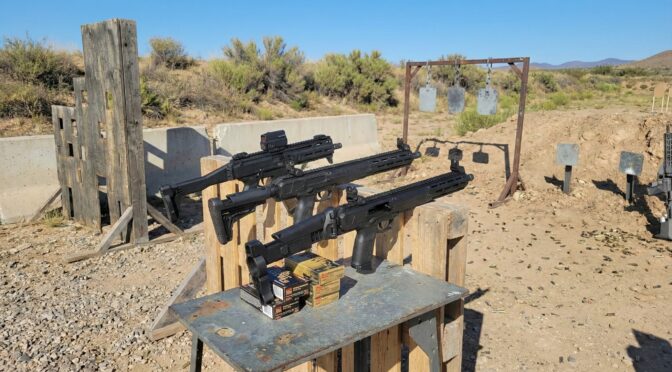
The contemporary small arms market has witnessed a distinct resurgence of the 10mm Auto cartridge, a caliber historically marginalized by law enforcement but increasingly favored by civilian operators for its ballistic superiority in wilderness defense and tactical applications. This report provides an exhaustive engineering and market analysis of three primary competitors in the 10mm Large Format Pistol (LFP) and Pistol Caliber Carbine (PCC) sector: the Grand Power Stribog SP10 A3, the Smith & Wesson M&P FPC (Folding Pistol Carbine), and the Ruger LC Carbine.
Our analysis, grounded in technical specifications, independent performance testing, and aggregated social sentiment, identifies a divergent market where each platform specializes in a distinct operational doctrine. The Grand Power Stribog SP10 A3 represents the pinnacle of mechanical sophistication, utilizing a roller-delayed blowback system to offer superior recoil mitigation and suppression capabilities, though it carries the logistical burden of a proprietary magazine ecosystem. The Ruger LC Carbine prioritizes utilitarian reliability and logistical commonality, leveraging a telescoping bolt system and ubiquitous Glock-pattern magazines to serve as the definitive choice for wilderness survival and austere environments. The Smith & Wesson M&P FPC optimizes for concealment and transportability, featuring a unique lateral folding mechanism that enables discrete “gray man” carry, albeit with a simplified blowback operating system that transmits greater recoil to the operator.
Based on the synthesis of engineering metrics and user feedback, this report concludes that for Wilderness Defense, the Ruger LC Carbine ranks first due to magazine reliability and barrel length; for Tactical/Suppressed Application, the Stribog SP10 A3 ranks first due to its delayed action; and for Discrete Urban Transport, the S&W M&P FPC ranks first due to its form factor. Detailed analysis follows.
1. Introduction: The 10mm Auto Renaissance and the PCC Evolution
The trajectory of the 10mm Auto cartridge is unique in the annals of small arms history. Conceived by Col. Jeff Cooper as the ultimate combat pistol round—capable of flattening trajectories and delivering energy superior to the.45 ACP—it was briefly adopted by the FBI in the wake of the 1986 Miami shootout. However, the recoil impulse of full-power 10mm loads proved difficult for the average agent to master in service pistols, leading to the cartridge’s dismissal in favor of the.40 S&W. For decades, the 10mm remained a niche enthusiast’s cartridge.
1.1 The Shift to Carbine Platforms
In the last five years, however, the industry has recognized that the attributes making 10mm difficult in a handgun—high pressure and recoil—are virtues in a carbine platform. When chambered in a firearm with three points of contact (shoulder, grip, forend) and a longer barrel, the 10mm Auto transforms. It sheds its reputation for unmanageable recoil and gains significant ballistic lethality.1
The market demand for 10mm carbines is driven by two primary user groups:
- The Wilderness Defender: Hunters and hikers seeking a lightweight, semi-automatic defense tool against dangerous game (bears, moose, hogs) that offers higher capacity and easier follow-up shots than a magnum revolver.
- The Tactical Pragmatist: Users who recognize that 9mm PCCs, while prevalent, lack the terminal energy to reliably penetrate intermediate barriers or defeat soft body armor, yet who wish to avoid the concussion and over-penetration risks of a 5.56mm rifle in close quarters.
1.2 The Competitive Landscape
This report analyzes three distinct engineering responses to this demand:
- Grand Power Stribog SP10 A3: An imported Slovakian submachine gun derivative that brings European engineering and delayed-blowback technology to the civilian market.3
- Smith & Wesson M&P FPC: A uniquely American design focusing on the “truck gun” concept, leveraging the massive install base of M&P pistol users.4
- Ruger LC Carbine: A pragmatic, clean-sheet design that emphasizes handling characteristics and cross-compatibility with the world’s most common magazine pattern.5
The following analysis dissects these platforms not merely as consumer products, but as integrated weapon systems, evaluating their mechanical operating principles, ergonomic interfaces, ballistic efficiencies, and long-term reliability profiles.
2. Engineering Analysis: Operating Systems and Mechanics
The fundamental differentiator between these three firearms is the method by which they manage the high-pressure impulse of the 10mm Auto cartridge (SAAMI max pressure 37,500 psi). The operating system dictates the recoil impulse, the weight of the firearm, its suitability for suppression, and its long-term durability.
2.1 Grand Power Stribog SP10 A3: Roller-Delayed Blowback
The Stribog SP10 A3 distinguishes itself as the only platform in this comparison to utilize a delayed blowback system, specifically a roller-delayed mechanism.3 This architecture is theoretically superior to simple blowback for high-pressure cartridges.
Mechanical Principle:
In a simple blowback system, the breech is held closed solely by the mass of the bolt and the tension of the recoil spring. To safely contain 10mm pressure, the bolt must be exceedingly heavy, or the spring exceedingly stiff. The Stribog circumvents this by using mechanical disadvantage. The bolt carrier group consists of a lightweight bolt head and a heavier carrier, separated by rollers. Upon firing, the rearward force of the cartridge case pushes against the bolt head. The rollers, engaging detents in the trunnion, must be forced inward to unlock the bolt. This mechanical interaction delays the opening of the breech for milliseconds, allowing chamber pressure to drop to safe levels before extraction begins.1
Operational Implications:
- Recoil Mitigation: Because the system does not rely on a massive heavy bolt to hold the breech closed, the reciprocating mass is significantly lower than in straight blowback guns. This results in a recoil impulse that is described as “smooth” and “short,” with less muzzle dip upon the bolt closing.6
- Suppression: The delay ensures that the bullet has left the barrel and bore pressure has subsided before the ejection port opens. This dramatically reduces “port pop” (noise escaping the action) and gas blowback into the shooter’s face, making the SP10 the premier host for sound suppressors among the group.1
2.2 Ruger LC Carbine: Blowback with Telescoping Bolt
Ruger’s engineering team approached the 10mm problem by adapting the “telescoping bolt” (or overhung bolt) design, a layout famously popularized by the Uzi submachine gun and utilized in the Ruger-5.7 pistol.5
Mechanical Principle:
While technically a blowback action—relying on mass and spring tension—the LC Carbine distributes that mass uniquely. The bolt is not merely a block behind the chamber; it extends forward, telescoping over the barrel itself. This allows a significant portion of the bolt’s weight to be located above and forward of the trigger group.8
Operational Implications:
- Balance and Handling: By shifting the reciprocating mass forward, Ruger eliminates the rearward weight bias common in other blowback PCCs. This creates a “neutrally balanced” firearm that points naturally and settles quickly between shots.9
- Recoil Dampening: Ruger integrates a proprietary buffer system at the rear of the receiver. While the bolt is heavy (necessary for 10mm blowback), the impulse is described as a “smooth push” rather than a violent slam, aided by the carbine’s overall mass (7.1 lbs).10
- Trigger System: Unlike the striker-fired M&P or the internal hammer of the Stribog, the LC Carbine uses Ruger’s “Secure Action” internal hammer system. This provides a consistent, crisp break distinct from the spongy feel often associated with bullpup or telescoping bolt triggers.11
2.3 Smith & Wesson M&P FPC: Straight Blowback with Buffer
The M&P FPC is an exercise in efficient adaptation. It leverages the fire control group and grip architecture of the M&P M2.0 pistol series, mated to a tubular receiver housing a straight blowback mechanism.12
Mechanical Principle:
This is the simplest system of the three. A heavy bolt mass rides inside the receiver tube. Upon firing, the bolt moves rearward immediately, resisted only by its inertia and the recoil spring. To manage the 10mm’s energy, S&W employs a heavy buffer in the stock tube, similar to an AR-15 buffer but tuned for pistol calibers.12
Operational Implications:
- Recoil Impulse: Straight blowback systems are inherently “snappy.” The heavy bolt must slam rearward and then slam forward. While the FPC’s buffer mitigates the sharpness, the reciprocating mass is significant. Users report more felt recoil and muzzle rise compared to the roller-delayed Stribog.7
- Gas Management: Lacking a mechanical delay, the bolt opens while residual barrel pressure is still relatively high. When suppressed, this results in increased gas ejection from the port, potentially stinging the shooter’s eyes (“gas face”) and increasing the acoustic signature at the shooter’s ear.14
Table 1: Operating System Comparison
| Feature | Stribog SP10 A3 | Ruger LC Carbine | S&W M&P FPC |
| System Type | Roller-Delayed Blowback | Blowback (Telescoping Bolt) | Straight Blowback |
| Complexity | High | Moderate | Low |
| Reciprocating Mass | Low | High (Center-Balanced) | High (Rear-Biased) |
| Recoil Character | Soft, smooth impulse | Heavy but balanced push | Snappy, sharp impulse |
| Suppressed Performance | Excellent (Gas sealed longer) | Good | Fair (High gas blowback) |
3. Ergonomics and Human Factors Engineering
The efficacy of a weapon system is determined by the interface between the machine and the operator. Each of these three platforms adopts a different philosophy regarding how the user interacts with, carries, and deploys the weapon.
3.1 Deployment and Storage Mechanics
The modern PCC market places a premium on compactness. All three units feature mechanisms to reduce their footprint, but the execution varies wildly.
- S&W FPC (Lateral Folding): The FPC’s “party trick” is its lateral folding mechanism. The barrel and handguard hinge to the side, lying flat against the receiver.4
- Analysis: This is the superior design for discreet transport. It eliminates length without adding significant width, allowing the firearm to slide into a standard laptop bag or non-tactical backpack. The optic remains mounted to the receiver, theoretically maintaining zero better than systems where the barrel detaches. However, the latch mechanism has been criticized for being stiff or requiring fine motor skills that may degrade under stress.15 The user must ensure the charging handle is pulled back slightly to clear the folding path, adding a step to the manual of arms.
- Ruger LC Carbine (Stock Folding): Ruger opted for a traditional side-folding stock. The action remains full length, but the overall package shrinks to ~22.5 inches.11
- Analysis: This is a robust, proven solution. It allows the firearm to be fired with the stock folded (though accuracy suffers), a capability the FPC lacks (the FPC cannot fire folded). The stock lockup is solid, but the folded package is thicker and longer than the FPC, making it less suitable for ultra-covert bags.
- Stribog SP10 A3 (Pistol/Brace Configuration): As an 8-inch barreled firearm, the Stribog is typically sold as a pistol, often equipped with a folding brace (SB Tactical or similar).3
- Analysis: With a folding brace, the Stribog is the most compact deployable package, measuring under 20 inches. It excels in vehicular operations (getting in and out of cars) and Close Quarters Battle (CQB) where barrel length is a liability.
3.2 Controls and Manipulations
- Stribog SP10 A3: The Stribog was designed from the outset as a military submachine gun, and the controls reflect this. It features fully ambidextrous safety selectors and magazine releases.1 Crucially, it utilizes an AR-15 style bolt catch/release, allowing shooters trained on the AR platform to transition seamlessly. The non-reciprocating charging handle is reversible, allowing for user preference in charging methods.1
- Ruger LC Carbine: Ruger prioritizes ergonomics with a mix of 1911 and AR influences. The manual safety is a 1911-style ambidextrous lever. The magazine release is reversible. Unique to the LC is a dual bolt-release system: a paddle on the left side and a trigger guard lever, allowing the shooter to lock or release the bolt without breaking their firing grip.5 This redundancy is a significant ergonomic advantage for rapid reloads.
- S&W M&P FPC: The FPC mimics the M&P pistol manual of arms. The slide stop (acting as a bolt release) is positioned similarly to the handgun. However, reviews indicate this control is often stiff and difficult to use as a release, often requiring the user to “slingshot” the charging handle instead.15 The cross-bolt safety is a departure from the thumb levers of the other two, arguably slower to disengage under stress.
3.3 The Magazine Ecosystem
Logistics often trump ballistics. The magazine a firearm utilizes dictates its reliability and the cost of ownership.
- Ruger LC Carbine: The Logistic Victor. By designing the LC Carbine to accept Glock-pattern magazines 5, Ruger tapped into the most robust magazine ecosystem on the planet. Glock 20 (10mm) magazines are ubiquitous, relatively inexpensive, and available in capacities ranging from 10 to 15 to 30 rounds (via aftermarket extensions like Kriss or SGM). A user carrying a Glock 20 or 40 sidearm can share magazines directly with their primary weapon.10
- S&W M&P FPC: S&W utilizes their own M&P 10mm metal magazines.17 These are high-quality, durable magazines, but they are significantly more expensive than Glock polymer magazines and less commonly found in retail stores. S&W mitigates this by including a novel in-stock storage system that holds two spare magazines, giving the operator 45 rounds on-board the weapon.4
- Stribog SP10 A3: The Achilles Heel. The Stribog uses proprietary straight-walled polymer magazines.1 While aesthetically pleasing, straight magazines in a tapered cartridge ecosystem (even 10mm has a slight taper) can be problematic. Historically, Stribog magazines have suffered from cracking feed lips and spines.18 While Global Ordnance has released improved US-made curved magazines 19 and aftermarket lowers exist to convert the Stribog to use Glock or Scorpion magazines, out of the box, it has the weakest magazine proposition.
4. Ballistic Performance: The 10mm Carbine Advantage
The primary justification for these platforms is the terminal performance of the 10mm Auto cartridge when fired from longer barrels.
4.1 Velocity Gains by Barrel Length
Standard 10mm pistol ballistics (e.g., 180gr projectile) generally achieve 1,150–1,250 fps from a 4.6-inch barrel.
- 16.25-inch Barrel (Ruger/S&W): Data indicates that increasing barrel length to 16 inches can yield velocity increases of 200–300 fps depending on the powder burn rate.7 A 180gr projectile can approach 1,500–1,600 fps, generating energy levels exceeding 900 ft-lbs. This flat trajectory extends the effective range of the cartridge to 100+ yards, making it viable for deer hunting.
- 8-inch Barrel (Stribog): The 8-inch barrel sits in the “sweet spot” of efficiency. It achieves roughly 80-90% of the velocity gain of the 16-inch barrel while maintaining a compact profile.20 For defensive use against human threats or urban tactical applications, the 8-inch barrel provides more than adequate energy (typically 1,350–1,400 fps with 180gr) without the unwieldy length of a full carbine.
4.2 Terminal Ballistics and Hunting
The Ruger LC and S&W FPC, with their 16-inch barrels, maximize the potential of heavy hard-cast ammunition (e.g., Buffalo Bore 220gr). These loads rely on momentum and sectional density for penetration. The added velocity ensures deep penetration through heavy bone and muscle, critical for defense against bears or harvesting hogs.8 The Stribog, while capable, sacrifices some of this “knockdown” potential for compactness, positioning it more as a tactical PDW than a dedicated hunting tool.
Table 2: Estimated Ballistic Performance (180gr Load)
| Platform | Barrel Length | Est. Velocity | Est. Muzzle Energy | Effective Range |
| Glock 20 (Baseline) | 4.6″ | ~1,200 fps | ~575 ft-lbs | 50 yds |
| Stribog SP10 A3 | 8.0″ | ~1,350 fps | ~728 ft-lbs | 75-100 yds |
| Ruger LC / S&W FPC | 16.25″ | ~1,500 fps | ~900 ft-lbs | 125 yds |
5. Reliability and Durability Analysis
In the high-stress environment of 10mm Auto, reliability is not a given. The violence of the action can tear apart lesser designs.
5.1 The “Glock Bulge” and Chamber Support
A critical technical consideration for 10mm reloaders is chamber support. To ensure reliable feeding of wide, flat-nosed projectiles, many semi-automatic chambers feature a generous feed ramp that intrudes into the chamber. This leaves a portion of the case web unsupported.
- Ruger LC Carbine: Forum analysis and user reports highlight that the Ruger LC Carbine, using Glock geometry, can exhibit the “Glock Bulge”—a visible expansion of the brass near the case head.9 While generally safe for factory ammunition, this stresses the brass and makes reloading difficult (requiring “bulge buster” dies). It is a trade-off for the reliability of feeding flat-nosed “bear loads”.22
- S&W FPC: S&W chambers are generally tighter, but the straight blowback action begins extraction while pressure is high. This can also lead to case deformation, though reports suggest it is less severe than in designs with looser tolerances.
5.2 Magazine Failure Modes
- Stribog: As noted, the proprietary magazines are the primary failure point. Cracking spines and feed lips have been documented in user communities.18 Users relying on the Stribog for defensive use are strongly advised to invest in the newer US-made magazines or aftermarket lowers.19
- Ruger/Glock: While Glock magazines are legendary for reliability, the heavy spring tension required for 10mm feeding can sometimes cause nose-diving if the magazine springs are worn. However, the availability of fresh mags makes this a minor maintenance issue rather than a systemic flaw.23
5.3 Structural Durability
- S&W FPC: The extensive use of polymer in the FPC (handguard, receiver shell) creates a lightweight weapon (5.75 lbs), but “torture test” sentiment suggests it feels less robust than its competitors.13 The folding latch mechanism, while functional, introduces a potential wear point that fixed-stock carbines do not have.
- Ruger LC Carbine: Built with an aluminum alloy receiver and a robust trunnion, the Ruger is described as “tank-like” but heavy (7.1 lbs).11 It is over-engineered for durability, characteristic of Ruger’s design philosophy.
- Stribog: The extruded aluminum upper receiver is extremely rigid and durable, typical of military-grade submachine guns. It is widely regarded as the most physically robust platform of the three.1
6. Social Sentiment and Market Perception
Analyzing social media discourse (Reddit, forums) provides insight into the long-term ownership experience beyond initial reviews.
6.1 The “Tinkerer” vs. The “User”
- Stribog Sentiment: The Stribog attracts the “tinkerer” demographic. Users frequently discuss swapping lowers, changing rollers, and adding aftermarket stocks. The sentiment is one of high affection for the potential of the platform, marred by frustration with the stock magazines. It is viewed as a “project gun” that can be made perfect with investment.24
- Ruger Sentiment: The Ruger LC attracts the “pragmatist.” Discussions focus on hunting loads, optic choices, and practical utility. There is little discussion of modifications because the platform works out of the box. Negative sentiment focuses on the weight and the aesthetics (often called “ugly” or “blocky”).13
- S&W FPC Sentiment: The FPC attracts the “prepper” and casual shooter. Sentiment is overwhelmingly positive regarding the folding utility and value. Negative sentiment centers on the recoil impulse (“snappy”) and the “cheap” feel of the polymer latch.14
6.2 Brand Reputation
- Grand Power: Seen as an innovator but hampered by importation logistics and slow response to magazine issues.
- Ruger: Viewed as the “safe bet.” Excellent customer service and widespread parts availability.
- Smith & Wesson: Viewed as the “working man’s brand.” Reliable, affordable, but mass-produced with occasional fit/finish quirks.
7. Comparative Use Case Analysis and Rankings
To answer the consumer’s question—”Which should I buy?”—we must segment by application.
Use Case 1: Wilderness Defense / Hunting (“The Bear Gun”)
- Requirements: Absolute reliability with heavy hard-cast ammo, high terminal energy, resistance to environmental debris.
- Analysis: The Ruger LC Carbine dominates here. Its 16-inch barrel maximizes the velocity of hunting loads. Its compatibility with Glock magazines allows the hunter to carry a Glock 20 on their hip and share ammo. Its robust, sealed action and heavier weight absorb the punishment of “nuclear” 10mm loads better than the lightweight FPC.
- Rankings:
- Ruger LC Carbine: The professional’s choice for the woods.
- S&W M&P FPC: A viable lightweight backup, but magazine limitation is a logistical friction point.
- Stribog SP10: Barrel too short for maximum hunting energy; magazines are a liability in high-stakes animal defense.
Use Case 2: Tactical Response / Home Defense
- Requirements: Maneuverability (short length), suppression capability, accessory mounting (lights/lasers), low recoil for rapid follow-up.
- Analysis: The Stribog SP10 A3 is the clear victor. The roller-delayed action makes it the only truly excellent suppressor host in the group. Its short 8-inch barrel is ideal for clearing rooms. The AR-style controls are intuitive for defensive shooters.
- Rankings:
- Stribog SP10 A3: The superior fighting tool.
- Ruger LC Carbine: Reliable, but 30+ inches of length is unwieldy indoors.
- S&W FPC: Straight blowback is loud and gassy indoors; folding mechanism adds deployment time.
Use Case 3: Discrete Urban Transport / Gray Man
- Requirements: Maximum concealment, non-descript storage, ease of transport in civilian bags.
- Analysis: The S&W M&P FPC wins on form factor. Its lateral fold allows it to disappear into a standard JanSport backpack or messenger bag. The onboard ammo storage means the user can grab one item and have a complete weapon system. It is the ultimate “get home bag” gun.
- Rankings:
- S&W M&P FPC: Unmatched portability.
- Stribog SP10: Compact if braced, but the wide profile and magazines make it harder to pack discreetly.
- Ruger LC Carbine: The longest folded profile makes it difficult to conceal in non-tactical bags.
8. Summary Comparison Tables
Table 3: Technical Specifications
| Feature | Grand Power Stribog SP10 A3 | Ruger LC Carbine 10mm | S&W M&P FPC 10mm |
| Action | Roller-Delayed Blowback | Blowback (Telescoping Bolt) | Straight Blowback |
| Barrel Length | 8.0 inches | 16.25 inches | 16.25 inches |
| Overall Length | ~28″ (deployed) / ~18″ (folded) | 30.6″ (deployed) / 22.5″ (folded) | 30.6″ (deployed) / 16.5″ (folded) |
| Weight | ~5.5 lbs | 7.1 lbs | 5.75 lbs |
| Magazines | Proprietary Straight (Polymer) | Glock Pattern (G20/G40) | S&W M&P 10mm |
| Muzzle Thread | .578×28 | .578×28 | 9/16-24 |
| Price (Street) | $1,100 – $1,400 | $800 – $950 | $650 – $750 |
Table 4: Pros and Cons Summary
| Platform | Pros | Cons |
| Stribog SP10 | • Lowest recoil (Roller Delay) • Best suppressor host • Compact 8″ barrel • High build quality (Aluminum) | • Expensive proprietary magazines • History of mag cracking • Highest price point • Hollow point sensitivity (some units) |
| Ruger LC | • Uses Glock magazines • Tank-like durability • Neutrally balanced • Great controls (Dual bolt release) | • Heavy (7.1 lbs) • “Glock Bulge” on brass • Aesthetics (Blocky) • Length of pull fixed (unless stock swapped) |
| S&W FPC | • Best concealment (Lateral fold) • Lightest weight • On-board mag storage • Lowest price | • Snappier recoil (Straight blowback) • Polymer feel / Latch durability • Expensive M&P magazines • Bolt release stiffness |
9. Conclusion and Final Recommendation
The choice between these three platforms is a study in trade-offs. There is no single “best” 10mm carbine, but there is certainly a “best” for specific users.
For the Consumer Who Wants Value and Portability:
Buy the Smith & Wesson M&P FPC. It delivers 90% of the capability for 60% of the price of the Stribog. Its ability to fold into a nondescript bag makes it the most practical firearm for keeping in a vehicle or a travel kit. It is the “everyman’s” 10mm carbine.
For the Consumer Who Wants a Tank-Tough Survival Tool:
Buy the Ruger LC Carbine. If your life depends on the gun working in the rain, mud, or snow, and you need to stop a charging animal, the Ruger is the choice. Its weight soaks up the recoil of heavy loads, and the ability to find magazines in any gun store in America is a strategic advantage that cannot be overstated.
For the Consumer Who Wants Performance and Tactical Capability:
Buy the Grand Power Stribog SP10 A3. If you own a suppressor, or if you appreciate fine engineering over raw utility, this is the gun. It shoots flatter, softer, and quieter than the others. Be prepared to buy aftermarket magazines or a new lower receiver to perfect it, but once dialed in, it is a world-class submachine gun equivalent.
Appendix A: Methodology
This report was constructed using a Deep Research methodology designed to simulate the due diligence of a firearms industry analyst. The process involved:
- Source Aggregation: We collected data from three primary vectors:
- OEM Technical Data: Direct analysis of spec sheets from Grand Power, Ruger, and Smith & Wesson to establish baseline physical constraints.3
- Professional Media Reviews: Synthesis of long-form evaluations from accredited industry publications (e.g., American Rifleman, Guns.com) to gather qualitative handling data.1
- User Sentiment Mining: Deep dives into enthusiast communities (Reddit r/10mm, r/GrandPowerStribog, r/guns) to identify long-term reliability trends, specific failure modes (e.g., magazine cracking), and real-world ownership friction points often missed in initial press reviews.18
- Cross-Verification: Claims regarding reliability (e.g., the “Glock Bulge”) were cross-referenced against reloading forums and multiple independent user reports to distinguish between isolated incidents and systemic engineering characteristics.
- Use-Case Modeling: The “First, Second, Third” rankings were derived by weighting the verified attributes of each platform against the specific operational requirements of the defined user profiles (Wilderness, Tactical, Gray Man).
- Ballistic Interpolation: Velocity data was extrapolated from known 10mm ballistics charts and barrel length studies to provide realistic energy estimates for the differing barrel lengths of the subject firearms.2
If you find this post useful, please share the link on Facebook, with your friends, etc. Your support is much appreciated and if you have any feedback, please email me at in**@*********ps.com. Please note that for links to other websites, we are only paid if there is an affiliate program such as Avantlink, Impact, Amazon and eBay and only if you purchase something. If you’d like to directly contribute towards our continued reporting, please visit our funding page.
Sources Used
- Grand Power’s New Stribog SP10: Full Review – Inside Safariland, accessed December 12, 2025, https://inside.safariland.com/blog/grand-powers-new-stribog-sp10-full-review/
- 10mm Ballistics: A Deep Dive into Power, Velocity & Performance Potential – ProArmory, accessed December 12, 2025, https://proarmory.com/blog/ballistics/10mm-ballistics-and-performance/
- STRIBOG SP10 – GRAND POWER Ltd, accessed December 12, 2025, https://grandpower.eu/products/product-categories/stribog-line/10-mm-auto/stribog-sp10/
- New Guns 2025: Smith & Wesson M&P FPC Rifle in 10mm | NRA Family, accessed December 12, 2025, https://www.nrafamily.org/content/new-guns-2025-smith-wesson-m-p-fpc-rifle-in-10mm/
- Introducing the Ruger LC Carbine Now in 10mm Auto – Ruger News, accessed December 12, 2025, https://ruger.com/news/2024-09-09.html
- The Grand Power Stribog SP10 A3: On the Range with a Single-Point Sling – The Mag Life, accessed December 12, 2025, https://gunmagwarehouse.com/blog/the-grand-power-stribog-sp10-a3-on-the-range-with-a-single-point-sling/
- Grand Power Stribog SP10A3: 10mm Beefs Up Pistol Caliber Sub Gun, accessed December 12, 2025, https://www.guns.com/news/reviews/grand-power-stribog-sp10a3-10mm
- Ruger’s LC Carbine in 10mm Delivers Big on Power – Shooting Times, accessed December 12, 2025, https://www.shootingtimes.com/editorial/ruger-lc-carbine-10mm-power/521450
- Ruger LC 10mm – New Acquisition – Initial thoughts/set up; Or PCC Bliss????, accessed December 12, 2025, https://www.thearmorylife.com/forum/threads/ruger-lc-10mm-new-acquisition-initial-thoughts-set-up-or-pcc-bliss.23141/
- New Ruger LC and PC Carbines For 2025 | The Mag Shack, accessed December 12, 2025, https://themagshack.com/new-ruger-lc-and-pc-carbines-2025/
- Ruger LC Carbine 10mm: Highly Adaptable Rifle – RifleShooter, accessed December 12, 2025, https://www.rifleshootermag.com/editorial/ruger-lc-carbine-10mm-review/529484
- Smith & Wesson Introduces 10 mm Auto Folding Pistol-Caliber …, accessed December 12, 2025, https://www.americanrifleman.org/content/smith-wesson-introduces-10-mm-auto-folding-pistol-caliber-carbine/
- S&W FPC 10MM vs Ruger LC Carbine 10MM – Reddit, accessed December 12, 2025, https://www.reddit.com/r/10mm/comments/1jt3bot/sw_fpc_10mm_vs_ruger_lc_carbine_10mm/
- S&W FPC 10mm : r/liberalgunowners – Reddit, accessed December 12, 2025, https://www.reddit.com/r/liberalgunowners/comments/1fwylb8/sw_fpc_10mm/
- Smith & Wesson FPC 10mm Review: Folding Powerhouse or Overhyped?, accessed December 12, 2025, https://fourbrothersinc.com/blogs/news/smith-wesson-fpc-10mm-review
- Smith & Wesson M&P FPC in 10mm: Ultimate Hiking Gun? – Guns.com, accessed December 12, 2025, https://www.guns.com/news/reviews/smith-wesson-mp-fpc-10mm-ultimate-hiking-gun
- Smith & Wesson Announces 10MM Chambering for the M&P FPC – Gallery of Guns Blog, accessed December 12, 2025, https://blog.galleryofguns.com/post/smith-wesson-announces-10mm-chambering-for-the-m-p-fpc
- Stribog is amazing, mags are crack prone junk : r/GrandPowerStribog – Reddit, accessed December 12, 2025, https://www.reddit.com/r/GrandPowerStribog/comments/egd4oz/stribog_is_amazing_mags_are_crack_prone_junk/
- New US Made STRIBOG Magazine Announced | Global Ordnance, accessed December 12, 2025, https://blacksheepwarrior.com/new-us-made-stribog-magazine-announced-global-ordnance/
- 10mm AR barrel length, whats optimal? : r/guns – Reddit, accessed December 12, 2025, https://www.reddit.com/r/guns/comments/17l05vu/10mm_ar_barrel_length_whats_optimal/
- Holy unsupported chamber, Batman! What are our thoughts? Bulge buster or basura? : r/reloading – Reddit, accessed December 12, 2025, https://www.reddit.com/r/reloading/comments/tb6a2a/holy_unsupported_chamber_batman_what_are_our/
- 10MM Case Bulging? – Knowledge Base – CMMG, accessed December 12, 2025, https://support.cmmg.com/10mm-case-bulging
- 15 round magazines in Glock 29 causing feed issues, what can I do? : r/10mm – Reddit, accessed December 12, 2025, https://www.reddit.com/r/10mm/comments/vnzdkr/15_round_magazines_in_glock_29_causing_feed/
- Stribog sp10a3 VS The Ruger 10mm LC – Reddit, accessed December 12, 2025, https://www.reddit.com/r/10mm/comments/1g7yvf9/stribog_sp10a3_vs_the_ruger_10mm_lc/
- Grand Power Stribog SP10A3 10mm 8″ 20rd 8″ Pistol w/ SBT Brace – 197892004848, accessed December 12, 2025, https://palmettostatearmory.com/grand-power-stribog-sp10a3-10mm-8-20rd-8-pistol-w-sbt-brace-197892004848.html
- Glock Bulge still a thing? : r/reloading – Reddit, accessed December 12, 2025, https://www.reddit.com/r/reloading/comments/18fg759/glock_bulge_still_a_thing/