
| Note I am not a lawyer and this is not legal advice. First, I’d recommend you read the actual ATF ruling (click here) and second, get legal assistance before spending the money to import something. |
The United States small arms market is currently navigating a profound structural realignment following the issuance of the Bureau of Alcohol, Tobacco, Firearms and Explosives (ATF) Ruling 2025-1. Signed into effect on June 24, 2025, this directive effectively reverses a restrictive interpretation of 18 U.S.C. § 925(d)(3) that has governed the industry for nearly two decades. For industry stakeholders—ranging from major importers and distributors to boutique manufacturers and collectors—this is not merely a bureaucratic adjustment; it represents a reopening of the global supply chain for authentic, military-grade components that have been effectively embargoed from the commercial market since 2005.
As an industry analyst, the significance of this ruling cannot be overstated. By discarding the “historical taint” doctrine, which previously banned barrels based on their past attachment to non-sporting or National Firearms Act (NFA) weapons, the ATF has shifted to a “current configuration” standard. This allows for the importation of barrels that are in a “sporting configuration” at the time of entry, regardless of their lineage. This shift creates immediate opportunities for margin expansion through the importation of high-value “Original Barrel” parts kits and necessitates a strategic pivot for domestic barrel manufacturers who previously enjoyed a protected market.
This report provides an exhaustive analysis of Ruling 2025-1, dissecting its legal mechanics, its immediate operational impact on importers, and the downstream effects on the U.S. consumer market. We project a “Surplus Renaissance” through late 2025 and 2026, characterized by the return of affordable, high-quality parts kits and a shift in domestic manufacturing priorities. Furthermore, we identify specific makes and models—from Cold War relics to modern tactical platforms like the FB Radom MSBS Grot and HK MR556 A4—that are poised to define the next fiscal year.
1. Regulatory Deconstruction: ATF Ruling 2025-1
To successfully navigate the new market landscape, importers and industry strategists must first possess a granular understanding of the changes to the regulatory framework. Ruling 2025-1 does not create new law; rather, it corrects an interpretation of 18 U.S.C. § 925(d)(3) that the industry has long contended was overzealous and inconsistent with the statutory text.
1.1 The Death of “Historical Taint”
For the past twenty years, the US firearms import market was defined by the constraints of the ATF’s November 2005 “Open Letter to Federally Licensed Firearms Importers.” This guidance enforced a policy where a barrel’s importability was determined not by its physical characteristics at the port of entry, but by its history. Under this regime, if a barrel had ever been attached to a machine gun (an NFA item) or a non-sporting rifle (such as a military AKM or FN FAL), that barrel was permanently “tainted.” It was banned from importation, even if it had been modified or was intended for a sporting purpose in the US.1
This policy effectively decimated the market for “original barrel” parts kits. Importers were forced to strip the barrels from surplus kits overseas, often destroying them or selling them for scrap, and then import the remaining components. This necessitated the US industry to rely on domestic barrel production or expensive, neutered imports to complete these kits, fundamentally altering the economics of the surplus trade.
Ruling 2025-1 explicitly supersedes this 2005 guidance.1 The new standard established by the ATF is the “Time-of-Import Configuration Test.”
- The Rule: A dual-use barrel is importable if, at the time of import, it is in a configuration typically associated with sporting firearms.1
- The Implications: The ATF no longer looks back at the barrel’s service life. A barrel removed from a decommissioned Soviet-era machine gun is now importable, provided it meets physical criteria—such as length, caliber, and lack of prohibited features like threads for specific suppressors (though this is less relevant now)—that fit a “sporting” profile upon entry.4 This shift from a history-based to a configuration-based assessment removes the “taint” that previously rendered millions of dollars of global inventory inaccessible to US markets.
1.2 The “Sporting Configuration” Requirement
The ruling introduces a nuanced definition of “dual-use.” A barrel is considered dual-use if it can be used on both sporting and non-sporting firearms. The critical gatekeeper is now the condition of the barrel as it sits in the shipping container, rather than its provenance.
- Identified Sporting Configuration: Importers must demonstrate that there is a commercially available “sporting” firearm that the barrel could fit. This is a theoretical capability test. If the barrel fits a single-shot hunting rifle or a sporting semi-automatic (like a localized version of the platform), it passes the test. This applies even if the importer knows the end-user will likely use the barrel to build a tactical rifle or a collected piece of military history.4
- Documentation Rigor: Form 6 applications must now be specific and technically accurate. Block 8 of the import application must describe the barrel as “dual-use” and include precise details regarding caliber, make, manufacturer, and length. This shifts the burden of proof to the physical specifications rather than the pedigree of the item.1 Importers must be prepared to provide technical data sheets or physical samples to prove the “sporting” potential of the component.
1.3 Post-Import Assembly and Compliance
Perhaps the most commercially significant aspect of the ruling is the ATF’s clarification on post-import usage. Once a dual-use barrel legally enters the United States, the “sporting” restriction that governed its entry evaporates, replaced by domestic manufacturing laws.
The ATF explicitly states: “Nothing in the statutes prevent a dual-use barrel from being used to assemble a sporting, non-sporting, or NFA firearm”.2
This is the green light for the industry. An importer can bring in a barrel under a sporting exemption—because it fits a sporting receiver—and immediately sell it to a manufacturer or consumer who builds a non-sporting tactical rifle or a registered machine gun. However, this freedom is bounded by strict adherence to domestic compliance statutes:
- 18 U.S.C. § 922(r): The domestic parts count requirement for non-sporting semi-automatics. We will explore this in detail in Section 5, as it becomes the primary complexity for builders using foreign barrels.
- The NFA (26 U.S.C. Chapter 53): Registration and tax requirements for machine guns or short-barreled rifles. If the barrel is used to assemble an NFA item, all NFA rules apply, including the $200 tax stamp (until potentially repealed in 2026) and registration.3
.
2. Impact on US Firearms Importers
For Federal Firearms Licensees (FFLs) engaged in importation (Type 08 and Type 11), Ruling 2025-1 represents a massive reduction in regulatory risk and a broadening of sourcing opportunities. It signals a shift from a defensive posture—where proving a negative (that a barrel was never on a machine gun) was the standard—to an offensive posture based on technical compliance.
2.1 Supply Chain Diversification
Previously, importers had to meticulously vet the “chain of custody” of surplus lots. A crate of AKM barrels from Romania had to be certified as never having been on machine guns—a near-impossible task for Cold War surplus stored in non-digitized depots for decades. This ambiguity led to widespread denials, seizures, and a general reluctance to engage with certain foreign stockpiles.
Now, sourcing agents can return to “tainted” markets. Warehouses in Eastern Europe, Asia, and South America holding stripped machine gun barrels are now viable sources.6 We anticipate a surge in procurement activities in specific regions:
- The Balkans (Serbia, Croatia): This region is a treasure trove for Yugo-pattern AK and SMG barrels. The Zastava M70 and M56 platforms, previously difficult to import with original barrels due to their military service history, are now prime targets for re-importation.
- Poland & Romania: These nations remain the stalwarts of the AKM supply chain. We expect a renewed flow of original chrome-lined barrels for the PM-63, PPS-43, and various AK variants.7
- Western Europe (Germany, Switzerland, Spain): High-value components for G3, CETME, and Sig PE57 rifles were previously hamstrung by the dual-use ban. The ability to import these precision-manufactured barrels opens a lucrative segment for high-end collector kits.9
2.2 Operational Streamlining vs. Compliance Rigor
While the sourcing is easier, the paperwork is more precise. The “Repair and Replacement” doctrine, which allowed some leeway for repair parts, is gone. Importers must now be technical experts on the “sporting configuration” of their imports.
- Risk of Seizure: The ATF retains the right to seize barrels that do not meet the sporting profile at entry. A “short” barrel (e.g., a 10-inch submachine gun barrel) might still be rejected if no sporting pistol or SBR configuration is identified and approved. This creates a technical hurdle: importers must prove that a pistol configuration exists for a barrel that may have originally come from a submachine gun.3
- Verification: Importers are advised to submit samples for evaluation. This creates a front-loaded delay but ensures long-term clearance. We expect major importers like Century Arms, The Armory (DSA, etc.), and Bowman Armaments to establish “pre-approved” profiles for common surplus barrels to expedite bulk shipments.1
2.3 Economic Implications for Importers
The cost basis for parts kits will shift fundamentally. Previously, an importer bought a “barrel-less” kit and then had to procure a US-made barrel (costing $100-$200 wholesale) to complete the package for the consumer.
- Cost Reduction: Importing the original barrel (often included in the surplus scrap price or available for nominal cost) significantly lowers the Cost of Goods Sold (COGS) for a complete kit. The “barrel” component of the kit cost drops from ~$150 (domestic) to ~$20-50 (imported/surplus allocation).
- Margin Expansion: Importers can either pass these savings to the consumer to drive volume or, more likely, retain the margin as “authenticity premiums.” The market has demonstrated a willingness to pay more for “Original Barrel” kits than for US-barreled counterparts due to collector demand for authenticity and perceived metallurgical superiority.11 This suggests that while costs drop, retail prices may hold steady or rise for premium “OG Barrel” SKUs, significantly boosting importer profitability.
3. Impact on the US Small Arms Market
The downstream impact of this ruling on manufacturers, retailers, and consumers will be transformative, creating distinct winners and losers in the US manufacturing ecosystem.
3.1 The “Surplus Renaissance” (2025-2026)
The immediate impact is a flood of “Original Barrel” parts kits. For the collector market, the barrel is the heart of the firearm. Original Cold Hammer Forged (CHF) chrome-lined barrels from state arsenals like Radom (Poland) or Cugir (Romania) are metallurgically superior to most budget US options and hold immense historical value.
- Collector Market: We are already seeing listings for “Original Barrel” kits for platforms like the Vz. 58, PPS-43, and CETME C.8 These listings explicitly highlight the barrel as a value-add, often utilizing “OG” branding to distinguish them from previous imports.
- Price Volatility: Initial prices for these kits are high (e.g., $1,400+ for rare kits like the French AA52 6), but as volume stabilizes, we expect the price of common kits (AKM, G3) to moderate. However, the days of sub-$300 kits are likely gone; the “Original Barrel” will command a premium tier, effectively creating a two-tiered market: “Shooter Grade” (US Barrel) and “Collector Grade” (Import Barrel).11
3.2 The Domestic Barrel Maker’s Dilemma
This ruling is a significant headwind for US barrel manufacturers who thrived during the ban era (e.g., Green Mountain, Rosco Manufacturing, AK-Builder). For 20 years, every imported parts kit required a US barrel for completion. That statutory demand has evaporated for “sporting” imports.
- Pivot to Premium: US manufacturers will need to pivot to “Match Grade” or “Custom Profile” barrels where surplus cannot compete. Rosco Manufacturing, for example, is focusing on “Bloodline” series barrels with specific treatments (Nitride) that offer different benefits than surplus chrome lining, targeting the precision and modernization segments rather than the restoration market.14
- 922(r) Parts Count: US barrels will still be relevant for compliance. If a builder uses an imported barrel, they lose a “US Part” count. To stay compliant with 18 U.S.C. § 922(r), they may need to swap other parts (trigger, piston, furniture) to US-made options. This shifts the aftermarket economy from barrels to fire control groups and furniture.3
3.3 The Return of “Authentic” Modern Imports
Beyond surplus, this ruling benefits modern manufacturers. Companies like Heckler & Koch (HK) and FN Herstal often produce barrels in their European factories that are superior to what they can economically produce or subcontract in the US.
- The “German Barrel” Factor: HK’s new MR556 A4 is marketed heavily on its barrel quality. The ability to import these barrels directly as “dual-use” replacements or components streamlines their logistics and enhances the product’s appeal to purists who want a “real” HK416 clone. Previously, HK had to navigate complex import restrictions that often resulted in US-finished barrels or heavy modification. The new ruling allows for a purer import product.17
4. Product Intelligence: New Imports and Planned Releases
Based on the synthesis of importer announcements, ATF filings, and surplus dealer inventory updates, we have identified the specific makes and models driving this market shift. The landscape is dividing into two distinct streams: the revival of historic Cold War arms and the streamlined introduction of modern European service weapons.
4.1 The Surplus Vanguard (Bowman, Atlantic, Centerfire)
The most immediate activity is in the “Parts Kit” sector. Importers like Bowman Armaments Group, Atlantic Firearms, and Centerfire Systems have aggressively capitalized on the ruling to market kits with “Original Barrels” (OG Barrels). These companies are the bellwethers for the surplus market.
- Eastern Bloc Submachine Guns: The PM-63 RAK and PPS-43 are appearing with original barrels. These are significant because their short barrels were previously difficult to import due to NFA/machine gun classifications. Now, they are likely imported as “pistol” barrels, fitting the definition of a dual-use component for a sporting pistol build. This opens the door for historically accurate semi-auto reconstructions.7
- Cold War Battle Rifles: The CETME C and HK G3 are seeing a resurgence. Atlantic Firearms and Centerfire Systems are listing kits with original barrels. This is a critical technical upgrade; the roller-delayed blowback system of the CETME/G3 requires a fluted chamber to function reliably. US-made reproductions of these barrels often suffered from poor fluting or incorrect metallurgy, leading to extraction failures. The return of the original Spanish and German barrels solves a major reliability headache for builders.10
- The Vz. 58: A standout platform in the current market. Atlantic is offering builds with “Original Czech Barrels,” which are prized for their durability and chrome lining. This indicates a supply line from the Czech Republic has fully opened, allowing for the importation of barrels that were likely stripped from vz. 58 V (folding stock) or P (fixed stock) service rifles.13
4.2 The Modern Tactical Wave (HK, FB Radom, Canik)
The ruling is also facilitating the importation of modern sporting rifles (MSRs) and pistols from major European defense contractors, who can now streamline their logistics by using their standard military production lines for barrel blanks.
- Heckler & Koch (HK): The MR556 A4 is the flagship of this new era. HK USA is marketing this rifle (and its upper receiver kits) with “German-made barrels.” The ruling allows these barrels to be imported more freely, potentially reducing the “HK Tax” (markup) or at least increasing availability. The A4 designation represents a modernization to match the HK416 A5 feature set (adjustable gas block, ambi controls), and the barrel is a key selling point for enthusiasts who prioritize German steel over US subcontracting.17
- FB Radom (Poland): The MSBS Grot is finally entering the US market. Previously delayed, the pistol variant (10.5″) and rifle variant are slated for 2026. The ability to import the military-production barrels (likely chrome-lined) without “taint” concerns simplifies the 922(r) conversion process for the importer. The Grot, having proven itself in the Ukraine conflict, carries significant “battle-tested” cachet, and the original barrel is a critical component of that brand identity.23
- Canik: While primarily a handgun manufacturer, Canik’s expansion into the US (via Century Arms) includes new sub-compacts like the Mete MC9 LS. The ruling simplifies the logistics for their barrel supply chain, ensuring that replacements and “threaded” variants for suppressors (dual-use) are easily imported without the need for complex “sporting purpose” re-engineering at the factory level.26
4.3 The “Endangered” Species (FN SCAR)
Conversely, FN Herstal appears to be pivoting away from the civilian market for the SCAR 17S/20S, with reports of discontinuation of certain commercial lines to focus on military contracts. However, the ruling creates a paradox: while new factory SCARs might become scarce, the surplus market for SCAR components (used barrels, replacement assemblies) might actually improve. Importers can now potentially bring in “used” barrels from foreign military stocks (e.g., Belgian or French service rifles) without the NFA taint, providing a lifeline for the secondary market to keep existing rifles running.28
Summary of Key Imports (2025-2026)
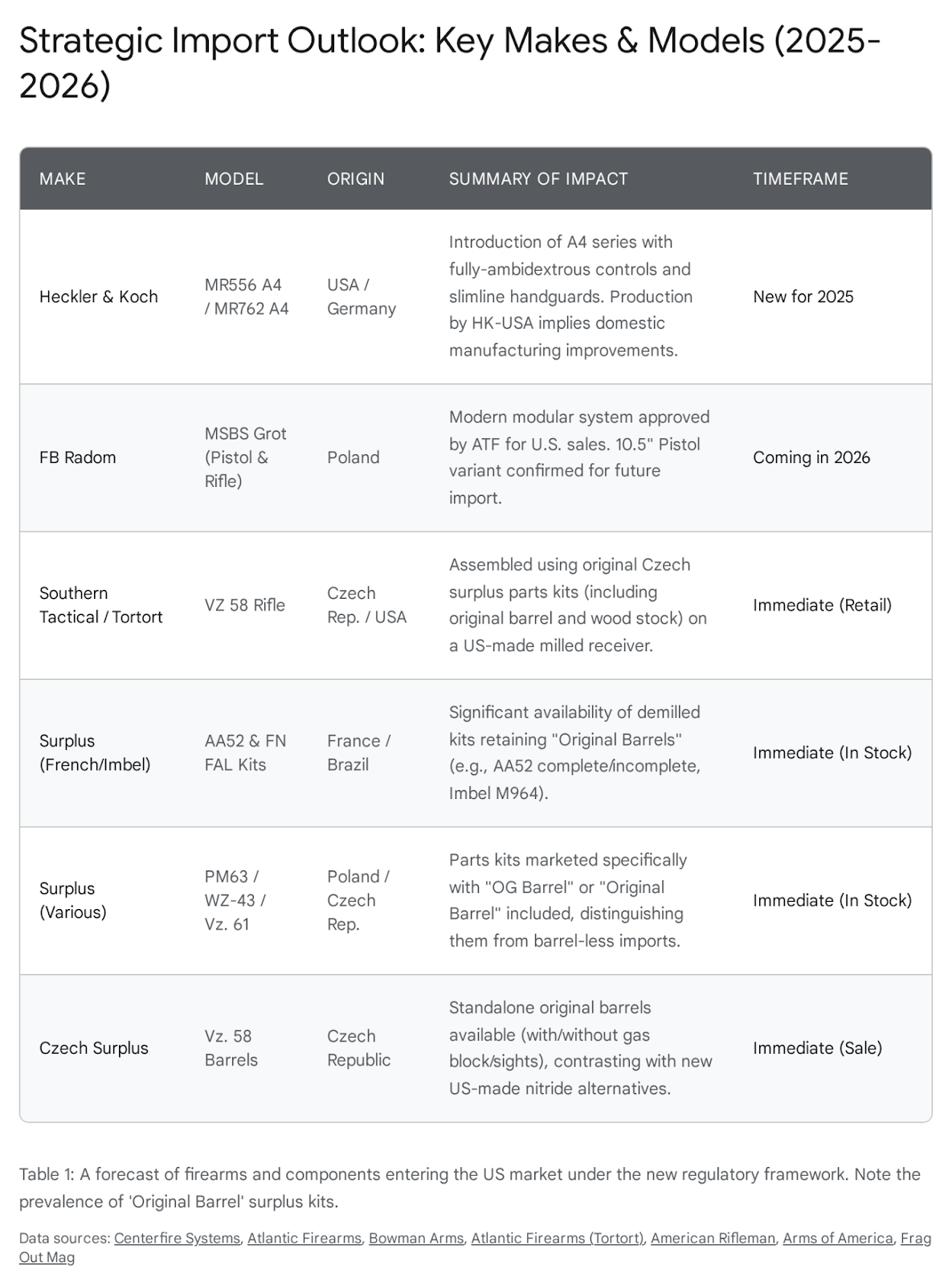
| Make | Model | Country | Summary of Impact | Expected Timeframe |
| Heckler & Koch | MR556 A4 | Germany | Introduction of the A4 variant with “German-made” barrels. Direct beneficiary of dual-use import easing for “military” lineage components. | Available Now / Late 2025 17 |
| FB Radom | MSBS Grot | Poland | Long-awaited civilian import of the Polish military modular rifle. Pistol (10.5″) and Rifle variants approved. | 2026 23 |
| CZ / Surplus | Vz. 58 | Czech Republic | Resurgence of parts kits featuring original Czech barrels, replacing US-barreled builds. High collector interest. | Available Now (Atlantic) 13 |
| Radom / Surplus | PM-63 RAK | Poland | Submachine gun kits now importable with original 9mm Makarov barrels intact (likely classified as pistol barrels). | Available Now (Bowman) 7 |
| Surplus | PPS-43 | Poland/USSR | WWII/Cold War SMG kits appearing with original barrels. Significant change from previous “cut barrel” imports. | Available Now (Bowman) 8 |
| Surplus | CETME C | Spain | Battle rifle kits with original barrels. Critical improvement for roller-delayed reliability over US repro barrels. | Nov 2025 / 2026 30 |
| SIG | Stgw 57 (PE57) | Switzerland | Rare Swiss battle rifle kits now appearing with original barrels. High-value collector item. | Available Now 9 |
| Canik | Mete MC9 LS | Turkey | New sub-compact carry pistols with extended barrels. Import streamlined by new ruling. | Available Now 27 |
| FN Herstal | SCAR 17S | Belgium | Contradictory trend: Factory civilian production slowing/ending, but ruling may allow importation of surplus replacement barrels. | 2025 (Transition Year) 28 |
5. Strategic Outlook: The Road to SHOT Show 2026
Looking beyond the immediate horizon, Ruling 2025-1 serves as a foundational pillar for a broader deregulation trend anticipated to culminate in 2026. The strategic implications extend into compliance strategy, future legislation, and the broader trade environment.
5.1 922(r) Compliance Strategies
The return of imported barrels forces a strategic pivot in 922(r) compliance. Under 18 U.S.C. § 922(r), a non-sporting rifle cannot contain more than 10 imported parts from a list of 20 regulated components (such as receiver, barrel, trigger, bolt carrier, etc.).
- The Math: Previously, when a kit was imported without a barrel, the builder was forced to use a US-made barrel. This barrel counted as one “US Part,” helping the builder stay compliant by reducing the foreign parts count.
- The Adjustment: Now, using an imported barrel removes that “US Part” credit and adds an “Imported Part” to the tally. To maintain compliance, builders will need to replace other foreign parts with US-made equivalents. We expect a surge in demand for US-made high-value components like Triggers (Geissele, ALG), Magazine Followers/Floorplates (Magpul), and Gas Pistons (KNS Precision). The aftermarket economy will shift from “Barrels & Receivers” to “Furniture & Internals”.3
5.2 The “Tax Repeal” Wildcard (H.R. 5289)
The industry is closely watching H.R. 5289 (part of the “One Big Beautiful Bill” initiative), which proposes to eliminate the $200 NFA tax for suppressors and Short-Barreled Rifles (SBRs) effective January 1, 2026.
- Synergy with Ruling 2025-1: If the tax is repealed, the demand for SBRs will likely explode. Ruling 2025-1 is the supply-side enabler for this potential demand shock. It allows the importation of short “dual-use” barrels (e.g., 10.4″ HK416 barrels, 12″ AK-104 barrels) that can be easily built into registered SBRs without the prohibitive $200 tax barrier. This synergy could create a golden age for short-barreled carbines in the US market.31
5.3 Geopolitical Constraints: The “Iron Curtain” of Sanctions
It is crucial to note that Ruling 2025-1 is not a blanket permission slip for the entire globe. While it liberalizes the technical restrictions, it does not override geopolitical sanctions.
- Russia and China: Imports from Russia (Izhmash, Molot) and China (Norinco) remain heavily sanctioned. Even if a Russian AK-12 barrel is “dual-use” and technically importable under ATF rules, it is blocked by Department of State and Treasury sanctions. The ruling benefits friendly nations (NATO allies, former Eastern Bloc states like Poland/Romania) but does not reopen the door to Russian or Chinese surplus.34
- Dual-Use Tech Concerns: Importers must also be wary of broader “dual-use” technology restrictions. While the ATF is focused on the “sporting” vs. “non-sporting” distinction, the Department of Commerce (BIS) monitors dual-use items for national security risks. High-tech barrel manufacturing equipment or advanced alloys could still face scrutiny under different regulatory regimes.36
5.4 SHOT Show 2026 Predictions
We predict SHOT Show 2026 will be dominated by “Classic Series” re-releases. Major importers will showcase “retromod” lines—firearms built on original surplus kits (with original barrels) but fitted with modern furniture and optics rails, bridging the gap between the collector and the tactical shooter. Expect the “Dual-Use” barrel to be the central marketing feature of these new product lines, with marketing materials emphasizing “Authentic European Steel” to justify premium pricing.37
Conclusion
ATF Ruling 2025-1 is a watershed moment for the US small arms industry. It restores the “authenticity” of the US surplus market, challenges domestic barrel makers to innovate beyond statutory protectionism, and sets the stage for a boom in NFA-configured firearms. For the importer, the door is open—but success requires mastering the technicalities of the “Sporting Configuration” test and navigating the shifting sands of 922(r) compliance. The winners of 2025 will be those who can secure high-quality foreign inventory and navigate the complex paperwork to bring it to a market hungry for authenticity.
Glossary of Terms
- Dual-Use Barrel: A firearm barrel that can be used on both “sporting” (importable) and “non-sporting” (restricted) firearms. Under Ruling 2025-1, these are importable if a sporting configuration is identified at the time of import.
- Sporting Purposes Test (925(d)(3)): A statutory requirement that imported firearms be “generally recognized as particularly suitable for or readily adaptable to sporting purposes.”
- 922(r) Compliance: Federal law prohibiting the assembly of a non-sporting semi-automatic rifle or shotgun from imported parts if it contains more than 10 parts from a specific list of 20.
- NFA (National Firearms Act): Federal law regulating machine guns, short-barreled rifles (SBRs), and suppressors.
- Parts Kit: A firearm that has been “demilled” (cut) to ATF specifications, sold as a collection of parts.
- OG Barrel: Industry slang for “Original Barrel,” referring to the factory-produced barrel included in a surplus parts kit.
If you find this post useful, please share the link on Facebook, with your friends, etc. Your support is much appreciated and if you have any feedback, please email me at in**@*********ps.com. Please note that for links to other websites, we are only paid if there is an affiliate program such as Avantlink, Impact, Amazon and eBay and only if you purchase something. If you’d like to directly contribute towards our continued reporting, please visit our funding page.
Sources Used
- ATF Ruling 2025-1 : Importing Dual-Use Barrels, accessed December 17, 2025, https://www.atf.gov/firearms/docs/ruling/atf-ruling-2025-1-importing-dual-use-barrels/download
- ATF Ruling 2025-1: Importing Dual-Use Barrels | Bureau of Alcohol, Tobacco, Firearms and Explosives, accessed December 17, 2025, https://www.atf.gov/firearms/docs/ruling/atf-ruling-2025-1-importing-dual-use-barrels
- Importing Dual-Use Barrels Under ATF Ruling 2025-1: What FFLs Need to Know – FFLGuard, accessed December 17, 2025, https://www.fflguard.com/atf-new-ruling/
- ATF Allows Importation of Dual-Use Firearm Barrels, Irrespective of Previous Status or Configuration – Wiley Rein, accessed December 17, 2025, https://www.wiley.law/alert-ATF-Allows-Importation-of-Dual-Use-Firearm-Barrels-Irrespective-of-Previous-Status-or-Configuration
- Firearms Rulings | Bureau of Alcohol, Tobacco, Firearms and Explosives – ATF, accessed December 17, 2025, https://www.atf.gov/rules-and-regulations/firearms-rulings
- Surplus Parts Kits – Page 1 – Centerfire Systems, accessed December 17, 2025, https://centerfiresystems.com/parts-kits/surplus-parts-kits/
- PARTS KITS – Bowman Armaments Group, accessed December 17, 2025, https://bowmanarms.com/parts-kits/
- DEALS OF THE WEEK – Bowman Armaments Group, accessed December 17, 2025, https://bowmanarms.com/categories/deals-of-the-week.html
- PARTS KITS – Arms of America, accessed December 17, 2025, https://armsofamerica.com/all-products/parts-kits/
- Cetme C parts kit with original barrel – RTG flat bending – 2025 – YouTube, accessed December 17, 2025, https://www.youtube.com/watch?v=2sH7sf7rgMI
- Parts kits coming back? : r/ak47 – Reddit, accessed December 17, 2025, https://www.reddit.com/r/ak47/comments/1lk79sw/parts_kits_coming_back/
- Parts Kits For SALE – AtlanticFirearms.com, accessed December 17, 2025, https://atlanticfirearms.com/parts-kits
- VZ 58 Wood Stock Rifle SALE – AtlanticFirearms.com, accessed December 17, 2025, https://atlanticfirearms.com/vz-58-rifle-original-czech-barrel
- DSA FAL SA58 21″ Chrome Lined Traditional FAL Profile Barrel Assembly – No Gas Block – DSArms, accessed December 17, 2025, https://dsarms.com/product/dsa-fal-sa58-21-chrome-lined-traditional-fal-profile-barrel-assembly-no-gas-block/
- Rosco Manufacturing AR15 Bloodline Series 16″ Barrel – M4 Profile – 5.56 NATO – Carbine, accessed December 17, 2025, https://dsarms.com/product/rosco-manufacturing-ar15-bloodline-series-16-barrel-m4-profile-5-56-nato-carbine/
- 922r Compliance: Everything You Need to Know – FastBound, accessed December 17, 2025, https://www.fastbound.com/ffl-blog/what-is-922r-compliance/
- New For 2025: H&K MR A4 Series | An Official Journal Of The NRA – American Rifleman, accessed December 17, 2025, https://www.americanrifleman.org/content/new-for-2025-h-k-mr-a4-series/
- HK416 A5, MR556 A4 Barrel – 5.56 / .223 – 16.5″ – HK Parts, accessed December 17, 2025, https://hkparts.net/rifle-smg-parts/h-k-hk-mr556-a4-16-5-barrel/
- Heckler & Koch MR556A1 5.56 NATO Rifle – M-LOK, accessed December 17, 2025, https://charliescustomclones.com/heckler-koch-mr556a1-5-56-nato-rifle-m-lok/
- Centerfire Systems, accessed December 17, 2025, https://centerfiresystems.com/
- [Parts] Czech VZ-58 folding stock parts kit with original barrel, stripped upper $229.00 : r/gundeals – Reddit, accessed December 17, 2025, https://www.reddit.com/r/gundeals/comments/k0uxtv/parts_czech_vz58_folding_stock_parts_kit_with/
- HK Now Offers Complete MR556 A4 Upper Receiver Kits, No FFL Needed – Guns.com, accessed December 17, 2025, https://www.guns.com/news/2025/05/21/hk-mr556-a4-upper-receiver-kits
- FB Radom MSBS Grot 10.5″ Pistol **Coming in 2026**, accessed December 17, 2025, https://armsofamerica.com/fb-radom-msbs-grot-10-5-pistol-coming-in-2026/
- Fabryka Broni: MSBS GROT Pistol approved by ATF for U.S. sales – Frag Out! Magazine, accessed December 17, 2025, https://fragoutmag.com/fabryka-broni-msbs-grot-pistol-approved-atf-us-sales/
- FB Radom MSBS GROT is coming to US : r/guns – Reddit, accessed December 17, 2025, https://www.reddit.com/r/guns/comments/1pjypb3/fb_radom_msbs_grot_is_coming_to_us/
- Press Releases – Century Arms, accessed December 17, 2025, https://www.centuryarms.com/releases
- New Handguns Coming in 2025 | NSSF SHOT Show 2026, accessed December 17, 2025, https://shotshow.org/new-handguns-coming-in-2025/
- Alas, We Could Hardly Afford Thee: FN Ends U.S. Commercial SCAR Line – Guns.com, accessed December 17, 2025, https://www.guns.com/news/2025/10/16/fn-ends-the-scar-line
- PSA/Information on discontinuation news : r/FNSCAR – Reddit, accessed December 17, 2025, https://www.reddit.com/r/FNSCAR/comments/1o6ndu0/psainformation_on_discontinuation_news/
- Spanish Cetme C parts kit with original barrel and bayonet – November 2025 – YouTube, accessed December 17, 2025, https://www.youtube.com/watch?v=lFfBbks18do
- 2026 NFA Tax Stamp Changes: What FFLs Must Know – Orchid Advisors, accessed December 17, 2025, https://orchidadvisors.com/2026-nfa-tax-stamp-changes/
- Legislative Update: “One Big Beautiful Bill” Moves Forward with Major NFA Tax Victory, accessed December 17, 2025, https://msrarms.com/blog/legislative-update-bbb/
- ATF Changes | | 2025 Gun Laws – FastBound, accessed December 17, 2025, https://www.fastbound.com/atf-changes/
- The Russian economy in 2025: Between stagnation and militarization – Atlantic Council, accessed December 17, 2025, https://www.atlanticcouncil.org/content-series/russia-tomorrow/the-russian-economy-in-2025-between-stagnation-and-militarization/
- Inside the Russo-Chinese Military Partnership: Strategic Depth, Constraints and Global Implications – https://debuglies.com, accessed December 17, 2025, https://debuglies.com/2025/10/16/inside-the-russo-chinese-military-partnership-strategic-depth-constraints-and-global-implications/
- all-press-releases | Bureau of Industry and Security, accessed December 17, 2025, https://www.bis.gov/news-updates
- 11 Wild New Guns Just Revealed at SHOT Show 2026 – YouTube, accessed December 17, 2025, https://www.youtube.com/watch?v=YipeqLkiPTw
- 10 Insane Rumors For Shot Show 2026 (We all Hope Its True)! – YouTube, accessed December 17, 2025, https://www.youtube.com/watch?v=EmvqqMd_9Mk